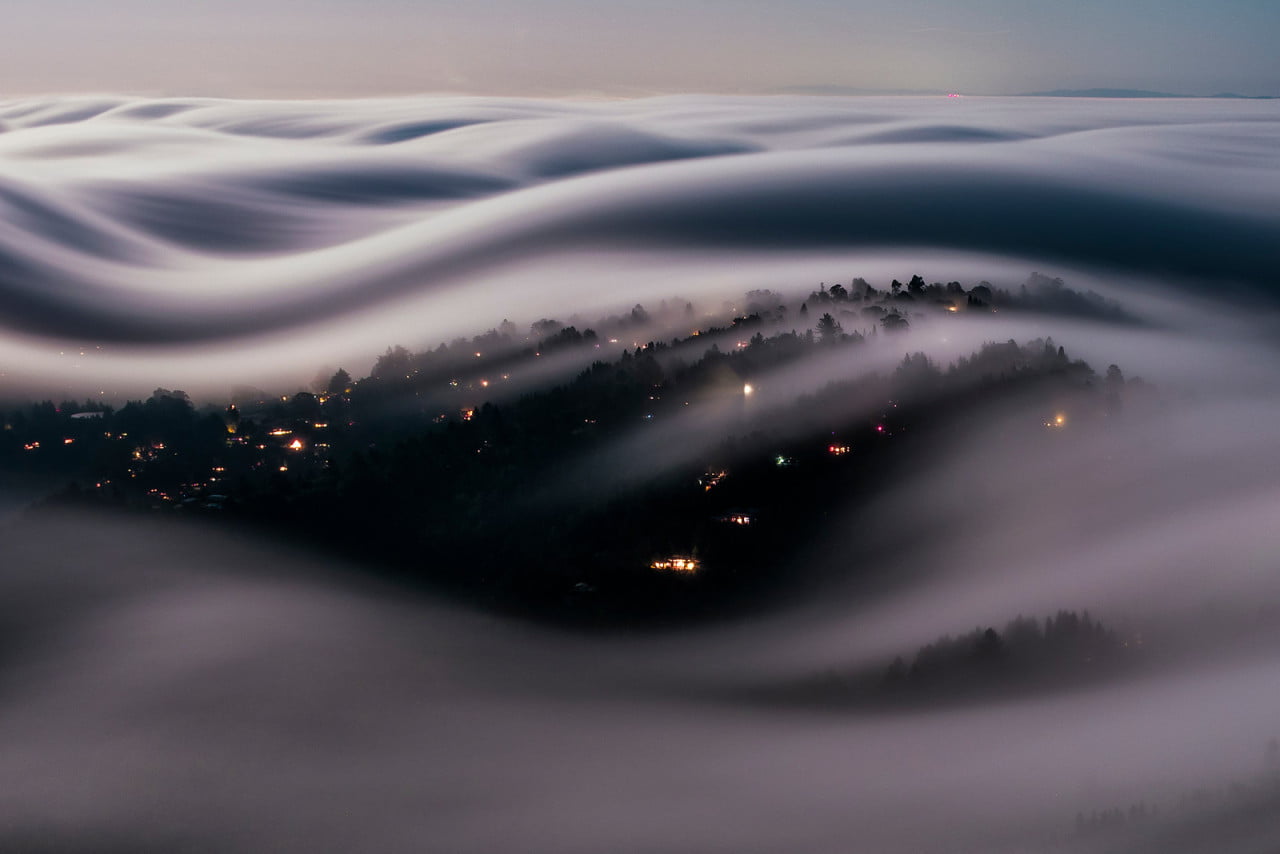
Fog rolls over the hills of Marin County in this long-exposure photograph by Lorenzo Montezemolo. One of the most beautiful aspects of fluid dynamics is the way the same patterns and forms show up across situations. The slow flow of fog over hills in moonlight can echo the blurring speed of rivers pouring over a rocky streambed. Despite the differences in speed, lengthscale, and fluid, the physics remain the same. (Photo credit: L. Montezemolo; via Colossal)
Category: Art

“Vorticity”
Photographer Mike Olbinski is back with another storm-chasing timelapse entitled “Vorticity”. Like his previous work, this film is a breath-taking example of physics in action. It is well worth taking a few minutes to watch in fullscreen, at high resolution, and with headphones. Olbinski’s timelapses beautifully capture the incredible dynamic motion of our atmosphere. Fittingly, “Vorticity” is all about the swirling, roiling motion of supercell thunderstorms and the tornadoes they can spawn, but the film also captures many other great phenomena from the convection that builds clouds to unusual formations like undulatus asperatus and mammatus clouds. (Video credit: M. Olbinski; submitted by Paul vdB)
“Memories of Paintings”
In “Memories of Paintings,” Thomas Blanchard gives us an up-close view of fluids and mixing. It’s a calming and curious video made from combinations of paint, oil, oat milk, and soap. The fluids feather and intertwine, driven by differences in surface tension. Paint gets encapsulated by immiscible oil to create little islands of color that float and dance against the background. It’s a fun journey through effects that we witness daily but rarely take the time to watch. (Video credit: T. Blanchard; via Gizmodo)
Sublimation
Sublimation is a transition directly from a solid phase to a gaseous one. Given typical Earth atmospheric conditions, one of the most commonly observed examples of sublimation is that of solid carbon dioxide, a.k.a. dry ice. Submerging dry ice in water both speeds up the sublimation–since water is a better conductor of heat than air–and creates ethereal fog that’s a combination of the expanding carbon dioxide and condensate from the water. This gorgeous video from Wryfield Lab lets you admire the process close-up. As the dry ice sublimates, watch for the ice crystals that grow on its surface. This is deposition–the opposite of sublimation–and comes from water vapor freezing onto the dry ice. (Video credit: Wryfield Lab; via Gizmodo)
A warning for those who want to try this at home: only do this in well-ventilated spaces. The shift from solid to gas requires a huge increase in volume. Carbon dioxide is denser than air, so it does stay low to the ground, but you can still suffocate yourself (or children or pets) if you do this in an enclosed space.
Paper Marbling
Fluid dynamics and art have gone hand-in-hand for centuries. In this video, artist Garip Ay demonstrates one of the coolest fluids-based art techniques: paper marbling. In this technique, artists float ink or paints on a liquid surface, manipulate the colors as desired–in this case to recreate Van Gogh’s “Starry Night”–and then float a piece of paper atop the surface to transfer the image. Multiple cultures around the world developed marbling techniques, dating all the way back to the Middle Ages. Ay is an expert in ebru, a Turkish form of the art. For more of Ay’s art, check out his website and YouTube channel. (Video credit: G. Ay; via Gizmodo)

Foggy Flows
The transparency of air makes it easy to overlook its fluid nature. In this National Geographic Travel Photographer of the Year entry, photographer Thierry Bornier captures the early morning view from China’s Yellow Mountain. Foggy clouds flow around and over nearby mountain peaks, like water flowing over rocks in a stream. To see other, similar effects, check out these timelapse videos of fog in the Grand Canyon and clouds around San Francisco. (Image credit: T. Bornier; via Colossal)

Viscous Fingers
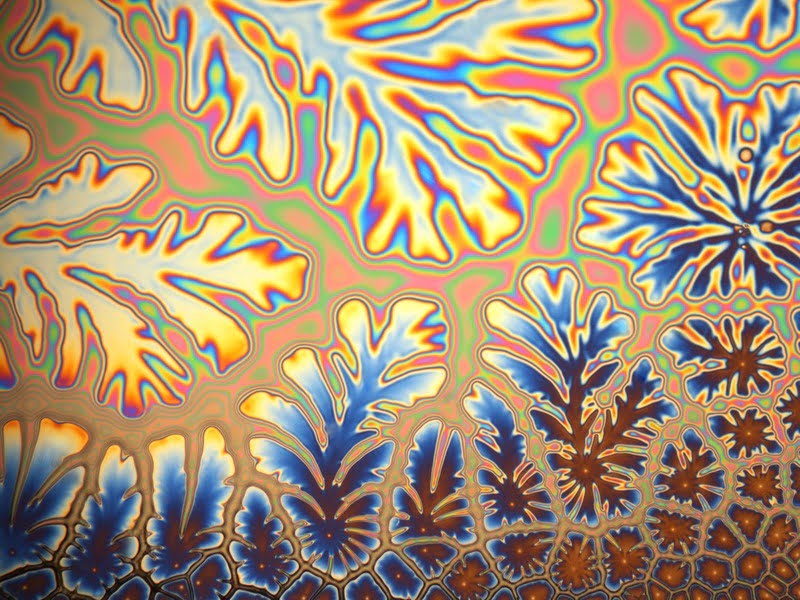
Viscous fingers form between air and titanium dioxide sol-gel in this photograph. The two fluids are trapped in a thin gap between glass plates – a set-up known as a Hele-Shaw cell. The dendritic fingers we see form when the less viscous air pushes into the more viscous sol-gel. This is an example of the Saffman-Taylor instability. The psychedelic colors are a result of thin-film interference and the way light interacts with very thin materials. The same effect is responsible for the colors on soap bubbles. (Image credit: C. Trease)

Rotating Jet
This photo, one of the winners of the Engineering and Physical Sciences Research Council’s (EPSRC) annual photography contest, shows a rotating viscoelastic jet. Rotating liquid jets are common to many manufacturing processes, and their sometimes-wild appearance comes from a balance of gravitational forces and centrifugal force against surface tension. But because this fluid contains a small amount of polymer additive, surface tension has the additional aid of some elasticity to help hold the jet together and keep the globules and ligaments you see from flying off. As centrifugal forces fling the fluid outward, it stretches the polymer chains within the fluid, and they pull back against that tension like a stretched rubber band. To see some of the other contest winners–including other fluids entries!–check out the Guardian’s run-down. (Image credit and submission: O. Matar et al., ICL press release)

Psychedelic Cymatics
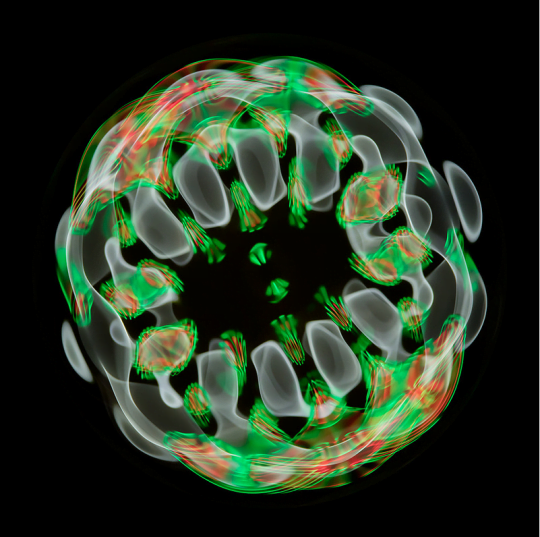
Cymatics are the visualization of vibration and sound. Here photographer Linden Gledhill has taken a simple speaker vibrating a dish of water and turned it into some incredible art. When you vibrate liquids like water up and down, it disturbs the usually flat air-water interface and creates waves on the surface. These Faraday waves are a standing wave pattern that differs depending on which sound is being played. By combining the wave patterns with LED lighting and strobe effects, Gledhill creates some remarkable images that combine sound, light, and fluid dynamics all in one. If you watch the video (make sure to hit the HD button!), you’ll see the patterns in motion and hear the sounds used to generate them. In the last clip (around 0:19), he’s added glitter to the set-up, which highlights the circulation within the vibrating fluid. As you can see, there are strong recirculating regions in each lobe of the pattern, but other areas, like the center region are almost entirely stationary. You can see more photos from the project in his Flickr feed. Special thanks to Linden for letting me post the video of his work, too! (Video and image cred
its and submission: L. Gledhill)
If you enjoy FYFD, please consider becoming a patron to help make sure the Internet keeps getting its daily dose of fluid dynamics!
Freezing Soap Bubbles
I’m not a winter person, but there’s something almost magical about the way water freezes. From instant snow to snow rollers and weird ice formations to slushy waves, winter brings all kinds of bizarre and unexpected sights. The video above is an artistic look at one of my favorites – freezing soap bubbles. Normally, the thin film of a soap bubble is in wild motion, convecting due to gravity, surface tension differences, and the surrounding air. Such a thin layer of liquid loses its heat quickly, though, and, as ice crystals form, the bubble’s convection and rotation slow dramatically, often breaking the thin membrane. Happily photographer Paweł Załuska had the patience to capture the beautiful ones that didn’t break! (Video credit: P. Załuska; via Gizmodo)
If you enjoy FYFD and want to help support it, please consider becoming a patron!