“The Flow II” film by Bose Collins and colleagues features a ferrofluid, a magnetically-sensitive liquid made up of a carrier fluid like oil and many tiny, ferrous nanoparticles. Although ferrofluids are known for many strange behaviors, their most distinctive one is the spiky appearance they take on when exposed to a constant magnetic field. This peak-and-valley structure is known as the normal-field instability. It’s the result of the fluid attempting to follow the magnetic field lines upward. Gravity and surface tension oppose this magnetic force, allowing the fluid to be drawn upward only so far until all three forces balance. (Video credit: B. Collins et al.)
Category: Art

“Clourant”
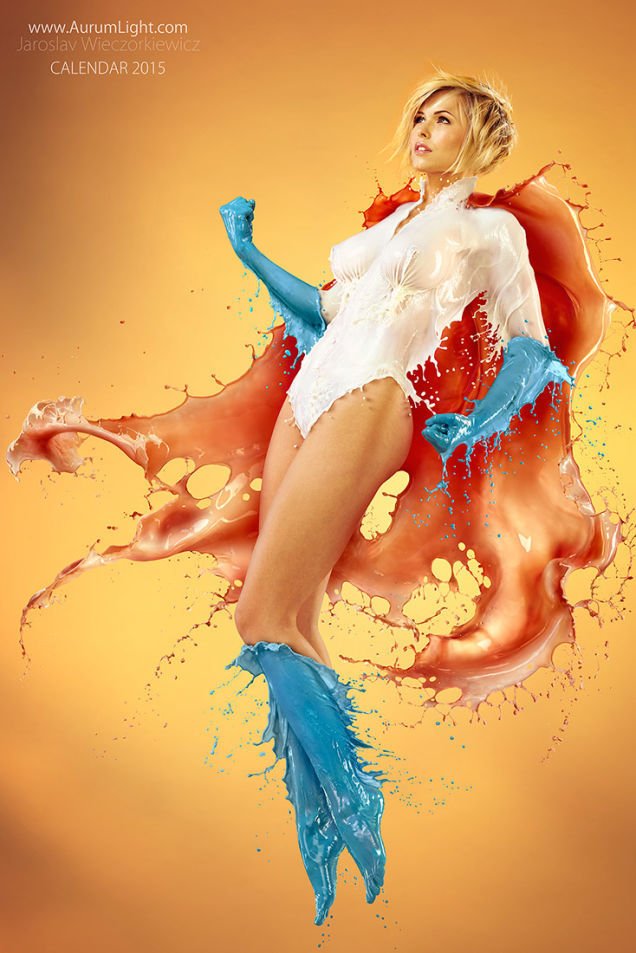
Photographers Cassandra Warner and Jeremy Floto produced the “Clourant” series of high-speed photographs of colorful liquid splashes. The artists took special care to disguise the origin of splashes, making them appear like frozen sculptures. The photos are beautiful examples of making fluid effects and instabilities. Many of them feature thin liquid sheets with thicker rims just developing ligaments. In other spots, surface tension has been wholly overcome by momentum’s effects and what was once ligaments has exploded into a spray of droplets. (Photo credit: C. Warner and J. Floto; submitted by jshoer; via Colossal)

“Chromatic Mushrooms”
Chemical Bouillon’s art often mixes chemistry and fluid dynamics. Here dense UV dyes falling through a less dense fluid form long strings with mushroom-like caps or tree-like branches. (For reference, gravity is pointing up relative to the video frame in most clips.) This behavior is related to the Rayleigh-Taylor instability that deforms interfaces and causes mixing between unstably stratified fluids. (Video credit: Chemical Bouillon)

Abstract Fluids
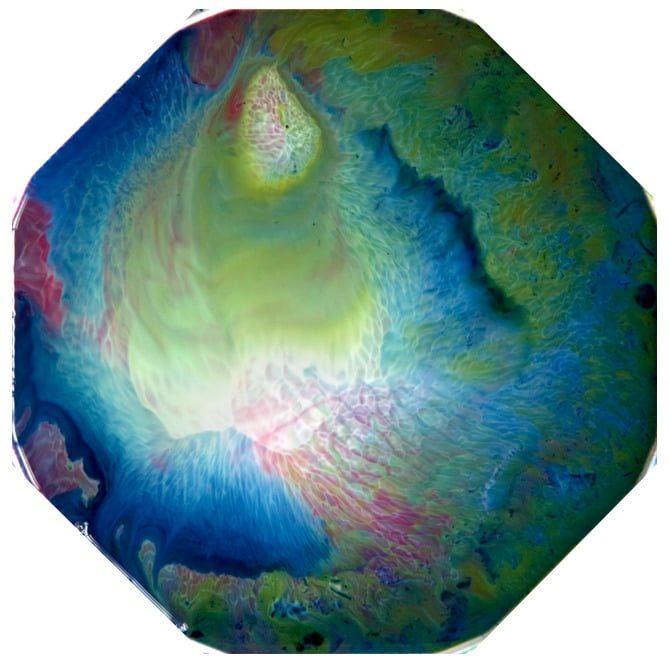
Janet Waters’ abstract photography is full of effects created with fluid dynamics. Diffusion merges different fluids, and gradients in surface tension drive interfacial flows. Changes in density and viscosity produce fingers and streaks and all manner of forms. Be sure to check out her photostream for many more examples of fluids as art. (Photo credits: J. Waters)

“Becoming Harmonious”
Much as I try to keep from getting repetitious, this was just too neat to pass up. This new music video for The Glitch Mob’s “Becoming Harmonious” is built around the standing Faraday waves that form on a water-filled subwoofer. The vibration patterns, along with judicious use of strobe lighting, produce some fantastic and kaleidoscopic effects. (Video credit: The Glitch Mob/Susi Sie; submitted by @krekr)

“High Ball Stepper”
The recently released music video for Jack White’s “High Ball Stepper” is a fantastic marriage of science and art. The audio is paired with visuals based around vibration effects using both granular materials and fluids. There are many examples of Faraday waves, the rippling patterns formed when a fluid interface becomes unstable under vibration. There are also cymatic patterns and even finger-like protrusions formed by when shear-thickening non-Newtonian fluids get agitated. (Video credit: J. White, B. Swank and J. Cathcart; submitted by Mike and Marius)

“Wallwave Vibration”
Loris Cecchini’s “Wallwave Vibration” series is strongly reminiscent of Faraday wave patterns. The Faraday instability occurs when a fluid interface (usually air-liquid though it can also be two immiscible liquids) is vibrated. Above a critical frequency, the flat interface becomes unstable and nonlinear standing waves form. If the excitation is strong enough, the instability can produce very chaotic behaviors, like tiny sprays of droplets or jets that shoot out like fountains. In a series of fluid-filled cells, the chaotic behaviors can even form synchronous effects above a certain vibration amplitude. (Image credit: L. Cecchini; submitted by buckitdrop)

“Demersal”
The ethereal shapes of inks and paints falling through water make fascinating subjects. Here the ink appears to rise because the photographs are upside-down. The fluid forms mushroom-like plumes and little vortex rings. The strands that split apart into tiny lace-like fingers are an example of the Rayleigh-Taylor instability, which occurs when a denser fluid sinks into a less dense one. Similar fingering can occur on much grander scales, as well, like in the Crab Nebula. These images come from photographer Luka Klikovac’s “Demersal” series. (Photo credit: L. Klikovac)

“Aurora”
This bulbous, ethereal shape is a spreading flame front captured by artist Fabian Oefner in his new “Aurora” series. Oefner used a few alcohol droplets in a glass vessel and ignited the volatile vapors, capturing the propagating flame. Take a look at it in action. Because the air inside the vessel is mostly still, the chemical reactions in the combustion occur much faster than the air’s motion. As a result, the flame spreads as a thin sheet instead of a uniform, widespread flame. The wrinkled and corrugated look of the flame front is due local turbulence distorting the flame. (Photo credit: F. Oefner)

Inksplosion
Chemical Bouillon are a trio of artists who use the chemistry of surface reactions to create abstract videos full of exploding and imploding droplets and colors. As chemicals react, local concentrations at the interface vary, which changes the local surface tension. These gradients drive flow from areas of low surface tension to those of higher surface tension. This is called the Marangoni effect – the same behavior that drives tears in a glass of wine. Chemical Bouillon have a whole YouTube channel dedicated to these kinds of videos, with everything from inks to ferrofluids. Be sure to take a look at some of their other videos and, if you like them, subscribe. (Video credit: Chemical Bouillon)