We wrote earlier this year about the discovery of a new type of fire whirl – the blue whirl – but now the authors have published video of the blue whirl in action! The blue whirl was discovered while investigating the use of fire whirls to more efficiently burn off oil spilled atop water. A tightly spinning yellow fire whirl produces less soot than a non-vortex burn; the blue whirl is even more efficient, producing little to no soot at all. Much remains to be learned about this new type of fire vortex, but in the meantime, enjoy some high-speed video of the blue whirl, particularly from 1:50 onward. (Video credit: M. Gollner et al.)
Month: November 2016

A Particle-Filled Splash


A drop of water that impacts a flat post will form a liquid sheet that eventually breaks apart into droplets when surface tension can no longer hold the water together against the power of momentum flinging the water outward. But what happens if that initial drop of water is filled with particles? Initially, the particle-laden drop’s impact is similar to the water’s – it strikes the post and expands radially in a sheet that is uniformly filled with particles. But then the particles begin to cluster due to capillary attraction, which causes particles at a fluid interface to clump up. You’ve seen the same effect in a bowl of Cheerios, when the floating O’s start to group up in little rafts. The clumping creates holes in the sheet which rapidly expand until the liquid breaks apart into many particle-filled droplets. To see more great high-speed footage and comparisons, check out the full video. (Image credit and submission: A. Sauret et al., source)

Surfing on Vapor
Place a drop of liquid on a surface much, much hotter than the liquid’s boiling point, and the portion of the drop that impacts will vaporize immediately. This leaves the droplet hovering on a thin layer of vapor. With a fluid like water, the vapor state is a much more efficient insulator than the liquid state. Thus, the vapor layer actually protects the liquid droplet, enabling it to boil off at a much slower rate than if the drop were touching the heated surface. This is known as the Leidenfrost effect, and it can be used to create self-propelled droplets. (Image credit: R. Thévenin and D. Soto)

Bouncing Droplets
Droplets bouncing on a pool form a beautiful and fascinating system, as recently featured by Physics Girl, Veritasium, and Smarter Every Day. The Lutetium Project – a consortium of French physics, graphic design, and music students – have their own take on the subject with beautiful short videos constructed from experimental research footage. With simple text explanations and lovely original music, they combine science, art, and outreach brilliantly. Also check out their quantum walker video and be sure to subscribe to their channel (in English or French) for more! (Video credit: The Lutetium Project; submitted by @g_durey)
Colors in Macro
Milk, acrylic paints, soap, and oil – all relatively common fluids, but together they form beautiful mixtures worth leaning in to enjoy. Variations in surface tension between the liquids cause much of the motion we see. Soap, in particular, has a low surface tension, which causes nearby colors to get pulled away by areas with higher surface tension, behavior also known as the Marangoni effect. Adding oil creates some immiscibility and lets you appreciate both the coalescence and fragmentation of the fluids. And finally, there’s one of my favorite sequences, where bubbles start popping in slow motion. As the bubble film ruptures, fluid pulls away, breaking into ligaments and then a spray of droplets as the bubble disintegrates. (Video credit: Macro Room; via Gizmodo)

Fingering Under Elastic


Take a couple panes of glass and stick a viscous fluid in between them; you’ve now constructed what fluid dynamicists call a Hele-Shaw cell. If you inject a low-viscosity fluid, like air, into the cell, you’ll get a beautiful finger-like pattern like the one shown on the left. If you change one of the walls to an elastic sheet, though, things get a bit different. The flexibility of the wall allows the upper surface to inflate as air gets pushed in. This can suppress the usual viscous fingers, as seen in the center animation. However, if you push the air in quickly, as in the right animation, the sudden inflation can wrinkle the elastic sheet. In this case, the wrinkles are the dominant influence, causing the the fluid to finger – but in an entirely different way than before! (Image credit: D. Pihler-Puzovic et al., sources 1, 2, 3; see also)

A Buoyant Rise
Hold a buoyant sphere like a ping pong ball underwater and let it go, and you’ll find that the ball pops up out of the water. Intuitively, you would think that letting the ball go from a lower depth would make it pop up higher – after all, it has a greater distance to accelerate over, right? But it turns out that the highest jumps comes from balls that rise the shortest distance. When released at greater depths, the buoyant sphere follows a path that swerves from side to side. This oscillating path is the result of vortices being shed off the ball, first on one side and then the other. (Image and research credit: T. Truscott et al.)
Avoiding Coalescence
If you watch closely as you go about your day, you may notice drops of water sometimes bounce off a pool of water instead of coalescing. Fluid dynamicists have been fascinated by this behavior since the 1800s, but it was Couder et al. who explained that these droplets can bounce indefinitely as long as the thin air layer separating the drop and pool is refreshed by vibrating the pool. In this video, Destin teams up with astronaut Don Pettit to film the phenomenon in beautiful high-speed. My favorite part of the video starts around 8:18, where Destin shows Don’s experiments with this effect in microgravity. It turns out that the cello produces just the right frequencies to create a cascade of bouncing water droplets, much like a Tibetan singing bowl turned back on itself! (Video credit: Smarter Every Day; submitted by Destin and effyeahjoebiden)
Living Fluid Dynamics
This short film for the 2016 Gallery of Fluid Motion features Montana State University students experiencing fluid dynamics in the classroom and in their daily lives. As in her previous film (which we deconstructed), Shanon Reckinger aims to illustrate some of our everyday interactions with fluids. This time identifying individual phenomena is left as an exercise for the viewer, but there are hints hidden in the classroom scenes. How many can you catch? I’ve labeled some of the ones I noticed in the tags. (Video credit: S. Reckinger et al.)

Crow Instability
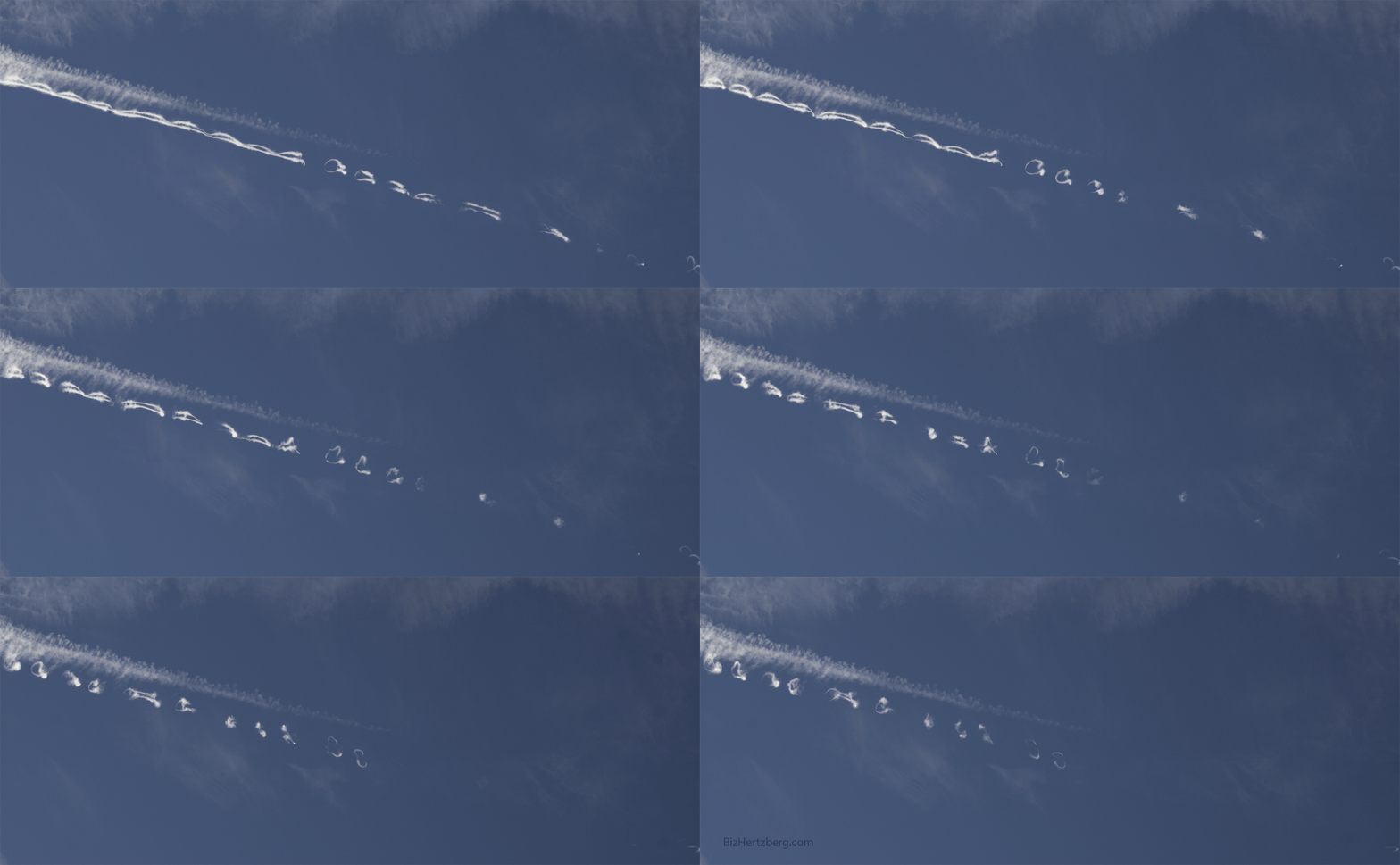
Watching airplane contrails overhead, you may have noticed them transform into a daisy chain of distorted rings. This is an effect known as the Crow instability. The contrails themselves are the airplane’s wingtip vortices, made visible by water vapor condensed out of the engine exhaust. These two initially parallel vortex lines spin in opposite directions. A slight crosswind can disturb the initially straight lines, causing them to become wavy. This waviness increases over time until the vortex lines almost touch. Then the vortices pinch off and reconnect into a line of vortex rings that slowly dissipate. Be sure to check out the full-resolution version of this animation for maximum effect. (Image credit: J. Hertzberg, source)