Month: November 2016

  • Featured Video Play Icon

    “Chemical Poetry”

    In “Chemical Poetry” artists Roman Hill and Paul Mignot use fluid dynamics to create incredible and engaging visuals. With a stunningly close eye to fluids mixing and chemicals reacting, their imagery feels like gazing on primordial acts of creation or destruction. There’s even a sequence that feels like you’re watching an explosion in slow-motion, but there’s no CGI in any of it. This is just the beauty of physics laid bare, revealing the dances driven by surface tension, the undulations of a fluid’s surface, and the dendritic spread of one fluid into another – all cleverly lit and filmed for maximum effect. It is well worth taking the time to watch the whole video and check out more of their work. (Image/video credit and submission: NANO; GIFs via freshphotons)

  • Meandering Colorado

    Meandering Colorado

    Sometimes the meandering of a river is best seen from above. Because of the way water moves to negotiate a bend in the river, any curvature of a river will get carved into a more extreme curve over time. Eventually the river’s course becomes so exaggerated that a loop can bend almost back on itself. At this point, the river often pinches off the bend and shortens its course, as the Colorado River did several thousand years ago with the abandoned meander labeled The Rincon near the bottom of this satellite photo. Left to its own devices, the Colorado would eventually cut away the loop west of Lake Powell, too. (Image credit: NASA/Expedition 47; via NASA Earth Observatory)

  • Featured Video Play Icon

    Buzzing Straws

    Many woodwind instruments owe their sound to the vibration caused when air moves past parts of them. As Nick Moore demonstrates in this video, you can create a simple version of this effect with a slit drinking straw. The buzzing the straw produces when air passes through is a sort of aeroelasticity – it’s a combination of aerodynamic and structural forces that drive the behavior. Low pressure created by the fast-moving flow tends to draw the straw together, but once flow is stopped, the elasticity of the straw makes it rebound open, allowing air to flow again. Even more elaborate vibrations are possible when the straw is elastic.  (Video credit: N. Moore)

  • Molasses Flood Press

    Molasses Flood Press

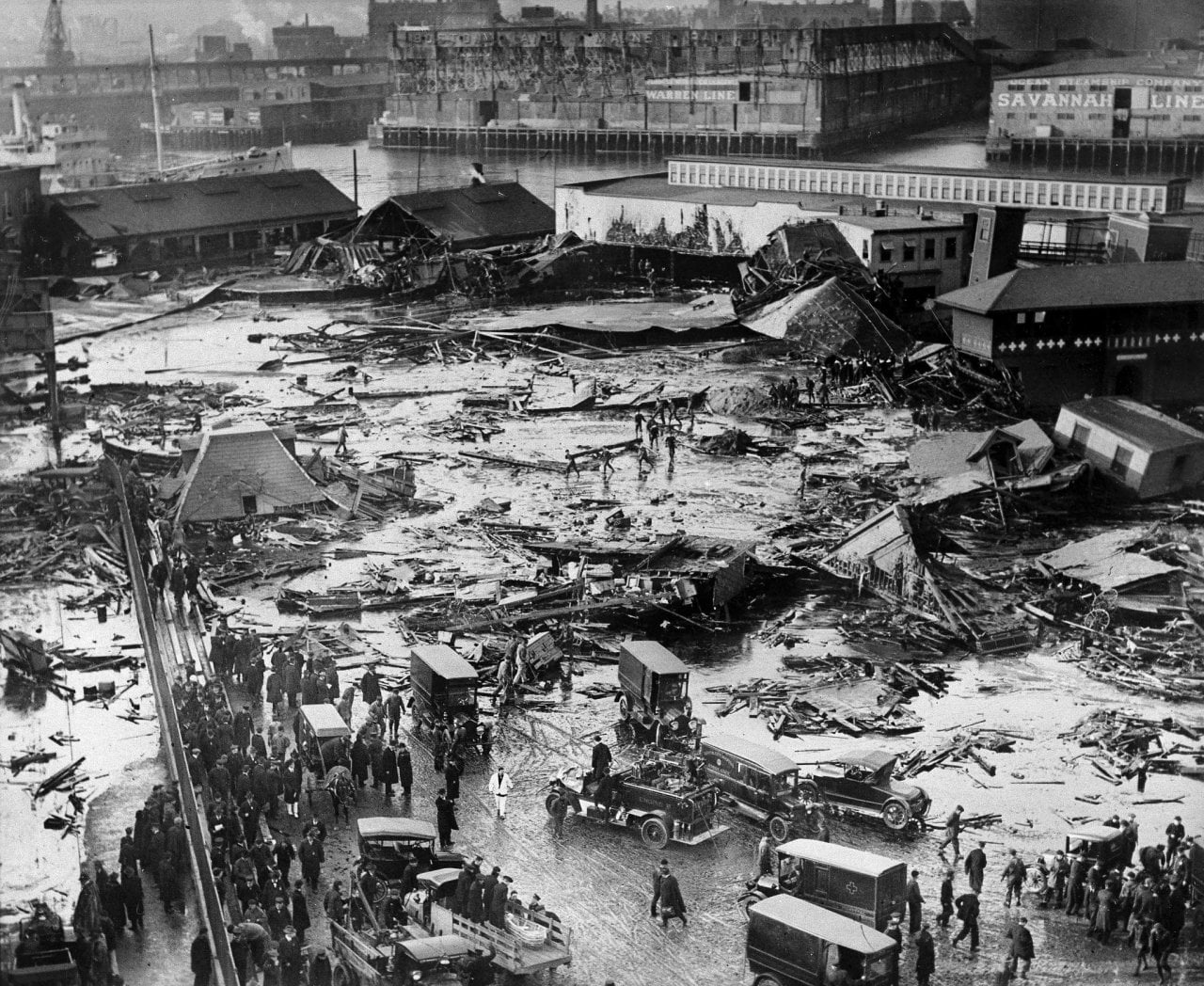
    My Molasses Flood project has gotten a bunch of press since my presentation earlier this week, including in the New York Times, the Associated Press, New Scientist, and on CBC’s “As It Happens”. There’s more links to recent articles on the revamped About page – I’ll continue filling out the “FYFD in the News” section sometime after the holiday weekend!

    I also just want to take a moment to thank all of you for your continued interest and support. I couldn’t keep this up without you! (Image credit: Associated Press)

  • Are Cats a Fluid?

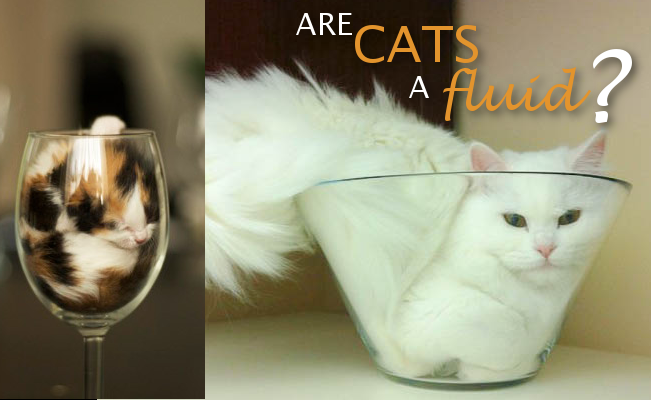
    Are Cats a Fluid?

    Are cats a fluid? It’s a question that has inspired many a meme. There are a few common definitions as to what makes a fluid. One is that a fluid changes its shape to that of its container. Another more technical definition is that a fluid deforms continuously under shear forces. But the real picture is messier than these seemingly simple definitions allow for. On the Improbable Research podcast, I tackle the question of whether cats are a solid or a fluid and what fluid dynamics–specifically, the subject of rheology–has to teach us about the topic. Give it a listen! (Original image credits: Huffington Postimgur; research credit: M. A. Fardin, pdf – article begins on page 16)

    Post-Thanksgiving bonus: Today is the traditional Science Friday broadcast of this year’s (abridged) Ig Nobel Prize ceremony. Check your local NPR station for broadcast times or listen to it on their website. You’ll hear me deliver a 24/7 lecture on the subject of “Fluid Dynamics” (and you may find me cropping up elsewhere, too). Alternatively, you can check out the full ceremony video on YouTube.

  • Starfish Vortices

    Starfish Vortices

    Starfish larvae, like other microorganisms, use tiny hair-like cilia to move the fluid around them. By beating these cilia in opposite directions on different parts of their bodies, the larvae create vortices, as seen in the flow visualization above. The starfish larvae don’t use these vortices for swimming – to swim, you’d want to push all the fluid in the same direction. Instead the vortices help the larvae feed. The more vortices they create, the more it stirs the fluid around them and draws in algae from far away. The larvae actually switch gears regularly, using few vortices when they want to swim and more when they want to eat. Check out the full video below to see the full explanation and more beautiful footage.  (Image/video credit: W. Gilpin et al.)

  • Saturnian Clouds

    Saturnian Clouds

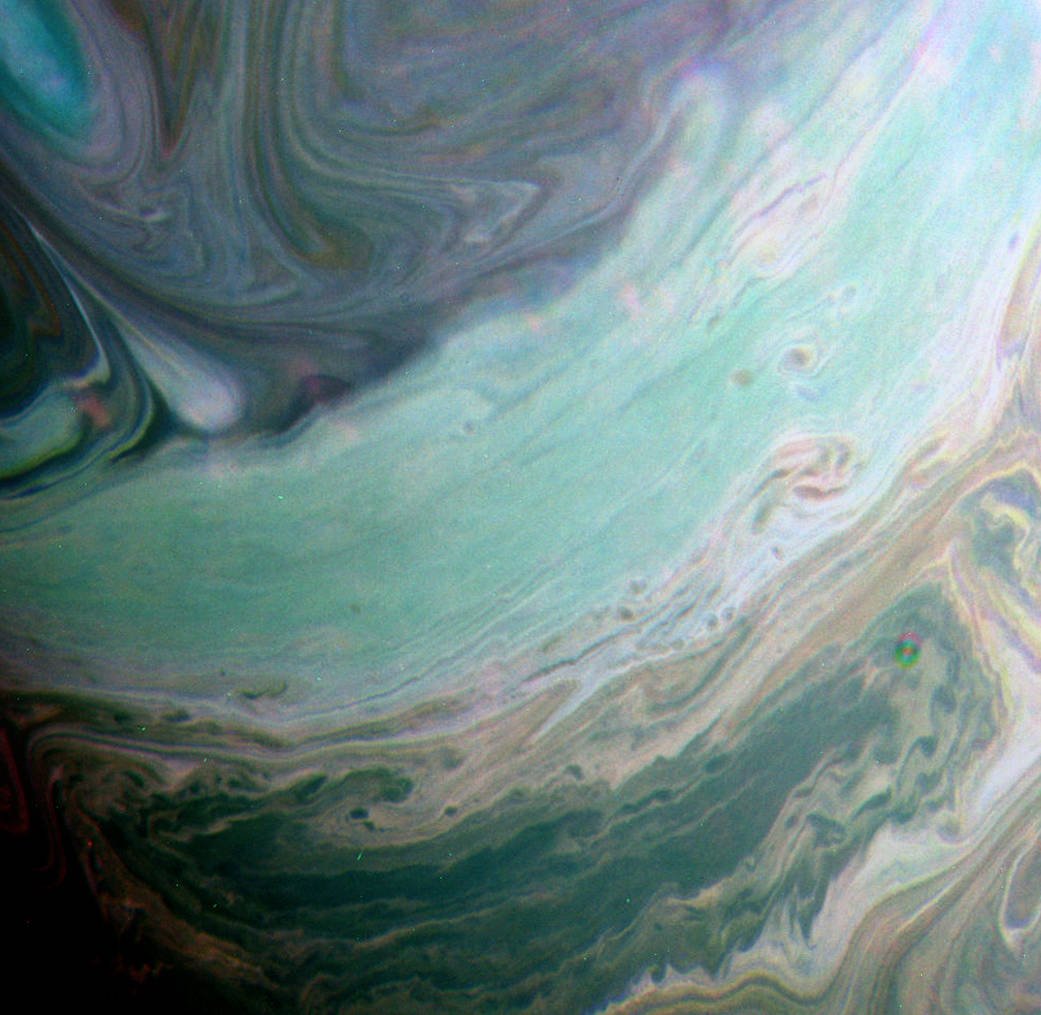
    It may look like an oil slick, but the photo above actually shows the clouds of Saturn. The false-color composite image reveals the gas giant in infrared, at wavelengths longer than those visible to the human eye. NASA uses this infrared photography to identify different chemical compositions in Saturn’s atmosphere based on how they reflect sunlight. You can see an example of how they construct these images here. This detail shot appears to show cloud bands of different compositions mixing. You can see hints of shear instabilities forming along the edges  where the light and dark bands meet. (Image credit: NASA; via Gizmodo)

  • Featured Video Play Icon

    Coarsening in a Soap Film

    Flow in a soap film is driven by gravity’s efforts to thin the film and surface tension’s attempts to stabilize variations in thickness. Because evaporation guarantees that the soap film will eventually dry out, gravity typically wins the battle and causes a soap film to rupture. This video takes a close look at what happens in the film just before it ruptures. Black dots form in the thinnest region of the flow. These areas are not holes, but they appear black because they are thinner than any wavelength of visible light. Before rupture, the black dots begin coalescing with one another, first due to diffusion and later more rapidly due to convection in the soap film. Ultimately, the black dots are the harbingers of doom for the fragile bubble. (Video credit: L. Shen et al.)

  • Oil in Alcohol

    Oil in Alcohol

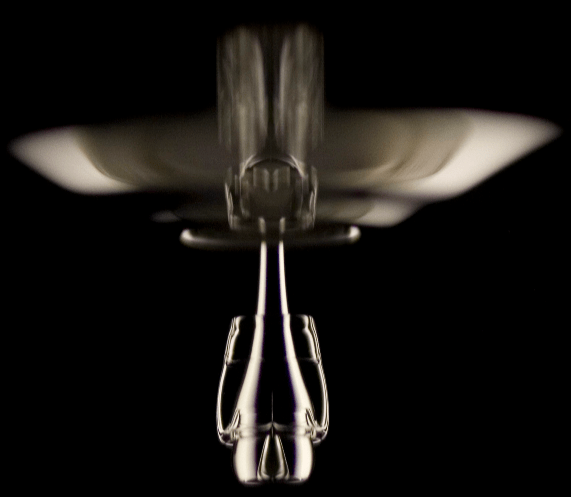
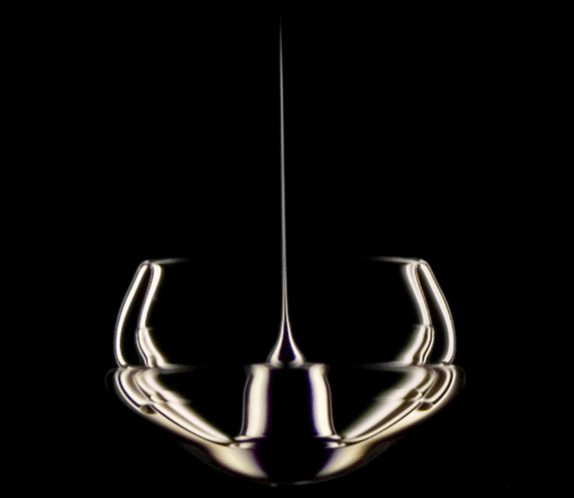
    A drop of oil impacts and falls through a pool of isopropyl alcohol. Momentum, viscosity, and diffusion combine to deform the drop into a shape that is initially like an upside-down wine glass (top image). Because the oil is both denser than the alcohol and soluble in it, the drop sinks and dissolves as it falls. The drop expands rapidly outward, thinning and formed a concave shape around its denser, sinking core (bottom image). Ultimately, the droplet will deform and fragment as it dissolves into the alcohol. (Image credit: R. La Foy et al.)

  • Featured Video Play Icon

    APS DFD 2016

    It’s the time of year again for the American Physical Society Division of Fluid Dynamics meeting! Tomorrow I’ll fly to Portland, OR for three days of non-stop fluid dynamics. This year I’ll be giving two talks:

    Sunday, November 20th, 3:23pm, Room B117: F*** Yeah Fluid Dynamics: Inisde the science communication process

    Monday, November 21st, 6:01pm, Room E147-148: “In a sea of sticky molasses”: The physics of the Boston Molasses Flood

    The latter talk is part of an ongoing project exploring the fluid dynamics of the Boston Molasses Flood of 1919. Since you’ll be hearing more about the project in the coming weeks and months, I’m sharing a sneak peek video I originally made for my Patreon patrons. If you’re interested in following the project’s progress, you may want to become an FYFD patron – otherwise, rest assured that you will see the final results eventually 🙂

    I hope to see some of you in Portland, but if you can’t make it, I encourage you to follow the meeting on social media with !

    (Video credit: N. Sharp/FYFD)