Supercritical fluids are neither a gas nor a liquid. The video above shows a tube of pressurized xenon, initially below its boiling point of approximately ~16 deg C. As the temperature is raised, you see the meniscus that marks the liquid xenon disappear. At this point, the xenon has transitioned into the supercritical state. It takes up the entire tube – like a gas – but it is still capable of dissolving materials – like a liquid. At the same time, though, the xenon has no surface tension because there’s no liquid/vapor interface. Toward the end of the video, the temperature gets reduced and the xenon condenses back into a liquid state. Supercritical fluids can be used in a wide variety of industrial applications, including in decaffeination, dry cleaning, and refrigeration. (Video credit: wwwperiodictableru)
Month: November 2016

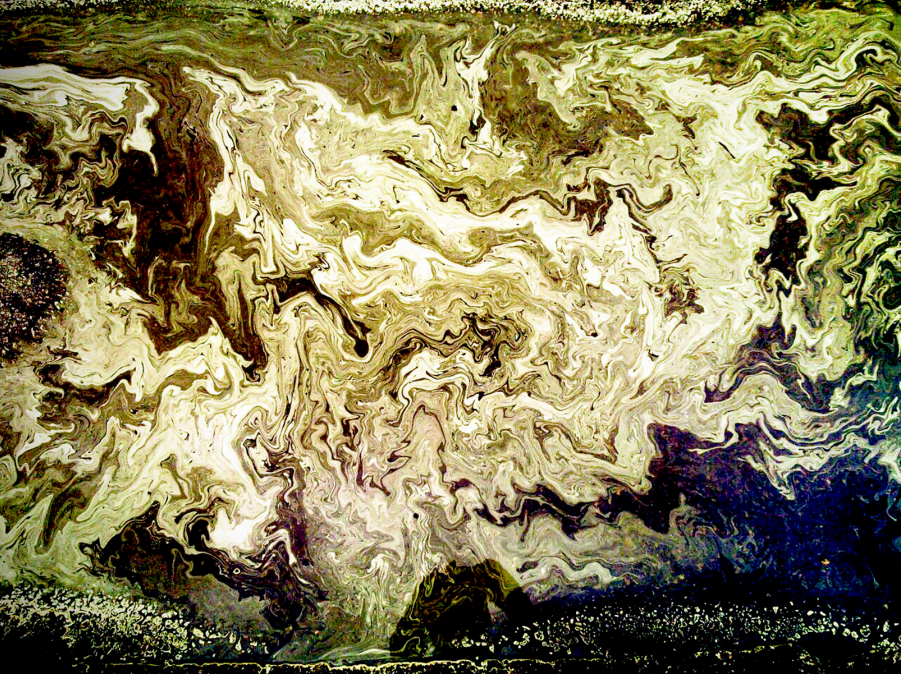
Swirling Pollen
This photo captures the chaotic mixing present in a simple puddle. Pine pollen strewn across the puddle’s surface acts as tracer particles, revealing some of the motion of the underlying water. As wind blows across the puddle, it moves the water through the formation of ripples and by shearing the surface. That deformation on the top of the puddle will cause further motion beneath the surface. With time and changing wind direction, the resulting pattern of flow can be very complex! (Photo credit: K. Jensen, original)

Pelican Surfing
Birds can be incredibly clever about using their surroundings to enhance their flight. Pelicans will even surf! As a line of waves rolls toward shore, it pushes a small updraft ahead of it – just like a line of mountains creates a windy updraft. Pelicans save energy by riding the updraft just like a surfer would ride the swell. Once the wave breaks, the air and water become turbulent and less useful, so the pelican cuts away to find his next ride. (Image and submission credit: N. Yarvin, source)