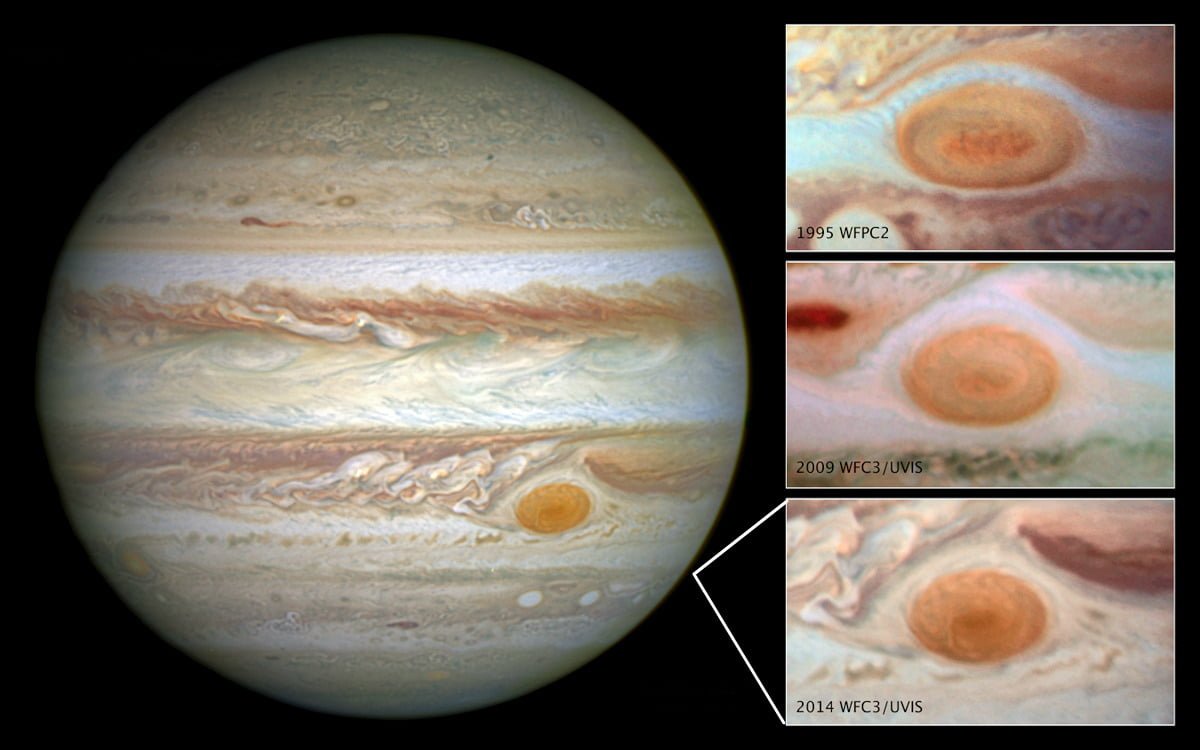
Observations show Jupiter’s iconic Great Red Spot is shrinking, most recently at a rate of more than 900 km a year. As it gets smaller, the storm is also changing shape and becoming more circular. Scientists don’t yet have an explanation for the shrinkage or its recent acceleration, but this is unsurprising given the rich complexity of the storm. For example, the source of the Red Spot’s longevity–it may be more than 300 years old–is still an open topic of research. Some of the most recent observations show smaller eddies feeding into the storm; the current hypothesis is that these eddies may be increasing the Red Spot’s dissipation and accelerating its breakup. (Photo credit: NASA/ESA; h/t to io9)
Month: May 2014

Separating Flow
Flow separation occurs when a fluid is unable to flow smoothly around an object. In the case of the photo above, fog is being used to visualize flow around an airfoil at a large negative angle of attack. The incoming flow stagnates at a point on top of the airfoil, and streamlines on either side of that point split to move around the airfoil. Those on top are accelerated to high velocity, generating smooth, low-pressure flow over the aft section of the upper surface. On the other side of the stagnation point, however, the fog is trying to flow around the curve of the leading edge but the local pressure gradient is increasing, which slows the flow. Ultimately, it separates from the airfoil, creating a large region of recirculating, turbulent flow. When this effect occurs on the upper surface of a wing at a high (positive) angle of attack, it is called stall and causes a dramatic loss in lift. (Photo credit: Wikimedia/Smart Blade GmbH)

Melting Ice Sheets From Below
A new study of ice sheets in West Antarctica has made major news this week with the announcement that the ice melt in this region is unstoppable and may raise sea levels by more than 1.2 meters. Part of what makes the ice sheet so unstable is the local topography, shown schematically in the animation above. The land on which the glacier sits lies well below sea level, and the grounding line marks where the ice, sea, and land meet. Part of the glacier projects outward as a sheet, with seawater between it and the land; this is not unusual, but it can encourage melting if the water under the ice sheet is warmer. A major problem for this region, though, is that the slope of the underlying land tilts downward. This means that, as warmer water begins circulating under the ice sheet, it causes the grounding line to retreat and expose a greater volume for warm water to fill beneath the ice. More warm water melts more ice and the process continues unabated. (Video credit: NASA/JPL; h/t to jtotheizzoe, jshoer)
Double-Diffusive Convection
Convection can be driven several mechanisms, including temperature and concentration differences. The video above shows convection between a a layer of sucrose solution and a layer of saline solution. Initially, the lighter sucrose layer sits over the denser salt water. After the interface is perturbed, the differences in concentration – and thus in density – between the fluids causes diffusion both upward and downward in the form of fingers. This instability behavior is analogous to salt-fingering, which occurs in the ocean when a layer of warm, salty water lies over a layer of cooler, less saline water. In the ocean, these temperature and salinity differences help drive ocean circulation as well as the mixing that occurs between different depths. (Video credit: William Jewell College)
Forming a Vortex
[original media no longer available]
Vortex rings show up remarkably often in nature. In addition to being the playthings of dolphins, whales, scuba divers, humans, and swimmers, vortex rings appear in volcanic outbursts and spore-spreading peat mosses. Vortex rings even occur in blood flow through the human left ventricle in the heart. In each of these cases, the vortex ring is formed by impulsively accelerating fluid through a narrow opening, like the dolphin’s blowhole. The fluid at the edge of injected jet is slowed by friction with the quiescent surrounding fluid. The fluid at the edge of the jet then slips around the sides and into the wake of the faster-moving fluid, where it’s accelerated through the middle of the forming vortex ring. This spinning from the inside-out and back-in persists as long as the vortex is intact, and is part of what keeps the ring from dissipating. (Video credit: SeaWorld; submitted by John C.)

Graduation!


Last night I walked across the stage as a student for the last time, receiving my PhD in aerospace engineering and getting hooded by my advisor in a tradition with roots back to medieval scholars. Even more so than the defense, it marked an official end to my PhD. None of that is really fluid dynamical, but I wanted to use the opportunity to thank each and every one of you who read and support FYFD. This blog began on a whim while I was a graduate student waiting for an opportunity to do the experiments I needed. I never could have predicted at the time the impact it would have on my life. FYFD became a part of my daily life, and thanks to you, readers, it became a source of inspiration and motivation for me as I pursued my studies. I have learned so much more about fluid dynamics in writing FYFD and answering your questions than I would ever have on my own. I have had opportunities to travel, to communicate and even meet with people from all corners of the globe who share some of my enthusiasm for the subject. It has been a wonderful experience so far, and I hope for many more ahead. Thank you all for being a part of it! (Photo credit: J. Mai)

Space Balls (of Water!)
The microgravity environment of space is an excellent place to investigate fluid properties. In particular, surface tension and capillary action appear more dramatic in space because gravitational effects are not around to overwhelm them. In this animation, astronaut Don Petit injects a jet of air into a large sphere of water. Some of the water’s reaction is similar to what occurs on Earth when a drop falls into a pool; the jet of air creates a cavity in the water, which quickly inverts into an outward-moving jet of water. In this case, the jet is energetic enough to eject a large droplet. Meanwhile, the momentum, or inertia, from the air jet and subsequent ejection causes a series of waves to jostle the water sphere back and forth. Surface tension is strong enough to keep the water sphere intact, and eventually surface tension and viscosity inside the sphere will damp out the oscillations. You can see the video in full here. (Image credit: Don Petit/Science off the Sphere)

Martian Barchans
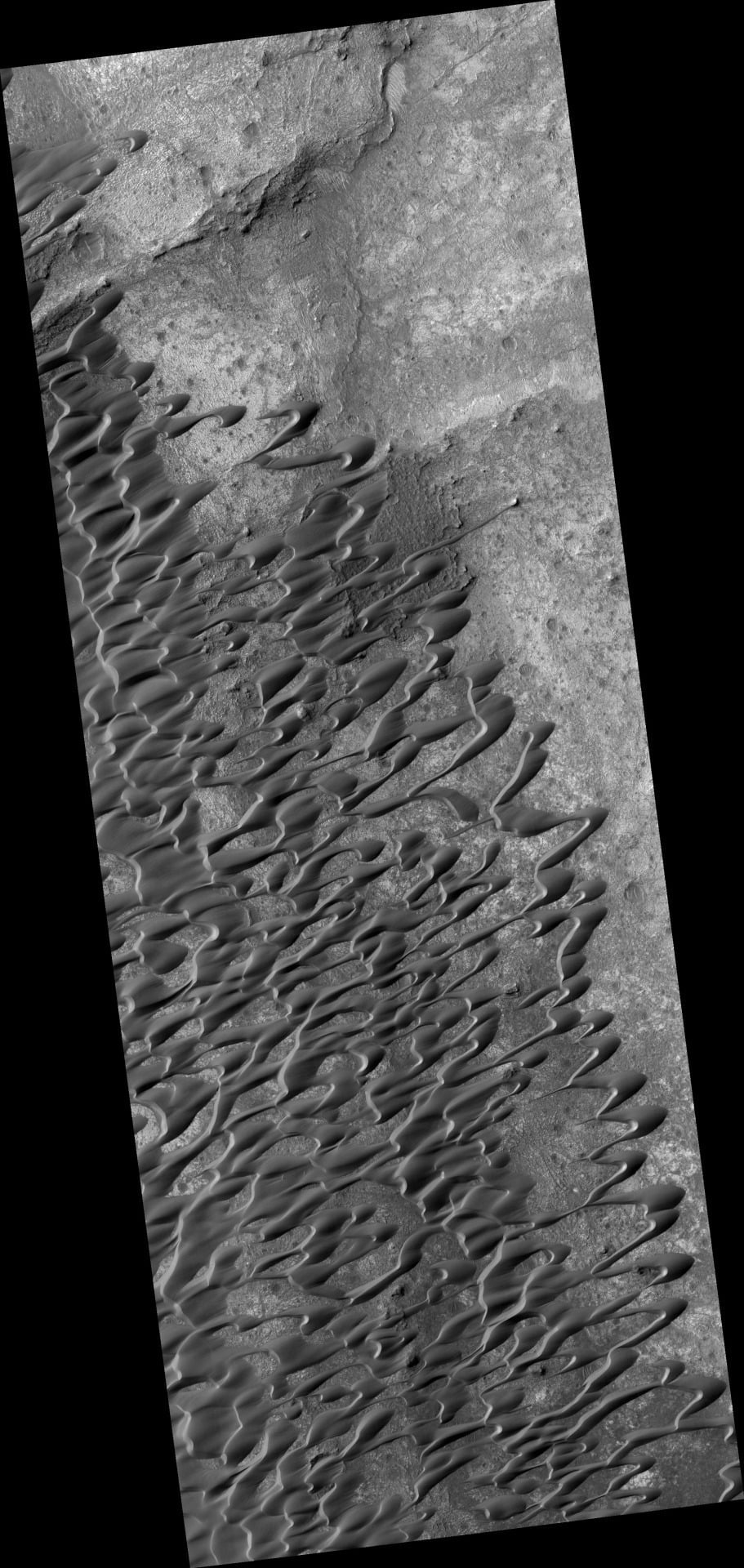
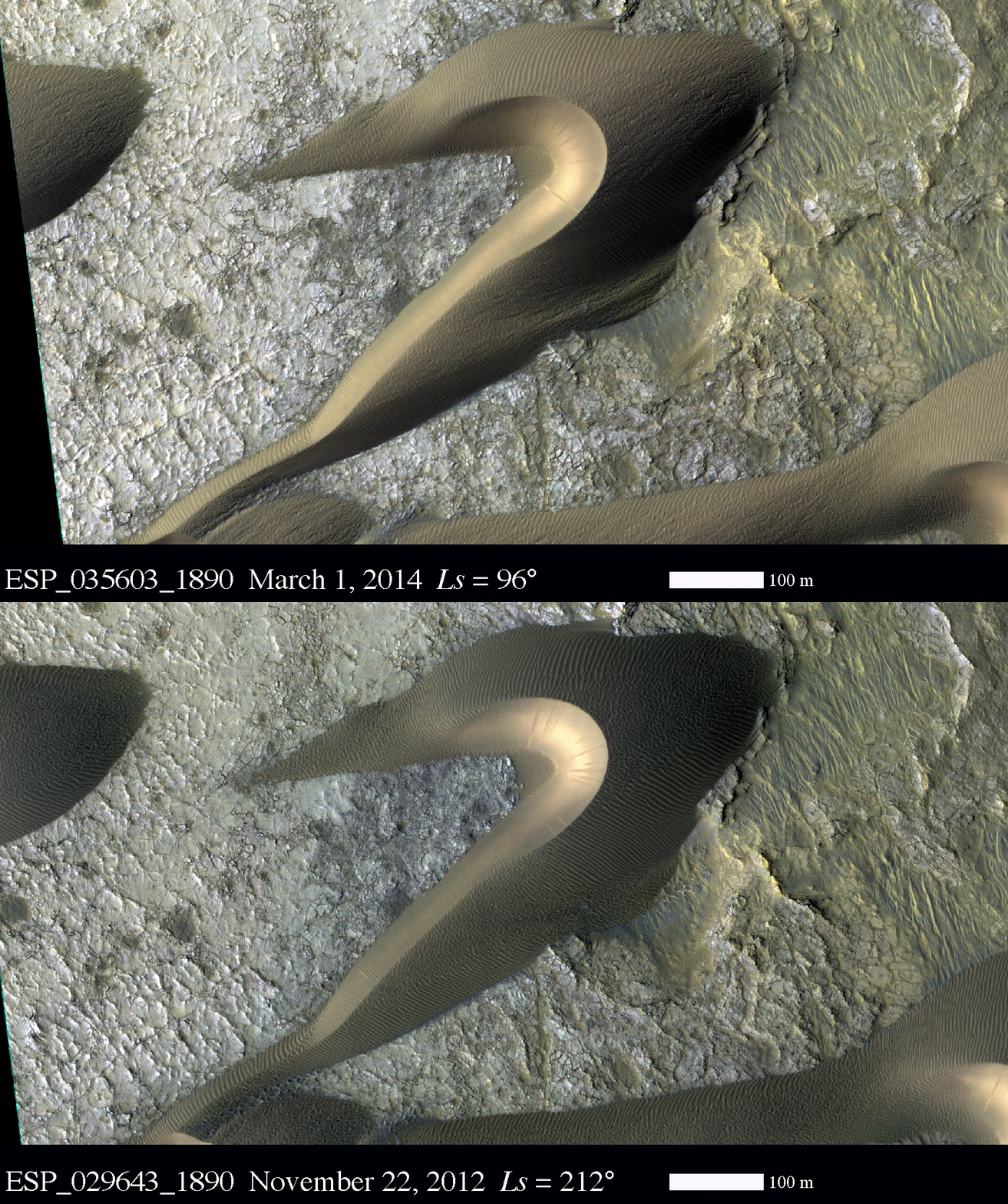
Dunes are a fascinating interplay between fluid and granular flow. This satellite photo shows a dune field on Mars, Nili Patera. The dominant direction of wind flow is from the upper right, pushing the dunes themselves slowly toward the left. Many of the dunes along the edge are barchans, crescent-shaped dunes with a long, gradual slope facing the wind and a steeper leeward side. As the wind blows, it erodes the sand on the windward slope and deposits it on the leeward side. This is how the dune migrates. Check out this close-up of a barchan to see the changes in its ripples and shape over the past couple months. (Photo credit: NASA/JPL/Univ. of Arizona)
Why Ketchup is Hard to Pour
Oobleck gets a lot of attention for its non-intuitive viscous behaviors, but there are actually many non-Newtonian fluids we experience on a daily basis. Ketchup is an excellent example. Unlike oobleck, ketchup is a shear-thinning fluid, meaning that its viscosity decreases once it’s deformed. This is why it pours everywhere when you finally get it moving. Check out this great TED-Ed video for why exactly that’s the case. In the end, like many non-Newtonian fluids, the oddness of ketchup’s behavior comes down to the fact that it is a colloidal fluid, meaning that it consists of microscopic bits of a substance dispersed throughout another substance. This is also how blood, egg whites, and other non-Newtonian fluids get their properties. (Video credit: G. Zaidan/TED-Ed; via io9)

Meandering River
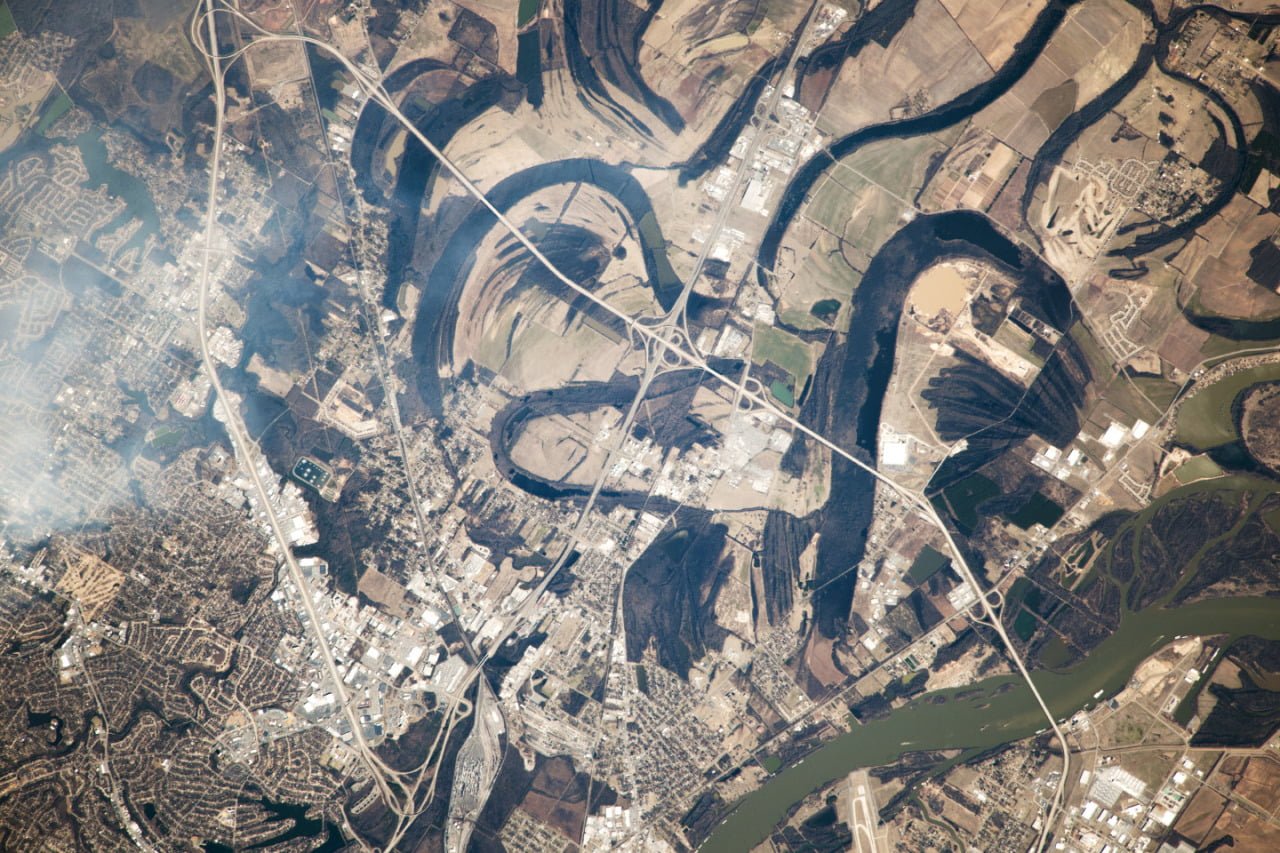
When unconstrained by the local topography, rivers tend to meander, as shown in this astronaut photograph of the Arkansas River near Little Rock, AR. The current course of the river is visible in green in the lower right hand corner of the image, but numerous lakes and curved banks show some of the former paths the river took. When rivers develop a bend, flow is faster on the inner bank than around the outer bank. This speed difference causes a vortical secondary flow inside the river that removes sediment from the outer bank and deposits it on the inner side. The end result is that the bend in the river gets sharper and the river meanders further. Sometimes the bends get so sharp they pinch off, leaving behind lakes. (Photo credit: Exp. 38/NASA Earth Observatory)