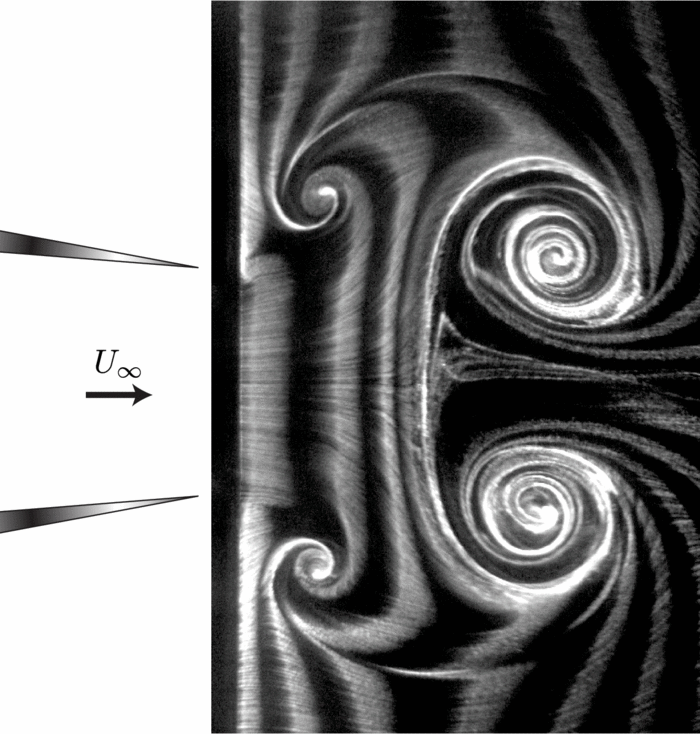
Many situations can generate high-speed liquid jets, including droplet impacts, vibrated fluids, and surface charges. In each of these cases, a concave liquid surface is impulsively accelerated, which causes the flow to focus into a jet. The image above shows snapshots of a microjet generated from a 50 micron capillary tube visible at the right. This jet formed when the meniscus inside the capillary tube was disturbed by a laser pulse that vaporized fluid behind the interface. Incredibly, the microjets generated with this method can reach speeds of 850 m/s, nearly 3 times the speed of sound in air. Researchers have found the method produces consistent results and suggest that it could one day form the basis for needle-free drug injection. You can read more in their freely available paper. (Photo credit: K. Tagawa et al.)
Month: May 2014

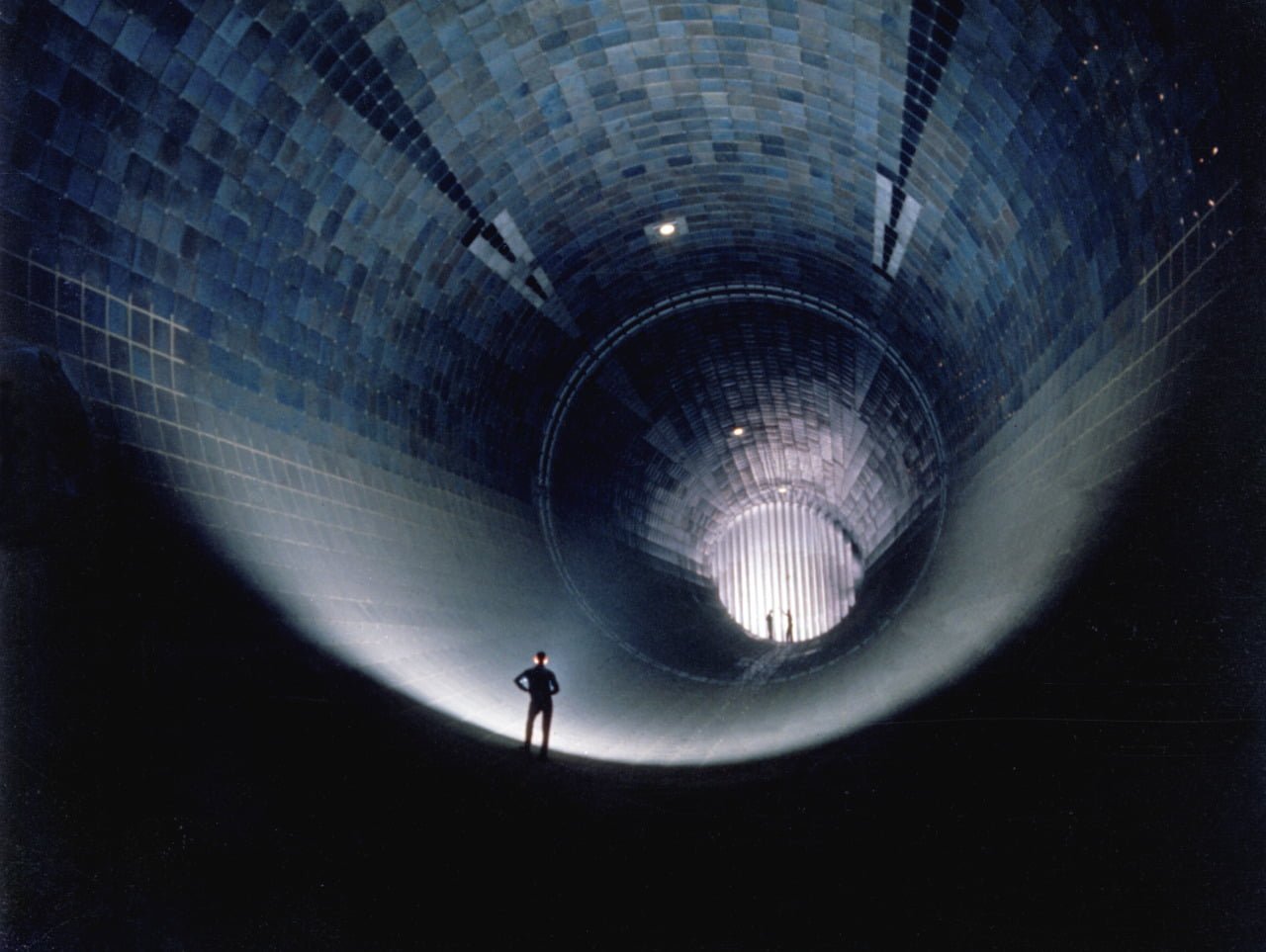
AEDC 16-ft Supersonic Tunnel
This 1960 photo shows three men standing inside Arnold Engineering Development Complex’s 16-ft supersonic wind tunnel facility. The wind tunnel was capable of Mach numbers between 1.60 and 4.75 through a test section 4.8 meters wide and 20.2 meters long. It served as a large-scale testing facility for aircraft and propulsion systems. Like many large-scale and high-speed wind tunnel facilities in the United States, it is no longer active. In recent years, many unique wind tunnel facilities at NASA, military bases, and universities have been closed down, depriving researchers and engineers of the ability to include large-scale testing in their design and development of new technologies. These facility closures leave a substantial gap between the speeds and Reynolds numbers achievable in small-scale experiments and computational fluid dynamics and those experienced in flight. (Photo credit: P. Tarver)

Colliding in Microgravity
On Earth, it’s easy for the effects of surface tension and capillary action to get masked by gravity’s effects. This makes microgravity experiments, like those performed with drop towers or onboard the ISS, excellent proving grounds for exploring fluid dynamics unhindered by gravity. The video above looks at how colliding jets of liquid water behave in microgravity. At low flow rates, opposed jets form droplets that bounce off one another. Increasing the flow rate first causes the droplets to coalesce and then makes the jets themselves coalesce. Similar effects are seen in obliquely positioned jets. Perhaps the most interesting clip, though, is at the end. It shows two jets separated by a very small angle. Under Earth gravity, the jets bounce off one another before breaking up. (The jets are likely separated by a thin film of air that gets entrained along the water surface.) In microgravity, though, the jets display much greater waviness and break down much quicker. This seems to indicate a significant gravitational effect to the Plateau-Rayleigh instability that governs the jet’s breakup into droplets. (Video credit: F. Sunol and R. Gonzalez-Cinca)
Droplets Surfing
The Leidenfrost effect can make water droplets skitter across a hot griddle or briefly protect a hand dunked in liquid nitrogen. When a liquid is exposed to a solid surface much, much hotter than its boiling point, the contact vaporizes part of the liquid, and, in the case of a droplet, forms a thin lubricating layer of vapor that the liquid drop can skate around on. Researchers have found that releasing these Leidenfrost droplets on textured surfaces creates self-propelling drops by directing the flow of vapor. In this video, one team demonstrates some of the neat tracks they’ve built for their drops. (Video credit: D. Soto et al.)

Advantages of Schooling

Many fish swim in close proximity to one another in large schools, causing scientists to wonder if this behavior is motivated primarily by defense against predators or whether fish derive some hydrodynamic advantages from schooling. Examining the fluid dynamics of an entire school of fish is rather impractical, so researchers approximate two neighboring swimmers using flapping hydrofoils. The images above show flow visualizations of the wakes of these two mechanical swimmers. When the two hydrofoils flap in-phase with one another (top image), one oscillation period produces a complicated pattern of many vortices zig-zagging behind the foils. This configuration produces more efficient propulsion than a single hydrofoil, meaning that more of the energy in the wake is used to produce thrust. The cost, however, is reduced thrust overall. The bottom image shows the wake pattern for hydrofoils flapping out-of-phase. This behavior enhanced thrust without reducing propulsive efficiency. The results suggest that schooling fish might choose different swimming strategies depending on the situation. (Image credits: P. Dewey et al.)
The March of Drops
I love science with a sense of humor. This video features a series of clips showing the behavior of droplets on what appears to be a superhydrophobic surface. In particular, there are some excellent examples of drops bouncing on an incline and droplets rebounding after impact. For droplets with enough momentum, impact flattens them like a pancake, with the rim sometimes forming a halo of droplets. If the momentum is high enough, these droplets can escape as satellite drops, but other times the rebound of the drop off the superhydrophobic surface is forceful enough to overcome the instability and draw the entire drop back off the surface. (Video credit: C. Antonini et al.)

Putting Out Wildfires Using Explosives

Wildfires damage millions of acres of land per year in the United States alone. Using explosives to put out an uncontrolled wildfire sounds a bit crazy, but it’s actually not that far-fetched. The animations above are taken from high-speed footage of a propane fire interacting with a blast wave. The first animation shows what the human eye would see, and the second is a shadowgraph video, a technique which highlights differences in density and makes the flame’s convection and the blast wave itself visible. At close range, the shock wave from the explosion and the high-speed gas behind it push the flames away from their fuel source, stopping combustion almost immediately. For a flame farther away from the blast, the shock wave introduces turbulent disturbances that can destabilize the flame. Much work remains to be done before the technique could be scaled from the laboratory to the field, but it is an exciting concept. You can read more about the work here. (Research credit: G. Doig/UNSW Australia; original videos: here and here; submitted by @CraigOverend)
Oily Foams
It is common in many industries to use oil as a defoamer to break up existing foams or prevent foams from forming. But with the right surfactants–additives that change the foam’s surface tension–it’s possible to make aqueous foams that are actually stabilized by the presence of oil. This video explores some of the ways that oil can interact with these kinds of foam, beginning with capillary action, which draws the oil up into the junctions between foam films. For more, see Piroird and Lorenceau. (Video credit and submission: K. Piroird)
Supercell Timelapse
The storm chasing group Basehunters captured this stunning timelapse of a supercell thunderstorm forming in Wyoming. This class of storm is characterized by the presence of a mesocyclone, seen here as a large, rotating cloud. These rotating features form when horizontal wind shear is redirected upright by an updraft. This requires a strong updraft, which is often formed by a capping inversion, where a layer of warm air traps colder air beneath it. Supercells can be very dangerous in their own right, releasing torrential rains and large hail, but they are also capable of spawning violent tornadoes. (Video credit: Basehunters; via Bad Astronomy; submitted by jshoer)
River Paths
As a follow-up to this recent post about river meander, check out this video from Numberphile about some of the mathematics behind the path of rivers. A river’s course is typically much longer than the direct distance between its origin and outlet; the ratio of these two distances is the river’s sinuosity. The fluid dynamics of a river’s bend tend to create stronger bends, but, once a bend reaches an extreme point, it will often be cut off, thereby straightening the river’s path. A model of unconstrained rivers suggests that, on average, the sinuosity of rivers should be about pi. As noted in the video, it would be very interesting to see how this theory holds up next to real rivers. But, given the way humans have fixed the course of rivers to prevent flooding, their current sinuosity is probably far from natural or unconstrained. (Video credit: Numberphile; research credit: H. Stølum; submitted by haxpaxmax)