In large-scale geophysical flows, rotation and density gradients often play major roles in the structures that form. Here the UCLA SPINLab demonstrates how large, essentially flat vortices–pancake vortices–form in rotating, stratified fluids. The stratification, in this case, is due to the density difference between salt water and fresh water; salt water is denser and therefore less buoyant, so it sinks toward the bottom of the tank. Note how the pancake vortex only forms when the fluid is both stratified and rotating. If it lacks one of the two, the structures will be very different. (Video credit: O. Aubert et al./SPINLab UCLA)
Month: December 2012

Freezing Bubbles
If you find yourself some place really cold this holiday season, may I suggest stepping outside and having some fun freezing soap bubbles? The crystal growth is quite lovely, as seen in this photograph. If you live in warmer climes, fear not, you can always experiment in your freezer. It would be particularly fun, I think, to see how a half-bubble sitting on a cold plate freezes in comparison to a droplet like this one. (Video credit: Mount Washington Observatory)

Tears of Wine
Physicist Richard Feynman once famously ended a lecture by describing how the whole universe can be found in a glass of wine. And there is certainly plenty of fluid dynamics in one. In the photo above, we see in the shadows how a film of wine drips down into the main pool below. This effect is known by many names, including tears of wine and wine legs; it can also be found in other high alcohol content beverages. Several effects are at play. Capillary action, the same effect that allows plants to draw water up from their roots, helps the wine flow up the wall of the glass. At the same time, the alcohol in this wine film evaporates faster than the water, raising the surface tension of the wine film relative to the main pool of wine below. Because of this gradient in surface tension, the wine will tend to flow up the walls of the glass away from the area of lower surface tension. This Marangoni effect also helps draw the wine upward. When the weight of the wine film is too great for capillary action and surface tension to hold it in place, droplets of wine–the legs themselves–flow back downward. (Photo credit: Greg Emel)
Underwater Gunfire
When a projectile is fired from a gun or other firearm, it is propelled by the expansion of high-temperature, high-pressure gases resulting from the combustion of a propellant, like gunpowder, inside the weapon. The explosive expansion of these gases transfers momentum to the bullet; however, the gases will continue to expand outward from the gun even after the bullet is fired. They do so in the form of a supersonic blast wave; it’s this blast wave that’s responsible for the noise of the firearm. Firing a gun underwater is one way to see the blast wave, though it is far from the only way. In fact, a blast wave viewed underwater is not equivalent to one in air. The differences in density and compressibility between the two fluids mean that, while the general form may be similar, the specifics and the results may not be. In general, a blast wave underwater is much more damaging than one in air. (Video credit: destinsw2/Smarter Every Day; requested by nikhilism)

Bouncing Jet
For the right flow speeds and incidence angles, a jet of Newtonian fluid can bounce off the surface of a bath of the same fluid. This is shown in the photo above with a laser incorporated in the jet to show its integrity throughout the bounce. The walls of the jet direct the laser much the way an optical fiber does. The jet stays separated from the bath by a thin layer of air, which is constantly replenished by the air being entrained by the flowing jet. The rebound is a result of the surface tension of the bath providing force for the bounce. (Photo credit: T. Lockhart et al.)
Stirring Faces
This video features simulation of the laminar flow around a plate plunging sinusoidally in a quiescent flow. As the plate moves up and down, it mixes the fluid around it. This is visualized in several ways, beginning with the vorticity. Clockwise and anti-clockwise vortices are shed by the edges of the plate as it moves. The flow is also visualized using particle trajectories, which are classified by their tendency to accumulate (attract) or lose (repel) particles. These trajectories are particularly intriguing to watch develop as they appear to show ornate faces and designs. (Video credit: S. L. Brunton and C. W. Rowley)

Fluorescing Shock Waves
Wind tunnel testing plays a major role in the planning of many space missions. Here a model of the Mars Sample Return Orbiter is tested at Mach 10 to determine the heat shield’s response to aerobraking off Mars’ atmosphere. The colors are the result of electron beam fluorescence, in which an electron gun is used to ionize molecules in the flow, which causes them to emit photons (light). The technique can be used for flow visualization–as in the case of the shock waves shown here–or to measure flow characteristics like density, temperature, and velocity. (Photo credit: Thierry Pot/DAFE/ONERA)

Swirling Jets
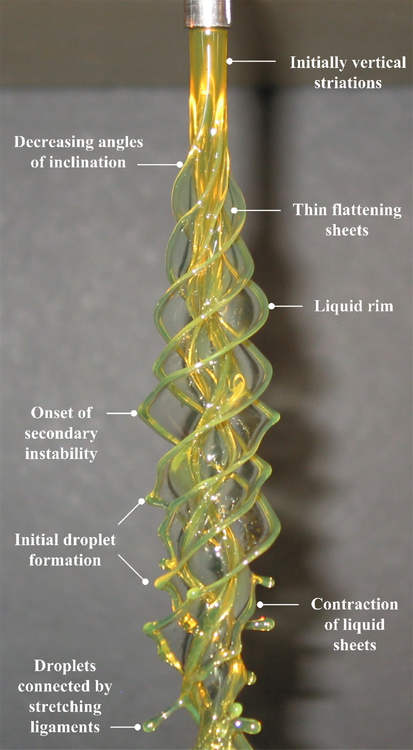
In fluid dynamics, we like to classify flows as laminar–smooth and orderly–or turbulent–chaotic and seemingly random–but rarely is any given flow one or the other. Many flows start out laminar and then transition to turbulence. Often this is due to the introduction of a tiny perturbation which grows due to the flow’s instability and ultimately provokes transition. An instability can typically take more than one form in a given flow, based on the characteristic lengths, velocities, etc. of the flow, and we classify these as instability modes. In the case of the vertical rotating viscous liquid jet shown above, the rotation rate separates one mode (n) from another. As the mode and rotation rate increase, the shape assumed by the rotating liquid becomes more complicated. Within each of these columns, though, we can also observe the transition process. Key features are labeled in the still photograph of the n=4 mode shown below. Initially, the column is smooth and uniform, then small vertical striations appear, developing into sheets that wrap around the jet. But this shape is also unstable and a secondary instability forms on the liquid rim, which causes the formation of droplets that stretch outward on ligaments. Ultimately, these droplets will overcome the surface tension holding them to the jet and the flow will atomize. (Video and photo credits: J. P. Kubitschek and P. D. Weidman)

Saturn’s Polar Vortex

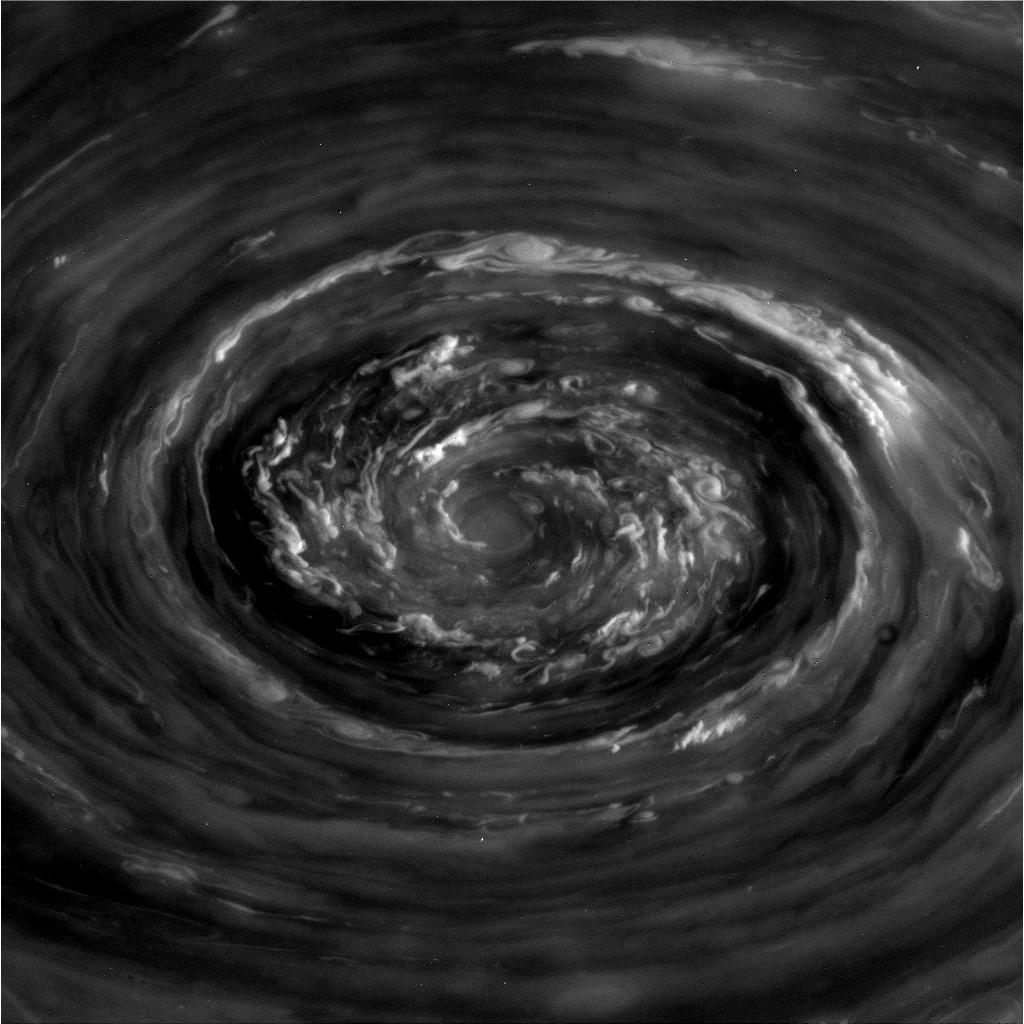
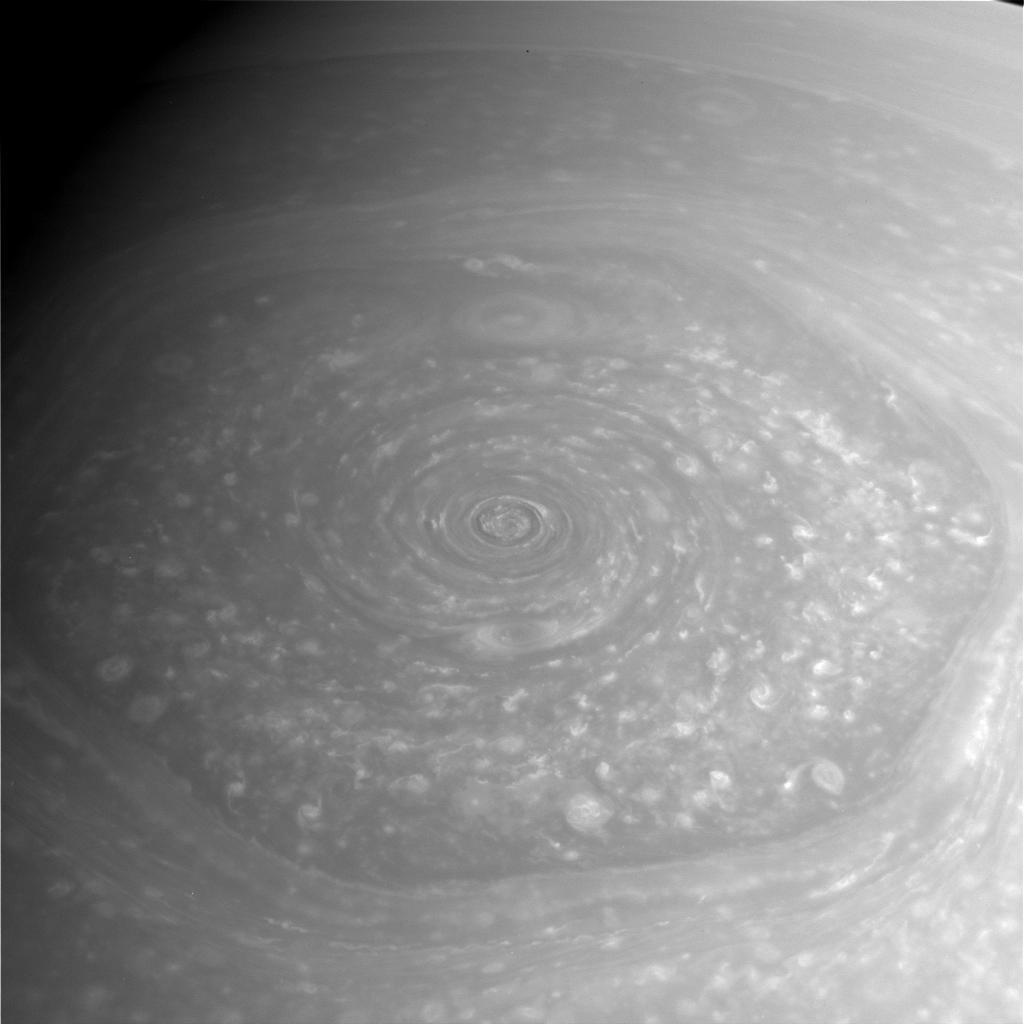

Nothing quite compares to the beauty of fluid dynamics on astronomical scales. What you see here are raw photographs of recent storms at Saturn’s north pole. The recent change in Saturnian seasons has afforded Cassini a sunlit view of the northern pole, which had previously lain in darkness. A roiling vortex filled with clouds being twisted and sheared was revealed near the center of its famed polar hexagon. (Photo credit: NASA/JPL-Caltech/Space Science Institute; submitted by J. Shoer)
Supersonic Bubble Shock Waves
Supercomputing has been an enormous boon to fluid dynamics over the past few decades. Many problems, like the interaction between a supersonic shock wave and a bubble, are too complicated for analytical solutions and difficult to measure experimentally. Numerical simulation of the problem, combined with visualization of key variables, adds invaluable understanding. Here a shock wave strikes a helium bubble at Mach 3, and the subsequent interactions in terms of density and vorticity are shown. This situation is relevant to a number of applications, such as supersonic combustion and shockwave lithotripsy–a medical technique in which kidney stones are broken up inside the body using shock waves. After impact, an air jet forms and penetrates the center of the structure while the outer regions mix and form a persistent vortex ring. (Video credit: B. Hejazialhosseini et al.; via Physics Buzz)