One day calligrapher Mae Nguyen accidentally squeezed a droplet out of her waterbrush pen, and a fun, new technique was born. Nguyen sometimes uses the arrays of droplets to paint and other times blows on them to create colorful splatters, like in the video above. I’d love to see the latter technique, in particular, in slow motion! I expect there is some really cool mixing as the droplets coalesce. Check out more of Nguyen’s work on her website and Instagram account. (Video credit: M. Nguyen)
Videos
Phytoplankton Swirl
During the warm summer months, phytoplankton blooms pop up in waters around the world. This natural-color satellite image shows a bloom in the Gulf of Finland. The tiny phytoplankton serve as tracker particles for the flow, revealing large-scale features like the spectacular vortex in the center of this image. The presence of the phytoplankton here suggests that this vortex could be pumping nutrients up from the deep.
Researchers also use particles for flow visualization. This can be as simple as adding small, neutrally buoyant particles, illuminating smoke, or even using natural snowfall to see what’s happening in the flow. (Image credit: NASA/USGS/J. Stevens/L. Dauphin)

Flying on Flexible Wings


Bats are incredible and rather unique among today’s fliers. Like birds, they flap to produce their lift and thrust, but where birds have relatively stiff wings, a bat’s wings are flexible. The thin webbing of skin stretched between the bat’s finger joints has muscles inside it that fire as the mammal flaps. This means that the bat may actively control just how stiff its wing is as it flies.
Compared to other natural and manmade fliers, the bat is incredibly agile and stable, able to recover from wind gusts in less than a full wingbeat cycle. They also have some incredible acrobatic capabilities. When preparing to perch, a bat loses almost all of its aerodynamic lift but still manages to maneuver itself so it flips over and grabs hold. Check out the full video above to learn more about these fascinating animals. (Video and image credit: Science Friday; research credit: S. Swartz and K. Breuer)
Editor’s Note: I’ll be travelling through the end of the month with limited email access. The blog should continue posting uninterrupted, but if you contact me, just know it may be awhile before I can get back to you. Thanks! – Nicole
The Actual Shape of Raindrops
If you imagine the shape of a raindrop, you probably think of a tear drop shape, but the reality of rain is much more complicated. It’s Okay to Be Smart has a great primer on the subject that takes a look at the forces on a raindrop and shows you the actual shape they take, which depends largely on their size.
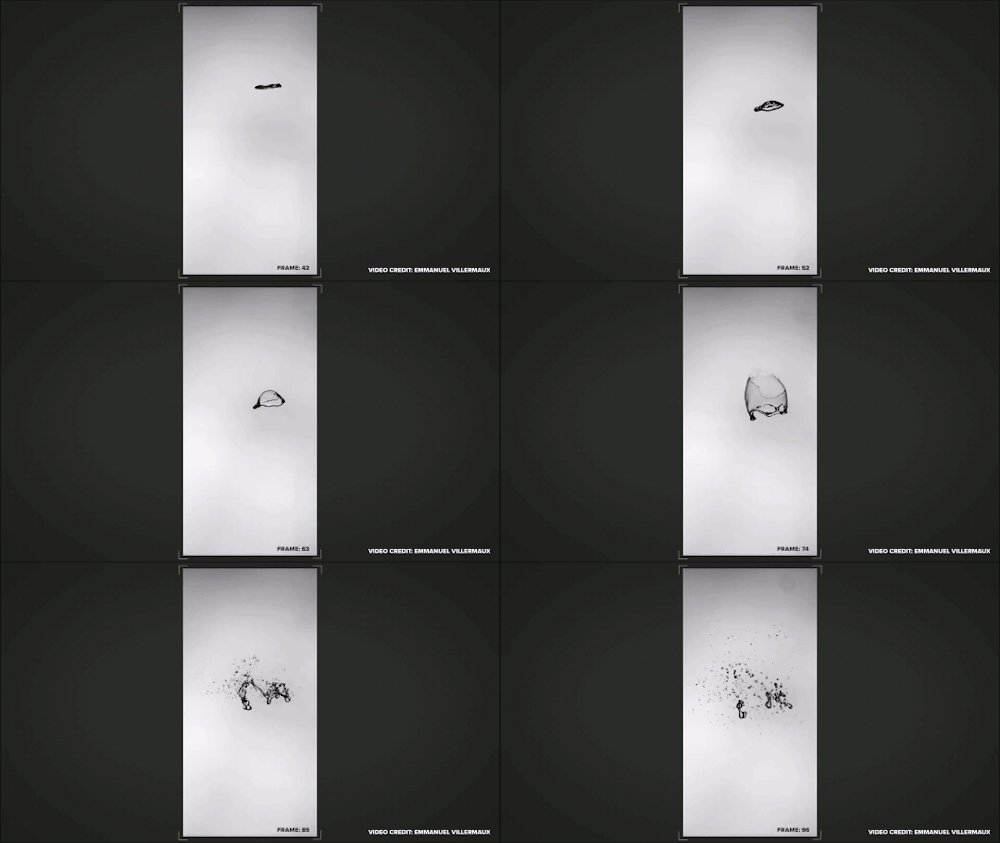
Small raindrops tend to coalesce together over time and get larger and progressively flatter. When the drop’s volume gets too large (below), it balloons up like a parachute. Researchers call this a bag. Stretched into a film, the drop’s surface tension is no longer able to win its fight against aerodynamic forces, and the drop shreds into smaller droplets. (Video and image credit: It’s Okay to Be Smart)

The Show in the Sky
There is a constant drama playing out overhead, though most of us do not take the time to watch. Fortunately, a few, like Blaž Šter, do and make timelapse videos that allow us to enjoy hours of atmospheric drama in only a few minutes. This timelapse shows a cloudy and rainy mid-July day in Slovenia, where an unstable atmosphere leads to turbulent and dramatic clouds. In an unstable atmosphere, it’s easier for vertical motion to take place between altitudes. For example, a parcel of warm air displaced upward will continue to rise because it will be lighter and more buoyant than the surrounding air. This is key to the strong convection that can generate thunderstorms. (Image and video credit: B. Šter, source)
From Firenado to Water Spout
Just a few years ago, fire tornadoes were almost fabled because they were so rarely captured on video. Now, with worsening wildfire seasons and cell phone cameras everywhere, there are new videos all the time. This video captures a fire tornado that sets off a water spout as it reaches the river (~1:15 in).
Neither the fire tornado or the water spout is truly tornadic; instead they are more like dust devils. They are driven by the rising heat of the fire. As cooler, ambient air flows inward to replace the rising air, it brings with it any vorticity it had. And, like an ice skater, the incoming air spins faster as it moves inward. This sets up both the fire tornado and the water spout’s vortices.
Although this is the first example I’ve seen video of, fire tornadoes have been known to create water spouts before. Lava flowing into the ocean can create whole trains of them. (Video credit: C. & A. Mackie; via Jean H.)
Why Fish Don’t Freeze
Have you ever wondered why it is that fish in a pond or lake don’t freeze during the winter? The secret is due to a peculiarity of water that’s vital for life here on Earth. In general, cold things are denser than warmer ones. This is why, for the most part, cold fluids tend to sink and warmer ones rise here on Earth. So as fall moves into winter and water near the surface of a pond cools, it sinks. But only to a point.
Water is at its densest at 4 degrees Celsius. Any colder and the water will actually expand and become less dense. This is why you can’t fill ice cube trays to the very top before putting them in the freezer. In the pond it means that buoyant convection shuts down at 4 degrees Celsius. When the water at the top keeps cooling down to the freezing point, it doesn’t sink. Instead, the fish and other pond life get to spend the winter at a chill – but not freezing – 4 degrees. (Video credit: A. Fillo)
“Volumes”

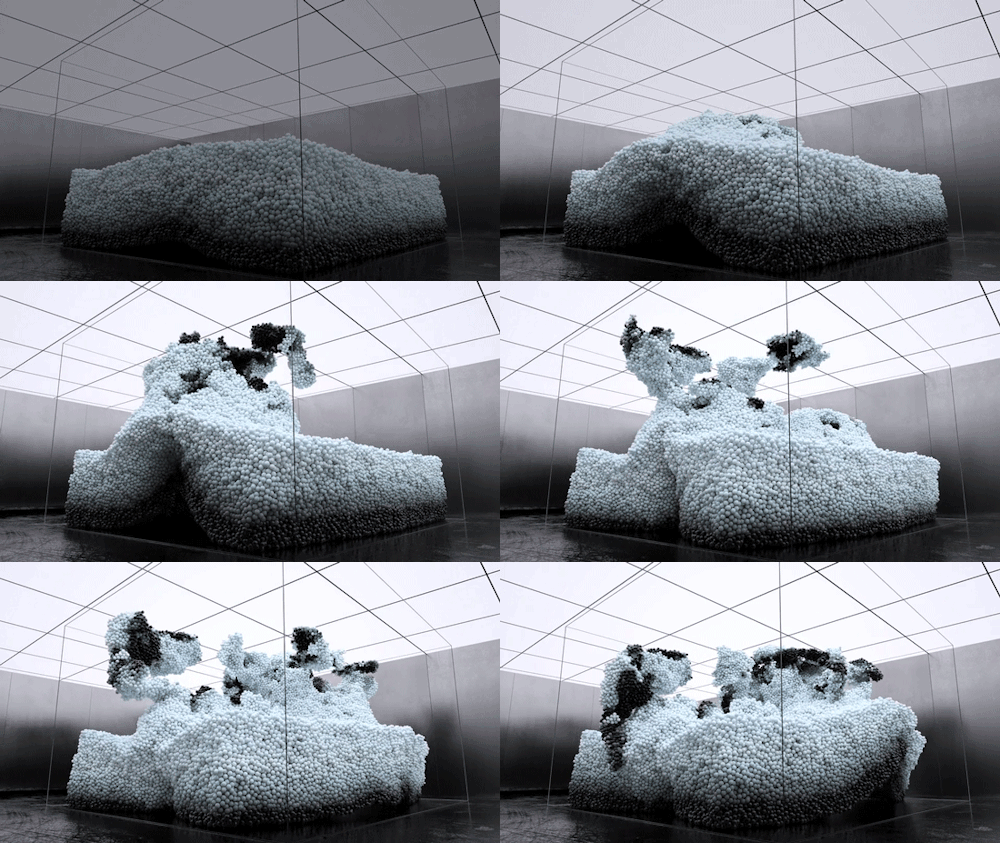
“Volumes” is an experimental art film by Maxim Zhestkov using physics-based particle animation. Waves and unseen forces send billions of color-changing particles aloft in the film. The motions – especially the way the particles seem to tear themselves – are reminiscent of a complex fluid, like yogurt. These substances have both liquid-like (viscous) and solid-like (elastic) properties depending on the forces they experience. Zhestkov’s particles are similar; they move like a fluid but tear more like a solid.
I particularly like the sequence beginning at 1:30. The upwelling of particles leaves behind a lower layer that looks like a snapshot of convection in a planetary mantle while the upper layer resembles the clash of ocean waves. The whole film is quite mesmerizing. Check it out! (Video and image credit: M. Zhestkov; GIFs via Colossal)
The Mystery of Carnegie Hall’s Sound
For nearly a century, the acoustics of Carnegie Hall were touted as among the very best in the world. But after a much-needed renovation in 1986, musicians and critics felt the magic of the old sound had been lost. In this video, Gizmodo explores the mystery of what changed. Was it a hole in the ceiling? The curtains that had been removed?
Eventually, a second renovation – this time for warping of the stage floor – revealed the likely culprit. Concrete had been installed to reinforce the stage in the first renovation, and this changed the stage’s resonance. Previously, instruments like the bass had caused the wooden floor to vibrate, which amplified their sound. The concrete damped that vibration, cutting out a key ingredient in Carnegie’s acoustics. When the second renovation restored the all-wooden stage, suddenly the venerable concert hall had its sound back. (Video credit: Gizmodo)
Pyrocumulus on the Horizon
The Cranston wildfire in California is intense enough that it’s creating its own weather. This timelapse video shows the formation and growth of a pyrocumulus cloud, also associated with volcanoes, over the wildfire. In both instances, the extreme heat causes a massive column of hot, turbulent air to rise. Because ash and smoke are carried upward as well, there are many places for any moisture in the atmosphere to nucleate, forming the cloud we see. In timelapse, the roiling nature of the air’s motion is especially apparent. This turbulence can be dangerous, as it may contribute to high winds and even lightning, both of which can spread the fire further. (Video credit: J. Morris; via James H.)