If you’ve been around fluid mechanics for very long, you’ve probably noticed that we like to name things after people. (Mostly dead, white guys, but that’s another subject.) Whenever someone describes or explains a new phenomenon, it tends to get their name attached to it. Some of the common names in fluid dynamics – Reynolds, Rayleigh, Kelvin, Taylor, von Karman, Prandtl – read like a who’s-who of nineteenth and twentieth century physics. This video gives some historical insight into a couple of those figures – particularly Arthur Worthington, who is known for his contributions to the understanding of splashes. Be sure to check out some of his awesome illustrations and photos. Can you imagine being able to piece together splash physics like that without high-speed video?! (Video credit: Objectivity; submitted by Kam-Yung Soh)
Videos

The Polar Vortex
Every year or two, the Northern Hemisphere gets treated to a bout of intensely cold temperatures thanks to the polar vortex. What you may not realize, though, is that it’s not the polar vortex that causes this cold weather – it’s the vortex breaking down. As Simon Clark explains in this video, the polar vortices (one at each pole) are intense and powerful regions of circulation in the stratosphere, or mid-atmosphere. They’re largely responsible for keeping cold air trapped in the Arctic and Antarctic. But occasionally, this region of the atmosphere will suddenly get warmer – to the tune of increasing by 80 degrees Celsius in less than a week! When this happens, a polar vortex will deform and potentially even split into smaller vortices, as seen below. When this happens, the vortex loses its hold on the cold air near the surface, allowing Arctic air to sneak as far south as Texas. After a couple of weeks of affecting our weather, the polar vortex will typically reform and we’ll return to normal. In the meantime, stay warm! (Video and image credit: S. Clark; submitted by Nikhilesh T.)

Dripping Down the Rivulet


If you’ve ever watched water running down the side of the street, you’ve probably noticed that it doesn’t flow smoothly. Instead, you’ll see waves, rivulets, and disturbances that form. That’s because the simple action of flowing down an incline is unstable. Water and other viscous liquids can’t flow downhill smoothly. Any disturbances – an uneven surface, the rumble of passing cars, a pebble in the way – will create a disruption that grows, often until the entire flow is affected. This video shows some of the complex and beautiful patterns you get then. (Video and image credit: G. Lerisson et al.)
“The Empire of C”


Filmmaker Thomas Blanchard has once again released a beautiful, fluid-filled short to captivate us. Built from paint, oil, and liquid soap, “The Empire of C” feels like it gives viewers a birds-eye perspective over a fantastical land. I was particularly drawn to two fluid dynamical aspects of the film. The first were the dendritic sequences in the opening, which feel a bit like watching river deltas form in real time. Despite their resemblance to the Saffman-Taylor instability, I think these fingers are interfacially driven – meaning that they result from differences in surface tension between the different liquids Blanchard is using.
The second thing that caught my eye and made me rewind the video over and over were the glittery droplets. The glitter acts like tracer particles, allowing you to see the flow inside the droplets. Check out that counter-circulation compared to the paint flowing by outside! It’s a reminder that even inside a seemingly still droplet, there’s lots going on. (Video and image credit: T. Blanchard)
Sonic Tractor Beam
Acoustic levitation uses the radiation forces generated by sound waves to trap small, lightweight particles at the nodes of standing waves. We’ve seen this a number of times previously, both with solid objects and liquid droplets. What makes this example particularly impressive, though, is that these researchers use an array of speakers to manipulate multiple objects at once. Check out the video above for a whole series of clips from the research. (Video credit: Science; research credit: A. Marzo and B. Drinkwater)
“Haboob”


Mike Olbinski’s latest storm chasing timelapse, “Monsoon V,” is once again spectacular. Although I do think the name could have been “Haboob” instead, given how many sweeping dust clouds encroach on the viewer. These towering wall clouds of dust can form from downdrafts at the leading edge of a cold front, or from the fading remains of a thunderstorm. In dry, dusty regions like Arizona, the strong downward winds spread outward as they near the ground, picking up dust and sand. Below you can see two examples of haboobs racing ahead of fronts.
The middle image shows a microburst, where a sudden, localized downdraft falls out of the storm. Notice how the wind and rain sweep outward as they near the ground. This is typical of any flow heading straight toward a wall! Check out the full video for lots more gorgeous fluid dynamics in action. (Video and image credit: M. Olbinski)
Fire Tornado in a Bubble
File this one under awesome tricks you shouldn’t try at home. Here bubble artist Dustin Skye demonstrates his handheld inverted fire tornado. First, he blows a large encapsulating bubble, then blows butane and smoke into a smaller secondary bubble. When he breaks the wall between the two, the mixture swirls into the larger bubble. Then, by breaking a narrow hole into the remaining bubble, Skye forms a swirling tornado. He’s using conservation of angular momentum here to concentrate the vorticity he created by blowing into the original butane bubble. As the big bubble shrinks, the vorticity inside gets pulled inward and speeds up – like when a spinning ice skater pulls his arms in. That’s how you get the tornado. And from there, it’s just a matter of lighting the exiting butane and air mixture. (Video credit: D. Skye; via Gizmodo)
“Winter’s Magic”
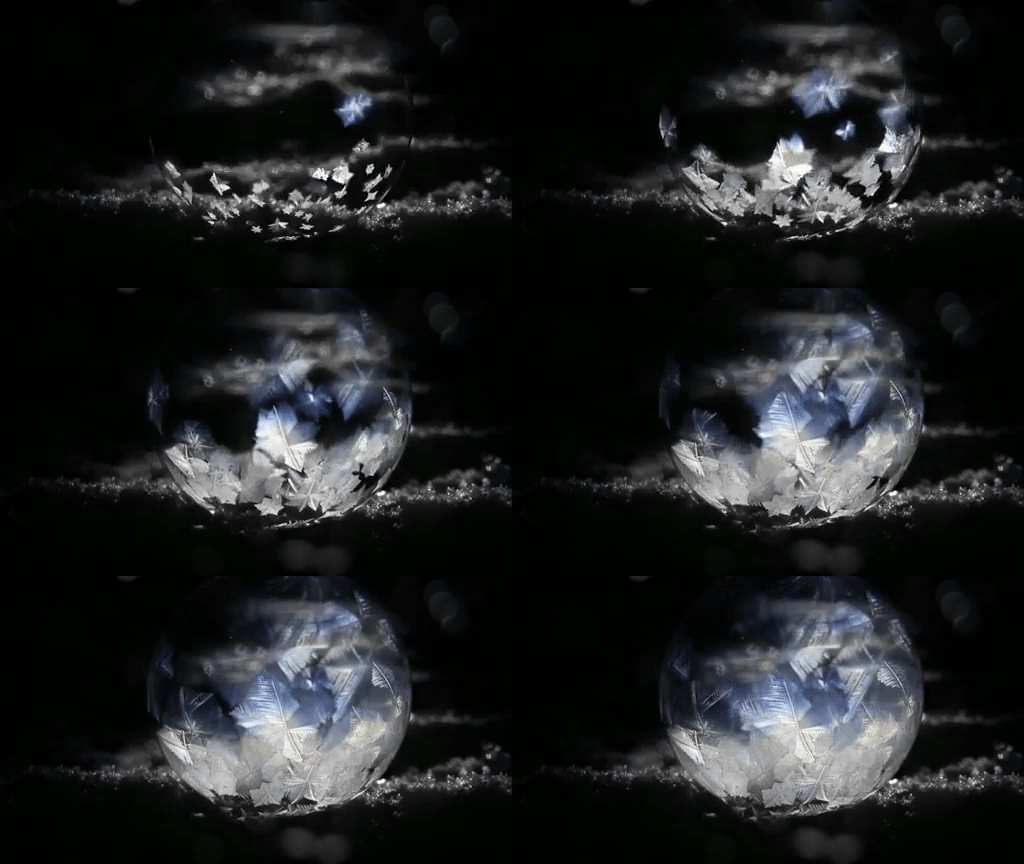
Don Komarechka’s beautiful short film, “Winter’s Magic,” captures the beauty of soap bubbles as they freeze. It’s a delicate process and one difficult to capture in video. The bubble freezes first at the bottom, where it touches the cold surface – in this case, snow. That freezing releases latent heat and creates a temperature gradient along the thin liquid film. With that temperature gradient comes a variation in surface tension, and it’s this that creates the flow that lifts the ice crystals from the surface and turns the bubble into a snow globe. Eventually, as the frozen crystals continue growing, flow in the bubble walls comes to halt as the film solidifies.
For more on the physics of freezing bubbles, check out this interview with the researchers, or, to learn more on how to film freezing bubbles, check out Komarechka’s description. (Video and image credit: D. Komarechka; via Laughing Squid; h/t to Jennifer O.)
A Musical Splatter
High-speed video is wonderful for appreciating fluid motion in ways we can’t on our own. In this video from Warped Perception, we see what happens when a vibrating tuning fork is lowered into water. The tines of the tuning fork create a spray of tiny droplets, reminiscent of what happens in ultrasonic atomization or when blowing through an immersed straw. The ejected droplets fall slowly back onto the disturbed surface; many of them bounce rather than coalescing. This is because the surface’s vibration pushes the drops aloft again before the air layer separating the drop from the surface has the time to drain away. (Video credit: Warped Perception)
How Water Towers Work
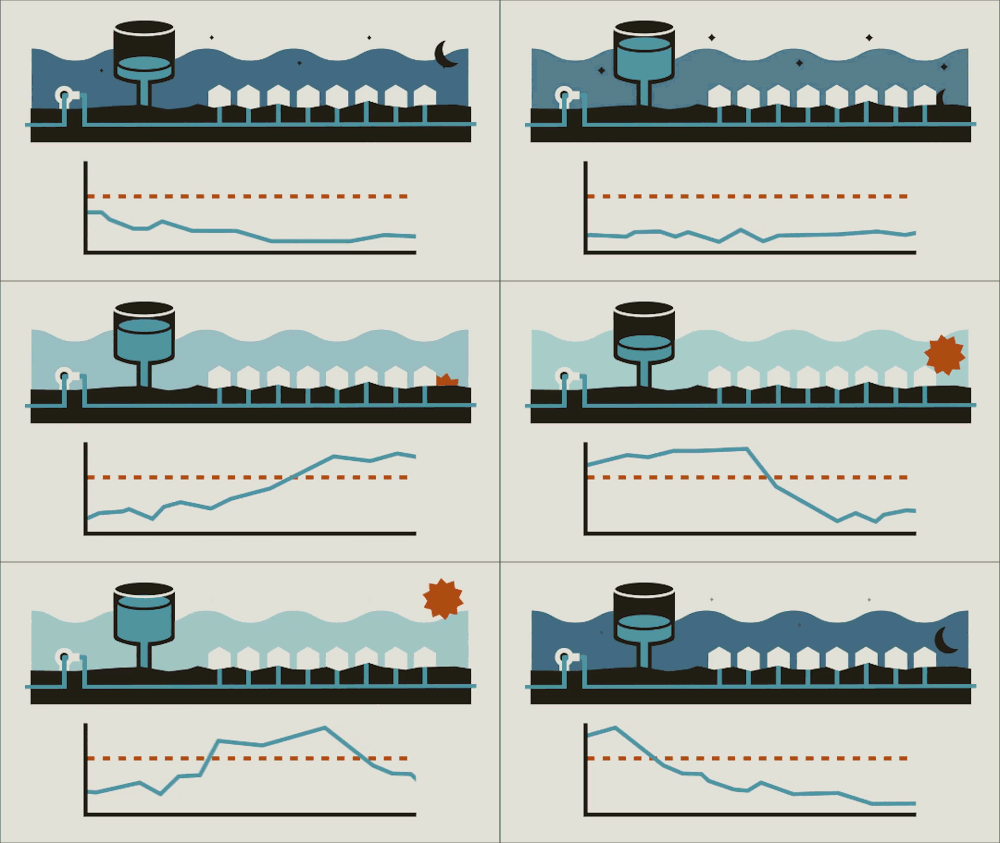
You may have noticed a water tower rising up over your town, but you may not have given much thought to how it works. Practical Engineering has a nice video overview of this important piece of infrastructure, which municipalities use to store and pressurize water in public distribution systems.
During off-peak hours, pumps fill the water tower, which creates potential energy (and therefore, water pressure) that depends on the height of the water level. If you’ve ever lost power, you can appreciate how the water tower ensures that your faucet still runs. Without power, there are no pumps to pressurize the water line. But with the hydrostatic pressure of water in the tower, your water will still run like normal. For many people who live outside of municipal water zones, that’s not the case. A loss of power means an immediate loss of water also since the pumps that work their wells go offline. (Video and image credit: Practical Engineering)