Artist Antoine Terrieux’s “En Plein Vol” exhibit shows off the power of hair dryers. Parts of the exhibit, like the floating ball at 0:16, rely on Bernoulli’s principle and the moving stream of air the dryers generate. Others, like the smoke tornado at 0:39 or the (suspended) paper airplane at 0:56, use the hair dryers to generate vorticity essential to the installation. It’s a neat concept and very well executed. (Video credit: A. Terrieux; via io9; submitted by Joseph S. and Eliza M.)
Videos

Underwater Explosions
As dangerous as explosions are in air, they are even more destructive in water. Because air is a compressible fluid, some part of an explosion’s energy is directed into air compression. Water, on the other hand, is incompressible, which makes it an excellent conductor of shock waves. In the video above we see some simple underwater explosions using water bottles filled with dry ice or liquid nitrogen. The explosions pulsate after detonation due to the interplay between the expanding gases and the surrounding water. When the gases expand too quickly, the water pressure is able to compress the gases back down. When the water pushes too far, the gases re-expand and the cycle repeats until the explosion’s energy is expended. This pulsating change in pressure is part of what makes underwater explosions so dangerous, especially to humans. Note in the video how the balloons ripple and distort due to the changing pressure. Those same changes in pressure can cause major internal damage to people. (Video credit: The Backyard Scientist; submitted by logicalamaze)
Calbuco
Filmmaker Martin Heck captured incredible timelapse footage of the Chilean volcano Calbuco erupting earlier this year. Fluid dynamics on these enormous geophysical scales is always awe-inducing. In the beginning, clouds bob gently and flow around the landscape. Then the volcano erupts, and the towering ash cloud of the eruption roils with turbulence, displaying eddies with length scales from hundreds of meters down to centimeters. And when the hot ash has risen and cooled, it forms a cap that spreads horizontally. Nature is a wonderful demonstrator of fluid dynamics, but what always amazes me is how very alike flows are whether they are confined to a laboratory or take up an entire planet. (Video credit: M. Heck; via It’s Okay To Be Smart)
Water in Oil
Pouring water on an oil fire is a quick way to cause almost explosive results. Since water is denser than oil, it quickly sinks to the bottom of a container, heating up as it does. When the water reaches its boiling point, it evaporates and expands as steam. That phase change involves a huge change in volume, a fact made especially clear in the video below. The steam expands and rises, throwing droplets of oil upward and outward. These smaller atomized droplets are easier to combust, which, in the case of the video above, causes a veritable cloud of flames if a fire has already started.
(Video credits: The Slow Mo Guys and N. Moore)
The Upside-Down Jellyfish
The upside-down jellyfish Cassiopea lives along the sea bottom in coastal regions. As its name suggests, the jellyfish rests upside-down with its bell against the sea floor and its frilly oral arms pointed upward. This jellyfish is a filter feeder, and it draws water up and through its arms by pulsing its bell. The video above visualizes this flow using dye. Each pulse propels fluid up through the arms and draws in fresh water from the surroundings. The frilly arms break up any large vortices from the pulsed flow and diffuse the filtered water as it moves upward. (Video credit: Applied Fluid Mechanics Laboratory at Oklahoma State University)
Convection from a Heat Source
Convection is a major driver in many flows in nature. In this film, the UCLA Spinlab demonstrates buoyant convection caused by a local heat source. They deposit dye on a submerged, continuously heated plate, then observe as the dye slowly rises with the heated (lower density) fluid. The surface forms a cap for the rising dye, which then spreads horizontally. Qualitatively similar flows can be seen in nature over volcanic eruptions or in thunderstorms when clouds reach the troposphere or a capping inversion. Be sure to check out the rest of the Spinlab’s videos. (Video credit: UCLA Spinlab; submitted by Jon B.)
Rain-spread Pathogens
Like humans, plants can spread pathogens to one another. Although scientists had observed correlations between rainfall and the spread of diseases among plants, this study is one of the first to look at the fluid dynamics of leaf and rainfall interaction. When a raindrop hits a leaf, it doesn’t simply splash as it would against an immobile surface. The impact of the drop deforms the leaf, and the plant’s rebound significantly affects the trajectory and size of the resulting droplets. Depending on factors like the leaf’s stiffness, a large drop, carrying many pathogens, may rebound and splatter onto a neighboring leaf. Other leaves tend to catapult out many smaller droplets, which may fly farther afield but carry fewer pathogens. For more, check out the press release or the original research paper. (Video credit: Massachusetts Institute of Technology; research credit: Bourouiba Research Group)

Get Your Own Space Coffee Cup
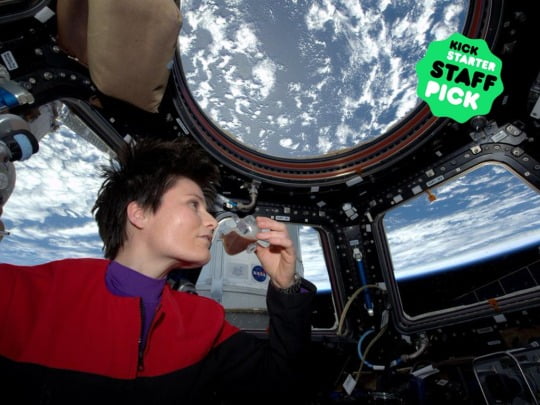
A few weeks ago, we reported on the espresso machine NASA and the ESA sent to astronauts aboard ISS. The Capillary Beverage Experiment, known colloquially as the “Space Coffee Cup”, is an accompanying project that aims to use our understanding of fluid behavior in microgravity to design an open cup that simulates earthbound drinking experiences. As you can see above, astronauts are already enjoying drinks with it. The cup’s special shape is optimized so that surface tension can replace the role gravity plays in drinking on Earth. Where we pour drinks on Earth, the cup wicks liquid to the spout using surface-tension-driven capillary action. Right now there are only a handful of 3D printed cups on-orbit and here on Earth, but the company that designed them wants to manufacture glass versions for use here on the ground. So if you’d like your own space coffee cup, be sure to check out their Kickstarter campaign! (Video credit: IRPI LLC; image credit: NASA/IRPI LLC; Kickstarter project link)
ETA: To those who have been asking, that’s European astronaut Samantha Cristoforetti, who is (clearly) a Star Trek fan. I believe she’s doing a tribute to Captain Janeway’s coffee. (Black.)
Re-lighting a Candle
When you blow out a candle, you can re-light the wick using the smoke trail left behind. This is a topic we’ve discussed before, but I’m thrilled to finally see the process in true high-speed, thanks to the Slow Mo Guys. The plume that rises from the extinguished candle is an atomized mixture of fuel (wax) and air. When you bring a new combustion source–the match–close enough, that mixture ignites and the flame spreads downward back to the wick. (Video credit: The Slow Mo Guys)

3D Printing Fluids
Most flows vary in three spatial dimensions and time. In experimental fluid dynamics, the challenge is measuring as much of this information as possible. For those who use computational fluid dynamics to study flows, their simulations provide massive amounts of data and the challenge comes in visualizing and processing that data in a useful way. Unless you can find and analyze the important aspects of the simulation results, they’re just a bunch of numbers. As computers have advanced, the size and complexity of simulation results has increased, too, making the task even more difficult. Using technologies like virtual reality projections (above) or 3D printing (below) allow researchers to interact with flow information in completely new but intuitive ways, hopefully leading to new insights into the data.
(Video credit: M. Stock; photo credit: K. Taira et al.)
** The 3D-printed vortices are an image I took of a poster at the APS DFD Gallery of Fluid Motion in 2013, but I’m missing the researchers’ names. If you know whose poster these were from, please let me know (fyfluids [at] gmail [dot] com) so that I can update the credits accordingly. Thanks to Shervin for helping me find the right lab to credit!