Videos

  • Featured Video Play Icon

    Hot Versus Cold

    Did you know that you can hear the difference between hot and cold water when they’re poured? Go ahead and give the video above a listen to try it out. I’ll wait.

    As explained in the video, the viscosity of water changes with temperature – the higher the temperature, the lower the viscosity. In fact, the viscosity of water at 10 degrees Celsius is more than 4 times higher than the viscosity at 100 degrees Celsius! That’s pretty significant, and it’s a big enough difference that we can hear it in the splash, even if we don’t see the difference when pouring. 

    Surface tension also decreases with temperature but not nearly as strongly. That 100 degrees Celsius water has 25% less surface tension than the 10 degrees Celsius water. But the combination of this change in viscosity and change in surface tension is why your cold water is more likely to dribble down the spout of your coffee pot when you’re filling the coffee machine than when you’re pouring coffee from the same pot. (Video credit: Steve Mould and Tom Scott; submitted by entropy-perturbation)
  • Featured Video Play Icon

    Sloshing in Space

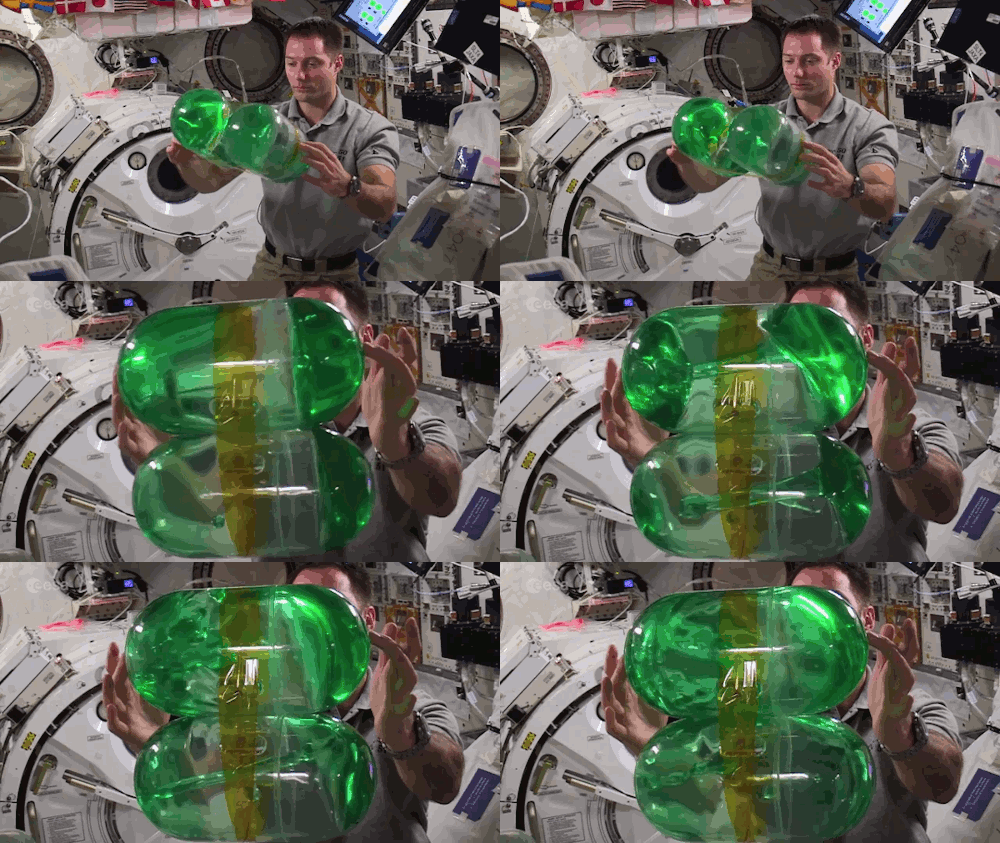
    Last month, French astronaut Thomas Pesquet posted a video of some experiments he did on the International Space Station exploring the movement of fluids in microgravity. He filmed the experiments as part of the SPHERES Slosh project. Sloshing is the technical term for how liquids respond to the motion of their container, and it’s a tough problem whether you’re carrying a full coffee mug on Earth or dealing with a partially-emptied fuel canister in orbit.

    Here on Earth, gravitational forces dominate how fluids respond, but in microgravity, surface tension is a more powerful player. Pesquet’s demonstrations help scientists here on Earth better understand and model how liquids respond to movement in space. One major application for this is in spacecraft fuel tanks, which engineers must be able to design so that they empty themselves consistently with or without the added complications of spinning, maneuvering, or impulsive kicks of acceleration. (Video and image credit: ESA; submitted by gdurey)

  • Featured Video Play Icon

    Molten Copper

    In this video, the Slow Mo Guys prove that pouring molten copper in slow motion is every bit as satisfying as one would imagine. Because they pour the metal from fairly high up, they get a nice break-up from a jet into a series of droplets; that’s due to the Plateau-Rayleigh instability, in which surface tension drives the fluid to break up into drops. Upon impact, the copper splashes and splatters very nicely, forming the crown-like splash many are familiar with from famous photos like Doc Edgerton’s milk drop. The key difference between the molten copper and any other liquid’s splash comes from cooling; watch closely and you’ll see some of the copper solidifying along the edges and surface of the fluid as it cools. In this respect, watching the molten copper is more like watching lava flow than seeing water splash. (Video and image credit: The Slow Mo Guys)

  • Featured Video Play Icon

    Bursting Droplets

    Mixing multiple fluids can often lead to surprising and mesmerizing effects, whether it’s droplets that dance or tears along the walls of a wine glass. A recent paper highlights another such mixture-driven instability – the bursting of a water-alcohol droplet deposited on an oil bath. The Lutetium Project tackles the physics behind this colorful burst in the short video above. The behavior is driven by the quick evaporation rate of alcohol in the droplet and the way this changing chemical concentration affects surface tension in the droplet. Alcohol evaporates more quickly from the edges of the drop, creating a region of higher surface tension around the edge. This pulls fluid to the rim of the drop, where it breaks up into droplets that get pulled outward as the inner drop shrinks.

    The oil bath plays an important role in the instability, too. Without it, friction between the drop and a wall is too high for the droplet to “burst”. A thick layer of oil acts as a lubricant, allowing the escaping satellite drops to speed away. (Video and image credit: The Lutetium Project; research credit: L. Keiser et al.; submitted by G. Durey)

  • Featured Video Play Icon

    How Jet Engines Work

    Jet engines are a major part of aviation today, and this great video from the new LIB LAB project breaks down how jet engines operate. It focuses especially on the subject of combustion, in which fuel-air mixtures are burned to generate power and thrust. By breaking fuels down into simpler compounds, jet engines are able to accelerate exhaust gases, which creates thrust. They even provide instructions for an effervescence-driven bubble rocket so that kids can (safely!) experiment with propulsion at home. (Video credit: LIB LAB/Corvallis-Benton County Public Library)

  • Featured Video Play Icon

    Spillways

    Extensive rains in California have brought an unusual sight to Lake Berryessa – an overflowing spillway. The upper photo, taken in 2010, shows the concrete structure of the spillway’s entrance, known as a bellmouth – or, in the words of locals, a glory hole. When the water level rises above the concrete, water begins to cascade down the spillway to relieve flooding.

    The flow is rather mesmerizing and beautifully laminar until it’s fallen many feet down the hole. This is intentional on the part of the designers – at least the laminar part. It means that the flow velocity at the entrance is slow, so that animals (or trespassing people) nearby are not going to get sucked down the spillway a la Charybdis. Nevertheless, the spillway does make quick work of excess water. The New York Times reported that on February 21st about two million gallons (7.5 million liters) of water a minute flowed down the spillway. (Image credits: J. Brooks; T. Van Hoosear; video credit: Lake Berryessa News; submitted by Zach B.)

  • Featured Video Play Icon

    Battery Rockets

    When I post Slow Mo Guys videos, it often comes with a warning not to try this at home. For their latest video, that deserves an extra-special mention: seriously, don’t try this. In this video, Dan and Gav explode lithium-ion batteries. In the process, they discover a safety feature – namely vents on one face of the battery. Because runaway thermal reactions (a.k.a. explosions) are a possibility with this type of battery system, consumer-grade batteries are designed to try and prevent extreme damage. One of these outwardly visible safety features are these four vents that release gas when when the battery is too hot. By venting the gas, manufacturers keep the battery from exploding and sending hot chemicals and shrapnel in all directions. Instead the venting gas turns the entire battery into a miniature rocket. (Video and image credit: The Slow Mo Guys)

  • Featured Video Play Icon

    An Octopus’ Handshake

    Cephalopods, especially octopuses, are fascinating creatures. At sea level, an octopus can generate an impressive pressure differential of 1 to 2 atmospheres with each of its suckers. That incredible grip is possible thanks to fluid dynamics. An octopus’s sucker consists of two main parts: the ring-shaped infundibulum on the outer surface and the inner, cup-shaped acetabulum. When the infundibulum makes contact with a surface, it creates a water-tight seal. The octopus then contracts radial muscles along the acetabulum. This expands the inner chamber. The water trapped in the acetabulum now has to take up a greater volume, causing the pressure to drop and creating suction. To let go, the octopus simply relaxes the radial muscles or contracts circular ones to reduce the chamber volume and release the suction. (Video credit: Deep Look)

  • Featured Video Play Icon

    Four Seasons

    The team behind Beauty of Science decided to explore the four seasons in this video combining macro footage of crystal growth, chemical reactions, and fluid dynamics. It’s always a fun game with videos like this to try and guess exactly what makes the mesmerizing patterns we see. Are those blue streaming waves in Spring caused by alcohol shifting the surface tension in a mixture? Are the dots of color welling up in Autumn a lighter fluid bursting up from underneath a denser one? As fun as the visuals are, though, what really made this video stand out for me was its excellent use of “The Blue Danube” to tie everything together. Check it out and don’t forget the audio! (Video credit: Beauty of Science; via Gizmodo)

  • Featured Video Play Icon

    Unboiling an Egg

    Cooking is something we think of as a one-way process. You add heat to food, it changes forms, and there’s undoing that. But that process is less one-directional than we thought, at least in some cases. Take boiling an egg. When you add heat to egg whites, it breaks down bonds between the folded proteins and lets those proteins build more bonds with other sections of proteins, eventually solidifying into a seemingly unbreakable mess. You can’t break those bonds by adding or removing thermal energy, but you can shake the proteins apart and refold them into their original shapes.

    Researchers accomplish this by putting the boiled egg whites in a solution of water and urea and spinning them. When they spin the fluid mixture, the fluid near the wall spins faster than the fluid in the center of the vial, which creates shear stress. That shear stress helps untangle the proteins and reform them into their original shape–thereby unboiling the egg white. Now you definitely don’t want to eat the results – urea is, of course, a component of urine – but it does demonstrate that fluid dynamics can be used to reverse chemical processes we thought were irreversible. And that surprising discovery nabbed the researchers an Ig Nobel Prize in 2015. (Video credit: TedEd/E. Nelson; research credit: T. Yuan et al.)