Archer fish have a remarkable superpower. When hunting, they target insects above the water and knock them down with a precision strike from a jet of water they spit out. As previous research has shown, the archer fish packs an impressive punch by carefully modulating the water jet so that its tail travels faster and catches up to the front of the jet just as it strikes its target. Even more impressively, the archer fish can make this perfect strike on targets at different distances, which requires the fish to make significant adjustments to each jet. As this video from Deep Look discusses, the archer fish’s impressive hunting hints that it may have greater intelligence than we thought possible, given a comparison of its brain to ours. (Video credit: Deep Look)
Videos

Freezing Bubbles
Soap bubbles are wonderfully ephemeral, their surfaces constantly in motion as air currents, surface tension variations, and temperature differences make them dance. In this video, though, photographer Paweł Załuska focuses on freezing soap bubbles. Watching the growth of ice crystals across the bubbles’ thin surface is mesmerizing. Snowflake-like crystals can nucleate anywhere on the film and, as in the sequence at 0:48, those crystals can float around on the bubble’s surface like snowflakes drifting on a breeze until enough of the film solidifies to bring the bubble to a halt and, then, a collapse. (Video credit: P. Załuska/ZALUSKart; via Gizmodo)
Pascal’s Barrel Follow-Up
Pascal’s Law tells us that pressure in a fluid depends on the height and density of the fluid. This is something that you’ve experienced firsthand if you’ve ever tried to dive in deep water. The deeper into the water you swim, the greater the pressure you feel, especially in your ears. Go deep enough and the pressure difference between your inner ear and the water becomes outright painful.
In the video demonstration above, you’ll see how a tall, thin tube containing only 1 liter of water is able to shatter a 50-liter container of water. Not only does this show just how powerful height is in creating pressure in a fluid, but it shows how a fluid can be used to transmit pressure over a distance – one of the fundamental principles of hydraulics! (Video credit: K. Visnjic et al.; submitted by Frederik B.)
Reader @hoosierfordman77 writes:
“They’re pressurizing the line by using a syringe sealed to the tube. Of course, the volume of water in the tube added to this. But it was not the only source of pressure. Also explaining that pressure only has one vector as in the illustration using Hoover Dam is preposterous. Sir [sic] later stated correctly that pressure is evenly distributed through the inside of a container. If her demonstration was correct then the pressure of the water in lake Meade is not proportional to the volume of the lake…only proportional to its depth. Now I’ve not done testing but I do not believe a 100,000 acre lake that’s 1 foot deep would be held back by the walls of a kiddie pool that routinely handle that depth.” (emphasis added)
Hi, hoosierfordman77, thanks for your comment! It does seem counter-intuitive that pressure in a reservoir is proportional to depth, not volume, but it is correct. If you go swimming 1 meter below the water surface, the pressure you experience is the same whether you’re in a backyard pool or the Gulf of Mexico. And, yes, a 100,000 acre lake that’s 1 foot deep has a static pressure that could be withstood by a kiddie pool.
Now engineers don’t build it that way for a couple of reasons. 1) Pascal’s Law only describes hydrostatic forces – that is, the force experienced when the water is motionless. In reality, a dam would need to withstand not only the hydrostatic forces caused by the water’s depth but also any forces exerted when the water moves due to wind action, temperature differences, etc. And 2) after evaluating all of the expected forces a structure will endure, engineers add a factor of safety to make the structure strong enough to withstand forces above and beyond what is expected in ordinary or extraordinary operation.
As for the syringe, it only adds additional pressure to the line if they do not allow a gap for air in the line to escape. That can be a bit of a challenge, as they acknowledge in the video when they discuss the effects of air bubbles in the line. However, there is every indication that they were aware of this potential in their demonstration and did everything they could to ensure that it was not affecting the result. The fact remains, however, that extra pressure in the line is unnecessary – the 1 liter of water’s depth alone will shatter that container.
Soap Bubbles Up Close
Watching soap bubbles up close is endlessly fascinating. The iridescent colors reflect the soap film’s thickness, or, in the case of black spots, its lack thereof. The dancing of the colors shows the soap film’s flow and the ever-shifting balance of surface tension necessary to keep the film intact. Even the junctures of the bubbles–so precise and mathematically perfect in structure–reflect the molecular interactions that govern them. (Video credit: Stereokroma; via R. Weston)
Pascal’s Barrel
Pascal’s Law tells us that pressure in a fluid depends on the height and density of the fluid. This is something that you’ve experienced firsthand if you’ve ever tried to dive in deep water. The deeper into the water you swim, the greater the pressure you feel, especially in your ears. Go deep enough and the pressure difference between your inner ear and the water becomes outright painful.
In the video demonstration above, you’ll see how a tall, thin tube containing only 1 liter of water is able to shatter a 50-liter container of water. Not only does this show just how powerful height is in creating pressure in a fluid, but it shows how a fluid can be used to transmit pressure over a distance – one of the fundamental principles of hydraulics! (Video credit: K. Visnjic et al.; submitted by Frederik B.)
“Pulse”
Photographer Mike Olbinski returns with another incredible storm-chasing timelapse video, this time all in black-and-white. To me, that choice helps “Pulse” emphasize the ominous majesty of these supercells and tornadoes by highlighting the textures that make up the clouds. Watching clouds in timelapse, they seem to materialize from nowhere as moisture drawn up from the land cools and condenses. Sped up, suddenly the convective rotation and the roiling turbulence inside clouds is perfectly clear. I especially love the sequence beginning at 2:25, where a distant black line slowly transforms into an incredible landscape marked with successive waves of rolling, turbulent clouds. Watch this one on a large screen at a high resolution, if you can. You won’t regret it! (Video credit: M. Olbinski)
“Kingdom of Colours”
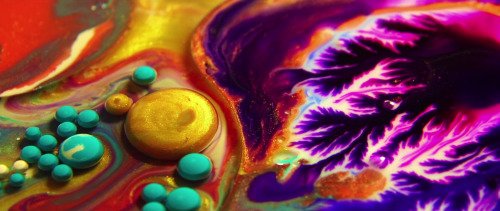
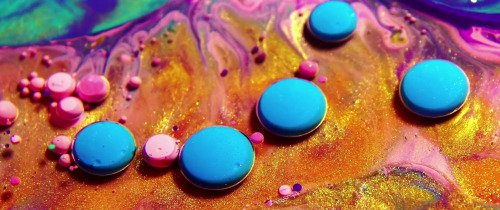
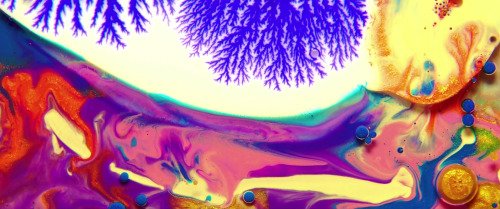
Oil, paint, and soap combine to create a polychrome landscape in Thomas Blanchard’s “Kingdom of Colours” short film. Colorful droplets of paint coated in oil form anti-bubbles that skim along the liquid surface until they burst, dispersing new colors. One of my favorite touches in this video, though, are the branching fingers of color that appear repeatedly (most often in blue-violet). This is an example of a phenomenon known as the Saffman-Taylor instability. It’s a hallmark of a low viscosity fluid pushing into a higher viscosity one–like air into honey. (Image/video credit: T. Blanchard; via Flow Vis)


Why Ice is Slippery
Ice is slippery. This is a fundamental fact we humans have dealt with so often that we rarely take the time to ask why. Other solids aren’t inherently slippery, so what is it that makes ice so? Remarkably, scientists only began to ask this question and propose theories within the past couple hundred years. One common suggestion is that the high pressure of an ice skate on ice locally melts the ice, creating a thin liquid layer a skater glides across. But this does not explain why ice is slippery for shoes or tires, nor why it’s possible to ice skate at more than a few degrees below freezing. Several other effects may be in play, such as frictional heating or the peculiar molecular forces between water molecules. Current research suggests that ice has a thin liquid layer tens or hundreds of nanometers thick that causes its slippery nature. For a great review of the subject, see Robert Rosenberg’s Physics Today article. (Video credit: SciShow)
Paint Spilling Physics
There is a remarkable amount of physics contained in art. In this video, scientists from The Splash Lab explore some of the physics involved in pouring paint atop a rectangular post. The spreading paint transforms its shape repeatedly, and, at the corners of the post, it preserves a tiny history of all the colors poured. Paint sliding down the sides shifts from a thin sheet to a thicker jet that deposits color in waves. For tall posts, the distance the paint falls is long enough for instabilities to set in, producing a paint puddle that’s riddled with curves and waves between each color of paint. It’s a lovely reminder of the complexity inherent even within a simple action. (Video credit: R. Hurd et al.)
Growing Snowflakes
Watching a snowflake grow seems almost magical–the six-sided shape, the symmetry, the way every arm of it grows simultaneously. But it’s science that guides the snowflake, not magic. Snowflakes are ice crystals; their six-sided shape comes from how water molecules fit together. The elaborate structures and branches in a snowflake are the result of the exact temperature and humidity conditions when that part of the snowflake formed. The crystals look symmetric and seem to grow identical arms simultaneously because the temperature and humidity conditions are the same around the tiny forming crystals. And the old adage that no two snowflakes are alike doesn’t hold either. If you can control the conditions well enough, you can grow identical-twin snowflakes! (Video credit: K. Libbrecht)