A cylinder standing upright in a flow creates a complicated system of vortices and recirculation. In the photo above, the flow is left to right. The cylinder itself is somewhat hard to see but is located in the center of the image; we see it from above. The colored streaks of dye show the flow path around the cylinder. In yellow, we see a spiraling vortex that forms just ahead of the cylinder and stretches downstream on either side. Because of its shape, this is called a horseshoe vortex. Its sense of rotation is such that it tends to pick up loose material in front of the cylinder; in other words, it can erode that area. This is often seen around the pilings of bridge supports and must be accounted for in designs. You also see the effects of this horseshoe vortex digging out material at the base of trees after snowfalls in areas with a dominant wind direction, and here’s an example with a snow roller. (Image credit: H. Werlé; via eFluids)
Tag: vortices

How Cycling Position Affects Aerodynamics


New FYFD video! How much does a rider’s position on the bike affect the drag they experience? To find out I teamed up with folks from the University of Colorado at Boulder and at SimScale to explore this topic using high-speed video, flow visualization, and computational fluid dynamics.
Check out the full video below, and if you need some more cycling science before the Tour de France gets rolling, you can find some of my previous cycling-related posts here. (Image and video credit: N. Sharp; CFD simulation – A. Arafat)
ETA: Please note that the video contained in this post was sponsored by SimScale.

Reconnecting
Vortices are a common feature of many flows. Here we see a helical vortex tube spinning in a swirling flow. The vortex itself is visible thanks to air trapped in its low-pressure core. As the vortex spins, two sections of it come together. This results in what’s known as vortex reconnection: the vortex lines break apart and rejoin in a new configuration – as a small independent vortex ring and a shorter section of helical vortex. Events like this are common but usually hard to observe directly. They’ve been previously visualized using vortex knots and have even been sighted in the quantum vortices of superfluid helium. (Image credit: S. Skripkin, source; research credit: S. Alekseenko et al., pdf)

Mosquito Flight


Mosquitoes are unusual fliers. Their wings are long and skinny, and they beat at around 700 strokes a second – incredibly quickly for their size. Examining how they move has uncovered some interesting mechanics. Despite their short stroke length, the mosquito generates a lot of lift on both its upstroke (when the wing is moving backward) and its downstroke (when the wing moves forward). Some features of the mosquito’s flight are highlighted in the images above. In the animation, blue indicates areas of low pressure and red indicates high pressure.
Like most flapping fliers, the mosquito generates a leading-edge vortex during its downstroke (and its upstroke). This vortex helps concentrate low pressure on the upward-facing wing surface, thereby creating lift. One of the things that makes the mosquito unique, however, is that it also creates trailing-edge vortices on both half-strokes. To do this, the mosquito rotates its wings precisely to catch the wake of its previous half-stroke. The flow gets trapped near the trailing edge of the wing and forms a vortex and low-pressure region. Like the leading-edge vortex, this low-pressure area on the upward-facing wing surface creates lift. For more secrets of mosquito flight, check out this video from Science or the original paper. (Image credit: R. Bomphrey et al., source)

Perijove
The Juno spacecraft continues to send back incredible photos of Jupiter’s atmosphere. This video animates images from the sixth close pass of Jupiter to give you a sense of what Juno sees as it swoops by our system’s largest planet. The trajectory passes from the north pole to the south, showing Jupiter’s whitish zones, dark belts, and massive storms. Up close Jupiter looks like an Impressionist painting, all vortices and shear instabilities. The large white spots you see are enormous counterclockwise rotating vortices known as anticyclones – many of them larger than our entire planet. (Video credit: NASA / SwRI / MSSS / G. Eichstädt / S. Doran)

Breaking Down Vortices
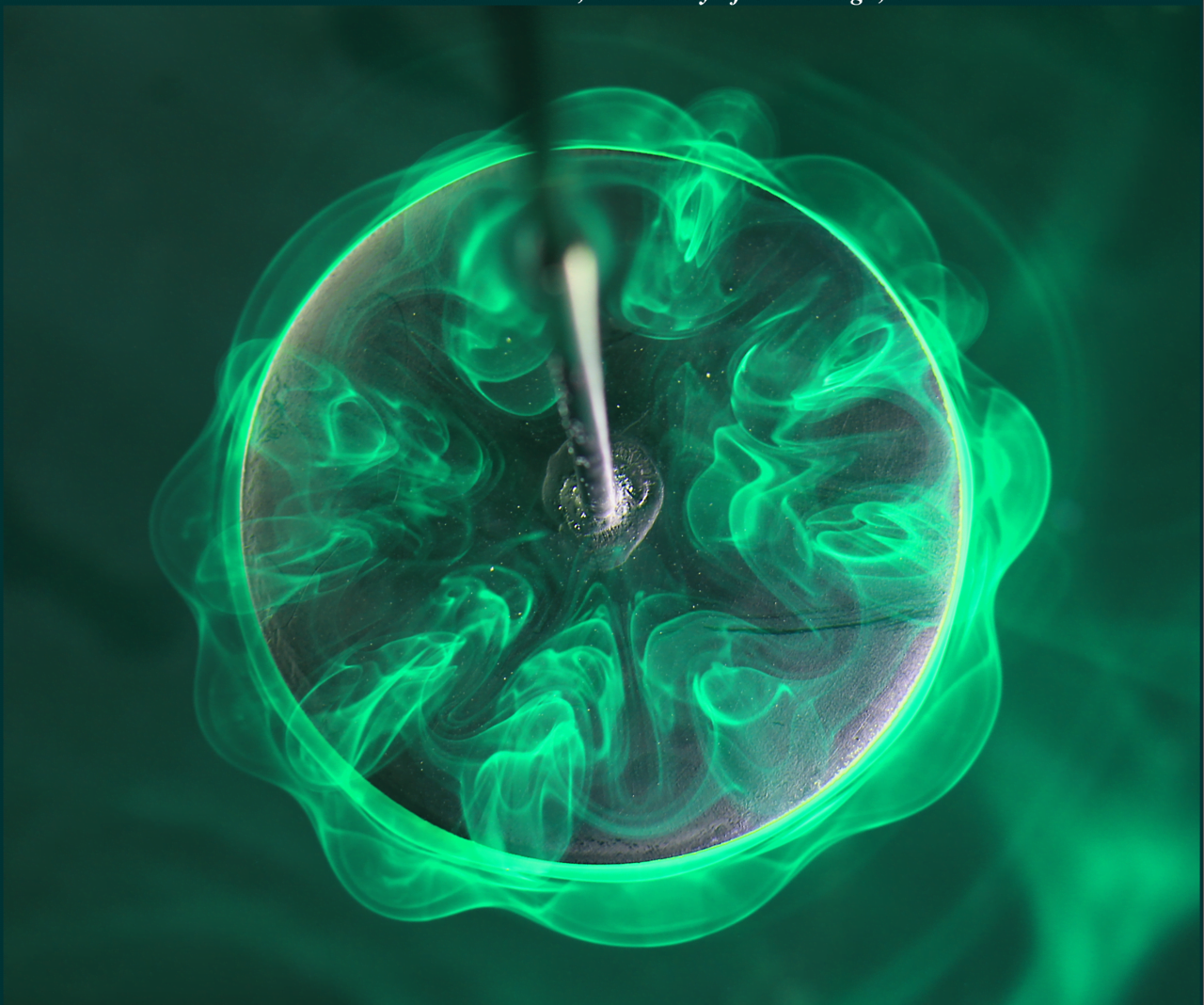
Vortex rings are ubiquitous in nature, showing up in droplet impacts, in propulsion, and even in volcanic eruptions. Understanding the interaction and breakdown of multiple vortices with one another is therefore key. The image above shows a circular disk that’s being oscillated up and down (in and out of the page). As the disk moves and changes direction, it generates vortices that interact with one another. Here some of those interactions are visualized with fluorescent dye. The overlapping vortices form complex and beautiful shapes on their way to breakdown. (Image credit: J. Deng et al., poster, paper)
Vortex Impact
When a vortex ring impacts a solid wall (or a mirrored vortex ring), it expands and quickly breaks up. The animations above show something a little different: what happens when a vortex ring hits a water-air interface. As seen in the side view (top image), the vortex starts to expand, but its shear at the interface generates a stream of smaller vortices that disrupt the larger vortex. (They even look like a little string of Kelvin-Helmholtz vortices!) When viewed from above (bottom image), the vortex ring impact and breakdown look even more complicated. Mushroom-like structures get spat out the sides as those secondary vortices form, and the entire structure quickly breaks up into utter turbulence. There’s some remarkable visual similarities between this situation and some we’ve seen before, like a sphere meeting a wall and drop hitting a pool. (Image credit: A. Benusiglio et al., source)

Jupiter’s Little Red Spot
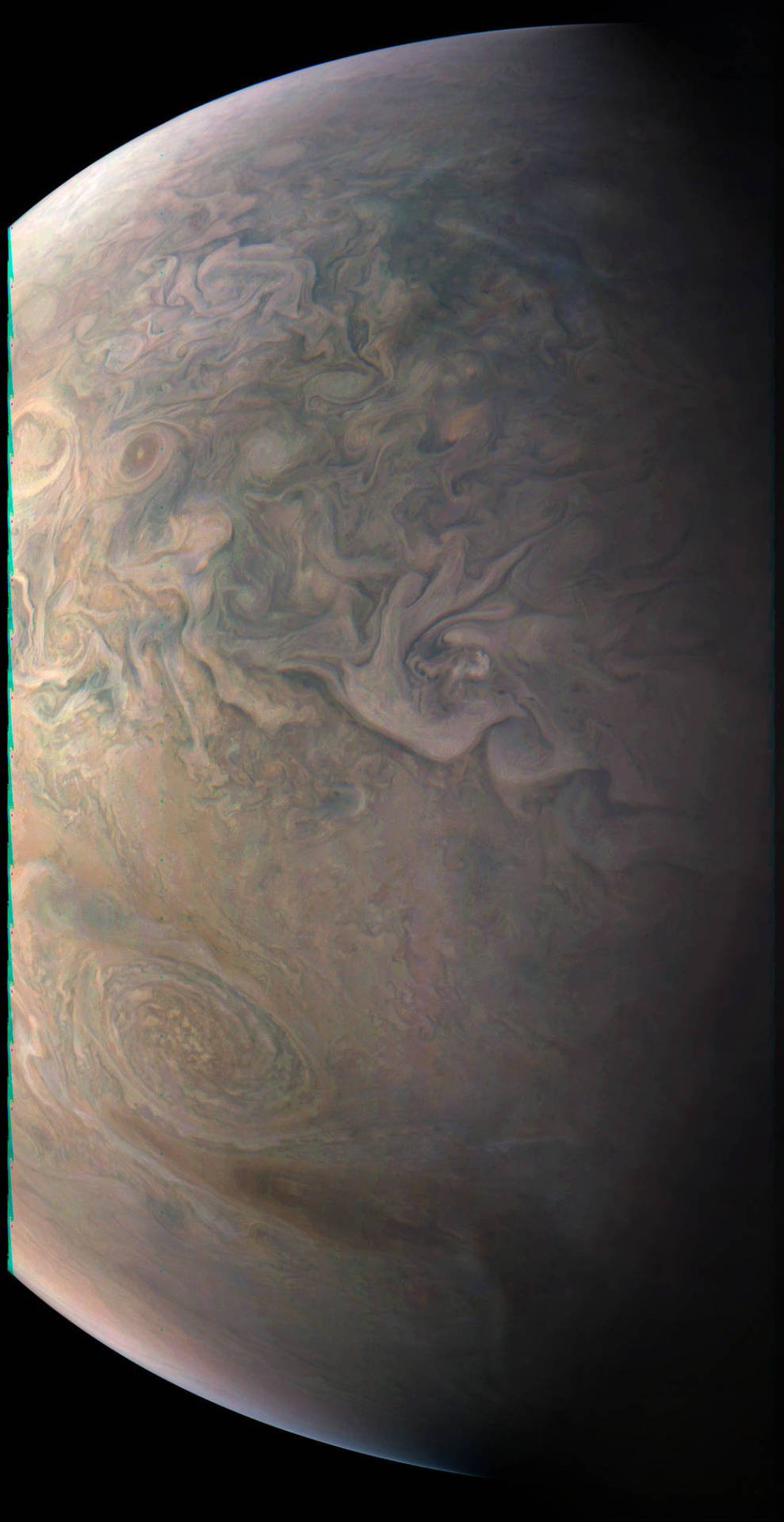
The Juno mission has been revealing angles of Jupiter we’ve never seen before. This photo shows Jupiter’s northern temperate latitudes and NN-LRS-1, a.k.a. the Little Red Spot (lower left), the third largest anticyclone on Jupiter. The Little Red Spot is a storm roughly the size of the Earth and was first observed in 1993. As an anticyclone, it has large-scale rotation around a core of high pressure and rotates in a clockwise direction since it is in the northern hemisphere. Jupiter’s anticyclones seem to be powered by merging with other storms; in 1998, the Little Red Spot merged with three other storms that had existed for decades. (Image credit: NASA/JPL-Caltech/SwRI/MSSS/Gerald Eichstaedt/John Rogers; via Bad Astronomy)

Jovian Poles


NASA’s Juno mission has been revealing a side of Jupiter we’ve never seen before. We all recognize the familiar stripes of the planet’s cloud bands, but its poles are entirely different. Unlike Saturn with its hexagonal polar vortex, Jupiter’s poles are a swirling tapestry of turbulent vortices – full of features that citizen scientists are helping to reveal. All of the images in this post were created by citizen scientists helping to process raw images from Juno, and you can contribute, too! The Juno mission solicits input from the public on where and what should be imaged, in addition to providing raw images individuals can process and repost. Check it out at the JunoCam website and become part of the science! (Image credits: All images – NASA/SwRI/MSSS + R. Tkachenko, Orion76; A. Mai)

Starfish Vortices
Starfish larvae, like other microorganisms, use tiny hair-like cilia to move the fluid around them. By beating these cilia in opposite directions on different parts of their bodies, the larvae create vortices, as seen in the flow visualization above. The starfish larvae don’t use these vortices for swimming – to swim, you’d want to push all the fluid in the same direction. Instead the vortices help the larvae feed. The more vortices they create, the more it stirs the fluid around them and draws in algae from far away. The larvae actually switch gears regularly, using few vortices when they want to swim and more when they want to eat. Check out the full video below to see the full explanation and more beautiful footage. (Image/video credit: W. Gilpin et al.)