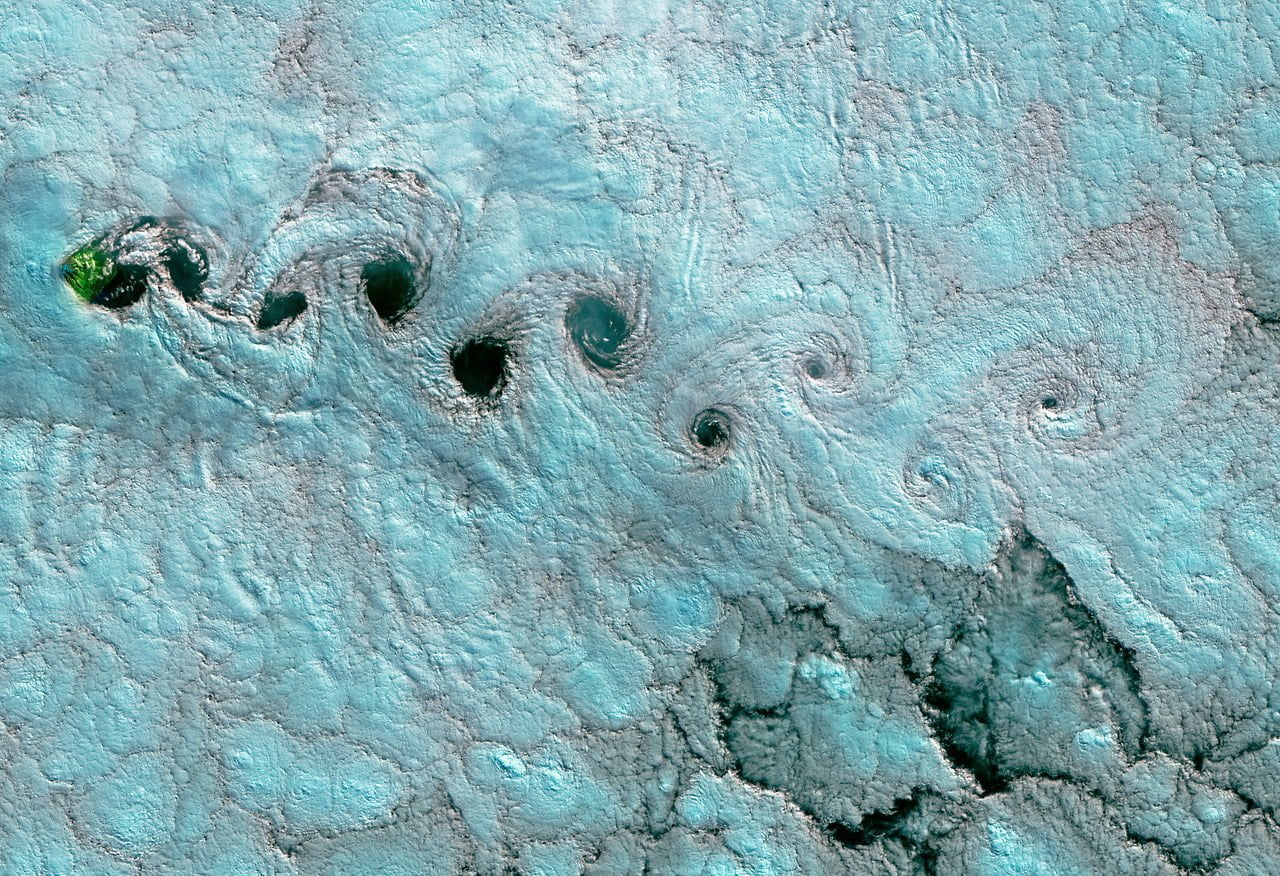
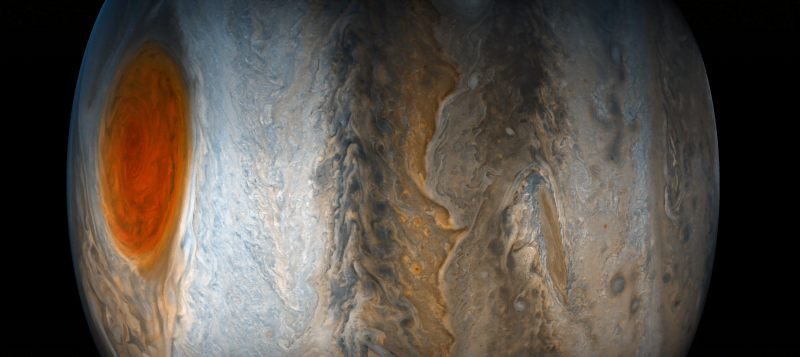
Satellite imagery often reveals patterns we might struggle to see from the ground. Here Gaudalupe Island off the western coast of Mexico perturbs the atmosphere into a series of vortices. Air flowing across the open ocean gets deflected around and over the rocky, volcanic island, creating a line of vortices that get shed off one side of the island, then the other. The pattern is commonly referred to as a von Karman vortex street, and it appears in the wakes of spheres and cylinders, as well as islands. The two rainbow-like bands framing the vortex street are an optical phenomenon known as a glory, which NASA Earth Observatory explains here. (Image credit: NASA Earth Observatory)
Tag: vortices

Catching Particles with Sound
Acoustic levitation traps particles using specially shaped sound waves, but, thus far, it’s only been useful for small particles. One common method of trapping forms the sound waves into a vortex-like shape. Particles in one of these acoustic vortices will spin rapidly, become unstable, and get ejected from the vortex if they’re larger than about half the wavelength of sound used. Recently, though, researchers have stabilized much larger particles by trapping them between two acoustic vortices with opposite spins. The researchers alternate between the two vortices so that each can counteract the other in order to hold the particle in the center of the trap. The new technique has enabled them to trap particles up to 4 times larger than those in previous experiments. (Image and research credit: A. Marzo et al., source; via Science)

Jovian Polar Vortices


Jupiter’s atmosphere is full of enduring mysteries, and its poles are no exception. Instruments aboard the Juno spacecraft have gotten a better look at Jupiter’s North and South poles than any previous mission, and what they’ve found raises even more questions. Both of Jupiter’s poles feature a central cyclone ringed by other, similarly-sized cyclones. The North pole has eight outer cyclones (top image), while the South pole has five (bottom image), shown above in infrared. Despite being close enough that their spiral arms intersect, the cyclones don’t seem to be merging into something like Saturn’s polar hexagon. For now, scientists don’t know how this arrangement formed or why it persists, but the longer Juno can study the vortices up close, the more we’ll learn. (Image credit: NASA/JPL-Caltech/SwRI/ASI/INAF/JIRAM; research credit: A. Adriani et al.; submitted by Kam-Yung Soh)
“Moving Creates Vortices and Vortices Create Movement”
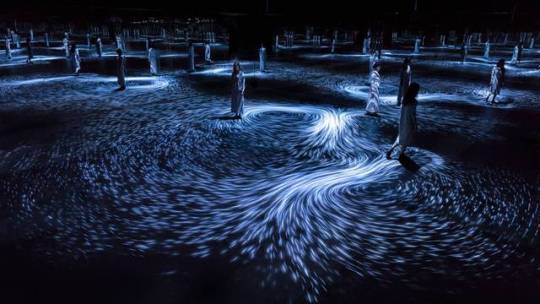
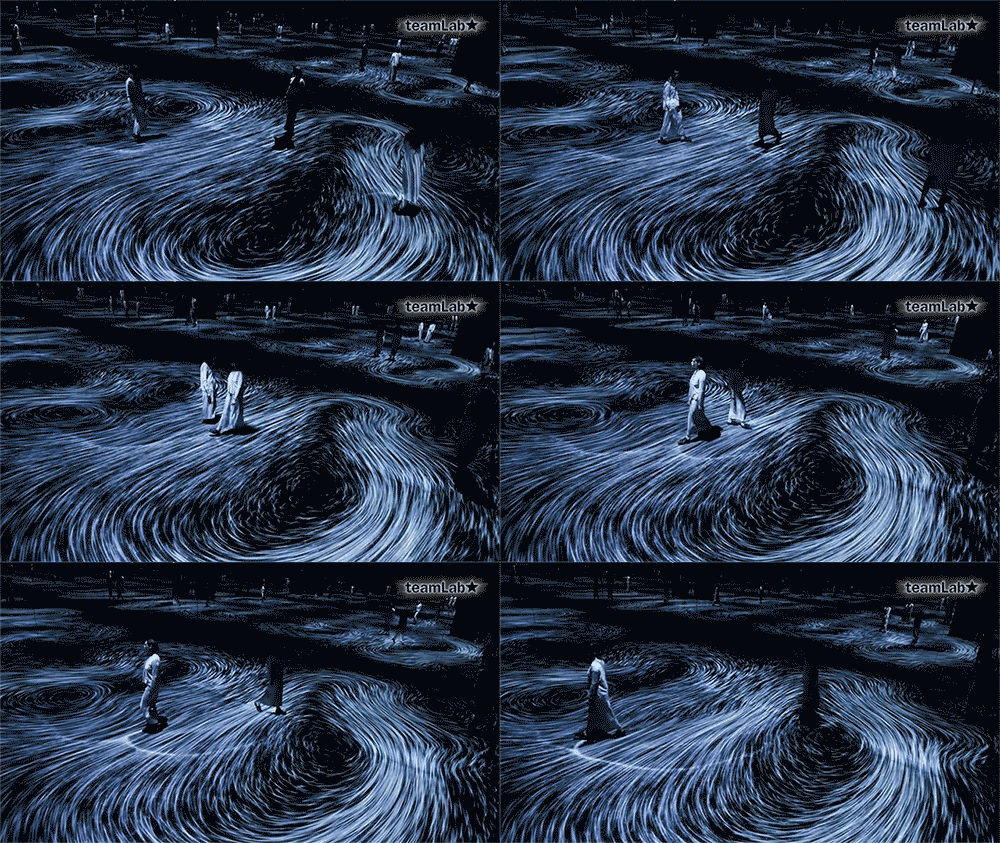

A new interactive installation by the Japanese art collective teamLab uses the movement of visitors to drive vortex motion. Entitled “Moving Creates Vortices and Vortices Create Movement,” the installation uses projectors in a mirror room to create the sensation of an infinite, indoor ocean that’s constantly churned by the paths visitors take. In the absence of motion, the room slowly fades to darkness. The installation is currently in the National Gallery of Victoria in Melbourne, Australia, and will be open until April 15th, 2018. (Image credit: teamLab; via Colossal; submitted by jshoer)
P.S. – Winter Olympic coverage will start on Monday, February 12th! – Nicole

Resisting Coalescence


When a droplet falls on a pool, we expect it to coalesce. There are exceptions, like bouncing droplets, but in general a droplet only sticks around for a split second before being engulfed. And yet, from morning coffee (top image) to walks in the woods, we frequently see millimeter-sized droplets sticking around for far longer than it seems like they should. New research offers a clue as to why: it’s thanks to a temperature difference.
When there’s an appreciable temperature difference between the drop and the pool, it causes rotating convective vortices (bottom image) in both the drop and the pool. When the temperature difference is large, the vortices are strong enough that their motion recirculates air inside the tiny gap between the drop and the pool. This supports the weight of the drop and keeps the two liquids separate. But the convection also redistributes heat, and eventually the drop and pool become similar enough in temperature that the circulation dies out, the air gap drains, and the two coalesce. (Image and research credit: M. Geri et al.; via MIT News; submitted by Antony B.)

Symmetric Wakes
Nature is full of remarkable patterns and moments of symmetry. This image shows the wake behind two rotating cylinders. Half of the cylinders are visible at the far left. The flow moves left to right. The cylinders are rotating at the same rate but in opposite directions, clockwise for the cylinder on top and counter-clockwise for the bottom one. At this speed relative to the freestream, there is a beautiful symmetry to the vortices in the wake, but the researchers found that even a slight deviation from this condition quickly destroyed the pattern. The flow is visualized here by introducing tiny hydrogen bubbles via electrolysis. The bubbles are small enough that their buoyancy has no appreciable effect. (Image credit: S. Kumar and B. Gonzalez)

Island Wakes
One of my favorite aspects of fluid dynamics is watching how patterns repeat at all kinds of scales. The cotton-candy-colored image above is a false-color satellite image of the island Tristan da Cunha (left), a volcanic island group in the South Atlantic. The prevailing winds, oriented roughly left to right in the image, flow over the rocky island and part in a series of swirls that alternate in their direction of rotation: clockwise for the upper set and counter-clockwise for the lower ones. This pattern is called a von Karman vortex street, named for an aerodynamicist who studied the mechanism. Von Karman vortices are frequently observed in satellite images of remote islands, but they are also common behind spherical and cylindrical objects of all sizes. Sometimes they even show up in sci-fi! (Image credit: NASA Earth Observatory; submitted by Steve G.)

Jupiter On Display
The rich detail of Jupiter’s atmosphere is on full display in this enhanced-color image from the Juno spacecraft. (Full resolution version here – trust me, you want to click that link.) To the north, on the left side of the image, Jupiter’s Great Red Spot swirls. To the center and right, the cloud bands of Jupiter’s southern region are coming into view. The color enhancements really highlight eddies on the edge of these bands. These are examples of Kelvin-Helmholtz instabilities caused by shear between cloud bands moving at different speeds. Within the bands, smaller vortices spin. Some of these are anti-cyclones, high-pressure storm systems found all over the planet. Jupiter’s atmosphere still holds many mysteries for scientists, but I love how every gorgeous image Juno sends back shows fluid physics written larger than life across our solar system’s biggest planet. (Image credit: NASA/JPL-Caltech/SwRI/MSSS/G. Eichstädt /S. Doran; via Gizmodo)

Review: “ABCs From Space”


For me, one of the most fun aspects of studying science is seeking out examples of it in the world around us. Adam Voiland – who writes for NASA Earth Observatory, one of FYFD’s favorite sources for excellent fluids in action – takes this a step further with his children’s book “ABCs From Space: A Discovered Alphabet”. Voiland has sought out satellite imagery from around the world to illustrate all twenty-six letters, creating a lovely book for budding scientists of all sorts.
Each letter has its own full-page image with no added text, like the G and H shown above. Younger children will have fun identifying and tracing out each letter. The back of the book provides more detail for older kids and adults, including brief descriptions of where and what each image shows, a map of all image locations, and some FAQs about satellite imagery and the geology, meteorology, and earth science on display. There are enough specifics to satisfy casual interest, but I suspect that science-inclined adults will find the book a fun springboard for more in-depth discussions with curious kids.
Fluid dynamics itself makes a solid showing in the book. Several letters are formed by vortices (like G above) and various types of clouds, including the ship track clouds (like H) that form when water condenses on aerosols released by ship exhaust. There are also meandering rivers, creeping glaciers, and erosion features among the letters.
I’m often asked about resources for teaching kids about fluid dynamics, and Voiland’s book is a great option for introducing that subject, as well as many other fields of science. (Image credits: A. Voiland/Simon & Schuster)
Disclosure: I received a review copy of this book but was not otherwise compensated by the author or publisher. All opinions are my own. Additionally, this post contains affiliate links. Purchases made using these links do not cost you anything extra but may provide FYFD with a commission. Thanks!

Songs in Soap
There are many beautiful ways to visualize sound and music – Chris Stanford’s fantastic “Cymatics” music video comes to mind – but this is one I haven’t seen. This visualization uses a soap film on the end of an open tube with music playing from the other end. You can see the set-up here. The result is a fascinating interplay of acoustics, fluid dynamics, and optics. As sound travels through the tube, certain frequencies resonant, vibrating the soap film with a standing wave pattern (3:20). At the same time, interference between light waves reflecting off the front and back of the soap film create vibrant colors that show the film’s thickness and flow.
When the frequency and amplitude are just right, the sound excites counter-rotating vortex pairs in the film (0:05), mixing areas of different thicknesses. With just a single note, the vortex pairs appear and disappear, but with the music, their disappearance comes from the changing tones. Watching the patterns shift as the film drains and the black areas grow is pretty fascinating, but one of the coolest behaviors is how the acoustic interactions are actually able to replenish the draining film (2:15). Because the tube was dipped in soap solution, some fluid is still inside the tube, lining the walls. With the right acoustic forcing, that fresh fluid actually gets driven into the soap film, thickening it.
There are several more videos with different songs here – “Carmen Bizet” is particularly neat – as well as a short article summarizing the relevant physics for those who are interested. (Video and research credit: C. Gaulon et al.; more videos here)