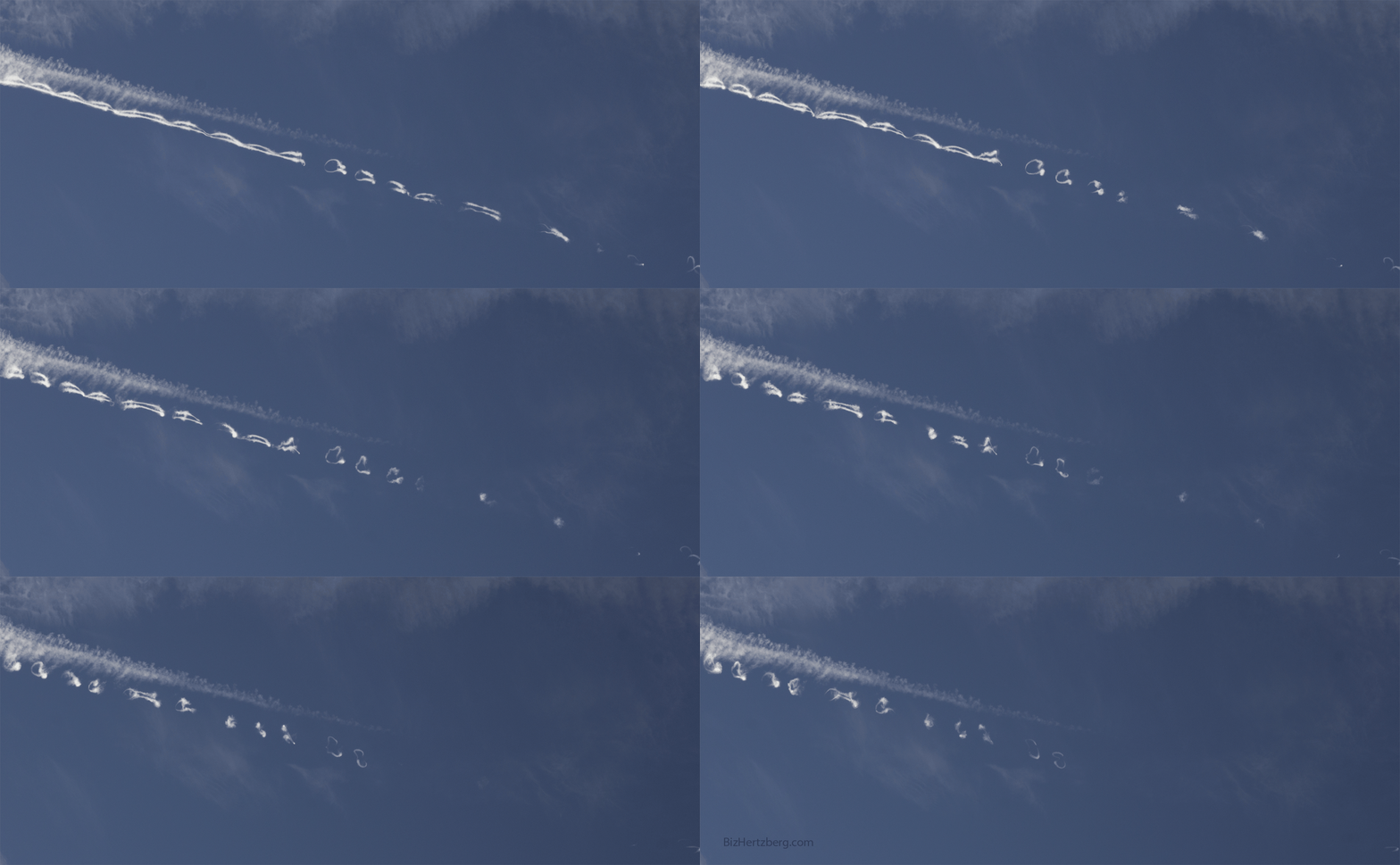
Watching airplane contrails overhead, you may have noticed them transform into a daisy chain of distorted rings. This is an effect known as the Crow instability. The contrails themselves are the airplane’s wingtip vortices, made visible by water vapor condensed out of the engine exhaust. These two initially parallel vortex lines spin in opposite directions. A slight crosswind can disturb the initially straight lines, causing them to become wavy. This waviness increases over time until the vortex lines almost touch. Then the vortices pinch off and reconnect into a line of vortex rings that slowly dissipate. Be sure to check out the full-resolution version of this animation for maximum effect. (Image credit: J. Hertzberg, source)
Tag: vortices

Jovian Poles
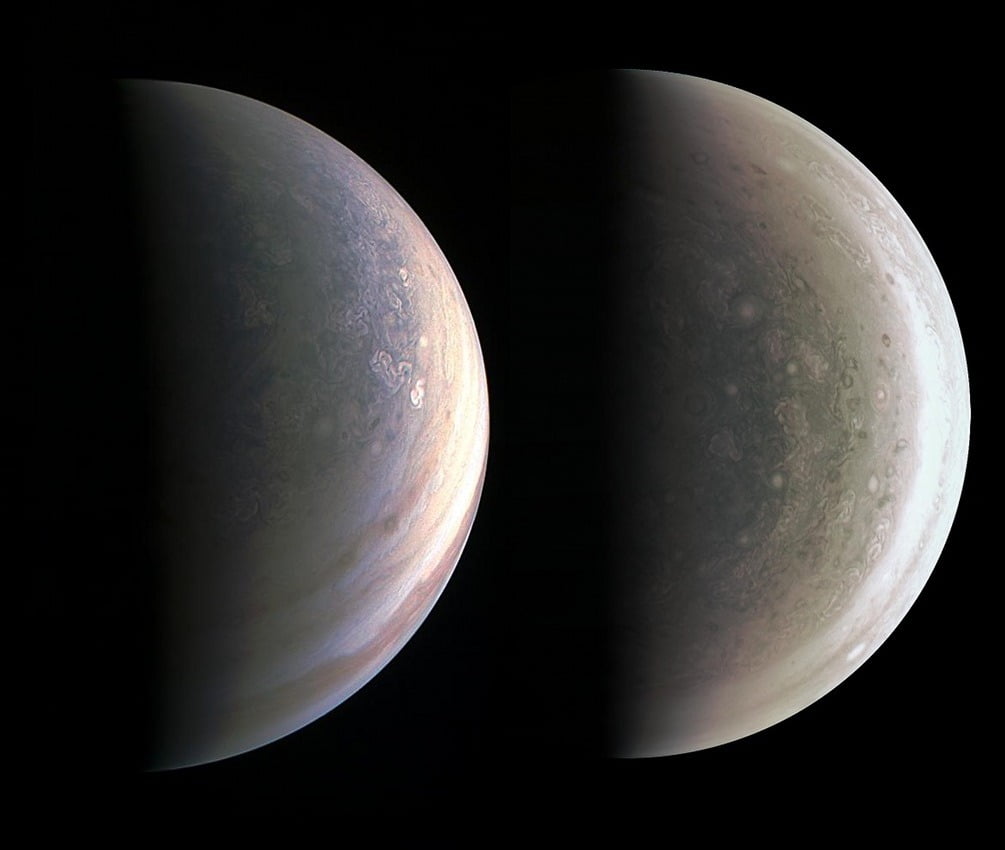
We’re used to viewing Jupiter from its equator, where bands of light and dark clouds dominate the picture. From its poles, Jupiter looks very different, as these recent images from Juno show. Jupiter’s north pole is shown on the left and its south pole on the right. Both are awash in vortices. There’s another great black-and-white image of the south pole here, where the vortices really stand out. Jupiter’s atmosphere contains both cyclones, which rotate counterclockwise in the northern hemisphere and clockwise in the southern hemisphere, and anticyclones, which behave in the reverse. Unlike in Earth’s atmosphere, anticyclones dominate on Jupiter, especially among storms more than 2000 km across. (Image credit: NASA/JPL/Juno Mission; via APOD)
P.S. – Tomorrow night is the Ig Nobel Prize Ceremony, and I’ll be giving one of their 24/7 lectures. If you’d like to tune in and hear me describe fluid dynamics in 24 seconds + 7 words, there will be a webcast here.

“Catacomb of Veils”


Burning Man’s “Catacomb of Veils”, the largest sculpture burned in the 2016 event, produced a series of smoke tornadoes as it blazed. Like dust devils or fire tornadoes, these vortices are driven by hot, buoyant air rising – in this case, from the fire. As the surrounding air moves in toward the fire, any rotational motion, or vorticity, in the air is intensified due to conservation of angular momentum. That concentrates it into a vortex, which becomes visible when it picks up smoke. Simultaneously, the wind was blowing in a consistent direction, sending any new vortices generated marching downstream. You can watch even more vortices and some slow-motion footage of the burning in the full video by Mark Day. (Image credit: M. Day, source; submitted by Larry B)

Soap Film Wakes
Soap films can create remarkable flow visualizations when illuminated with monochromatic (single color) light. Each of the photos above shows a flow moving from left to right with a small object near the left creating an obstruction. In the top two images, the objects are cylinders; in the lower one it’s a flat plate tilted at 45 degrees. All of the objects shed vortices as the flow moves past. These vortices alternate in direction – the first spins clockwise, the next counter-clockwise, then clockwise again and so on. This pattern is known as a von Karman vortex street and can even show up in the atmosphere! (Image credit: D. Araya et al.)

Vortices in the Wind
Heard Island, a remote patch of rock in the southwestern Indian Ocean, peeks its head above the marine cloud layer. The volcanic island disrupts the atmosphere enough to generate a von Karman vortex street, a line of alternating vortices shedding from either side of the island. Usually these vortices would march in a straight line downstream from their source. But here strong winds from the south have blown a bunch of its vortices northward, creating an unusual kink in the island’s wake. (Image credit: J. Schmaltz/LANCE EOSDIS Rapid Response; via NASA Earth Observatory)

Silent Flying
As nocturnal hunters, owls are aerodynamically optimized for stealthy flying. This clip from BBC Earth demonstrates just how quiet a barn owl is in flight compared to a pigeon or a peregrine falcon. The owl’s large wingspan relative to its body size gives it enough lift that it does not have to flap often, allowing it to glide instead, but this is far from its only stealthy adaptation. Owl feathers feature a serrated leading edge that helps break flow over the wing into smaller, quieter vortices. Their fringe-like trailing edge breaks flow up even further and acts to damp noise from airflow. The downy feathers of the owl’s body also help muffle any noise from the bird’s movement, allowing the barn owl to fly almost silently. (Video credit: BBC Earth; via Gizmodo)
The Kelvin-Helmholtz Instability
The Kelvin-Helmholtz instability is a pattern frequently found in nature. It has a distinctive shape, like a series of breaking ocean waves that curl over on themselves to create a string of vortices. The instability shows up when there is a velocity difference between two fluid layers. The unequal shear between the two layers magnifies any disturbance to their interface, which manifests in the fractal, overturning whorls seen in the numerical simulation above. You can find the Kelvin-Helmholtz instability in the lab, in the sky, in the ocean, on Jupiter and Mars–even on the sun! For more information on the methods used to create the simulation above, check out the full paper. (Video and research credit: K. Schaal et al.)
Soap Film Visualization
Soap films provide a simple and convenient method for flow visualization. Here an allen wrench swept upward through a soap film leaves a distinctive wake. This trail of counter-rotating vortices is known as a von Karman vortex street. Their spacing depends on the wrench’s size and speed. Although the von Karman vortex street is usually associated with the wake of cylinders, it shows up often in nature as well, especially in the clouds trailing rocky islands. (Photo credit: P. Nathan)

Rowing Water Striders

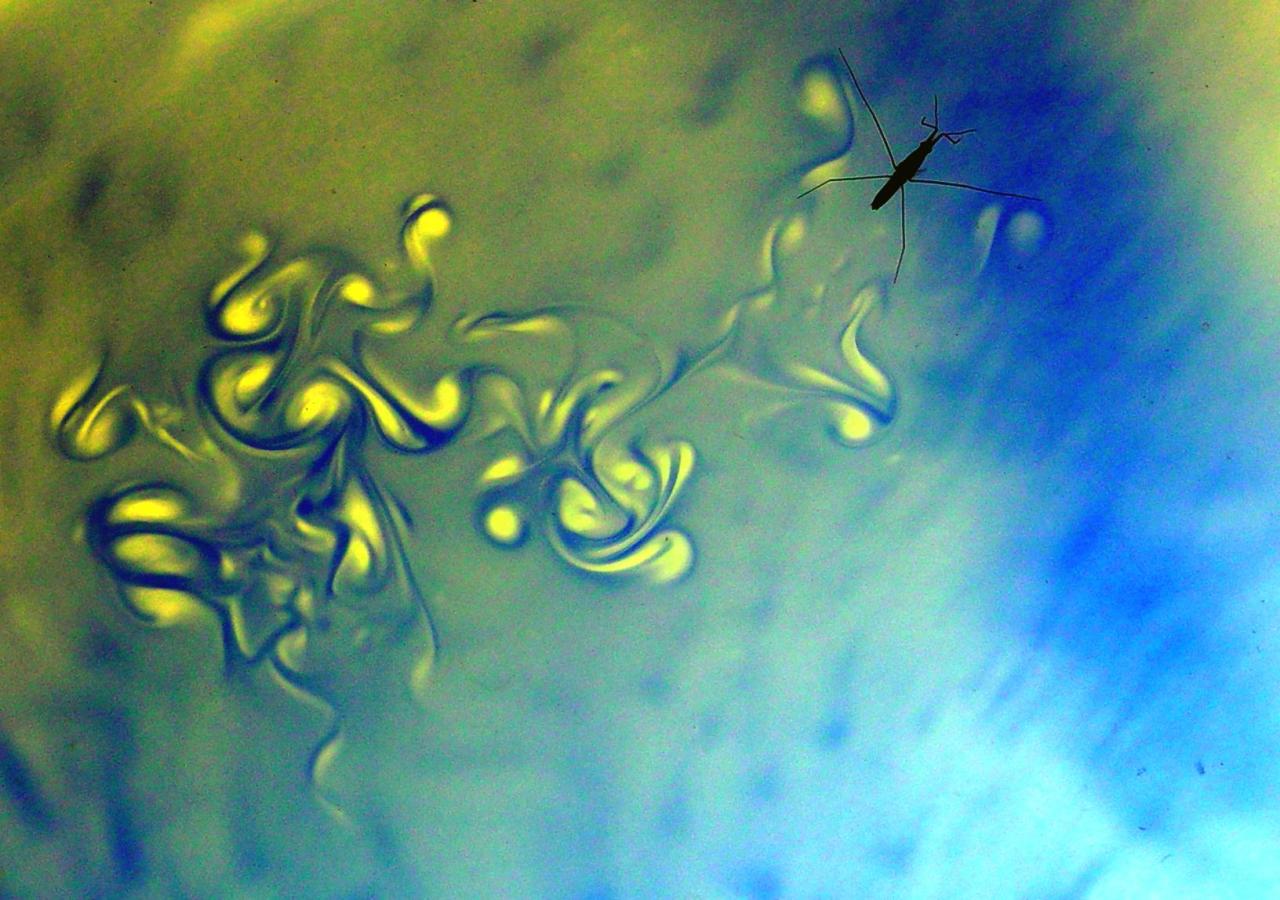
Water strider insects are light enough that their weight can be supported by surface tension. For some time, they were thought to propel themselves by using their long middle legs to generate capillary waves–ripples– that pushed them forward, but juvenile water striders are too small for this technique to work. Instead researchers found that water striders move by using their middle legs like oars. The leg motion creates vortices about 4 mm below the water surface, and this water moving backward propels the insect forward. In the photos above, the scientists visualized the flow by sprinkling thymol blue on the water and letting the striders move freely. You can learn more about the work here or in this Science Friday episode. (Photo credits: J. Bush et al.)

Wingtip Vortices


Wingtip vortices are the result of high-pressure air from beneath a wing sneaking around the end of the wing to the low-pressure area on top. They trail for long distances behind aircraft, and are, most of the time, an invisible hazard for other aircraft. If you’ve ever sat in a line of airplanes waiting to take off and wondered why there is so much time between subsequent take-offs, wingtip vortices are the answer. The larger a plane, the stronger its vortices are and the greater their effect on a smaller craft. Much of the time between planes taking off (or landing) is to allow the vortices to dissipate so that subsequent aircraft don’t encounter the wake turbulence of their predecessor. Crossing the wake of another plane can cause an unexpected roll that pilots may not be able to safely correct, a factor that’s contributed to major crashes in the past. (Image credits: flugsnug, source video; submitted by entropy-perturbation)