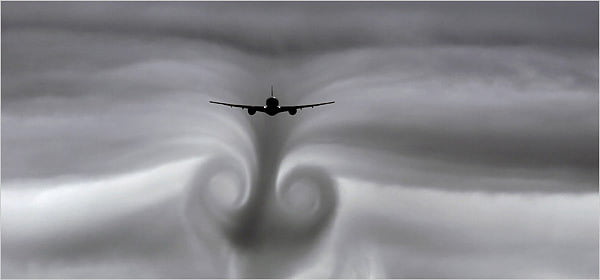
The wingtip vortices in the wake of a commercial airliner distort the clouds as the plane descends. Wingtip vortices form as a result of high pressure air from the underside of the wing accelerating around the wingtips to reach the low pressure on top of the wing. They can be hazardous to other (lighter) aircraft. They also contribute to downwash that decreases the effective lift of a wing. Geese use the same mechanism to their advantage when flying in a V-formation, and some snakes use it to glide.
Tag: vortices

Island Vortex Street
The von Karman vortex street is a series of vortices shed periodically in the wake of a bluff body. Although they are commonly observed in the lab behind cylinders, they also occur in nature, as seen here in the wake of Juan Fernandez Islands near Chile. The strong equatorward wind creates steady flow over the mountainous island, creating a pattern in the clouds that stretches 10,000 times longer than vortex streets created in a laboratory. (via freshphotons)

Leapfrogging Vortices
This numerical simulation shows two pairs of vortices interacting in a leap-frogging motion. Another version shows the same situation but with a small perturbation in the rotational alignment that causes even more interesting interactions. Both simulations are of potential flow–an idealized flow without viscosity where velocity can be described as the gradient of a scalar function. The mathematics governing potential flow are notably easier than the full Navier-Stokes equations that govern fluid mechanics. (submitted by jessecaps)
Computational Vortex Rings
Computational fluid dynamics (CFD) sometimes gets a bad rep as “colorful fluid dynamics”, but as computers get faster and faster, more complicated and physically accurate simulations are possible. Shown here are simulations of vortex rings and wingtip vortices in stunningly gorgeous detail. Understanding the evolution of these vortices from a fundamental level helps fluid mechanicians design better methods of controlling them. As mentioned in the video, wingtip vortices are a particularly hazardous everyday example; the time it takes for one plane’s wingtip vortices to disperse determines how quickly the next airplane can take-off or land on that same runway. Being able to break down these vortices faster would allow more frequent use of existing facilities.

Discovery Wingtip Vortices
Wingtip vortices mark the path of Discovery as she makes her final landing. Though not always visible, these vortices are generated by any lifting body planform and can be a major source of induced drag on the craft. Here the vortices are visible because the low pressure in the core of the vortex caused a local temperature drop below the dew point, thus causing condensation. Such vortices persist for significant lengths of time in the wake of aircraft; they are a major source of wake turbulence, which limits how frequently aircraft can take-off or land on a single runway. (Photo by Jen Scheer)

Smokestack Plumes
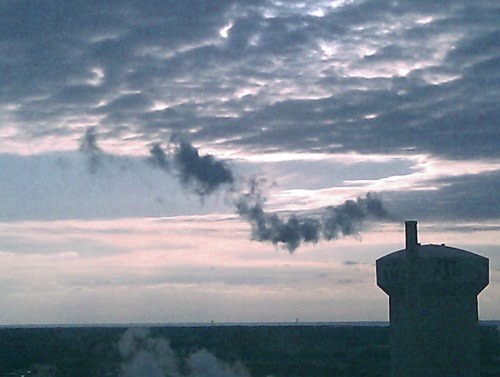
On a cold and windy day, the plume from a smokestack sometimes sinks downstream of the stack instead of immediately rising (Figure 1). This isn’t an effect of temperature–after all, the exhaust should be warm compared to the ambient, which would make it rise. It’s actually caused by vorticity.

Figure 2: Simple geometry (side view) In Figure 2, we see a simplified geometry. The wind is blowing from right to left, and its velocity varies with height due to the atmospheric boundary layer. Mathematically, vorticity is the curl of the velocity vector, and because we have a velocity gradient, there is positive (counterclockwise) vorticity generated.

Figure 3: Vortex lines (top view) According to Helmholtz, we can imagine this vorticity as a bunch of infinite vortex lines convecting toward the smokestack, shown in Figure 3. Those vortex lines pile up against the windward side of the smokestack–Helmholtz says that vortex lines can’t end in a fluid–and get stretched out in the wake of the stack. If we could stand upstream of the smokestack and look at the caught vortex line, we would see a downward velocity immediately behind the smokestack and an upward velocity to either side of the stack. It’s this downward velocity that pulls the smokestack’s plume downward.

Figure 4: Vortex wrapped around stack Now Helmholtz’s theories actually apply to inviscid flows and the real world has viscosity in it–slight though its effects might be–and that’s why this effect will fade. The vortex lines can’t sit against the smokestack forever; viscosity dissipates them.

Wake of a Rising Sphere
This flow visualization shows the wake left by a freely rising sphere. Observations of rising and falling spheres date at least back to Newton, who observed that the inflated hog bladders he used “did not always fall straight down, but sometimes flew about and oscillated to and fro while falling”. That vibration is caused by the vortices seen here in the wake. There are actually four vortices shed per oscillation cycle–two primary vortices (marked P) and two secondary vortices (marked S). #

Butterfly Soap Spiral
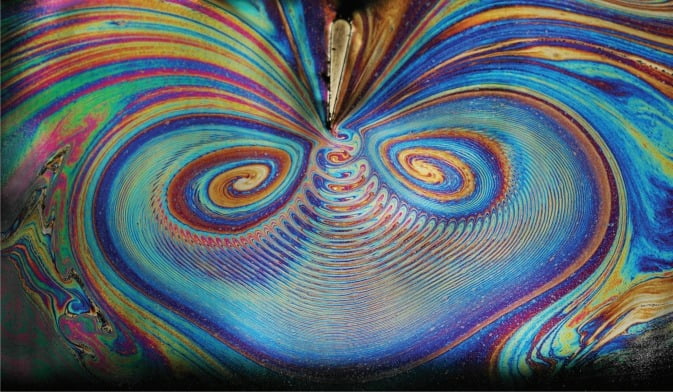
A stationary soap film disturbed by a flapping foil (seen in the top center) creates a butterfly-like double spiral roll. Two vortices form at the tip of the foil each time it changes direction; look carefully and you can see those tiny vortices all the way through the spirals. (From the 2010 Gallery of Fluid Motion; pdf)

Vortex Street
A flow visualization behind a cylinder shows the formation of a von Karman vortex street. The frequency of vortex shedding in the wake is directly related to the speed of the airflow–the higher the velocity, the faster vortices will shed from the cylinder. This relationship is expressed in the Strouhal number, which remains constant for any cylinder. (via freshphotons)

Tubercles and Turbines
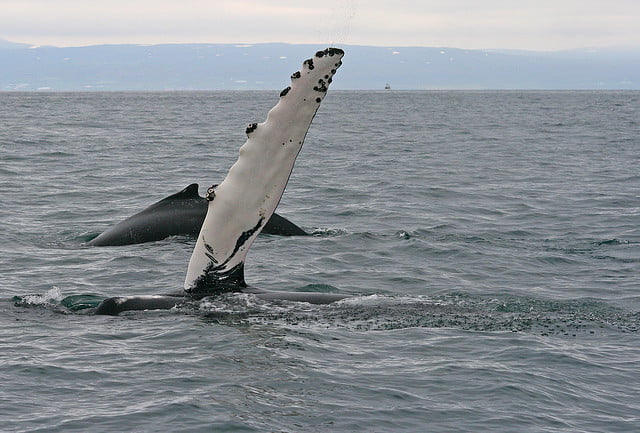
The flippers of humpback whales include bumps–called tubercles–on their leading edges. The tubercles create vortices that prevent the boundary layer from separating, which causes stall and a loss of lift. New research shows that adding similar bumps to the leading edge of tidal turbine blades results in greater energy production at low flow speeds compared to conventional designs. See Scientific American for more. #