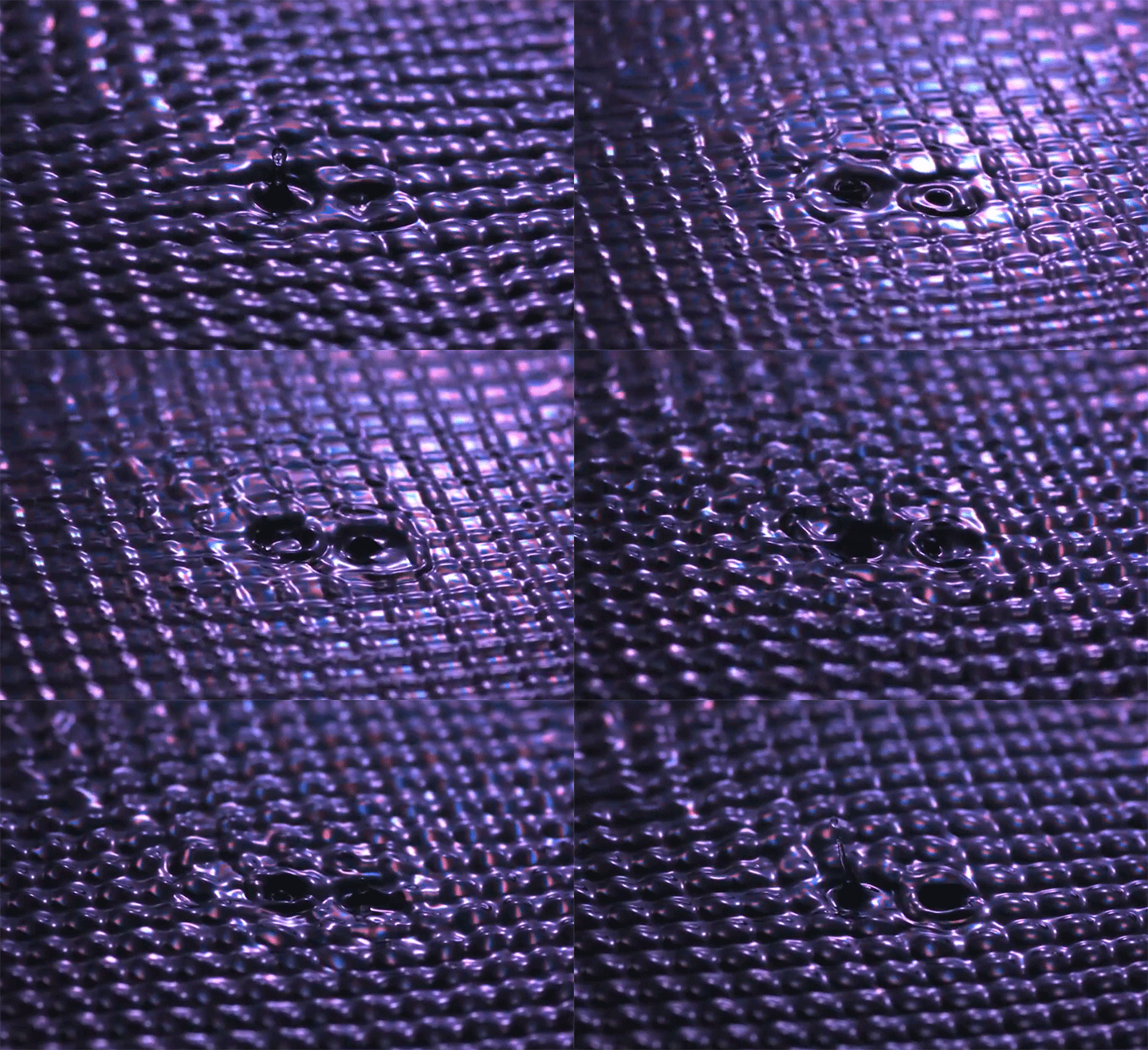
Vibration is one method for breaking a drop into smaller droplets, a process known as atomization. Here, researchers simulate this break-up process for a drop in microgravity. Waves crisscrossing the surface create localized craters and jets, making the drop resemble the Greek mythological figure of Medusa. With enough vibrational amplitude, the jets stretch to point of breaking, releasing daughter droplets. (Image and research credit: D. Panda et al.)
Tag: vibration

Superradiance in Fluids
A group of excited atoms can collectively emit more photons than they could individually in a phenomenon known as superradiance. Now researchers have shown that vibrating fluids can produce superradiance as well.

Two different wave fields used in the experiment, each with a different distance between the circular cavities. Similar to other hydrodynamic quantum analogs, the researchers vertically vibrated a pool of liquid at a frequency that produced Faraday waves. Beneath the pool, they placed two circular wells, varying the distance between them to observe how their wave fields interacted. With a large enough vibration, the two circular wells emitted droplets (top image), and the number of droplets they produced was higher than expected for two independent wells, indicating superradiance. The results suggest that it may be possible to build even more hydrodynamic analogs of quantum systems than previously thought! (Image and research credit: V. Frumkin et al.; via APS Physics)

Paint Ejection
Shaking paint on a speaker cone and filming it in high speed is an oldie but a goodie. Here, artist Linden Gledhill films paint ejection at 10,000 frames per second, giving us a glorious view of the process. As the paint flies upward, accelerated by the speaker, it stretches into long ligaments. As the ligaments thin, surface tension concentrates the paint into droplets, connected together by thinning strands. When those strands break, they snap back toward the remaining paint, imprinting swirling threads of different colors, thanks to their momentum. Eventually, surface tension wins the tug-of-war and transforms all the paint into droplets. (Video and image credit: L. Gledhill)

Little Surfer
Here’s another look at SurferBot, a low-cost, vibration-based robot capable of traversing both water and land. SurferBot’s vibration creates asymmetric ripples on the water surface. Because the waves are bigger at the rear of the robot, it gets propelled forward. But there doesn’t have to be water for SurferBot to get around! It’s actually amphibious, moving on both land and water. It can even transition from land to water on its own. (Image and video credit: E. Rhee et al.; research credit: E. Rhee et al.)

Pumping With Faraday Waves
Vibrate a liquid pool vertically, and it will form a pattern of standing waves known as Faraday waves. Here, researchers confine those waves to a narrow ring similar in size to the wave. The confinement causes a type of secondary flow — a streaming flow — beneath the water surface. As a result, the wave pattern rotates around the ring. The applications of this rotation are pretty neat. As the team demonstrates, it can drive complex fluid networks and even create a pump! (Image and video credit: J. Guan et al.)

Recreating the Rings of Power Opening
Everyone loves a good title sequence, especially when they feature neat visuals. Many who watched “The Rings of Power” zeroed in immediately on their use of cymatics — visuals born from the vibrations of sound. In the video above, Steve Mould delves into the physics behind cymatics and recreates patterns similar to those in the show’s opening, which was a mixture of CGI and live action.
For Tolkien fans, the opening sequence holds additional layers of meaning; in Tolkien’s mythology, the universe is born from song, and many of the patterns shown in the opening — the two trees, Fëanor’s star, and the Silmarils themselves — are drawn directly from Tolkien’s myths. In a way, the opening sequence tells the story of the creation of Arda and the rise of Sauron’s predecessor, Melkor/Morgoth, and all the events that led to the show itself. It’s incredibly cool, both from a physics perspective and a literary one. (Image and video credit: S. Mould)

Free Contact Lines
How a simple drop of water sits on a surface is a strangely complicated question. The answer depends on the droplet’s size, its chemistry, the roughness of the surface, and what kind of material it’s sitting on. Vetting the mathematical models that describe these behaviors is especially difficult since droplets often get stuck, or “pinned,” along their contact line where water, air, and surface meet.
To get around this issue, researchers sent their experiment to the International Space Station, asking astronauts to run the tests for them. Without gravity‘s influence squishing drops, the astronauts could use much larger droplets than they could on Earth. Larger drops are less likely to get pinned by a stray surface defect, so on the space station, astronauts could place droplets on a vibrating platform and observe their contact line freely moving as the drop changed shape. Under these conditions, the experiment tested many surfaces with different wetting characteristics, thereby gathering data to test models we cannot easily confirm on Earth. (Image and research credit: J. McCraney et al.; via APS Physics)

Surf’s Up!
Inspired by honeybees and their ability to surf on capillary waves of their own making, researchers have developed SurferBot, a low-cost, untethered, vibration-driven surf robot. Built on a simple 3D-printed platform, the bot has a vibration motor powered by a simple coin cell battery. As the motor vibrates, it propels the bot forward (Image 2). With the motor placed off-center, the bot’s vibrations create larger capillary waves at the rear of the bot than at the front (Image 3). It’s this asymmetry that drives the robot forward. The flow pattern created by the bot’s propulsion is impressively strong (Image 4) and consists of a pair of counter-rotating vortices trapped ahead of the bot and a strong central jet in its wake.
Best of all: SurferBot is a great platform for educational experimentation, costing <$1 apiece! (Image and submission credit: D. Harris; research credit: E. Rhee et al.)

Shattering With Resonance
Resonance is a phenomenon that is both familiar and somewhat mysterious. It takes place when a system is excited near its natural frequency. In this case, we’re seeing a mechanical resonance that’s driven by sound waves near the glass’s natural frequency. Once excited, the glass vibrates by flexing side-to-side along one axis and then again in a perpendicular direction. Eventually, the amplitude of this flexing is large enough to break the glass. When the glass is filled with water, its flexing instead generates a cloud of tiny droplets in a process known as vibration-induced atomization. The inverse problem — an empty glass resonating within a pool of liquid — is also an extremely cool problem. (Image and video credit: The Slow Mo Guys)

Adhering Through Vibration
This little robot relies on vibration to generate its adhesion. By vibrating its flexible disk, it generates low pressure in the thin air layer between the disk and the surface. The force created is strong in the normal direction — meaning that the robot won’t come off the surface, even when carrying large weights — but relatively weak in the plane of the surface, allowing the robot to move freely. The system does have some disadvantages, though. It requires a relatively smooth surface to work, and the necessary frequency of vibration is around 200 Hz — well inside of human hearing — which makes the robot very noisy. (Image, video, and research credit: W. Weston-Dawkes et al.; via IEEE Spectrum; submitted by Kam-Yung Soh)