Tag: vibration

  • Featured Video Play Icon

    Ejecting Water from a Smartwatch

    Making electronics water-resistant can be a challenge, but as this Slow Mo Guys video demonstrates, engineers have some clever ways to deal with unwanted liquids. The Apple Watch, for example, uses its speakers to eject water that gets into the watch during immersion. As seen above, the vibration of the speakers ejects most of the water as tiny droplets. Occasionally, surface tension makes this tough and drops instead coalesce on the watch’s surface. To counter this tendency, the speakers sometimes pause, allowing water to collect before they begin vibrating again. (Video and image credit: The Slow Mo Guys)

  • Toad Singing

    Toad Singing

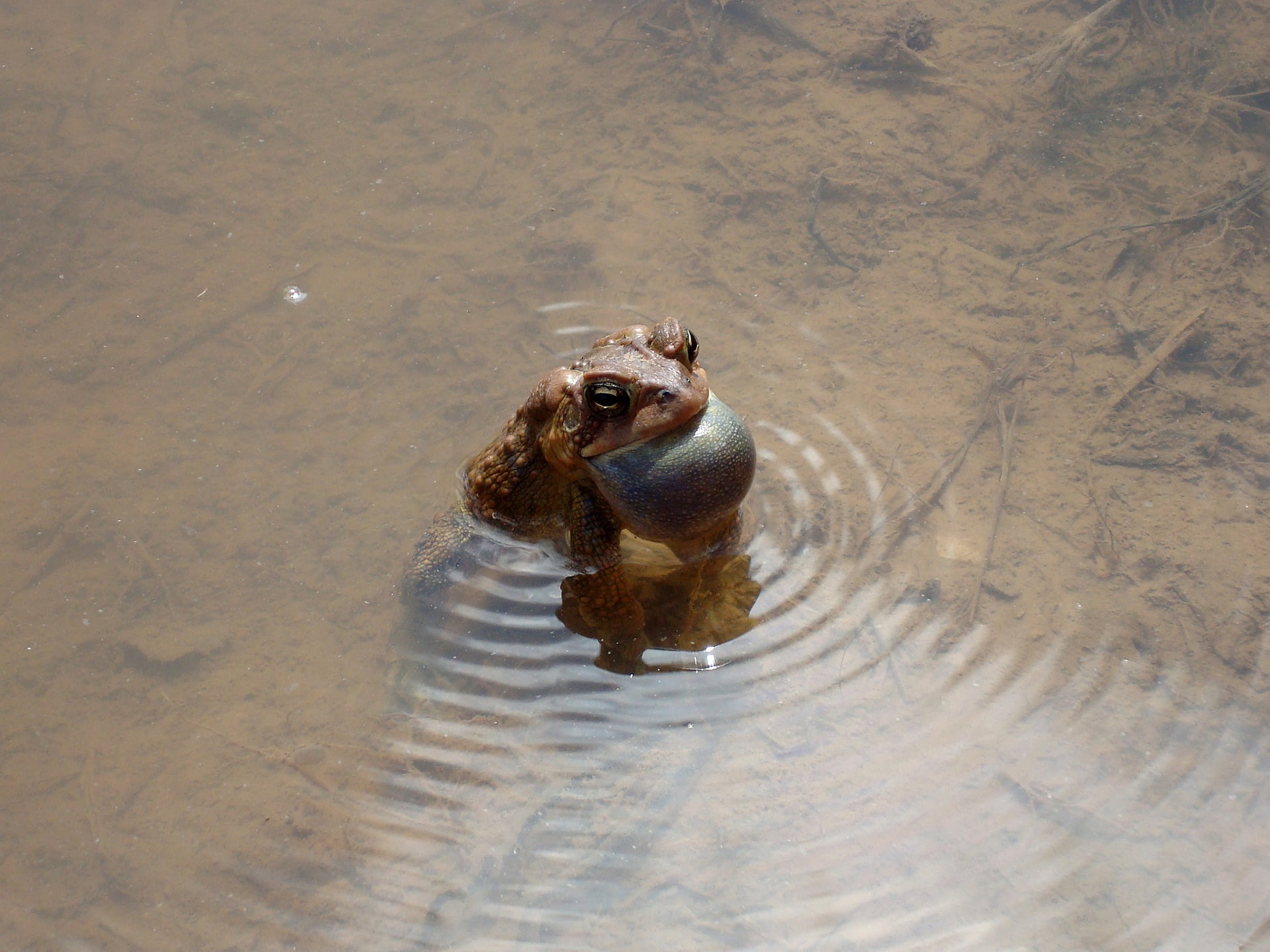
    With spring heading into summer, many parts of the United States enjoy a nighttime chorus of frogs and toads. These amphibians are singing to attract mates and delineate territory. Some, like this American toad, sing from the water, and the vibration of their vocal sac creates ripples that last as long as they’re vocalizing. The toad sings by closing its nostrils and mouth, then forcing air from its lungs over its vocal cords. Those vibrations are amplified by resonance in its vocal sac, generating the high chirp we hear. (Image credit: cassiescisco)

  • Measuring Contaminants in Drops and Bubbles

    Measuring Contaminants in Drops and Bubbles

    Rising bubbles and droplets are common in many chemical and industrial applications. But just a tiny concentration of contaminants on their surface can completely alter their behavior, disrupting coalescence and slowing down chemical reactions.

    Historically, it’s been hard to measure the level of contamination in these some drops and bubbles, but a new study outlines a way to measure these small concentrations by perturbing the drops and watching how they deform. By analyzing how the drop shimmies and shakes, they’re able to measure its surface tension and, ultimately, the concentration of contaminants. (Image credit: S. Sørensen; research credit: B. Lalanne et al.; via APS Physics)

  • Featured Video Play Icon

    Singing in the MRI

    We rarely consider just how complex the process is when we speak or sing. Sound waves produced in our larynx are shifted and amplified by the geometry of our throats, mouths, sinus cavities, tongues, and lips. This video provides a glimpse of that hidden complexity through a trained vocalist singing inside an MRI machine. He sings the same aria in four distinctly different vocal styles, and it’s incredible to watch all the changes his tongue, lips, and soft palette go through to produce those different sounds. (Image and video credit: T. Ross; via Flow Vis)

  • Robotic Research Facilities

    Robotic Research Facilities

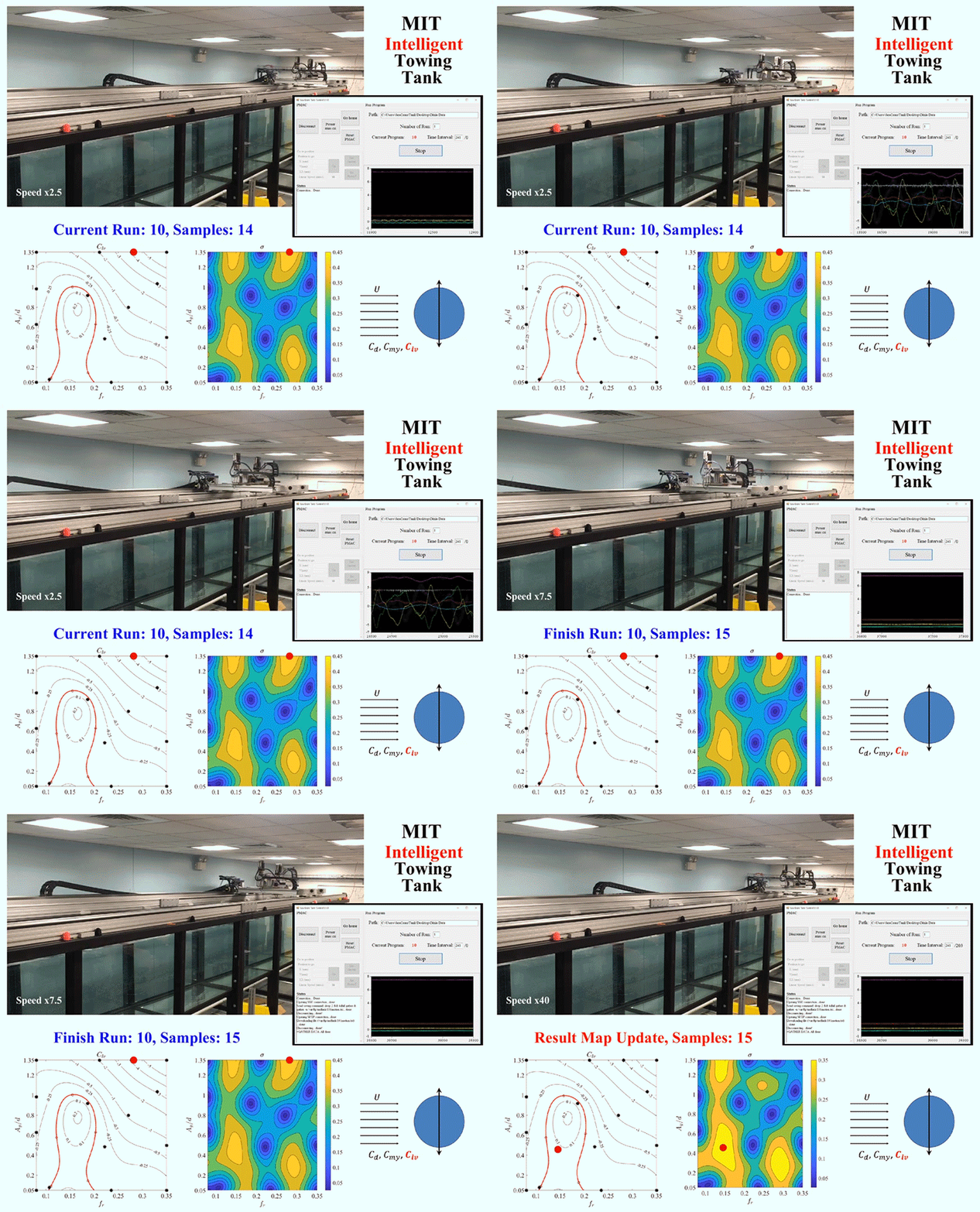
    One of the major challenges in fluid dynamics is the size of the parameter spaces we have to explore. Because many problems in fluid dynamics are non-linear, making small changes in the initial set-up can result in large differences in the results. Consider, for example, a simple cylinder towed through a water tank. As the cylinder moves, vortices will form around it and shed off the back, causing the cylinder to vibrate. The details of what will happen will depend on variables like the cylinder’s size and flexibility, the speed it’s being towed at, and which directions it’s allowed to vibrate in. Mapping out the parameter space, even sparsely, could take a graduate student hundreds of experiments.

    To speed up this process, engineers are now building robotic facilities like the Intelligent Towing Tank (ITT) shown above. Like graduate students, the ITT can work into the wee hours of the night, but, unlike graduate students, it never needs to eat, sleep, or stop experimenting. Now, one could use a facility like this to brute-force the answers by testing every possible combination of parameters, but even working 24 hours a day, that would take a long time. Instead, researchers use machine learning to guide the robotic facility into choosing test parameters in a way that optimizes the factors the researchers define as important.

    Essentially, the system starts with experiments chosen at random within the parameter space, and then uses those results to select areas of interest until it’s gathered enough data to satisfy the limits specified by human researchers. In theory, a well-designed algorithm can dramatically reduce the number of experiments needed to explore a parameter space. (Image and research credit: D. Fan et al.; submitted by Kam-Yung Soh)

  • Avoiding Shear Thickening

    Avoiding Shear Thickening

    Many substances – like the cornstarch and water mixture above – exhibit a property called shear-thickening. In these fluids, deforming them quickly causes the viscosity to increase dramatically. That shear-thickening occurs when particles inside the fluid jam together, creating large chains able to resist the force being applied. That’s why the oobleck on this vibrating speaker can sustain these “cornstarch monsters”.

    Shear-thickening is useful in many contexts, but it’s problematic during manufacturing, when pumping these substances can become incredibly difficult due to the fluid’s innate resistance to flowing. A new study, though, finds that it’s possible to temporarily suppress shear-thickening using acoustic waves. The researchers used piezoelectric devices to generate acoustic waves at a frequency around 1 MHz while shearing the cornstarch mixture. The acoustic waves disrupt the formation of particle chains inside the mixture, keeping its viscosity 10 times lower than during regular shear-thickening. (Image credit: bendhoward, source; research credit: P. Sehgal et al.; submitted by Brian K.)

  • Superwalkers

    Superwalkers

    Walking droplets – drops that bounce their way across a pool of the same liquid without coalescing – have fascinated researchers in recent years with their unusual behaviors, some of which mimic quantum phenomena. In a new experiment, researchers vibrate the pool at two frequencies simultaneously, which helps support much larger droplets, known as superwalkers. When the two driving frequencies are close to a harmonic match – like at 80 Hz and just under half that at 39.5 Hz – the droplets will walk, then come to a stop, and then begin walking again. (Image and research credit: R. Valani et al.; via APS Physics; submitted by Justin B and Kam-Yung Soh)

  • Guiding Particles with Chladni Patterns

    Guiding Particles with Chladni Patterns

    During the 19th century, Ernst Chladni and Michael Faraday independently explored the patterns formed by particles of different sizes placed on a vibrating plate. Faraday found that large particles accumulated at nodes of the plate, where there was no vertical vibration, whereas smaller particles moved toward anti-nodes, where air currents caused by the large vibration amplitude lifted them up.

    The situation becomes a little different if you submerge the vibrating plate in water. Then large, heavy particles gather at the anti-nodes. Drag keeps the particles on the plate, while acoustic forces and gravity conspire to move the particles horizontally toward the anti-nodes (top). Because anti-node patterns change with frequency, this actually provides a way to manipulate particle’s trajectories. The researchers demonstrated this by steering a particle through a maze (bottom) as well as by manipulating an entire swarm of beads. (Image and research credit: K. Latifi et al.; via Physics World; submitted by Kam-Yung Soh)

  • Granular Instabilities

    Granular Instabilities

    Granular mixtures show surprising similarities to fluids, even though their underlying physics differ. The latest example of this is a Rayleigh-Taylor-like instability that occurs when heavy particles sit atop lighter ones. By combining vertical vibration and an upward gas flow, researchers found that the lighter particles form fingers and bubbles that seep up between the heavier grains (upper left). Visually, it looks remarkably similar to a lava lamp or other Rayleigh-Taylor-driven instability (upper right).

    But the physics behind the two are distinctly different. In the fluid, buoyancy drives the instability while surface tension acts as a stabilizing force. There’s no surface tension in a granular material, though. Instead, the drag force from gas flowing upward provides the vertical impetus while friction between the grains – essentially an effective viscosity – replaces surface tension as a stabilizing influence.

    The similarities don’t stop there, though. When the researchers tested a “bubble” of heavy grains suspended in lighter ones (lower left), they found that, instead of sinking, the granular bubble split in two and drifted downward on a diagonal. Eventually, those daughter bubbles also split. Again, visually, this looks a lot like what happens to a drop of ink or food coloring falling through water (lower right), but the physics aren’t the same at all. 

    In the fluid, the breakup happens when a falling vortex ring splits. In the granular example, gas moving upward tends to channel around the heavy grains because they’re harder to move through. Eventually, this builds up a solidified region under the bubble. When the heavy grains can’t move directly down, they split and sink through the surrounding suspended particles until they build up another jammed area and have to split again. (Image credits: granular RTI – C. McLaren et al.; RTI simulation – M. Stock; bag instability – D. Zillis; research credit: C. McLaren et al.; submitted by Kam-Yung Soh)

  • Vibrating in the Flow

    Vibrating in the Flow

    Objects can obviously affect flows, but that’s not a one-way street. Flows can also affect objects, even ones as simple a circular cylinder. If you live somewhere with traffic lights mounted to a horizontal bar, you’ve probably seen this. On a windy day, the beam holding the traffic lights will oscillate up and down. This is an example of vortex-induced vibration, a coupling between the flow structures formed by an object and the motion of the object itself. With cylinders, engineers have mostly studied a situation like the traffic light – one where the motion of the cylinder is perpendicular to the direction of the flow. 

    But it’s also possible to get vortex-induced vibration in the same direction as the flow. That’s what you see visualized in the images above. Notice how the oscillation of the cylinders is inline with the flow direction. As with the crossflow version of vortex-induced vibration, this inline example has several wake forms that vary based on flow conditions. (Image and research credit: T. Gurian et al.)