Pouring cream in coffee produces some of the most mesmerizing displays of fluid dynamics. The density difference between the two fluids sets up Rayleigh-Taylor instabilities that mushroom out and help create the turbulence that eventually mixes the drink. You can learn more about Rayleigh-Taylor instabilities in this FYFD video, and, if you need more awesome caffeine-filled examples of fluids, check out the coffee dynamics blog. (Video credit: S. Geraldine and L. Kang)
Tag: turbulence

Mammatus Clouds
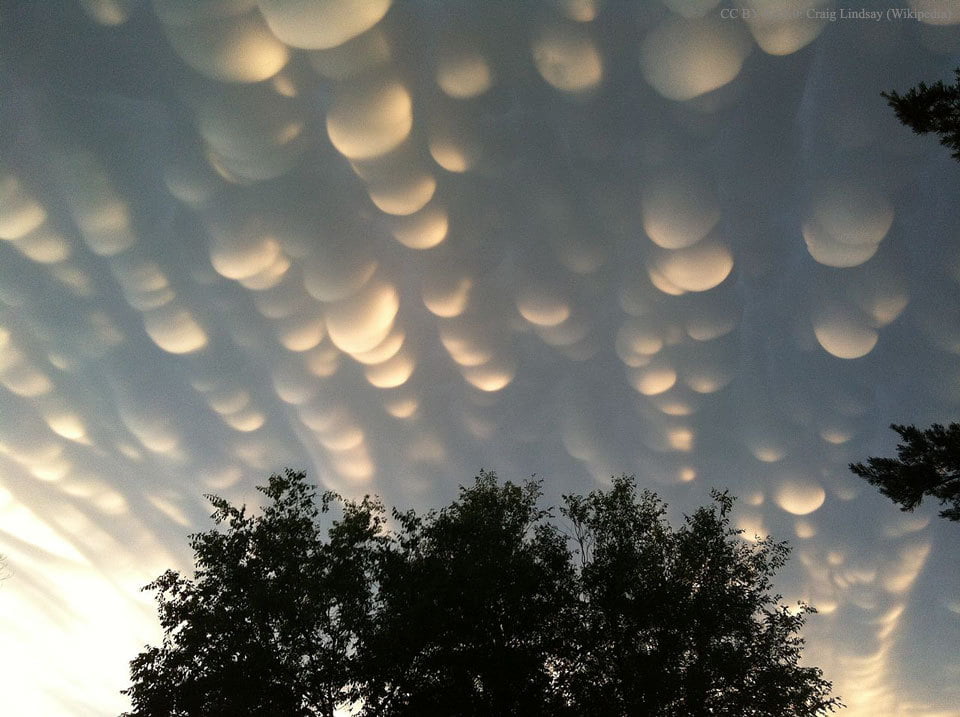
Mammatus clouds, the bubble-shaped protrusions sometimes seen underneath cumulus clouds, are a rare and dramatic type of cloud. The mammatus is typically short-lived, with lobes lasting only 10 minutes or so. Their rarity and short appearances are among the reasons why this cloud type has been little studied. As a result, there are many theories as to how the clouds form their distinctive, bulbous lobes, but, to my knowledge, there is no single widely accepted explanation. Mammatus often appear before or after severe thunderstorms and are associated with strong turbulence, so this may play a factor in their formation. (Photo credit: C. Lindsey; via APOD)

Bullet-Time Inferno
Remember the bullet time effect from The Matrix? This spectacular video gives you a similar effect with the turbulent flames created by firebreathers. To capture this level of detail, Mitch Martinez uses an array of 50 cameras placed around the performers, allowing him to reconstruct the full, three-dimensional representation of the flames. Similarly, some scientists use arrays of high-speed video cameras to collect 3D, time-resolved data about phenomena like combustion. Because these flows are so complex in terms of their fluid dynamics and chemistry, capturing full 3D data is important to help understand and model the flow better. (Video credit: M. Martinez; via Rakesh R.)

Phytoplankton Bloom
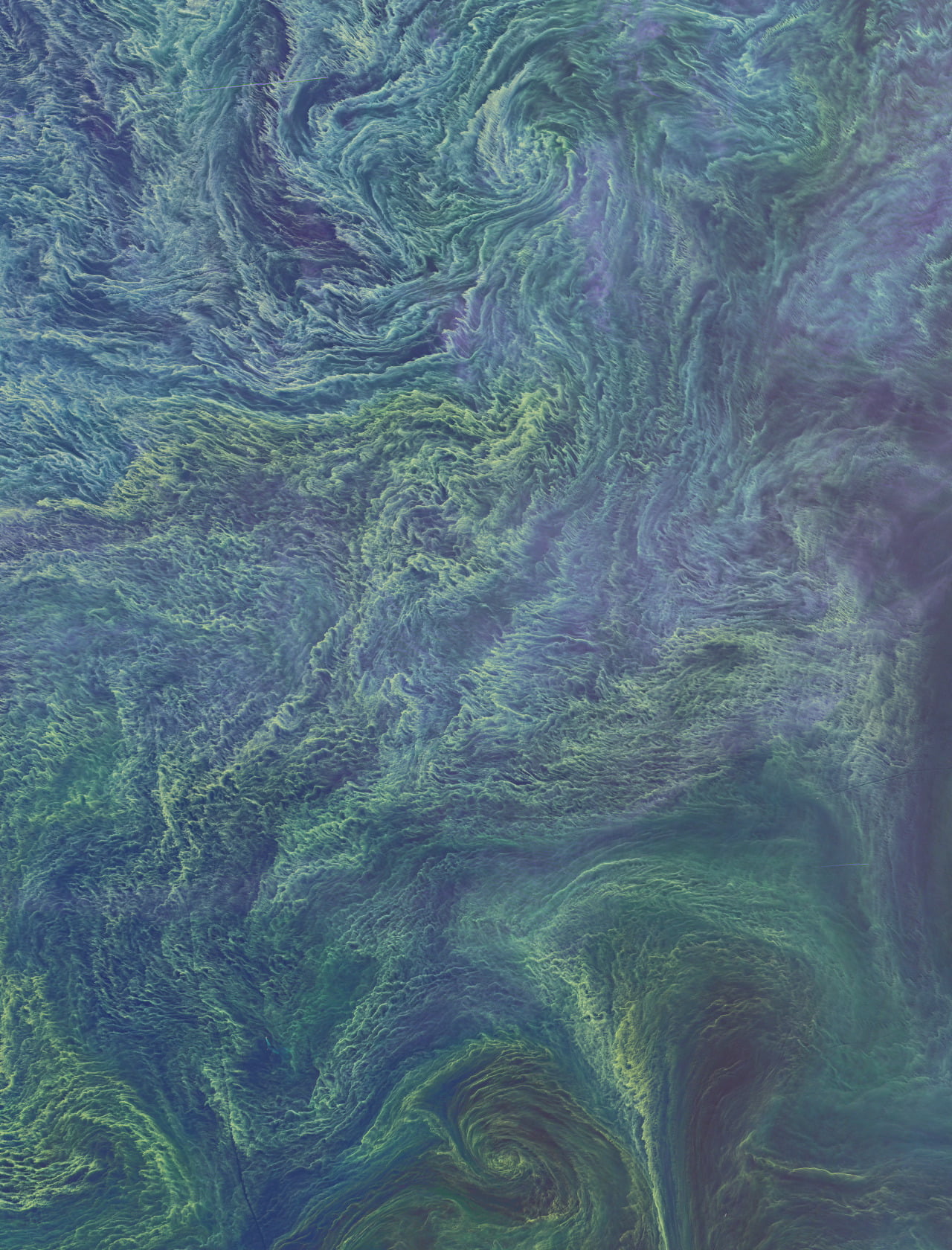
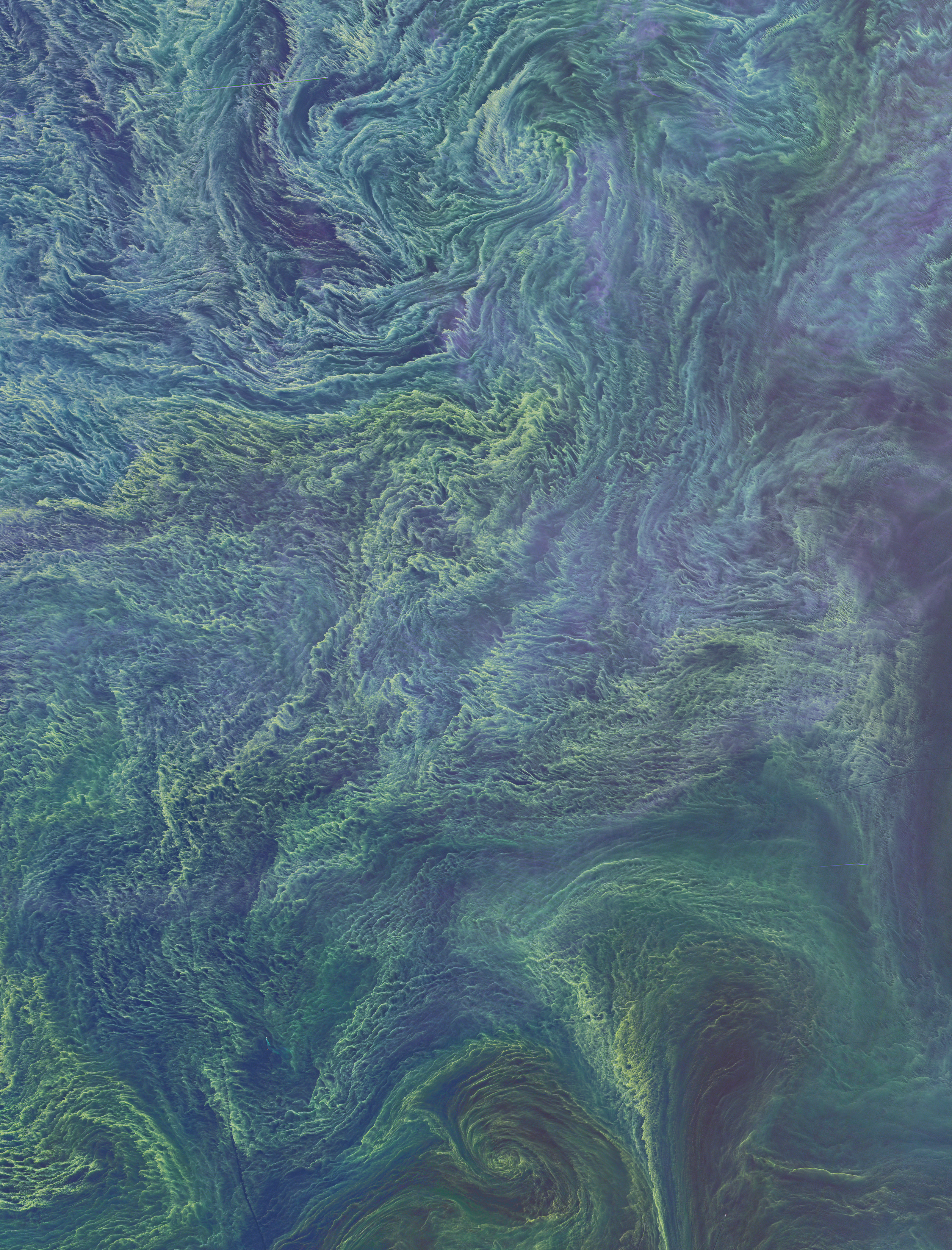
This incredible false-color satellite image shows a cyanobacteria phytoplankton bloom in the Baltic Sea. The image is roughly 900 km across and is beautifully detailed. Check out the full resolution version. The tiny phytoplankton act like tracer particles in the flow, sketching out the massive whorls as well as the tiny lacy wisps that make up the turbulent sea. Beautiful as they appear from orbit, such massive blooms can be dangerous to animal life, depriving large areas of the oxygen other animals need to survive. In recent years more and more large phytoplankton blooms are happening around the world as agricultural and industrial run-off supply waters with excess nitrogen and other nutrients favored by the phytoplankton. (Image credit: NASA Earth Observatory)
Sandscapes
Many of us have played with sand art–the rotating frames filled with water, sand, and air. In this video, Shanks FX demonstrates some of the realistic and surrealistic landscapes you can create using this toy. It also makes for a neat fluid dynamics demonstration. The buoyancy of the trapped air bubbles lets the sand sift slowly down instead of falling immediately. And the sand descends in a variety of ways–sometimes laminar columns and other times wilder turbulent plumes. (Video credit and submission: Shanks FX/PBS Digital Studios)
Turbulent Ink
Turbulence is found throughout our lives, but rarely is it as startlingly beautiful as in this Slow Mo Guys video. Here they show high-speed videos of ink being injected into water. The resulting plumes are turbulent from the very start, with innumerable folds and eddies billowing outward as the plume expands. The large difference in length scales–from the millimeter-sized curls to the meter-sized length of the plume–is one of the classic characteristics of turbulence and part of what makes turbulent flows so difficult to model computationally. Energy in these flows is generated at the large scales, but it’s dissipated at the very smallest scales through viscosity. This means that to properly model a turbulent flow, you have to capture the largest scales, the smallest scales, and everything in between in order to represent this energy cascade from large to small. It’s a problem that engineers, mathematicians, meteorologists, and physicists have struggled with for more than a century. But, here, at least, we can all just sit back and enjoy the beauty. (Video credit: The Slow Mo Guys)
Calbuco
Filmmaker Martin Heck captured incredible timelapse footage of the Chilean volcano Calbuco erupting earlier this year. Fluid dynamics on these enormous geophysical scales is always awe-inducing. In the beginning, clouds bob gently and flow around the landscape. Then the volcano erupts, and the towering ash cloud of the eruption roils with turbulence, displaying eddies with length scales from hundreds of meters down to centimeters. And when the hot ash has risen and cooled, it forms a cap that spreads horizontally. Nature is a wonderful demonstrator of fluid dynamics, but what always amazes me is how very alike flows are whether they are confined to a laboratory or take up an entire planet. (Video credit: M. Heck; via It’s Okay To Be Smart)

Jumps in Stratified Flows

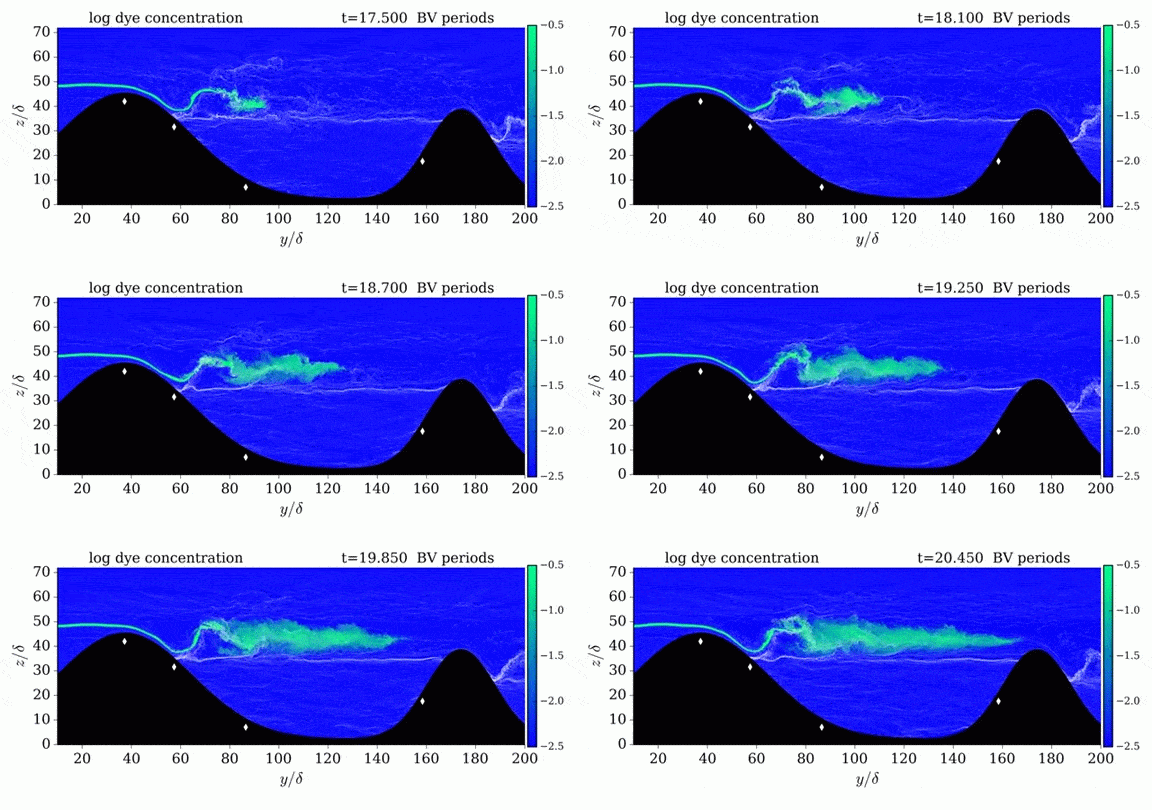
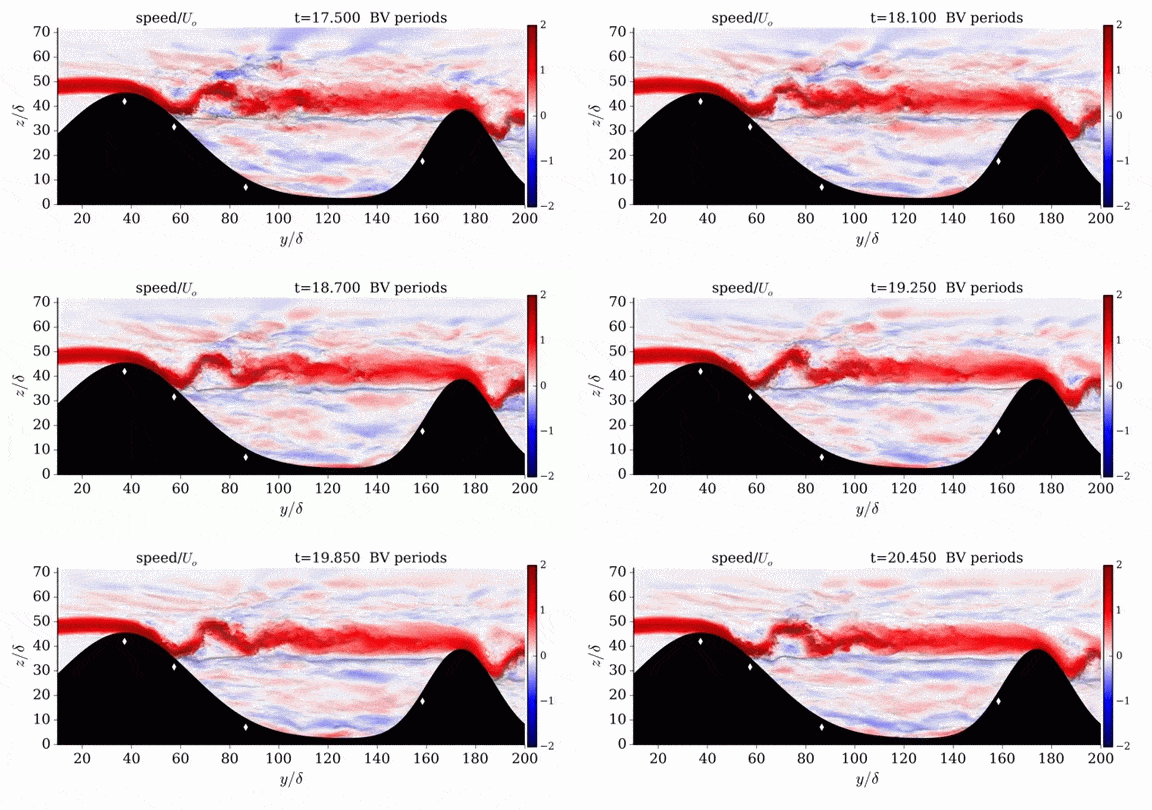
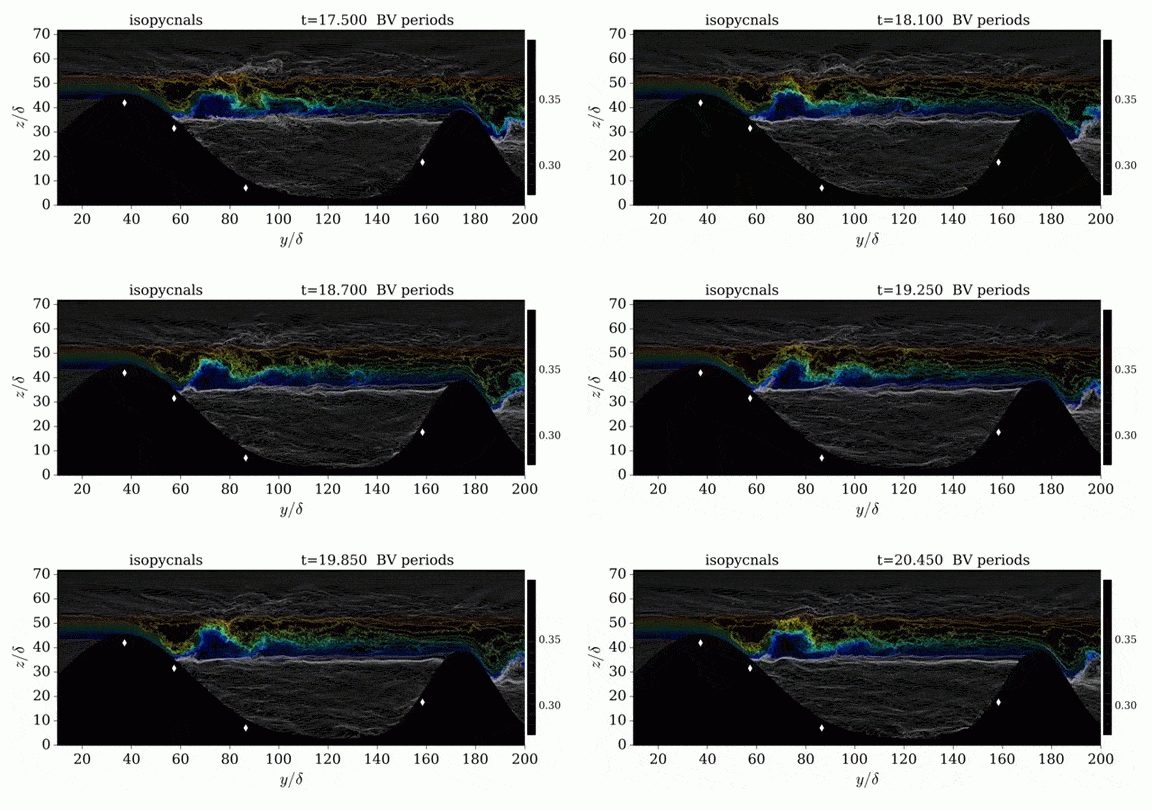
One of the factors that complicates geophysical flows is that both the atmosphere and the ocean are stratified fluids with many stacked layers of differing densities. These variations in density can generate instabilities, trap rising or sinking fluids, and transmit waves. The animations above show flow over two ridges with dye visualization (top), velocity (middle), and contours of density (bottom). The upstream influence of the left ridge creates a smooth, focused flow that quickly becomes turbulent after the crest. The jet rebounds as a turbulent hydraulic jump before slowing again upstream of the second ridge. Like the first ridge, the second ridge also generates a hydraulic jump on the lee side. Clearly both stratification and the local topography play a big role in how air moves over and between the ridges. If prevailing winds favor these kinds of flows, it can help generate local microclimates. (Image credit and submission: K. Winters, source videos)

Phytoplankton Blooms
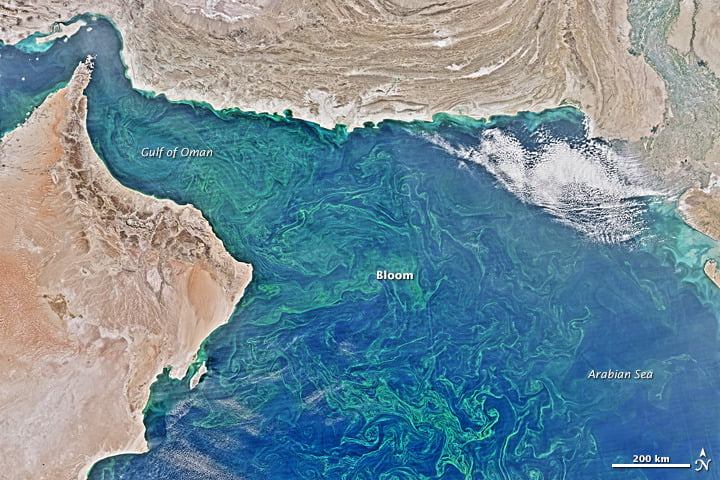
When the right nutrients come together in coastal waters, it can feed a phytoplankton bloom large enough to be visible to satellites. The phytoplankton themselves are microscopic organisms that are easily carried along by oceanic flows. In fluid dynamics terms, they are passive scalars or seed particles–additives that reveal the structure of the flow without altering it. Here the phytoplankton uncover the large-scale turbulent structure of flow in the Arabian Sea. Check the scale in the lower right. Many of the green eddies and swirls in this satellite image are hundreds of kilometers across. Yet, if we could zoom way in, we would still see turbulence acting on scales down to the millimeter length or below. This incredibly large range of length scales–eight or more orders of magnitude here–is a common characteristic of turbulence and part of what makes it such a challenge to understand or model. (Image credit: NASA Earth Observatory)
Cloud Formation
Clouds are so ubiquitous here on Earth that it’s easy to take them for granted. But there’s remarkable complexity in the mechanics of their formation. This great video from Minute Earth steps through the processes of evaporation and condensation that drive basic cloud formation. After evaporation, buoyancy lifts warm, moist air upward. That warm air expands and cools until it reaches an altitude where water droplets can condense onto dust particles in the atmosphere. These droplets form the wispy cloud we see. Turbulence mixes these droplets and helps them collide and grow. Interestingly, although we understand the basic process of cloud formation, relatively little is understood about the details, and the subject is still very much an area of active research. (Video credit: Minute Earth; via io9)