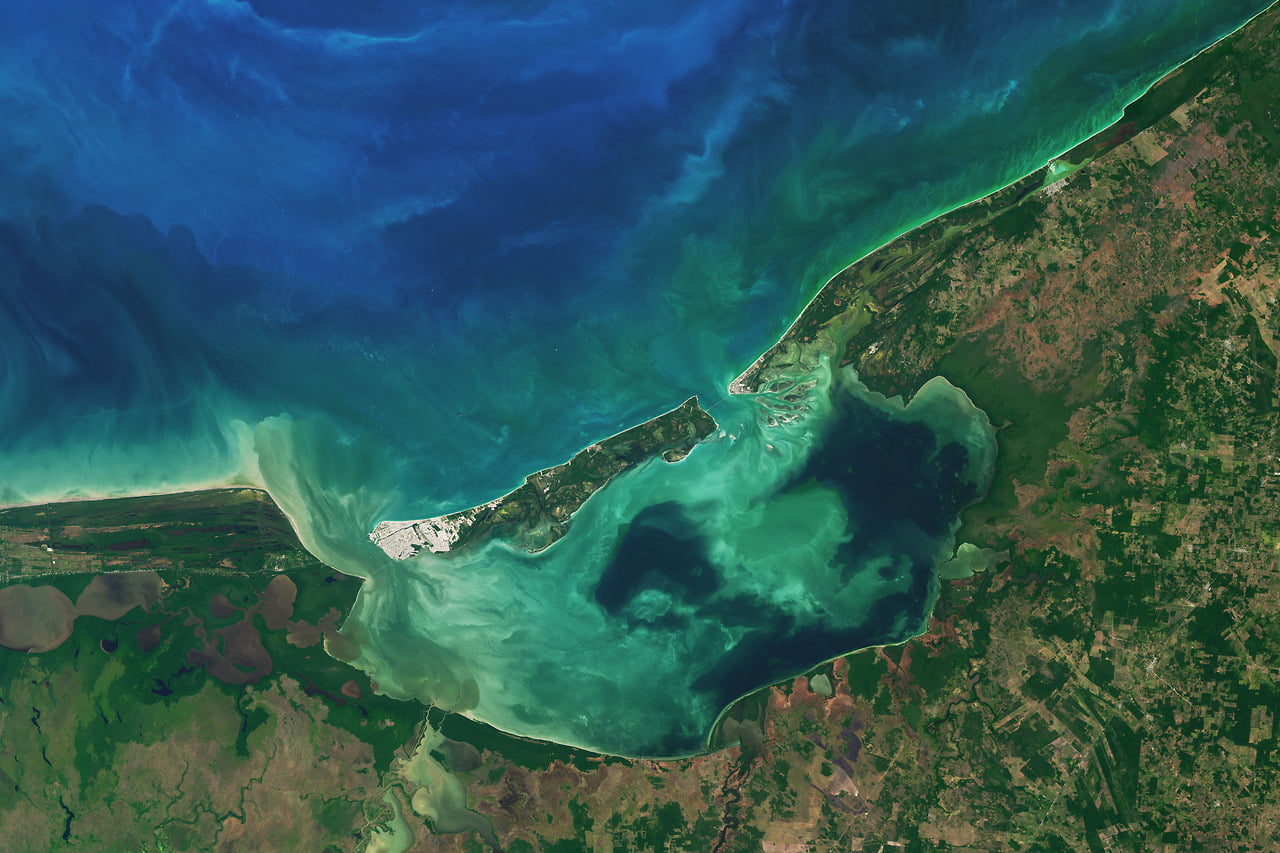
The meeting of land and sea often creates a rich and colorful environment. This satellite image shows Mexico’s Laguna de Términos, a coastal lagoon off the Gulf of Mexico. A skinny barrier island forms the lagoon’s two connections to the ocean; the eastern side is the usual inlet (right), while the western side forms an outlet. Rivers feed freshwater into the lagoon from the south and southwest. These introduce sediments that cause some of the lighter swirls in the image. Winds and tides also contribute to this turbidity. The sheltered nature of the lagoon allows fresh and salt water to mix gradually, providing harbor for many forms of life. Oyster beds thrive in the river mouths; seagrasses prefer the calmer, saltier waters, and mangrove trees line the shore, slowly desalinating water for themselves as their roots shelter young fish and shrimp. (Image credit: NASA Earth Observatory)
Tag: turbulence

Bubbles Sliding


Two-phase flows involve more than one state of matter – in this case, both gas and liquid phases. Flows like this are common, especially in applications involving heat transfer. In some heat exchangers, bubbles will rise and then slide along an inclined surface, as shown above. The motion of these bubbles is a complicated interplay between the surface, the bubble, and the surrounding fluid. The bubble’s wake, visualized here using schlieren imaging, is unsteady and turbulent. Although the bubble oscillates in its path, the wake spreads even wider, and its turbulence stirs up the liquid nearby, increasing the heat transfer. (Image and research credit: R. O’Reilly Meehan et al., source)

Lighting Engines
Combustion is complicated. You’ve ideally got turbulent flow, acoustic waves, and chemistry all happening at once. With so much going on, it’s a challenge to sort out the physics that makes one ignition attempt work while another fails. The animations here show a numerical simulation of combustion in a turbulent mixing layer. The grayscale indicates density contours of a hydrogen-air mixture. The top layer is moving left to right, and the lower layer moves right to left. This sets up some very turbulent mixing, visible in middle as multi-scale eddies turning over on one another.
Ignition starts near the center in each simulation, sending out a blast wave due to the sudden energy release. Flames are shown in yellow and red. As the flow catches fire, more blast waves appear and reflect. But while the combustion is sustained in the upper simulation, the flame is extinguished by turbulence in the lower one. This illustrates another challenge engineers face: turbulence is necessary to mix the fuel and oxidizer, but turbulence in the wrong place at the wrong time can put out an engine. (Image, research, and submission credit: J. Capecelatro, sources 1, 2)


Rocket Launch Systems


If you’ve ever watched a rocket launch, you’ve probably noticed the billowing clouds around the launch pad during lift-off. What you’re seeing is not actually the rocket’s exhaust but the result of a launch pad and vehicle protection system known in NASA parlance as the Sound Suppression Water System. Exhaust gases from a rocket typically exit at a pressure higher than the ambient atmosphere, which generates shock waves and lots of turbulent mixing between the exhaust and the air. Put differently, launch ignition is incredibly loud, loud enough to cause structural damage to the launchpad and, via reflection, the vehicle and its contents.
To mitigate this problem, launch operators use a massive water injection system that pours about 3.5 times as much water as rocket propellant per second. This significantly reduces the noise levels on the launchpad and vehicle and also helps protect the infrastructure from heat damage. The exact physical processes involved – details of the interaction of acoustic noise and turbulence with water droplets – are still murky because this problem is incredibly difficult to study experimentally or in simulation. But, at these high water flow rates, there’s enough water to significantly affect the temperature and size of the rocket’s jet exhaust. Effectively, energy that would have gone into gas motion and acoustic vibration is instead expended on moving and heating water droplets. In the case of the Space Shuttle, this reduced noise levels in the payload bay to 142 dB – about as loud as standing on the deck of an aircraft carrier. (Image credits: NASA, 1, 2; research credit: M. Kandula; original question from Megan H.)

“Pursuit”
Photographer Mike Olbinski has released yet another breathtaking timelapse film of weather over the Great Plains. This one has a little bit of everything: storms, tornadoes, incredible cloud formations, and even sunny days. Olbinski’s work is a reminder that there’s a constant beautiful drama playing out over our heads if we just take the time to watch. Under blue skies, condensation and turbulence are building towering mountains, and even when the sky is gray, it can be churning like the ocean just over your head. The U.S. Great Plains may be home to particularly dramatic examples of this behavior (thanks largely to the atmospheric influence of the Rocky Mountains), but these same phenomena are going on all the time overhead. (Video and image credits: M. Olbinski)


Impressionist Gibraltar
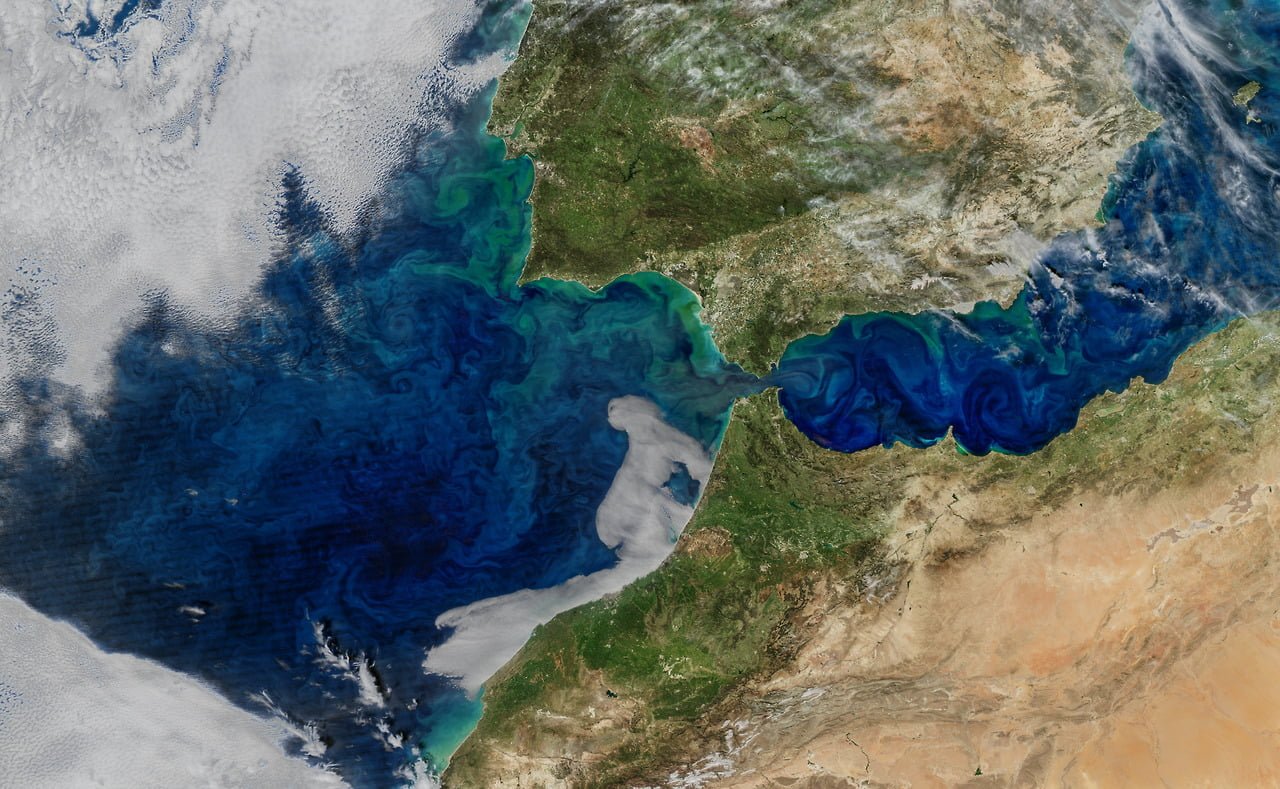
Swirls of phytoplankton make this satellite image of Gibraltar look like an Impressionist painting. The photo is a composite of data from several instruments, with colors enhanced to highlight features of the phytoplankton blooms. The tiny plankton act as tracer particles that reveal some of the complex flow between the North Atlantic and the Mediterranean. Although narrow, the Strait at Gibraltar has deep and complex terrain that was formed during a breach flood event millions of years ago. Water flowing through that terrain sets up enormous and complicated waves well beneath the ocean surface. These drive some of the turbulence that we see here as the blue swirls east of the Strait. (Image credit: NASA/N. Kurig; via NASA Earth Observatory)

Spots of Turbulence
One of the enduring mysteries of fluid dynamics lies in the transition between smooth laminar flow and chaotic turbulent flow in the area near a wall. That region, known as the boundary layer, has a major impact on drag and other effects. The process begins with disturbances that are too tiny to see or measure, but eventually, those disturbances can grow large enough to generated an isolated turbulent spot, like the one imaged above. Flow in the photograph is from left to right. Turbulent spots have a distinctive wedge-like shape that expands as the spot grows and widens. These turbulent spots can merge together to create still larger spots, and when a surface eventually becomes completely covered in them, we call it fully-developed turbulent flow. (Image credit: M. Gad-El-Hak et al.)
“Ink in Motion”
In this short film, the Macro Room team plays with the diffusion of ink in water and its interaction with various shapes. Injecting ink with a syringe results in a beautiful, billowing turbulent plume. By fiddling with the playback time, the video really highlights some of the neat instabilities the ink goes through before it mixes. Note how the yellow ink at 1:12 breaks into jellyfish-like shapes with tentacles that sprout more ink; that’s a classic form of the Rayleigh-Taylor instability, driven by the higher density ink sinking through the lower density water. Ink’s higher density is what drives the ink-falls flowing down the flowers in the final segment, too. Definitely take a couple minutes to watch the full video. (Image and video credit: Macro Room; via James H./Flow Vis)

When Vortices Collide
In a new ad campaign for paint manufacturer Sherwin-Williams, the production team at Psyop show off some awesome fluid dynamics by swirling and injecting paint underwater. You can see one sequence above, where red and blue paint vortex rings collide head-on before breaking down into a purple turbulent cloud. (What a great way to demonstrate the mixing power of turbulence, right?) Here’s the full 30-second ad clip. Impressively, everything in the video is a practical effect, even the segment that flies past multicolored turbulent plumes. You can see how they filmed everything in their behind-the-scenes featurette below. In the meantime, enjoy the mesmerizing beauty of real-world physics and check out FYFD’s “fluids as art” tag for more examples. (Image and video credit: Psyop for Sherwin-Williams; submitted by Alan B.)

Reducing Drag with Bubbles
Large ships experience a great deal of drag due to friction between their hull and the water. One method shipbuilders are considering to combat this drag is the use of bubbles, which have been found to reduce drag by up to 40%. The physical mechanism behind this drag reduction is not yet understood, but a recent study suggests that bubble size and bubble coalescence play an important role.
Researchers introduced surfactants into bubbly boundary layers and found that the reductions in drag evaporated as soon as the surfactants spread. Adding only 6 parts per million of the surfactant decreased average bubble size from 1 mm to 0.1 mm and helped prevent the bubbles from growing via coalescence. The implications are that bubble-induced drag reduction could be extremely sensitive to water conditions. (Image credit: G. Kiss; research credit: R. Verschoof et al.)