Tag: thermodynamics

  • Boiling on Mars

    Boiling on Mars

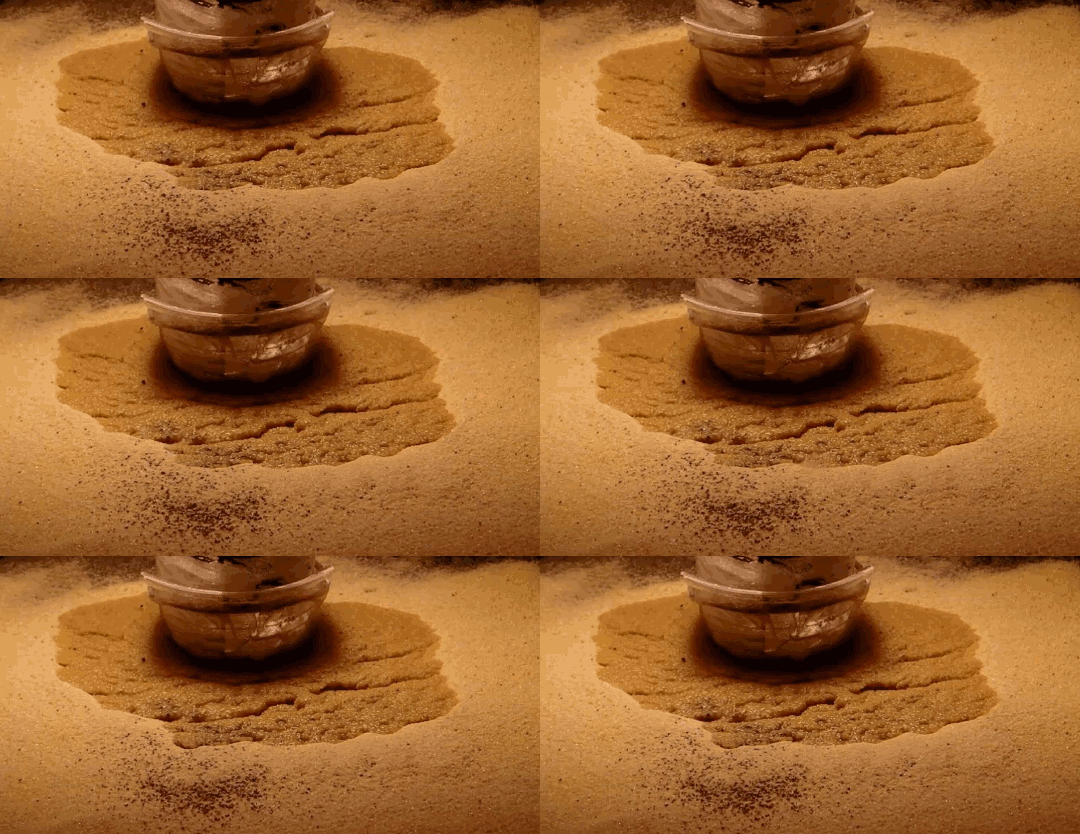
    Today’s Mars is cold and dry, with a thin and insubstantial atmosphere. One of the challenges facing planetary scientists is unraveling the processes behind the complex terrain we can observe on the surface. Without flowing water, how do we explain these features? A new experiment suggests that the answer lies in boiling.

    Surface conditions on Mars include atmospheric pressures low enough to be below the triple point of water* – the critical temperature and pressure where water vapor, liquid water, and ice can all exist simultaneously. This means that liquid water is unstable under Martian conditions; any water that seeped up to the surface would immediately begin to boil. That explosive boiling ejects sand particles, as seen in the animation above. The authors suggest that this hybrid process of wet percolation combined with vaporous ejection of sediment may better explain the Martian surface features we observe. (Image credit: M. Masse et al., source: Supplementary Movie 3; via Gizmodo; submitted by Paul vdB)

    * The evidence we’ve seen so far on Mars points to briny water flowing near the surface. Although brines have lower freezing temperatures than pure water, the authors’ argument holds for them, as well. The boiling is simply not as vigorous.

  • Pouring Molten Aluminum on Dry Ice

    Pouring Molten Aluminum on Dry Ice

    What happens when you pour molten aluminum on dry ice? As the Backyard Scientist shows, you get what looks like slippery, sliding, boiling metal. In fact, what you see may remind you of the Leidenfrost effect, where a liquid can slide around over an extremely hot surface on a thin film of its own vapor. Despite the opposite temperature extremes–this is a very cold surface rather than a very hot one–a very similar thing is happening here. The molten aluminum is so much hotter than the dry ice that it causes the dry ice to sublimate, releasing gaseous carbon dioxide that the aluminum slides around on. For the same reason, the aluminum appears to boil in the bottom animation. What we’re really seeing is carbon dioxide gas rising and escaping the aluminum so violently that it carries some of the metal with it. Be sure to check out the full video for more awesome physics!  (Image credit: The Backyard Scientist, source; via Gizmodo)

    Do you enjoy FYFD and want to help support it? Then please consider becoming a patron!

  • Featured Video Play Icon

    Inside a Can of Compressed Air

    Many gases are stored in liquid form at high pressures. This video takes a look at tetrafluoroethane, better known as the substance in compressed air cans used for dusting electronics. At atmospheric pressure, tetrafluoroethane boils at about -26 degrees Celsius, but in an air duster, at around 7 atmospheres of pressure, it is a liquid. As demonstrated in the video, releasing the pressure causes the liquid to boil off. Even exposed to atmospheric pressure, though, the liquid doesn’t boil off instantly – the act of boiling requires thermal energy and, without a sufficient source of heat, the liquid consumes its own heat until it drops to a temperature below the boiling point. As it warms up from the surrounding air, it will start boiling again. I don’t recommend trying to open up an air duster can at home, though. High-pressure containers can be dangerous to open up, and tetrafluoroethane is now being phased out in some parts of the world due to its high global warming potential.  (Video credit: N. Moore)

  • Does Liquid in a Vacuum Boil or Freeze?

    Does Liquid in a Vacuum Boil or Freeze?

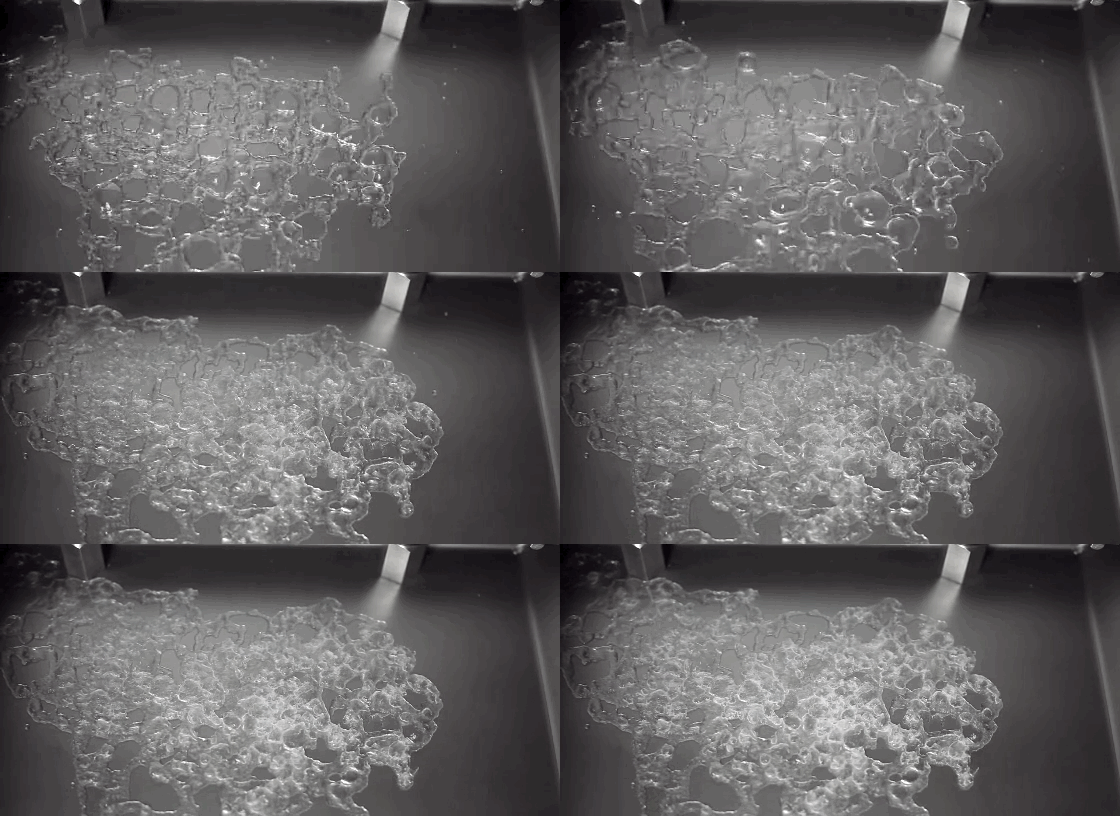
    What happens to a liquid in a cold vacuum? Does it boil or freeze? These animations of liquid nitrogen (LN2) in a vacuum chamber demonstrate the answer: first one, then the other! The top image shows an overview of the process. At standard conditions, liquid nitrogen has a boiling point of 77 Kelvin, about 200 degrees C below room temperature; as a result, LN2 boils at room temperature. As pressure is lowered in the vacuum chamber, LN2’s boiling point also decreases. In response, the boiling becomes more vigorous, as seen in the second row of images. This increased boiling hastens the evaporation of the nitrogen, causing the temperature of the remaining LN2 to drop, the same way sweat evaporating cools our bodies. When the temperature drops low enough, the nitrogen freezes, as seen in the third row of images. This freezing happens so quickly that the nitrogen molecules do not form a crystalline lattice. Instead they are an amorphous solid, like glass. As the residual heat of the metal surface warms the solid nitrogen, the molecules realign into a crystalline lattice, causing the snow-like flakes and transition seen in the last image. Water can also form an amorphous ice if frozen quickly enough. In fact, scientists suspect this to be the most common form of water ice in the interstellar medium. (GIF credit: scientificvisuals; original source: Chef Steps, video; h/t to freshphotons)

  • Featured Video Play Icon

    Steam Hammer

    The steam hammer phenomenon–and the closely related water hammer one–is a violent behavior that occurs in two-phase flows. Nick Moore has a fantastic step-by-step explanation of the physics, accompanied by high-speed footage, in the video above. Pressure and temperature are driving forces in the effect, beginning with the high-temperature steam that first draws the water up into the bottle. As the steam condenses into the cooler water, the steam’s pressure drops, drawing in more water. Eventually it drops low enough that the incoming water drops below the vapor pressure. This triggers some very sudden thermodynamic changes. The drop in pressure vaporizes incoming water, but the subsequent cloud cools rapidly, which causes it to condense but also drops the pressure further. Water pours in violently, cavitating near the mouth of the bottle because the acceleration there drops the local pressure below the vapor pressure again. The end result is a flow that’s part-water, part-vapor and full of rapid changes in pressure and phase. As you might imagine, the forces generated can destroy whatever container the fluids are in. Be sure to check out Nick’s bonus high-speed footage to appreciate every stage of the phenomenon. (Video credit and submission: N. Moore)

  • Featured Video Play Icon

    Geyser Physics

    Three basic components are necessary for a geyser: water, an intense geothermal heat source, and an appropriate plumbing system. In order to achieve an explosive eruption, the plumbing of a geyser includes both a reservoir in which water can gather as well as some constrictions that encourage the build-up of pressure. A cycle begins with geothermally heated water and groundwater filling the reservoir. As the water level increases, the pressure at the bottom of the reservoir increases. This allows the water to become superheated–hotter than its boiling point at standard pressure. Eventually, the water will boil even at high pressure. When this happens, steam bubbles rise to the surface and burst through the vent, spilling some of the water and thereby reducing the pressure on the water underneath. With the sudden drop in pressure, the superheated water will flash into steam, erupting into a violent boil and ejecting a huge jet of steam and water. For more on the process, check out this animation by Brian Davis, or to see what a geyser looks like on the inside, check out Eric King’s video. (Video credit: Valmurec; idea via Eric K.)

  • Penguins Can Be Colder Than Their Surroundings

    Penguins Can Be Colder Than Their Surroundings

    Thermal imaging of emperor penguins in Antarctica shows that, in still conditions, large portions of their bodies remain colder than ambient temperatures. In the image above, the heads, beaks, eyes, and flippers of this pair of penguin are the warmest while much of their feathered surface remains several degrees colder than the temperature around them. Not only does this indicate that the penguins’ skin and feathers are extremely effective insulators–the core temperature of each penguin is roughly the same as a human’s–but it means that the penguins are losing heat via radiative cooling toward the sky, the same way your car does when frost forms. The measurements in the study are for penguins at least one body length away from any other penguins; of course penguins typically huddle together to generate additional warmth. The mathematics of this behavior are under active research. (Photo credit: D. McCafferty et al.; via Wired)

  • Reader Question: Snow from Boiling Water?

    [original media no longer available]

    Reader kylewpppd asks:

    Have you seen the post of a man in Siberia throwing boiling water off of his balcony? Can you provide a better explanation of what’s going on?

    As you can see in the video (and in many similar examples on YouTube), tossing near boiling water into extremely cold air results in an instant snowstorm. Several effects are going on here. The first thing to understand is how heat is transferred between objects or fluids of differing temperatures. The rate at which heat is transferred depends on the temperature difference between the air and the water; the larger that temperature difference is the faster heat is transferred. However, as that temperature difference decreases, so does the rate of heat transfer. So even though hot water will initially lose heat very quickly to its surroundings, water that is initially cold will still reach equilibrium with the cold air faster. Therefore, all things being equal, hot water does not freeze faster than cold water, as one might suspect from the video.

    The key to the hot water’s fast-freeze here is not just the large temperature difference, though. It’s the fact that the water is being tossed. When the water leaves the pot, it tends to break up into droplets, which quickly increases the surface area exposed to the cold air, and the rate of heat transfer depends on surface area as well! A smaller droplet will also freeze much more quickly than a larger droplet.

    What would happen if room temperature water were used instead of boiling water? In all likelihood, a big cold bunch of water would hit the ground. Why? It turns out that both the viscosity and the surface tension of water decrease with increasing temperature. This means that a pot of hot water will tend to break into smaller droplets when tossed than the cold water would. Smaller droplets means less mass to freeze per droplet and a larger surface area (adding up all the surface area of all the droplets) exposed. Hence, faster freezing!

  • Featured Video Play Icon

    Freezing Bubbles

    If you find yourself some place really cold this holiday season, may I suggest stepping outside and having some fun freezing soap bubbles? The crystal growth is quite lovely, as seen in this photograph. If you live in warmer climes, fear not, you can always experiment in your freezer. It would be particularly fun, I think, to see how a half-bubble sitting on a cold plate freezes in comparison to a droplet like this one. (Video credit: Mount Washington Observatory)

  • Featured Video Play Icon

    Rapid Freezing

    Thermodynamics can play strange games with liquids.  Here a bottle of chilled soda water is used to demonstrate a method of rapid freezing.  Because the water is at a higher pressure than atmospheric, its temperature can be lower than the normal freezing point in a standard atmosphere.  This is why the soda water remains a liquid in the bottle.  However, when the bottle is opened, the pressure drops and the water’s temperature is too low to remain a liquid, so it rapidly freezes in the bottle. A similar mechanism may be at work below Antarctic glaciers. As the internal flow beneath the ice sheet forces water up submerged mountainsides, the pressure drops, causing the water to freeze into new ice at the bottom of the glacier.