Tag: thermodynamics

  • Polygonal Droplets

    Polygonal Droplets

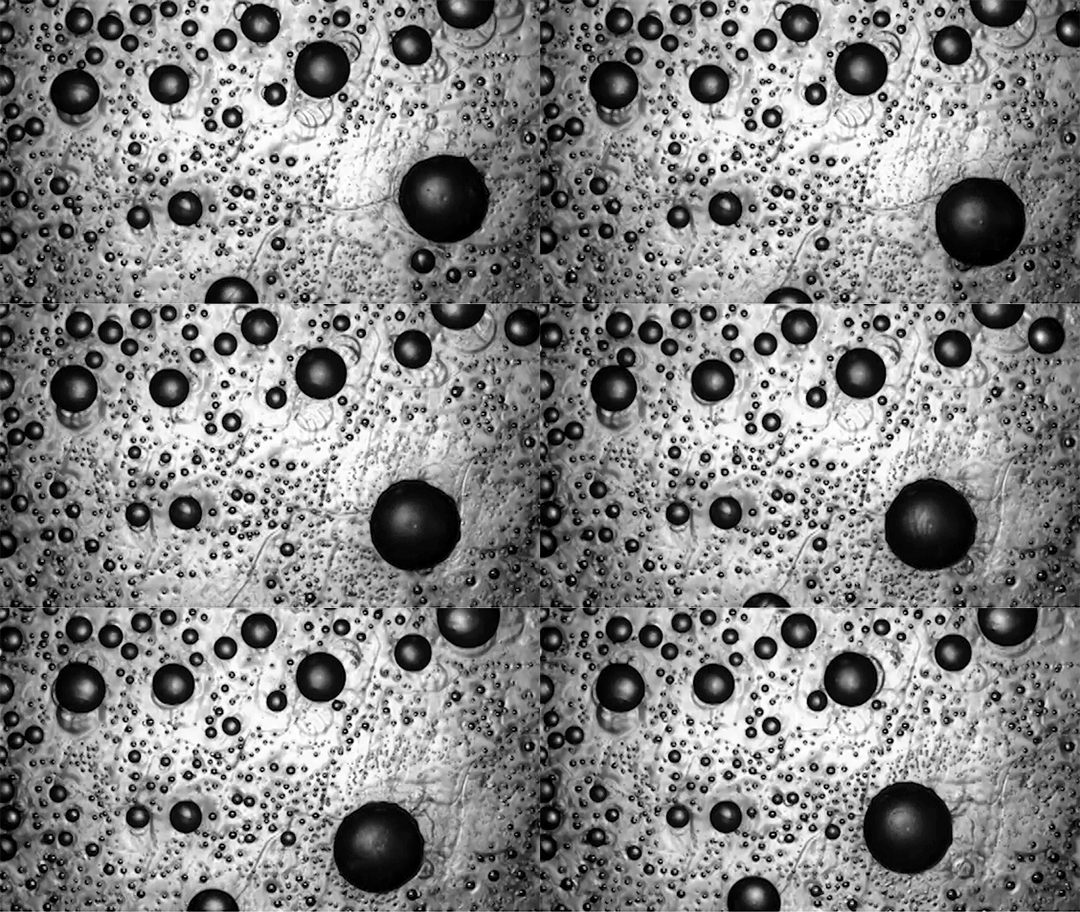
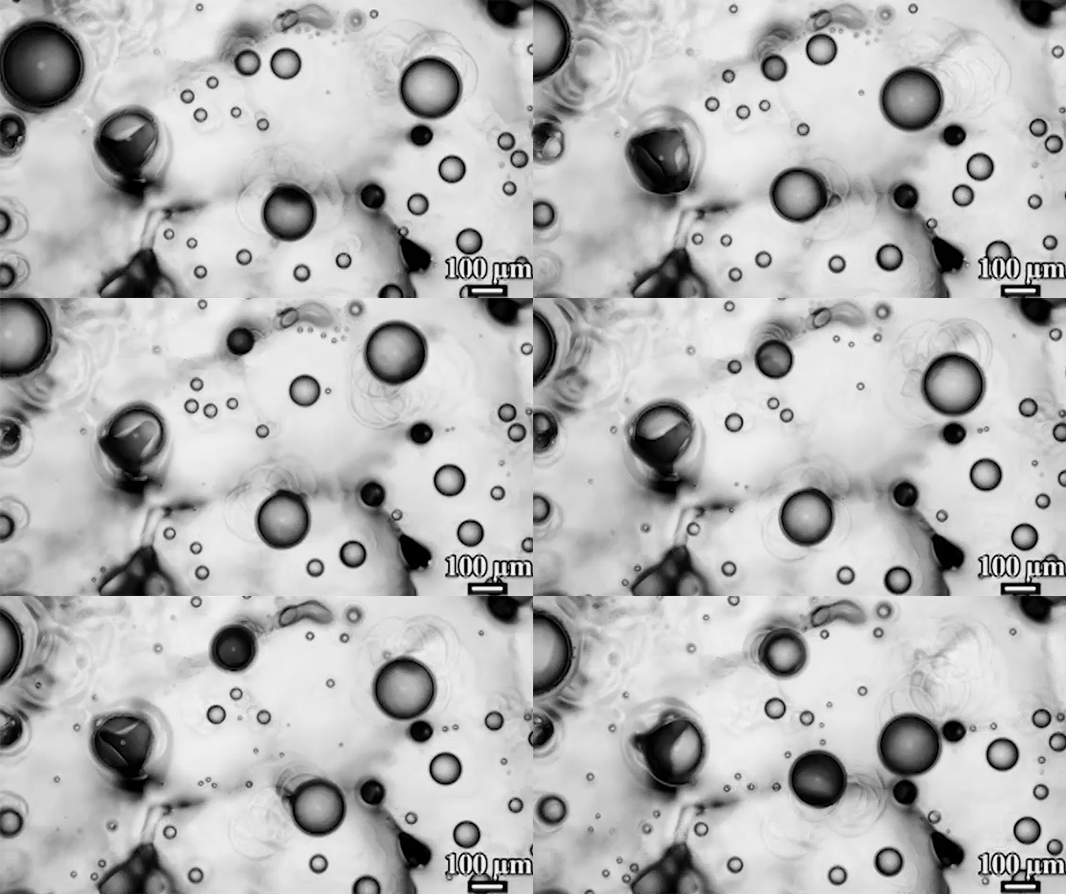
    Spheres are a special shape; they provide the smallest possible surface area necessary to contain a given volume. And since surface tension tries to minimize surface energy by reducing the surface area, drops and soap bubbles are, generally, spherical. There’s subtlety here, though: namely, what if reducing the surface area doesn’t minimize the surface energy?

    That’s the issue at the heart of this study. It looks at microscale oil droplets, like the ones above, that are floating in water and stabilized by surfactants. We’d expect droplets like these to be round, and above a critical temperature, they are. But as the temperature drops, the surfactant molecules along the droplet’s interface crystallize. The drop itself is still liquid, but interface is not.

    This changes the rules of the game. There’s no way for the surfactant molecules to form a sphere when solidified; they simply can’t fit together that way. So instead defects form along the interface and the drop becomes faceted. As the temperature drops further, the energy relationship between the water, oil, and surfactants continues shifting, causing the droplet to change shape – even to increase its surface area – all to minimize the overall energy. The effect is reversible, too. Raise the temperature back up above the critical point, and the interface “thaws” so that the drop becomes round again. (Image and research credit: S. Guttman et al.; via Forbes; submitted by Kam-Yung Soh)
  • Pluto’s Subsurface Ocean

    Pluto’s Subsurface Ocean

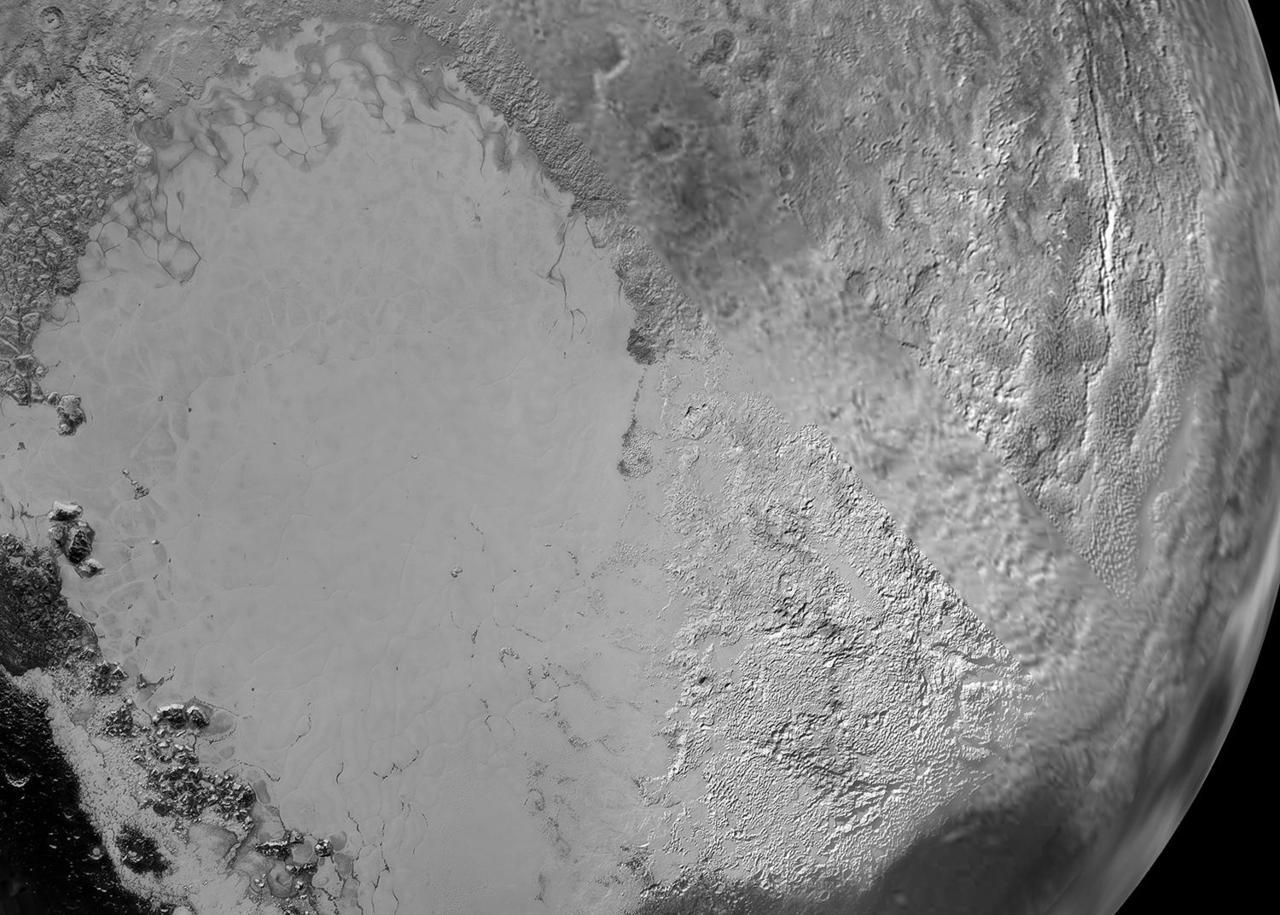
    Since the New Horizons probe visited Pluto in 2015, scientists have suspected that Sputnik Planitia (a.k.a. Pluto’s Heart), shown above, may hide a subsurface ocean. But it’s tough to explain how that ocean could stay warm enough to be liquid while the surface ice remains cold and viscous enough to support the variations in thickness we see. One theory cites the possibility of ammonia in the ocean, essentially serving as anti-freeze, but that would require much higher concentrations of ammonia than have been observed in comets – which, like Pluto, spend most of their time in the icy, frigid regions of the Kuiper Belt.

    A new study suggests another theory: a layer of gas-trapping hydrates between the liquid ocean and its icy cap. A thin layer of clathrate hydrates, as proposed by the authors, would trap gases like methane and create a thermally-insulating layer between a warm ocean and much colder ice cap. Because heat would struggle to cross the insulation layer, the water beneath would stay above the freezing point without the cold ice above leeching all of its warmth away.

    It would likely require future missions to Pluto or other potential ocean worlds to confirm the presence of such a hydrate layer, but, for now, the theory provides a possible new explanation for how icy objects like Pluto maintain liquids. (Image credit: NASA/JHU Applied Physics Laboratory/SwRI; research credit: S. Kamata et al.; via Gizmodo)

  • Phase-Switching to Avoid Icing

    Phase-Switching to Avoid Icing

    Preventing ice and frost from forming on surfaces – especially airplane wings – is a major engineering concern. The chemical de-icing cocktails currently used in aviation are a short-lived solution, and while superhydrophobic surfaces can be helpful, they tend to be easily damaged and therefore impractical. Another possible solution, shown here, are so-called phase-switching liquids – substances like cyclohexane that have freezing points higher than that of water. This means that they form a solid coating near the freezing temperature of water.

    Water droplets on these coatings move in a random stick-slip walk (above) but they tend not to freeze. This is because freezing requires the droplets to release heat, which melts part of the phase-switching liquid. Now, instead of solidifying to the surface, the droplet moves on a film of the phase-switching liquid. Re-freezing that liquid is tough because it’s thermodynamically unfavorable, and the smoothness of the liquid layer makes it harder for ice to find a nucleation point. In lab tests, the phase-switching liquid surfaces resisted ice and frost more than an order of magnitude longer than conventional materials. (Image and research credit: R. Chatterjee et al.; video credit: Univ. of Illinois at Chicago; submitted by Night King)

  • Reducing Viscosity With Bacteria

    Reducing Viscosity With Bacteria

    Conventional wisdom – and the Second Law of Thermodynamics – require all fluids to have viscosity, with the noted and bizarre exception of superfluids, which can flow with zero viscosity. In essence, you cannot have work (i.e. flow) for free. Some effort has to be lost to resistance.

    But scientists have discovered, bizarrely, that adding bacteria to water can result in zero or even negative viscosities – meaning that effort is required to keep the flow from accelerating. Before you ask, no, this is not a recipe for a perpetual motion machine. What happens when the bacteria-filled fluid is sheared is that the bacteria align and start collectively swimming. The local effects of each bacteria combine en masse to create a fluid that seemingly flows on its own. In the end, though, it’s the bacteria that are supplying that work. It certainly raises interesting prospects, though, for harnessing the power of bacterial superfluids. See the links below for more. (Image credit: M. Copeland, source; research credit: S. Guo et al.A. Loisy et al.; via Quanta; submitted by Kam-Yung Soh)

  • Featured Video Play Icon

    The Drinking Bird

    At first glance, the drinking bird is a simple desk toy, but the physics and engineering behind the device is clever enough to have challenged many great minds. In this video, Bill Hammack dissects the drinking bird, revealing the heat engine beneath the felt and feathers. The bird’s drinking is driven by thermodynamics and the relative pressures of fluids in its head and body. When the beak is wetted, fluid wicks up the felted head and slowly evaporates, thereby cooling the vapor inside the head. Some of that vapor condenses, lowering the vapor pressure in the head and allowing liquid to rise from the body. When enough fluid reaches the head, the bird tips forward. This allows vapor to rise up the liquid column into the head, equalizing the pressure between the two ends. The bird sits up with a freshly wetted head and starts the cycle over. Check out the full video for more detail, including a look at what other methods can drive the bird, including bourbon and light bulbs. (Video and image credit: B. Hammack; via J. Ouellette)

  • Resisting Coalescence

    Resisting Coalescence

    When a droplet falls on a pool, we expect it to coalesce. There are exceptions, like bouncing droplets, but in general a droplet only sticks around for a split second before being engulfed. And yet, from morning coffee (top image) to walks in the woods, we frequently see millimeter-sized droplets sticking around for far longer than it seems like they should. New research offers a clue as to why: it’s thanks to a temperature difference. 

    When there’s an appreciable temperature difference between the drop and the pool, it causes rotating convective vortices (bottom image) in both the drop and the pool. When the temperature difference is large, the vortices are strong enough that their motion recirculates air inside the tiny gap between the drop and the pool. This supports the weight of the drop and keeps the two liquids separate. But the convection also redistributes heat, and eventually the drop and pool become similar enough in temperature that the circulation dies out, the air gap drains, and the two coalesce. (Image and research credit: M. Geri et al.; via MIT News; submitted by Antony B.)

  • The Mist of Champagne

    The Mist of Champagne

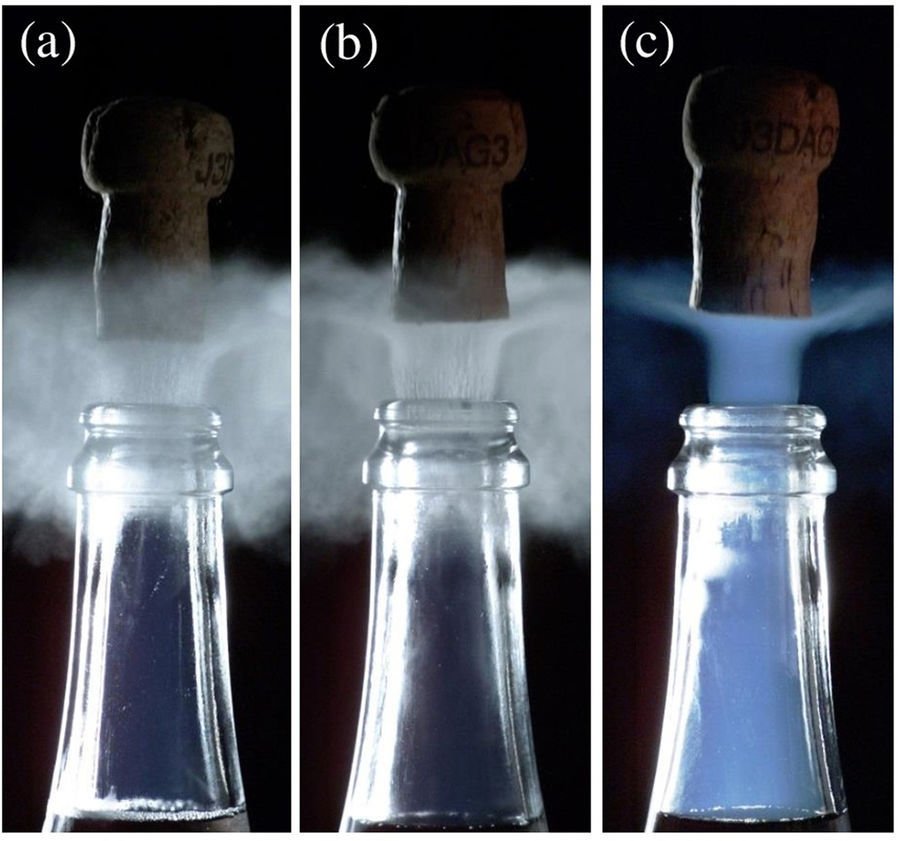
    If you’ve ever popped open a chilled bottle of champagne, you’ve probably witnessed the gray-white cloud of mist that forms as the cork flies. Opening the bottle releases a spurt of high-pressure carbon dioxide gas, although that’s not what you see in the cloud. The cloud consists of water droplets from the ambient air, driven to condense by a sudden drop in temperature caused by the expansion of the escaping carbon dioxide. Scientifically speaking, this is known as adiabatic expansion; when a gas expands in volume, it drops in temperature. This is why cans of compressed air feel cold after you’ve released a few bursts of air.

    If your champagne bottle is cold (a) or cool (b), the gray-white water droplet cloud is what you see. But if your champagne is near room temperature ( c ), something very different happens: a blue fog forms inside the bottle and shoots out behind the cork. To understand why, we have to consider what’s going on in the bottle before and after the cork pops.

    A room temperature bottle of champagne is at substantially higher pressure than one that’s chilled. That means that opening the bottle makes the gas inside undergo a bigger drop in pressure, which, in turn, means stronger adiabatic expansion. Counterintuitively, the gas escaping the warm champagne actually gets colder than the gas escaping the chilled champagne because there’s a bigger pressure drop driving it. That whoosh of carbon dioxide is cold enough, in fact, for some of the gas to freeze in that rushed escape. The blue fog is the result of tiny dry ice crystals scattering light inside the bottleneck.

    That flash of blue is only momentary, though, and the extra drop in temperature won’t cool your champagne at all. Liquids retain heat better than gases do. For more, on champagne physics check out these previous posts. (Image and research credit: G. Liger-Belair et al.; submitted by David H.)

  • Creating Clouds

    Creating Clouds

    Despite their ubiquity and importance, we know surprisingly little about how clouds form. The broad strokes of the process are known, but the details remain somewhat fuzzy. One challenge is understanding how nucleation – the formation of droplets that become clouds or rain – works. A recent laboratory experiment in an analog cloud chamber suggests that falling rain drops may help spawn more rain drops.

    The experiment takes place in a chamber filled with sulfur hexafluoride and helium. The former acts like water in our atmosphere, appearing in both liquid and vapor forms, while the latter takes the place of dry components of our atmosphere, like nitrogen. The bottom of the chamber is heated, forming a liquid layer of sulfur hexafluoride, seen at the bottom of the animation above. The top of the chamber is cooled, encouraging sulfur hexafluoride vapor to condense and form droplets that fall like rain. A top view of the same apparatus during a different experiment is shown in this previous post.

    When droplets fall through the chamber, their wakes mix cold vapor from near the drop with warmer, ambient vapor. This changes the temperature and saturation conditions nearby and kicks off the formation of microdroplets. These are the cloud of tiny black dots seen above. Under the right conditions, these microdroplets grow swiftly as more vapor condenses onto them. In time, they grow heavy enough to fall as rain drops of their own. (Image credits: P. Prabhakaran et al.; via APS Physics; submitted by Kam-Yung Soh)

  • Featured Video Play Icon

    Supercritical

    Supercritical fluids are neither a gas nor a liquid. The video above shows a tube of pressurized xenon, initially below its boiling point of approximately ~16 deg C. As the temperature is raised, you see the meniscus that marks the liquid xenon disappear. At this point, the xenon has transitioned into the supercritical state. It takes up the entire tube – like a gas – but it is still capable of dissolving materials – like a liquid. At the same time, though, the xenon has no surface tension because there’s no liquid/vapor interface. Toward the end of the video, the temperature gets reduced and the xenon condenses back into a liquid state. Supercritical fluids can be used in a wide variety of industrial applications, including in decaffeination, dry cleaning, and refrigeration. (Video credit: wwwperiodictableru)

  • A Molecular View of Boiling

    A Molecular View of Boiling

    All matter is made up of molecules. But most of the time we treat fluids as materials with given properties – like density, viscosity, and surface tension – without worrying about the individual molecules responsible for those material characteristics. Now that we have much more powerful computers, though, we can begin to simulate fluid behavior in terms of molecules.

    The animations above show some examples of this. In the top animation, we see a gas condensing into a liquid. As the temperature decreases, molecules start clumping together, and eventually settle into a droplet on the solid surface. The lower animation shows the opposite situation – boiling – in which bubbles of vapor nucleate next to the solid surface and grow as more liquid changes phase. To see more examples, including droplets pinching off, check out the full video.   (Image credit: E. Smith et al., source; submitted by O. Matar)