Tag: thermodynamics

  • Featured Video Play Icon

    Tricking a Kettle

    Electric kettles are designed to shut off when the water inside them boils. But what does that mean exactly? In this video, Steve Mould explores that question by trying to trick his kettles into boiling off ethanol, a liquid with a lower boiling temperature than water. Steve figures that, if a kettle is designed to shut off at 100 degrees Celsius (water’s boiling point), then it will overboil ethanol since its temperature will never get that high.

    I’ll let you watch the video and see what happens…

    (more…)
  • Inside a Super-Earth

    Inside a Super-Earth

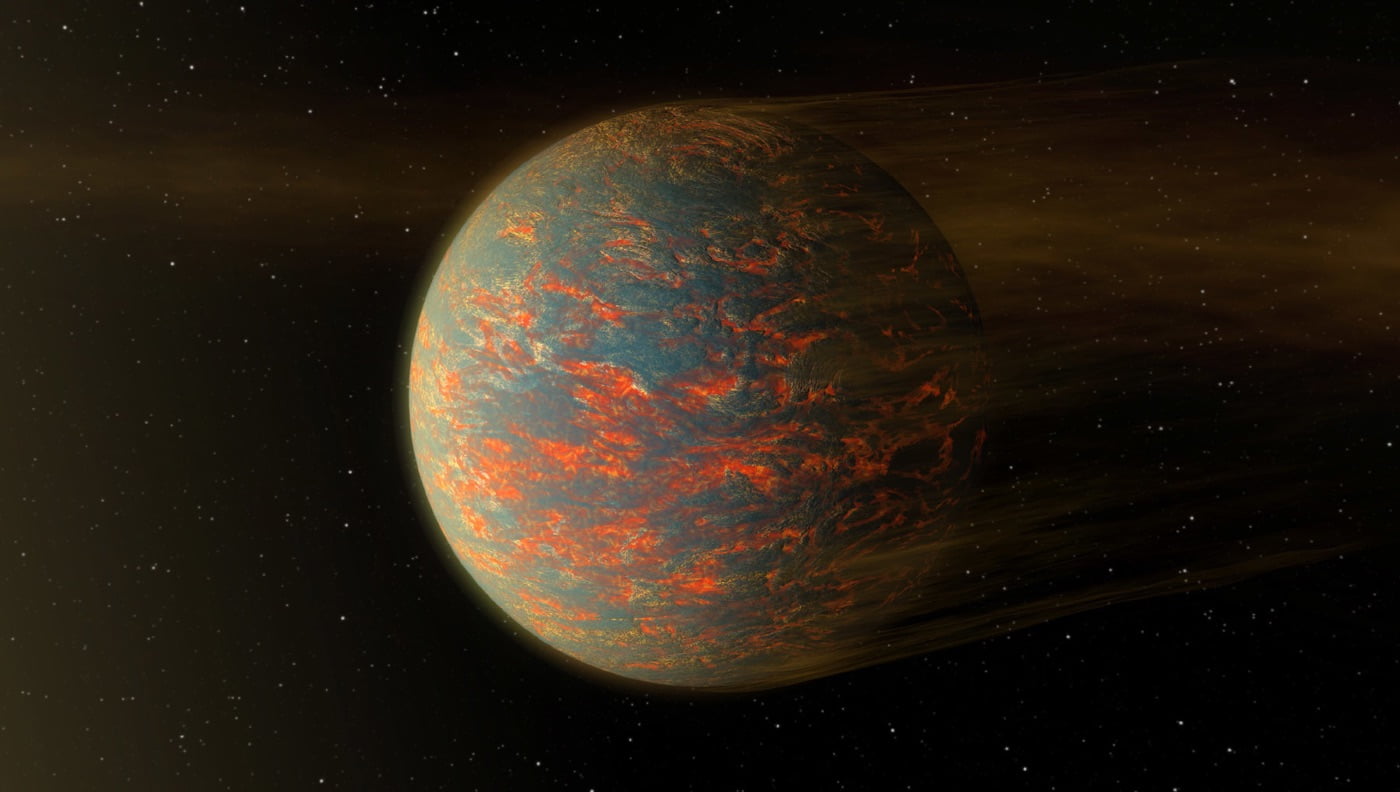
    When studying exoplanets, scientists often judge habitability by the possibility of liquid water on the planet’s surface. But there is more to Earth’s habitability than water. The liquid iron dynamo within our planet is critical for life here because it generates magnetic fields that protect the planet from harmful solar radiation. It’s been difficult to predict what the interiors of a bigger and more massive planet like a super-Earth would look like, but a recent study changes that.

    Researchers at the National Ignition Facility used its high-powered lasers to subject liquid iron to conditions similar to those expected in a super-Earth’s core, including pressures as high as ~1000 GPa. That’s more than 3 times higher than pressures at the boundary where Earth’s liquid iron meets its solid core. Based on their findings, the team concluded that super-Earths likely have a similar interior structure to our planet, with a solid iron-heavy core surrounded by churning liquid iron capable of generating a protective magnetosphere. (Image credit: NASA; research credit: R. Kraus et al.; via Science)

  • Viscosity and Quantum Mechanics

    Viscosity and Quantum Mechanics

    Viscosity describes a fluid’s resistance to changing its shape. Like surface tension, it’s a fundamental property of a fluid that comes from the interactions between molecules. But viscosity is a slippery beast, and especially so for liquids. There is no generic way to calculate a liquid’s thermodynamic properties from quantum dynamical first principles. But that hasn’t stopped theoretical physicists from making progress on deducing the connections between quantum mechanics and liquids.

    Although viscosity changes with temperature, all liquids have a minimum viscosity, and those minima are all fairly close to the same value as water’s (excluding any superfluids, which are their own brand of quantum weirdness). Why would liquids share a similar minimum viscosity? Because it turns out the minimum viscosity is quantum! Physicists found that the minimum viscosity is set by an equation depending on Planck’s constant and the mass of an electron — both fundamental constants.

    Physicists sometimes like to conjecture about the habitability of the universe if fundamental quantities like Planck’s constant had a different value. This work shows that changing that value would alter water’s viscosity, completely changing the viability of microscopic life! (Image credit: A. Rozetsky; research credit: K. Trachenko and V. Brazhkin; via Physics Today)

  • Freezing Splats

    Freezing Splats

    When a drop hits a surface colder than its freezing point, there’s a competition between retraction and solidification that determines the final shape of the splat. For many materials, like wax or soldering metals, the contact angle between their liquid and solid phase is zero, so there’s no major shape change once solidification begins. But water — as is so often the case — is an exception.

    Water and ice have a non-zero contact angle, which means that retraction can continue even after the drop begins freezing. As a result, the final shape of the splat varies depending on how cold the surface is. For a surface only a little colder than the freezing point, the final splat forms a spherical cap (Image 1). But once the surface is colder, freezing happens before the water can fully retract and the final splat forms a ring (Image 2). (Image and research credit: V. Thiévenaz et al.)

  • Watching a Droplet Freeze

    Watching a Droplet Freeze

    Whether it’s rain hitting an airplane wing or droplet-based 3D printing, the dynamics of a droplet impacting and solidifying on a surface are important. This new study observes the process from below, tracking the progress of freezing on a scale of hundreds of nanoseconds.

    All three of the drops you see above are liquid hexadecane. Each droplet was the same size and impacted at the same velocity. What differs in each image is how much colder the surface was than hexadecane’s melting point. The leftmost image shows a droplet on a surface only a few degrees cooler than the melting point. The initial expanding ring shows the droplet’s contact line expanding as it impacts. Then frozen crystals appear and grow inside the drop until the entire thing freezes.

    With a slightly colder surface (middle image), frozen crystals form while the contact line is still expanding, and rather than form in distinctive spots, they form as a cloud that quickly expands throughout the drop.

    But with an even colder surface (right image), something entirely new happens. As the drop freezes, we see multiple dark rings expand through the drop. Each of these rings is made up of frozen crystals. The researchers argue that we’re seeing a combination of freezing and hydrodynamics here. Essentially, whenever the frozen crystals get large enough, the outward flow of the impacting drop sweeps them toward the contact line. As new crystals grow near the center of the drop, they’re dragged out in a subsequent wave. (Image, research, and submission credit: P. Kant et al.)

  • Featured Video Play Icon

    Why Compressed Air Cans Get Cold

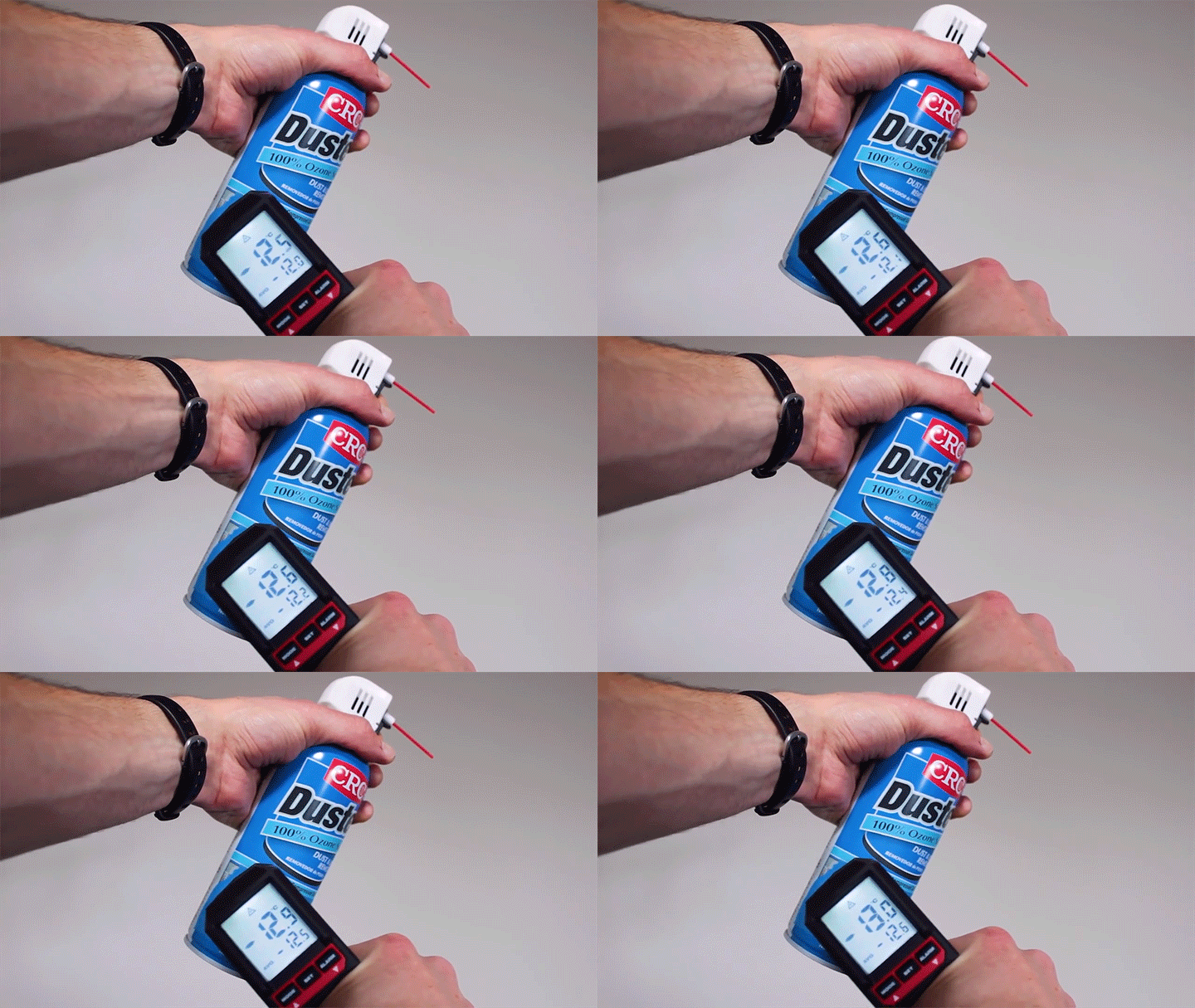
    Anyone who’s used a can of compressed air to clean their computer or keyboard knows that the can quickly gets quite cold to the touch. This Minute Physics video explores some of the thermodynamics behind that process. Henry first identifies a few explanations that don’t quite line up with observations, before focusing in on the contents of the can: 1,1-difluoroethane. Inside the sealed can, this chemical sits in an equilibrium of part-liquid, part-vapor. But when pressure is released by opening the nozzle, the liquid boils, generating extra vapor and cooling whatever remains in the reservoir.

    Although it’s not a good explanation for the compressed air can’s cooling, the cooling of an expanding gas is very important in applications like supersonic wind tunnels. That first equation you see at 0:36 in the video (for isentropic adiabatic expansion) is key to what happens in a nozzle with supersonic flow. As the flow accelerates to supersonic speeds, its temperature drops dramatically. When I was in graduate school, we actually had to preheat our hypersonic wind tunnel (in pretty much the same way you would preheat your oven at home) before we ran at Mach 6 because otherwise the temperature inside the test section would drop so low that the oxygen would liquefy out of the air! (Image and video credit: Minute Physics)

  • Featured Video Play Icon

    The Cricket’s Chirp

    Growing up, my summer nights often featured a chorus of crickets and bull frogs. Even now, the sound of those chirps reminds me of home. So how do crickets make their calls? As this video shows, it’s a matter of scraping the hard edge of one wing along a tiny series of spines, similar to the teeth of a comb, that sit on the other wing.

    How fast the cricket’s wings move affects how frequently the chirps are heard. Being cold-blooded, the insects’ speed is affected by the external temperature, which is why you can count cricket chirps to estimate the temperature. Essentially, the chemical reactions necessary to regulate wing movement are temperature-dependent, so colder crickets produce slower chirps. (Video and image credit: Deep Look)

  • Featured Video Play Icon

    Boiling Water Using Ice Water

    Steve Mould demonstrates a neat thermodynamic trick in this video by using ice water to boil hot water. The key to understanding this is recognizing that the boiling point of water depends both on its temperature and its pressure.

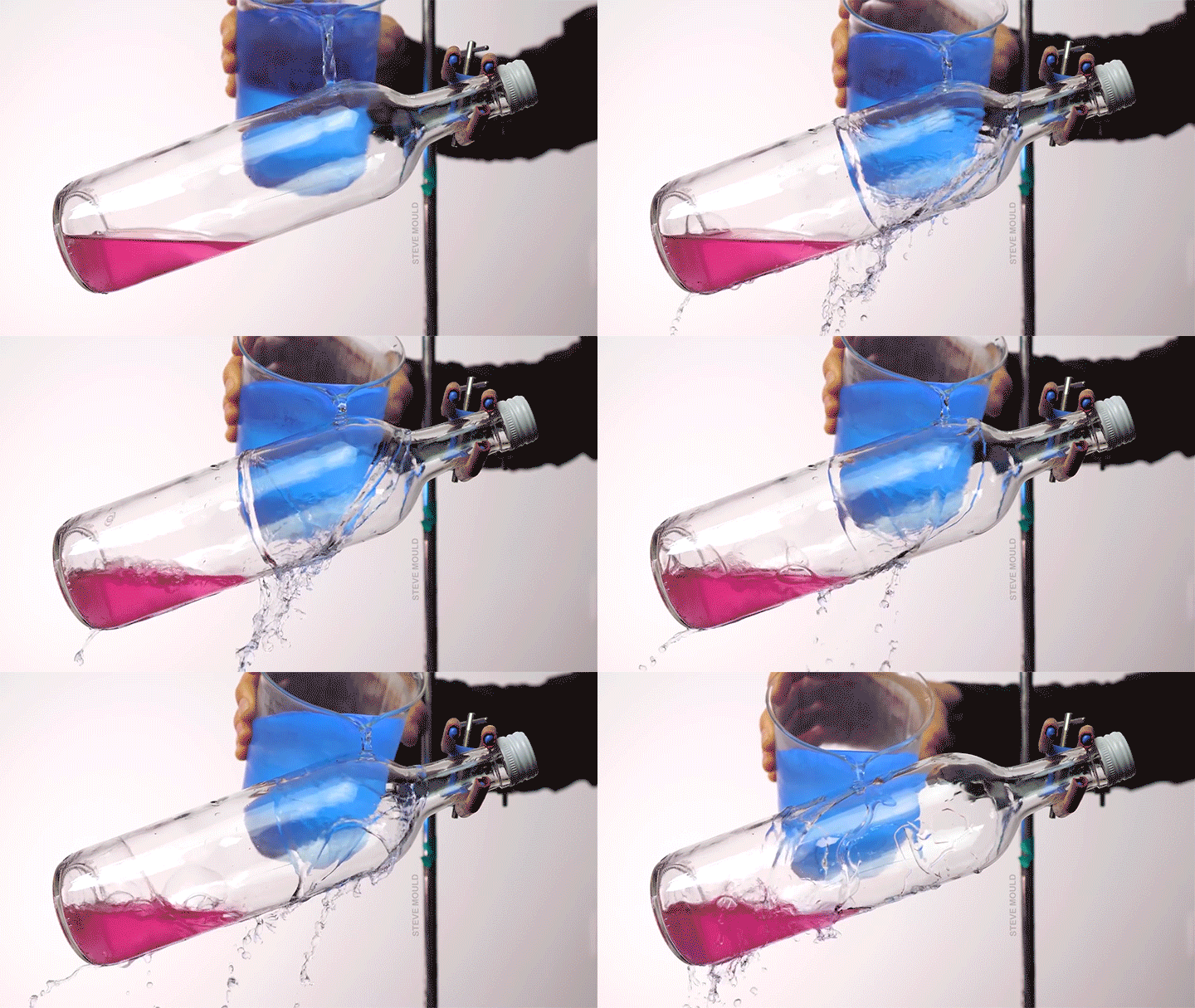
    Here’s the set-up (which, to be clear, neither he nor I recommend you try yourself): microwave some water in an open bottle until the water is hot enough to boil. Remove the bottle from the microwave and screw on the lid. At this point, you’ve confined any water vapor coming off the hot water, thereby raising the pressure inside the bottle. Even though it’s still quite hot, the water will stop visibly boiling.

    Now pour ice water over the top of the bottle. Because water vapor has a lower heat capacity than liquid water, this will preferentially cool the vapor. As its temperature drops, its pressure will also drop. Liquid water boils at lower temperatures when the pressure is lower. (This is part of why cooking and baking instructions are quite different in Denver than they are in Miami.) When the internal pressure in the bottle drops, the remaining hot water will start to visibly boil. (Image and video credit: S. Mould)

    Animation of boiling water using ice water.
  • Freezing Bubbles

    Freezing Bubbles

    Scientists have observed distinctive differences in the way soap bubbles freeze depending on their environment. If a bubble is surrounded by room temperature air but placed on a cold surface (top), it freezes from the bottom up, with a clear freeze front that slowly creeps upward.

    In contrast, bubbles in an isothermal environment – one where it’s equally cold everywhere – freeze with a snow-globe-like effect of ice crystals (bottom). This freezing mode is actually triggered by a Marangoni flow. As the thin bottom layer of the soap bubble begins to freeze, it releases latent heat. That local heating changes the surface tension enough to generate an upward flow. You can see the plumes form right as the bubble touches the surface. Those plumes lift up tiny ice crystals, which continue to grow, ultimately forming the snowy crystals we see take over the surface. (Image and research credit: S. Ahmadi et al.; submitted by Kam-Yung Soh)

  • Featured Video Play Icon

    Supercooling Thermodynamics

    In the latest Gastrofiscia episode, Tippe Top Physics takes on thermodynamics and the complicated truth behind certain phase changes. Although we’re accustomed to thinking of water freezing at 0 degrees Celsius and boiling at 100 degrees Celsius, reality is more complex, and temperature is only one of the factors that goes into a change of phase. Pressure and purity also play an important role. 

    This is why it’s possible, for instance, to supercool purified water to below 0 degrees Celsius without freezing it. Liquid water needs a nucleus to serve as a seed for its freezing. Without dust or other impurities, it takes a lot of energy for water to spontaneously generate its own nucleus. Check out the full video to see how and why that’s so. (Image and video credit: Tippe Top Physics)