
A labyrinthine pattern forms in this timelapse video of a multiphase flow in a Hele-Shaw cell. Initially glass beads are suspended in a glycerol-water solution between parallel glass plates with a central hole. Then the fluid is slowly drained over the course of 3 days at a rate so slow that viscous forces in the fluid are negligible. As the fluid drains, fingers of air invade the disk, pushing the beads together. The system is governed by competition between two main forces: surface tension and friction. Narrow fingers gather fewer grains and therefore encounter less friction, but the higher curvature at their tips produces larger capillary forces. The opposite is true of broader fingers. Also interesting to note is the similarity of the final pattern to those seen in confined ferrofluids. (Video credit and submission: B. Sandnes et al. For more, see B. Sandes et al.)
Tag: science

“Cascades”
Ryan Teague’s “Cascades” music video features the enchanting process of ice growth. A chamber full of supercooled water vapor subject to a strong electric field is stimulated to grow crystals by providing a needle as the initial nucleation site. Because the vapor is supercooled, it will freeze upon contact with the nucleation site; the electric field keeps the water molecules aligned so that the crystal patterns formed are more even. The tree-like pattern seen here is called dendritic crystal growth; branches form at faults in the crystalline pattern. (Video credit: Ryan Teague, Village Green, Words are Pictures; via Gizmodo)

Viscous Dripping

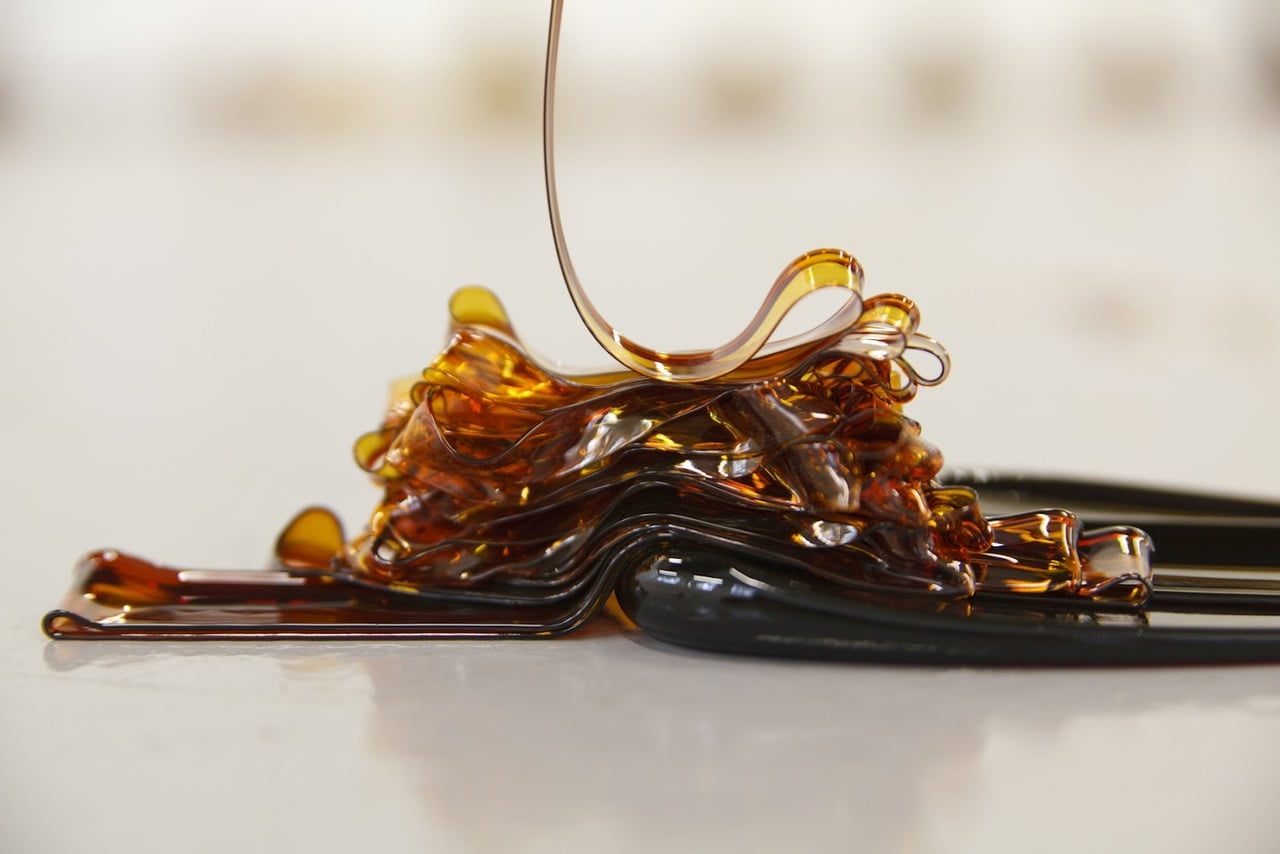


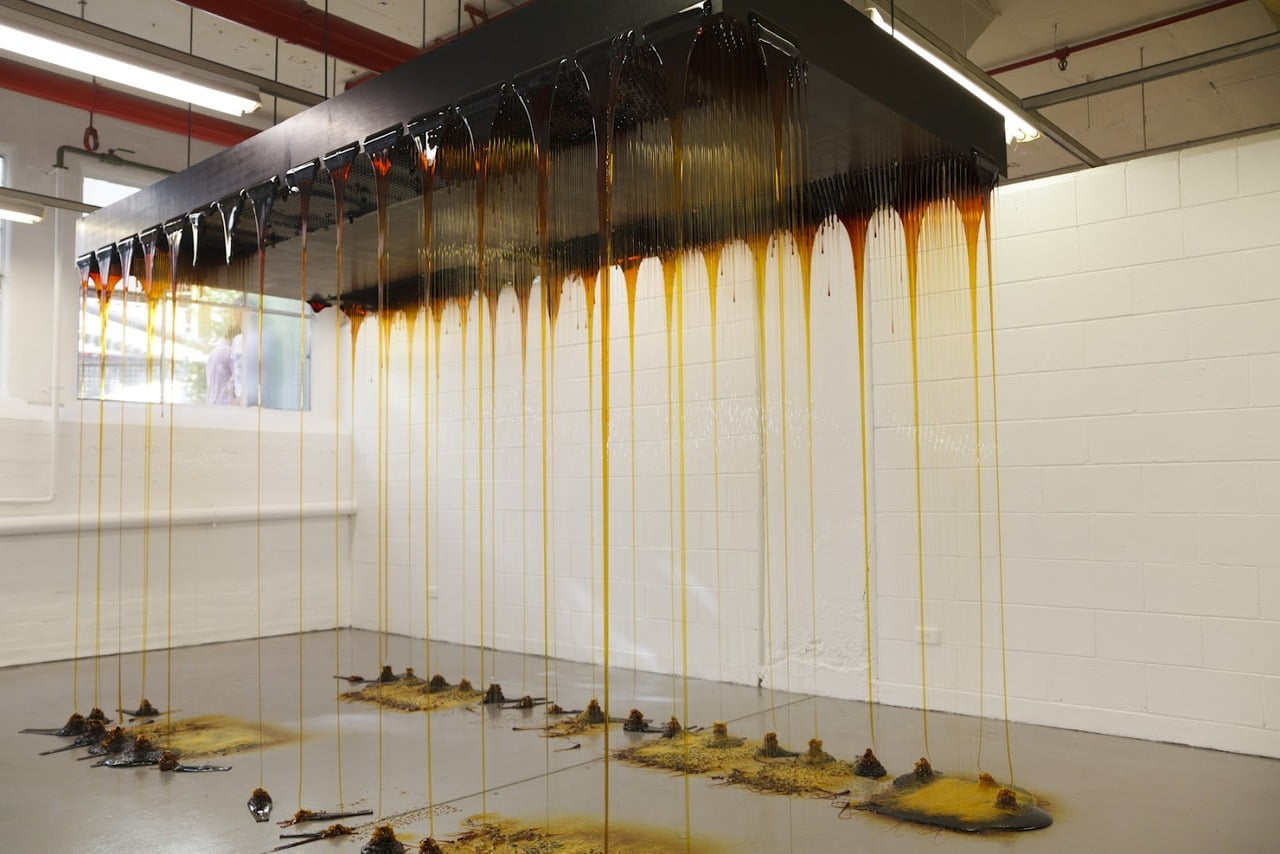

Artist Skye Kelly’s “Creep (strain)” sculpture shown above is made from toffee. The viscous fluid deforms under the force of gravity, resulting in elongated drips and slow jets that buckle and coil upon reaching the floor. (Photo credits: Skye Kelly; via freshphotons)
Why Tacoma Narrows Bridge Fell
We’ve talked about aeroelastic flutter and the demise of the Tacoma Narrows Bridge before, but this explanation from Minute Physics does a nice job of outlining the process simply. As noted in the video, the common explanation of resonance is inaccurate because the wind was constant, so there was no driving frequency for the system. (In contrast, consider vibrating a fluid where the response of the fluid depends on the frequency of the vibrations. This is resonance.) Instead the constant wind supplied energy that fed the natural frequencies of the structure such that an uncontrolled excitation built up. (Video credit: Minute Physics)
Antibubbles
Antibubbles–a liquid droplet surrounded by a thin film of gas and immersed in more liquid–are fragile things. This video explores how antibubbles behave when placed in proximity to a tornado-like whirl. When placed near the eye, where fluid motion is primarily vertical, the antibubble is stretched vertically. When placed in the rotating eyewall, the antibubble is distorted into a ring-like shape before it breaks down. (Video credit: D. Terwagne et al; APS Gallery of Fluid Motion 2009)

Fractal Fluids
These images from a numerical simulation of a mixing layer between fluids of different density show the development and breakdown to Kelvin-Helmholtz waves. The black fluid is 3 times denser than the white fluid, and, as the two layers shear past one another, billow-like waves form (Fig 1(a)). Inside those billows, secondary and even tertiary billows form (Fig 1(a) and (b)). Fig 1 (c)-(e) show successive closeups on these waves, showing their beautiful fractal-like structure. (Photo credit: J. Fontane et al, 2008 Gallery of Fluid Motion) #
How Mosquitoes Fly in the Rain
One might think that rainfall would keep the mosquitoes away, but it turns out that rain strikes don’t bother these little pests much. Because the insect is so small and light compared to a falling raindrop, the water bounces off instead of splashing. This results in a relatively small transfer of momentum, although the mosquito does get deflected quite strongly. Researchers estimate that the insects endure accelerations up to 300 times that of gravity, which is more than 10 times what a human can withstand. (Video credit: A. Dickerson et al; submitted by Phillipe M.)
Dancing Sands
Here a collection of dry grains are vertically vibrated, creating a series of standing waves on the surface of the sand. The shapes of these Faraday waves are dependent upon the frequency of the vibration. Despite the solid nature of sand particles, this behavior is much the same as the behavior of a vibrated fluid.

Splash Rebound
A ball dropped onto a puddle loses some of its rebound momentum to fluid motion. On impact, a splash curtain and radial jet form as the fluid is displaced by the ball. As the ball rebounds, the splash curtain is drawn inward into a column of fluid drawn up by the ball, reminiscent of the way cats and dogs drink. Eventually, when the gravity’s force on the fluid column overcomes the force of the ball’s inertia, the fluid column pinches off and falls back downwards, leaving the ball free to utilize its remaining kinetic energy as it flies upward. (Photo credit: T. Killian, K. Langley, and T. Truscott)
Dolphin Bubble Rings
Dolphins create vortex rings to play with by exhaling through their blowholes. The sharp impulse of air, combined with the round shape, creates a vortex ring of bubbles. Humans can do this underwater, too, but dolphins aren’t content to lie at the bottom of the pool. Because smaller vortex rings are more coherent and last longer, they will break the growing vortex so that the vortex fragment rejoins as a smaller vortex ring. They also spin the water nearby to cause wave instabilities in the ring.

