A buoyant plume of smoke rises from a stick of incense. At first the plume is smooth and laminar, but even in quiescent air, tiny perturbations can sneak into the flow, causing the periodic vortical whorls seen near the top of the photo. Were the frame even taller, we would see this transitional flow become completely chaotic and turbulent. Despite having known the governing equations for such flow for over 150 years, it remains almost impossible to predict the point where flow will transition for any practical problem, largely because the equations are so sensitive to initial conditions. In fact, some of the fundamental mathematical properties of those equations remain unproven. (Photo credit: M. Rosic)
Tag: science

The Kelvin-Helmholtz Instability in the Lab
Though often spotted in water waves or clouds, the Kelvin-Helmholtz instability is easily demonstrated in the lab as well. Here a tank with two layers of liquid – fresh water on top and denser blue-dyed saltwater on the bottom – is used to generate the instability. When level, the two layers are stationary and stable due to their stratification. Upon tilting, the denser blue liquid sinks to the lower end of the tank while the freshwater shifts upward. When the relative velocity of these two fluids reaches a critical point, their interface becomes unstable, forming the distinctive wave crests that tumble over to mix the two layers. (Video credit: M. Stuart)
Turning Sound into Light
Sonoluminescence – the creation of light from sound – was discovered in the 1930s, and, due to the difficulty of obtaining direct measurements, the exact mechanism remains highly debated even today. The phenomenon typically takes place within a tiny cavitation bubble inside a liquid. When bombarded with ultrasonic sound, such a bubble will repeatedly expand and collapse. Once a bubble is established, the cycle can be kicked off by increasing the driving acoustic pressure. This will collapse the bubble, drastically increasing its pressure and temperature (up to thousands of degrees Kelvin) and causing the bubble to emit a pulse of light before the pressure imbalance causes it to expand again. Several theories exist as to how the light is generated, the leading one being that the high temperatures in the bubble ionize the noble gases within and that those free electrons emit light via thermal bremstrahlung radiation. Sonoluminescence happens outside the lab, too. Both the previously discussed pistol shrimp and the mantis shrimp generate such light-emitting bubbles when hunting. (Video credit: The Point Studios; suggested by Bobby E.)

The Kaye Effect
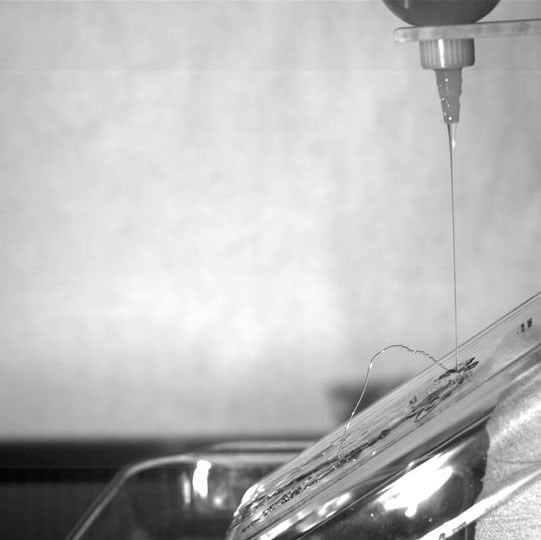
When a viscous fluid falls onto a surface, it will form a heap, like honey coiling. But for shear-thinning liquids like soap or shampoo something a little wild can happen as the heap grows. A dimple can form and, when the incoming jet of fluid hits that dimple, it slips against it and is ejected outward. If you wonder why you don’t see this every day in the shower, it’s because the outgoing jet usually hits the incoming jet, causing the whole system to collapse in less than 300 ms. By dropping the fluid on an inclined surface, one can keep the two jets from colliding, thereby creating a stable Kaye effect. (Photo credit: E. Eichelberger)
Bubble Lenses
In this video, artist Jesse Zanzinger experiments with the lens-like refractive properties of bubbles. Though focused on the bending of light, there’s plenty here in terms of coalescence, surface tension, and miscibility. He has a similar video that includes a shot of his set-up here. (Video credit: J. Zanzinger)

Fluids Round-up – 25 May 2013
Sometimes I come across cool links and stories about fluid dynamics that don’t quite fit into a typical FYFD post, but I’d like to start sharing those semi-regularly with round-up posts. Here’s some fun stuff I’ve seen lately:
- We’ve talked before about penguins and fluid dynamics, but this IOP talk from Helen Czerski is a great take on how they use fluids to escape predators.
- Over at FlowViz, Richard has a great video demonstrating deep versus shallow water waves side-by-side.
- io9 shows off the vibrational modes of mercury as well as explaining why birds can be good at flying or swimming but not both.
- Giant paint explosions (specifically here) may be fun to watch but the dangers are not for squeamish viewers.
- Dylan G sent us this 512K real-time fluid particle simulation that’s a fun distraction.
- xckd’s Randall Munroe answers all kinds of physics questions at his What If? blog, but occasionally there are some fluids ones. Two of my favorites consider a hypersonic steak and what happens if the glass is literally half full.
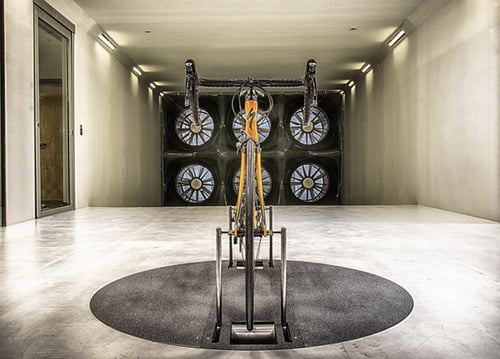
- Finally, for the cyclists and triathletes among you, the recent news that bicycle manufacturer Specialized has built its own wind tunnel has generated lots of discussion of aerodynamics in sport. Mark Cote (@MITAeroBike) and Chris Yu (@chrisyuinc) of Specialized’s aero R&D have been answering questions on Slowtwitch, Twitter, and in live chats.
And, yes, that last Specialized video chat includes an FYFD shout-out about 49 minutes in. 🙂
(Photo credit: Specialized)

Turbulence and Magnetic Field Lines
During a solar flare, magnetic field lines on the sun are often visible due to the flow of plasma–charged particles–along the lines. According to theory, these magnetic lines should remain intact, but they are sometimes observed breaking and reconnecting with other lines. An interdisciplinary team of researchers suggests that turbulence may be the missing link. In their magnetohydrodynamic simulation, they found that the presence of chaotic turbulent motions made the magnetic line motion entirely unpredictable, whereas laminar flows behaved according to conventional flux-freezing theory. (Photo credit: NASA SDO; Research credit: G. Eyink et al.; via SpaceRef; submitted by jshoer)
Breaking into Droplets
A falling column of liquid, like the water from your faucet, will tend to break up into a series of droplets due to the Plateau-Rayleigh instability. This instability is driven by surface tension. Small variations in the radius of the column occur naturally. Where the radius shrinks, the pressure due to surface tension increases, causing liquid to flow away, which shrinks the column’s radius even further. Eventually the column pinches off and breaks into droplets. What’s especially neat is that the size of the final droplets can be predicted based on the column’s initial radius and the wavelength of its disturbances. (Video credit: BYU Splash Lab)
Bouncing on a Pool
There’s something wonderfully serene about watching water droplets skate their way across the surface of a pool. Here the pool of water is being vibrated at a frequency just below the Faraday instability – meaning that no standing waves form on the surface. Instead, the bounce is just enough to create a thin layer of air between the droplet and the pool to prevent coalescence. With each bounce, gravity’s effect on the water tries to drain the air away, but each rebound lets more air rush in to hold the droplet up. Eventually, gravity wins and the droplets coalesce into the pool. In high-speed that process is mesmerizing, too. (Video credit: K. Welch)
Effects of Hills on Flow
Hills and other topology can have interesting and complex effects on a flowfield. With the FAITH experiment, NASA has been investigating an axisymmetric model hill using a combination of experimental methods. The video above shows flow visualization over the hill in a water channel using dye injection both upstream and downstream of the model. They’ve also done wind tunnel tests with oil-flow visualization, particle-image velocimetry, pressure sensitive paint and other measurement techniques. There are nice photos of some of these by Rob Bulmahn. By combining qualitative and quantitative flow measurement techniques, the researchers are able to capture many different aspects of the flow, which can then be shared and compared with other groups’ works. (Video credit: NASA Ames Research Center)