Large filter-feeders like the manta ray face the interesting challenge of obtaining enough small particulates like plankton to sustain an animal the size of a car. They do this through what is known as ram filter-feeding, essentially swimming open-mouthed through food-laden waters, filtering out the food, and releasing the water through their gills. Their internal filtration doesn’t simply catch particles like a colander does, though – it would be too easy for the ray’s filters to clog. Instead, the animals use several alternative methods to catch and redirect particles toward their esophagus. One, known as crossflow filtration, causes water to turn sharply through the filters. Heavier particles cannot accelerate that quickly, so they are carried onward. Another method, vortex filtration, works like a tiny centrifuge, spinning the water and ejecting the heavier particles back toward the esophagus. (Video credit: Science Friday; research credit: E. Paig-Tran, thesis)
Tag: science

Wrinkling Fluids
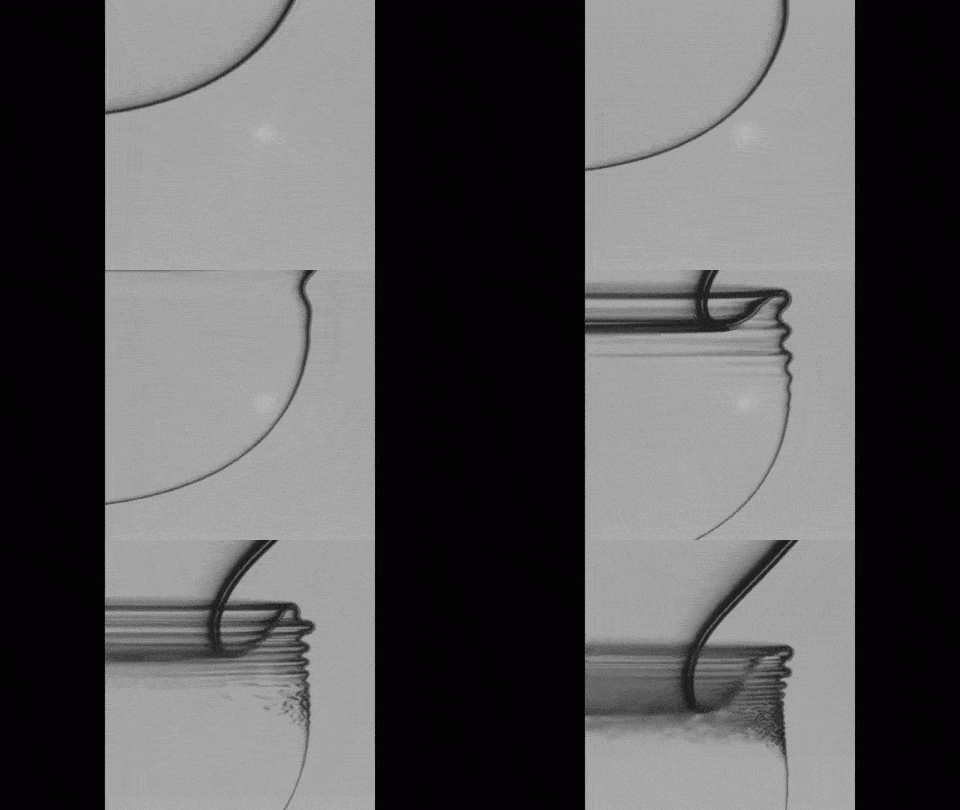
What you see here is a viscous drop falling into a less viscous fluid. Shear forces between the drop and the surrounding fluid cause the drop to quickly deform into a shape like an upside-down mushroom as it descends. The cap forms a vortex ring that curls the viscous fluid back on itself. As it does, that motion compresses the viscous sheet, causing it to wrinkle, as seen in the close-up in the bottom animation. Check out the full video here. (Image credit: E. Q. Li et al., source)

Singing Sand Dunes
Reports of singing sand dunes date at least as far back as 800 C.E. Strange as it sounds, about forty sites around the world have been associated with this phenomenon, in which avalanches of sand grains on the outer surface of the dune cause a deep, booming hum for up to several minutes. As you can hear in the video above, the sound of the dune is somewhat like a propeller-driven airplane. A leading explanation for this behavior is that it results not from the size or shape of the sand grains but from the structure of the underlying dune.
Measurements show that the booming sand dunes contain a hard packed layer of sand 1-2 meters below the surface. When sand at the surface is disturbed by the wind or sliding researchers, it creates vibrations. Those disturbances have trouble crossing into the air or into the harder layers below. Instead they resonate in the upper surface of the sand, which acts as a waveguide, reflecting and enhancing the sound, just as the body of a violin resonates to enhance the vibration of its strings. For more, check out this video from Caltech or the research paper linked below. (Video credit: N. Vriend; research credit: M. Hunt and N. Vriend, pdf)

Review: “Life in Moving Fluids”

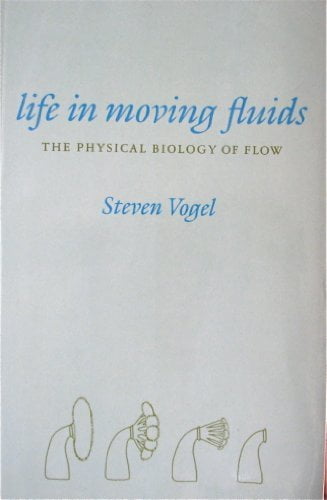
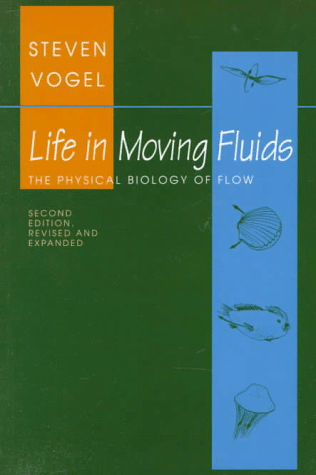
If you liked the prairie dog post earlier this week and you’re interested in more examples of biological fluid dynamics, you may enjoy Steven Vogel’s “Life in Moving Fluids”. I’m often asked for suggestions of readable textbooks for those who want an introduction to fluid dynamics, and this book is a great option. It addresses a wide variety of basic fluids concepts without getting as bogged down mathematically as many of the engineering texts do. It is written as an introduction to fluid dynamics for working biologists, though, so it contains plenty of technical detail – including relevant equations, discussions of basic flow measurement techniques, and overviews of the early academic literature.
It is also chock full of interesting biological applications of fluid dynamics with examples ranging from the growth patterns of barnacles to the shape-shifting drag capabilities of trees. Vogel keeps a light-hearted tone and dry humor throughout and doesn’t shy away from puns.
I read a first edition of the book (copyright 1981). The second edition, from the mid ‘90s, has updated coverage of the research literature, but I dare say the the topic has exploded within the last 20 years, so your mileage may vary with regard to the literature review. However, age in no way impacts the quality of Vogel’s coverage of the basics of fluid dynamics, and I feel confident in recommending this as an introductory text for those who’d like to pursue fluids in more depth. (Images: S. Vogel/Princeton U. Press; h/t to Chris R.)
Dyeing the River
Every year Chicago dyes part of its river green to celebrate St. Patrick’s Day. This timelapse video gives a great view of the 2016 dyeing. If you watch closely, you’ll see that what’s being put in the river isn’t originally green. It’s actually an orange powder being distributed through flour sifters by the men on the boat. The exact formula is secret, but the dye is considered environmentally safe. To mix up the dye, a chase boat follows the dye boat, using its motor and wake structure to help add some turbulence to the river. It takes several passes to get the water uniformly green, but it requires a remarkably small amount of dye to do so, only about a paint can’s worth. So enjoy a little fluid dynamics today with your festivities! (Or, if you prefer to celebrate a different sort of fluid dynamics today, allow me to offer you the physics of Guinness.) (Video credit: Chris B Photo)
Dancing Droplets
The seemingly-alive dancing droplets are back in a new video from Veritasium. These droplets of food coloring attract, merge, and chase one another due to evaporation and surface tension interactions between their two components: water and
propylene glycol. Because the droplets are constantly evaporating, they are surrounded by a cloud of vapor that helps determine a drop’s surface tension. These localized differences in surface tension are what causes the drops to attract. The chasing is also surface-tension-driven. Like any liquid, the drops will flow from areas of low surface tension to those of higher surface tension due to the Marangoni effect. Thus drops of different concentration appear to chase one another. This is a relatively simple experiment to try yourself at home, and Derek outlines what you need to know for it. (Video credit: Veritasium; research credit: N. Cira et al.; submitted by @g_durey)

Prairie Dog Physics

One challenge facing burrowing mammals is ensuring sufficient oxygen within their den. Prairie dogs achieve this with a clever use of Bernoulli’s principle. They build multiple entrances to their tunnels. One of them, labeled as Entrance A above, is built with a raised mound of dirt, while the other, Entrance B, is not. The raised mound creates an obstacle for the wind to move around, which increases the wind velocity at Entrance A compared to the normal wind speed at Entrance B. From Bernoulli’s principle, we know that a higher velocity means a lower pressure, so there is a decreasing pressure gradient through the tunnel from Entrance B to Entrance A. That favorable pressure gradient pulls fresh air through the prairie dog tunnels, allowing the colony to breathe easy. (Image credits: N. Sharp; original prairie dog photos by jinterwas and J. Kubina; final images shared under Creative Commons; research credit: S. Vogel et al.; h/t to Chris R.)
Pyroclastic Flow
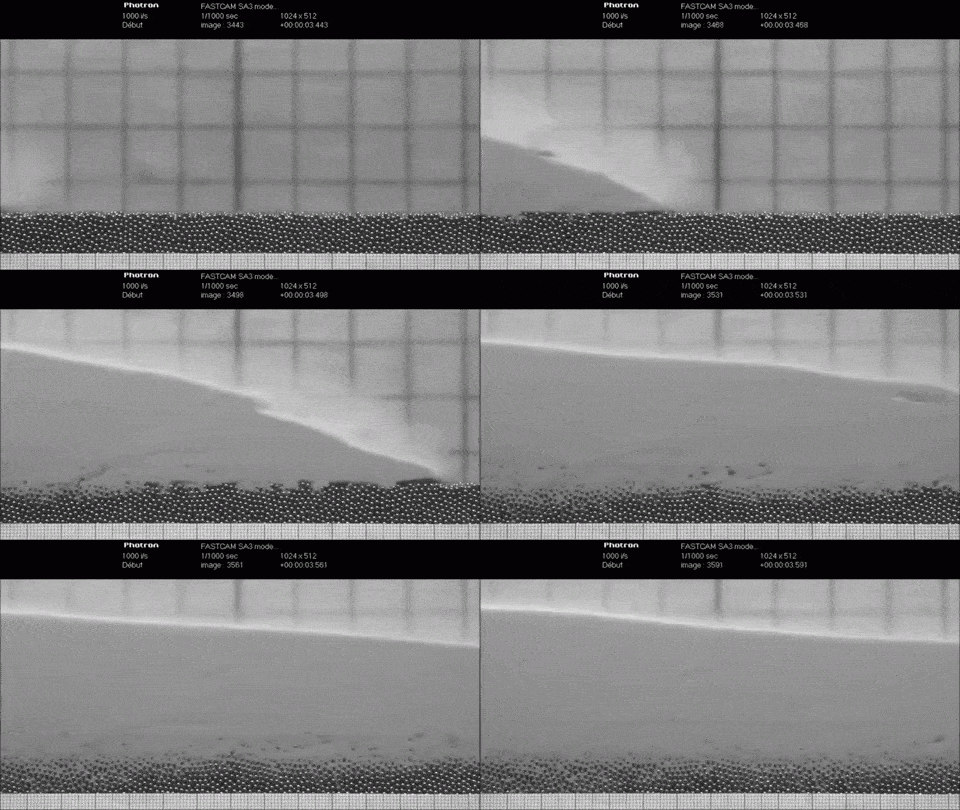
Major volcanic eruptions can be accompanied by pyroclastic flows, a mixture of rock and hot gases capable of burying entire cities, as happened in Pompeii when Mt. Vesuvius erupted in 79 C.E. For even larger eruptions, such as the one at Peach Spring Caldera some 18.8 million years ago, the pyroclastic flow can be powerful enough to move half-meter-sized blocks of rock more than 150 km from the epicenter. Through observations of these deposits, experiments like the one above, and modeling, researchers were able to deduce that the Peach Spring pyroclastic flow must have been quite dense and flowed at speeds between 5 – 20 m/s for 2.5 – 10 hours! Dense, relatively slow-moving pyroclastic flows can pick up large rocks (simulated in the experiment with large metal beads) both through shear and because their speed generates low pressure that lifts the rocks so that they get swept along by the current. (Image credit: O. Roche et al., source)
Rogue Wave Recreated
If you look online, the term “rogue wave” gets thrown around a lot – a whole lot. And most of the videos you see of “rogue waves”, “freak waves”, and “monster waves” are just, in fact, big waves. What makes a deep-water ocean wave a rogue, scientifically speaking, is that it is extreme compared to its surroundings. One definition requires that a rogue wave be more than twice as tall as the height of average large waves in the area – like the rogue that takes out the Lego boat above. Outside the lab, this is a rare event – fortunately – because a true rogue wave has tremendous destructive power and seems to appear out of the blue.
This seemingly unpredictable behavior is thought to arise from nonlinear interactions between waves. Essentially, under the right conditions, a rogue wave grows monstrously large by sucking energy out of other surrounding waves. One way to try and predict rogue waves is to measure all the waves nearby and simulate their potential nonlinear interactions computationally – but this is time-consuming and requires a lot of computing power.
Instead, researchers have developed an alternative method, illustrated in the time series above. Instead of considering the rogue potential for all waves, they identify waves with characteristics that make them more likely to go rogue and focus on simulating those waves. In the animation, the wave packets are colored from green to red based on their increasing likelihood of turning into rogue waves. The algorithm is simple enough to run quickly on a laptop and can provide a couple minutes of warning to a ship’s crew – enough time to batten down before the wave hits. (Image credits: simulation – T. Sapsis et al., source; experiment: N. Ahkmediev et al., source; via The Economist and MIT News; submitted by 1307phaezr)

Fluids Round-up
Last week was supposed to have a fluids round-up, but we were having too much fun walking on water instead. So here it is now!
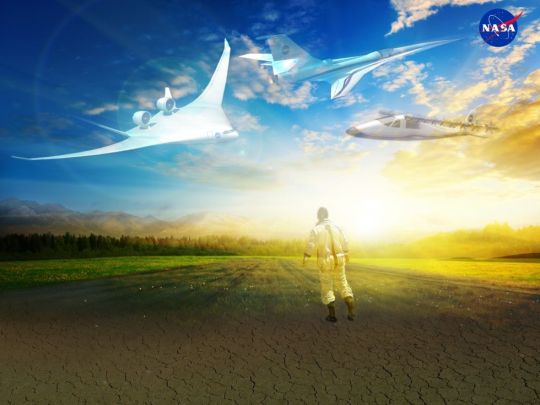
– NASA has asked Congress for funding for new X-plane programs to explore solutions for greener airliners and quieter sonic booms to enable next-generation air travel. Popular Science, Gizmodo, and Ars Technica take a closer look at the proposed projects. I won’t lie – as an aerospace engineer I am hugely in favor of this. The first ‘A’ in NASA has been neglected for quite a while and projects like these are needed if we want to advance the state-of-the-art in aeronautics.
– The New York Times’ ScienceTake video series took a look back at their most popular videos, and 3 of the top 5 videos are fluid dynamics-related. Because we are just that awesome. (via Rebecca M)
– I made a guest appearance on last week’s Improbable Research podcast, where we talked about bizarre experiments trying to unravel swimming.
– Physics Girl shows us 5 weird ways to blow out a candle. There’s some neat and potentially non-intuitive fluid dynamics involved!
– SciShow offers an explanation of why we sneeze. Spoiler alert: it’s more than just to get rid of irritants.
– Fluid dynamics made the short list for NPR’s Golden Mole awards with the discovery of dancing droplets. Here’s Skunkbear’s take on it.
– Ernst Mach, of Mach number fame, was also a bit of an artist and philosopher. (via @JenLucPiquant)
– It’s not quite fluid dynamics, but this Slow Mo Guys video of spinning burning steel wool might be their most beautiful video yet. Check it out!
(Image credit: NASA)