Tag: science

  • Self-Pouring Fluids

    Self-Pouring Fluids

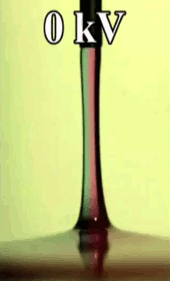
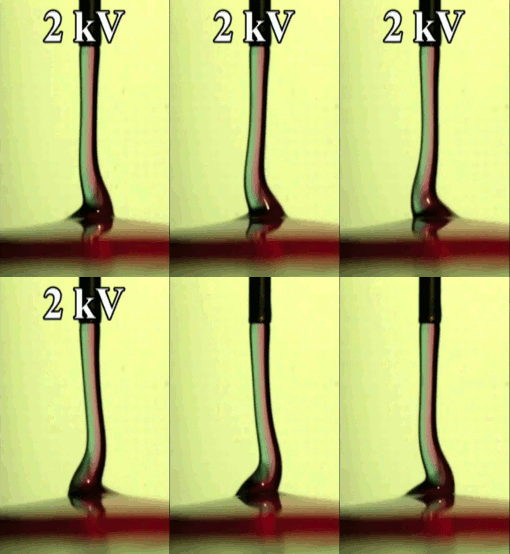
    Non-Newtonian fluids are capable of all kinds of counter-intuitive behaviors. The animations above demonstrate one of them: the tubeless or open siphon. Once the effect is triggered by removing some of the liquid, the fluid quickly pours itself out of the beaker. This is possible thanks to the polymers in the liquid. The falling liquid pulls on the fluid left behind in the beaker, which stretches the polymers in the fluid. When stretched, the polymers provide internal tension that opposes the extensional force being applied. This keeps the fluid in the beaker from simply detaching from the falling liquid. Instead, it flows up and over the side against the force of gravity, behaving rather more like a chain than a fluid!  (Image credit: Ewoldt Research Group, source)

  • Miniature Bursting Bubbles

    Miniature Bursting Bubbles

    Fizzy drinks like soda or champagne contain dissolved carbon dioxide which forms bubbles when the pressure inside its container is released. The tiny bubbles rise to the surface where the liquid film covering them can rupture, creating a small cavity at the surface. The cavity collapses in a matter of milliseconds (bottom animation). Above the surface, the cavity reverses its curvature to create a liquid jet (top animation) which can expel multiple tiny droplets. These droplets can tickle a drinker who hovers too close, but they also carry and distribute the aroma molecules that are part of the experience of a drink like champagne. (Image credit: E. Ghabache et al., source)

    (Today’s topic brought to you by my impending nuptials to my favorite physicist/spacecraft engineer.)

  • Featured Video Play Icon

    The Inverted Glass Harp

    You may be familiar with the glass harp, the instrument created by rubbing the rim of a partially-filled wine glass. But did you know that you can create the same effect by immersing an empty glass in water? In this video, Dan Quinn explains the physics behind both types of glass harps and why the pitch changes as you add or remove water. Vibration is the driving factor (as with most sound), and the key to the shifting pitches has to do with the change in mass of the material being vibrated. For more great physics, also be sure to check out Quinn’s previous video on tears of wine.  (Video credit: D. Quinn)

  • Featured Video Play Icon

    Printing in Glass

    A group at MIT have created a new 3D printer that builds with molten glass. This allows them to manufacture items that would difficult, if not impossible, to create with traditional glassblowing or other modern techniques. One of the coolest aspects of this technique is that it can use viscous fluid instabilities like the fluid dynamical sewing machine to create different effects with the glass. You can see this around 1:56 in the video. Varying the height of the head and the speed at which it moves will cause the molten glass to fall and form into different but consistent coiling patterns. All in all, it’s a very cool application for using some nonlinear dynamics! (Video credit: MIT; via James H. and Gizmodo)

  • Io’s Magma Ocean

    Io’s Magma Ocean

    Jupiter’s moon Io is the most volcanically active world in our solar system. The energy that drives its geological activity comes from tidal forces the moon experiences from Jupiter and from other Jovian moons. These forces flex the moon and heat its interior via friction. Previous models of Io’s tidal heating assumed a solid body, but their results predicted volcanoes in locations that did not match observations of the moon. A new study suggests that the missing piece of the puzzle is a subsurface ocean of magma. Highly viscous liquids like magma also generate heat when deformed by tidal forces, and applying this model to Io allowed scientists to better match the volcano distribution actually seen on the world. For more, check out NASA’s article. (Image credit: NASA; via Gizmodo; submitted by jshoer)

  • The Angle of Repose

    [original media no longer available]

    Granular materials like sand tend to form heaps when poured. The steepness of the heap at rest is described by the angle of repose, which is determined by a balance between gravity, normal force, and friction on the grains. When a heap of grains is disturbed, it can trigger an avalanche. As can be seen in the video above, avalanches are a surface phenomenon, only moving the top few layers of grain while most of the heap remains stationary.  (Video credit: Peddie School Physics)

  • How Dogs and Cats Drink

    How Dogs and Cats Drink

    We humans do our hands-free drinking via suction, using the shape of our lips and mouths to create low pressure that draws liquids in. Dogs and cats, on the other hand, have no cheeks and, therefore, no suction. Instead, both cats (top) and dogs (bottom) drink using adhesion, or the tendency of a liquid to stick to a surface. Both species flatten part of their tongue against the water surface, then pull it up rapidly. This draws a column of water up after their tongue, which they then snap their jaws closed around. Although they use the same method, cats are daintier drinkers than dogs, which sometimes leads to the misconception that the animals drink differently. (Image credits: NYTimes, source; research credit: S. Jung et al.)

  • Boiling Water in Oil

    Boiling Water in Oil

    Most people know that throwing water into hot oil is a bad idea. But, as dramatic as the results can be, the boiling of a water droplet submerged in oil is remarkably beautiful, as seen in the animations above. The initial water droplet expands as it shifts from liquid to vapor (top). At a critical volume, the expansion occurs explosively (middle), causing the bubble to overexpand relative to the pressure of the surrounding fluid. The higher pressure of the oil around it collapses the drop, which then re-expands, creating the cycle we see in the final two animations. This oscillation triggers a Rayleigh-Taylor type instability along the bubble’s interface, causing the surface corrugations observed. The vapor bubble will continue to rise through the oil, eventually breaking the surface and scattering hot oil droplets.  (Image credits: R. Zenit, source)

  • The Challenges of Micro Air Vehicles

    The Challenges of Micro Air Vehicles

    Interest in micro-aerial vehicles (MAVs) has proliferated in the last decade. But making these aircraft fly is more complicated than simply shrinking airplane designs. At smaller sizes and lower speeds, an airplane’s Reynolds number is smaller, too, and it behaves aerodynamically differently. The photo above shows the upper surface of a low Reynolds number airfoil that’s been treated with oil for flow visualization. The flow in the photo is from left to right. On the left side, the air has flowed in a smooth and laminar fashion over the first 35% of the wing, as seen from the long streaks of oil. In the middle, though, the oil is speckled, which indicates that air hasn’t been flowing over it–the flow has separated from the surface, leaving a bubble of slowly recirculating air next to the airfoil. Further to the right, about 65% of the way down the wing, the flow has reattached to the airfoil, driving the oil to either side and creating the dark line seen in the image. Such flow separation and reattachment is common for airfoils at these scales, and the loss of lift (and of control) this sudden change can cause is a major challenge for MAV designers. (Image credit: M. Selig et al.)

  • Shock Waves in Flight

    Shock Waves in Flight

    Schlieren optical systems have been used to visualize shock waves in labs for more than a century, but the technique did not translate well to photographing shock structures outside the lab. But now NASA’s Armstrong Research Center and Ames Research Center have developed a method that allows them to capture highly-detailed images of the shock waves around airplanes while they are flying. This is incredible stuff. Be sure to check out the high-resolution versions on this page, along with more description of the coordination necessary to pull off the photos.

    The light and dark lines you see emanating from the airplane are places with strong density gradients. The dark lines are mostly shock waves, with the strongest shock waves appearing black due to the large change in air density. Many of the light streaks are expansion fans, areas where the density and pressure drop as air speeds up.

    The goal of this research is to better understand shock wave structures around supersonic planes in order to reduce the noise supersonic aircraft cause when flying overhead. As you can see in the photos, the shock waves at the nose and tail of the aircraft persist far away from the aircraft; these are what cause the twin sonic boom heard when the plane flies by. (Photo credit: NASA; via J. Hertzberg)