Tag: science

  • Taking A Turn

    Taking A Turn

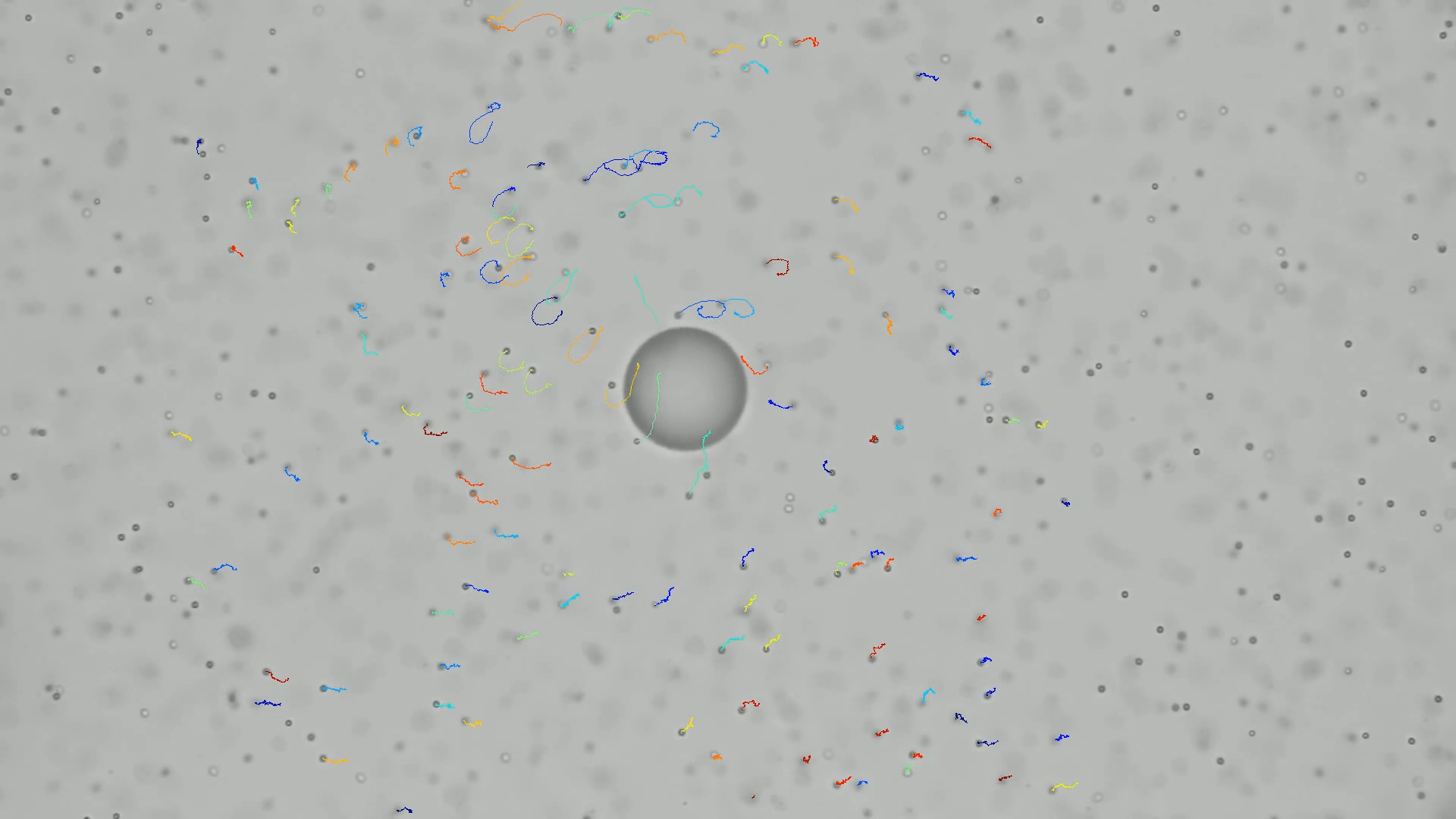
    Water droplets immersed in a mixture of oil and surfactants will move about, propelled by the Marangoni effect. Surfactant molecules congregate along the interface between the water and oil, but they do not do so uniformly. This uneven grouping causes variations in the surface tension, which in turn creates flows inside the droplet from areas of low surface tension to ones with higher surface tension. Those internal flows then dictate how the droplet as a whole moves.

    Researchers found that droplet trajectories in these systems depend on the droplet’s size. Small droplets move in relatively straight lines, whereas larger droplets take highly curved paths. The difference comes from the way surfactants get distributed around the drop’s interface. Larger drops are more sensitive to shifts in surfactant location, making them more prone to take changeable, curving paths. (Image credits: top – P. Godfrey, others – S. Suda et al.; research credit: S. Suda et al.; via APS Physics)

  • Featured Video Play Icon

    How Sinkholes Form

    Growing up in the Ozarks, I explored my fair share of caves and sinkholes. These geological features form when flowing groundwater erodes soil, sand, and even rock underground. The Ozark Plateau consists largely of limestone, which is water soluble, making it very prone to this internal erosion. As bedrock dissolves away, it is eventually unable to hold up the weight of ground above it, causing a catastrophic collapse into a sinkhole. Although my childhood sinkholes were naturally occurring, they can also form in spots where leaking pipes and infrastructure help wash underlying soil away. Unfortunately for engineers, this internal erosion can take place for years without any visible sign above ground. (Image and video credit: Practical Engineering)

  • Featured Video Play Icon

    “Stranded”

    The advantage of flying a drone over a volcanic eruption is getting all of the beauty with none of the danger. No asphyxiating on sulfuric gases, no burns from intense heat, no ash or flying rocks. Just the stunning, glowing beauty of fresh earth being born. “Stranded” takes us over and around the recent Icelandic eruption in a way that no human can ever experience. Sit back, relax, and feast your eyes on the spectacle. (Image and video credit: S. Ridard; via Colossal)

  • Stingray Eyes

    Stingray Eyes

    With their flexible, flattened shape, rays are some of the most efficient swimmers in the ocean. But, at first glance, it seems as if their protruding eyes and mouth would interfere with that streamlining. A new study uses computational fluid dynamics to tackle the effects of these protrusions on stingray hydrodynamics.

    With their digital stingrays, the team found that the animal’s eyes and mouth created vortices that accelerated flow over the front of the ray and increased the pressure difference across its top and bottom surfaces. The result was better thrust and the ability to cruise at higher speeds. Overall, the ray’s eyes and mouth increased its hydrodynamic efficiency by more than 20.5% and 10.6%, respectively. The lesson here: looks can be deceiving when it comes to hydrodynamics! (Image credit: D. Clode; research credit: Q. Mao et al.)

  • Featured Video Play Icon

    Starlings Over Rome

    Each winter millions of starlings migrate to Rome, where they form enormous murmurations in the sky above. The ephemeral and amorphous displays are driven by each bird responding to its neighbor’s motions. But the slight delay in individual responses gives the flock as a whole a wave-like, fluid appearance. Behaviors like this help protect the starlings from predators while they search out places to roost.

    As neat as the displays are, though, they come with some real downsides, as the latter part of this video reveals. I don’t know about you, but I wouldn’t want to park my car outside in that storm! (Video credit: BBC Earth)

  • Twisting Free

    Twisting Free

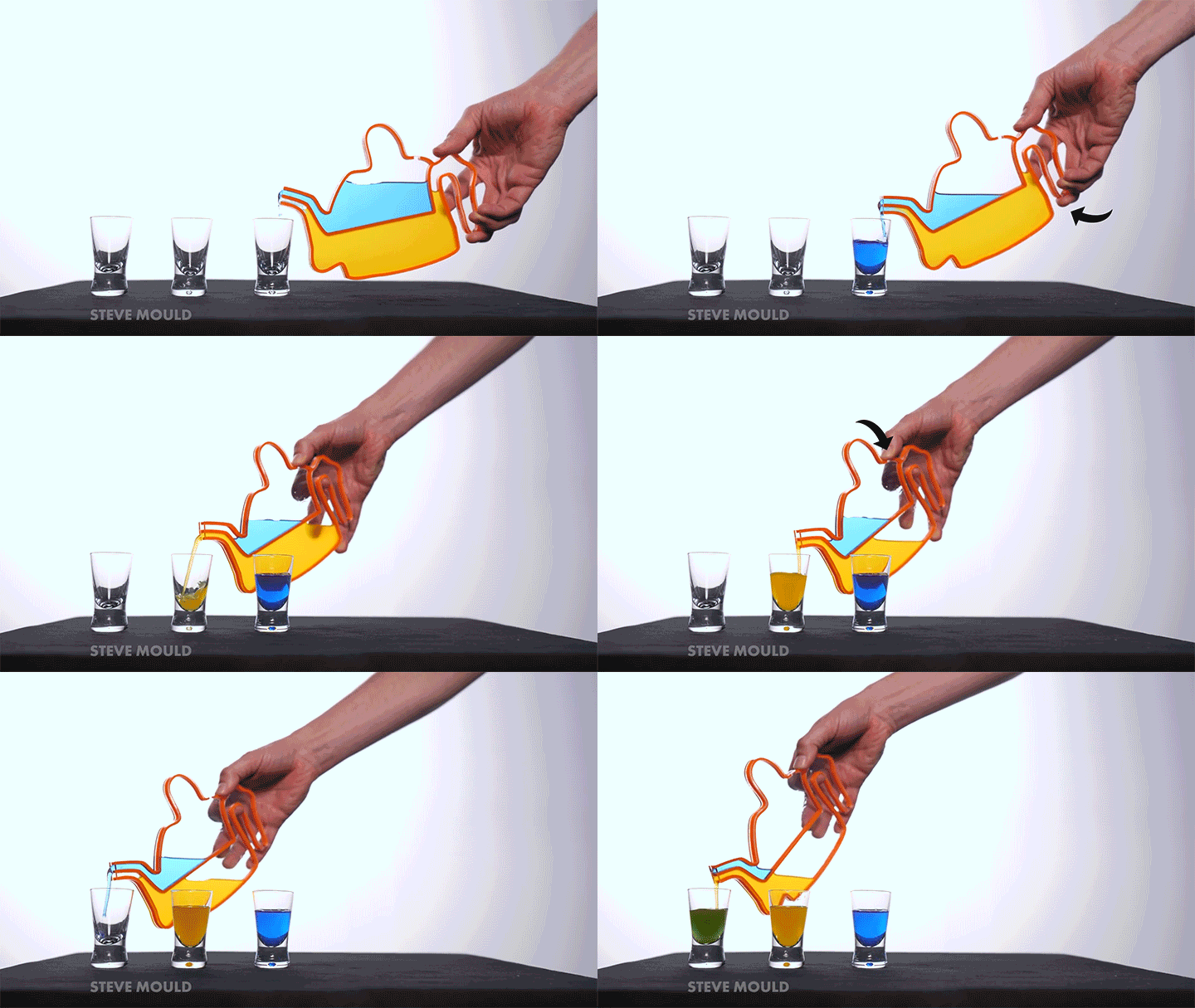
    Anyone who’s dealt with hot glue guns is familiar with the long, thin tails of glue they leave behind. 3D printers suffer from a similar problem with the nozzle pulls away from viscoelastic materials like plastics and polymers. Little tails, like the ones seen above, are left behind on the part and must be cleaned away by hand. The source of the trouble is the elasticity of the fluid. Pulling on these liquids stretches them into long thin strands as the molecules inside the fluid resist. But researchers have found an alternate method to break the liquid cleanly: twisting.

    When a viscoelastic liquid bridge gets twisted, the liquid undergoes what’s known as edge fracture, an elastic effect that creates an indentation that forces its way inward and breaks the bridge’s connection cleanly. Since the technique only requires spinning the 3D printer’s nozzle when detaching, it should be relatively easy for printer manufacturers to implement! (Image credit: 3D-print – T. Claes, illustration – H. Hill/Physics Today, animation – S. Chan et al.; research credit: S. Chan et al.; via Physics Today)

  • Featured Video Play Icon

    Really, Really Slow Mo Fluids

    Fluid dynamics is a perfect subject for high-speed video. So much goes on at speeds that are far too quick for our eyes and brains to perceive. But there is such a thing as too slow – a concept explored in this Slow Mo Guys video, which takes everyday activities like turning on a faucet or splashing into a pool and slows them down a speed where one second lasts an hour. The video I’ve embedded here isn’t nearly that long; it speeds up and slows down. But if you really want to, you can watch Gav fall into a pool for a full hour. (Image and video credit: The Slow Mo Guys)

  • Tides and Tempests of the Coast

    Tides and Tempests of the Coast

    Photographer Rachael Talibart specializes in capturing the majestic and tumultuous power of the sea along England’s coast. Her most recent book “Tides and Tempests” looks incredible — full of turbulent crashing waves, skies of spray, and shorelines of surge and froth. I love how her photographs freeze the water in positions that seems surreal while underlining the sheer power of these storms. You can find more of her work on her website and Instagram. (Image credit: R. Talibart; via Colossal)

  • Animals Lapping

    Animals Lapping

    Without full cheeks, cats, dogs, and many other animals cannot use suction to drink. Instead, these animals press their tongue against a fluid and lift it rapidly to draw up a column of liquid. They then close their mouth on the liquid before it breaks up and falls down. (Cats are a bit neater about it, but as the high-speed images above show, dogs use the same method.)

    A new study takes a look at the mathematics behind this feat, specifically how long it takes for the liquid column to break up. Normally, we describe that problem using the Plateau-Rayleigh instability, but in its usual form, the PR instability doesn’t account for the kind of acceleration drinking animals apply to the fluid. This new study modifies the equations to account for acceleration and finds that the predicted time it takes for breakup is consistent with the timing of animals closing their mouths on the water. In other words, cats and dogs are likely timing their lapping to maximize the amount of water they catch with each bite. (Image credits: top – C. van Oijen, others – S. Jung et al. 1, 2; research credit: S. Jung)

  • Noctilucent Clouds

    Noctilucent Clouds

    Noctilucent clouds are the “highest, driest, coldest, and rarest clouds on Earth.” Formed in the mesosphere at altitudes over 80 kilometers, these clouds typically form at polar latitudes where they can catch sunlight hours after sunset, hence their night-shining name. The clouds take shape when water vapor in cold mesospheric air layers freezes onto dust left behind by meteors.

    Fun fact: because of their high altitude and particle size and density, noctilucent clouds were considered a hazard for space shuttle reentry, and planners explicitly avoided trajectories that would take the spacecraft near potential clouds. (Image credit: top – N. Fewings, other – J. Stevens/NASA Earth Observatory)

    Satellite image of noctilucent clouds above the North Pole.