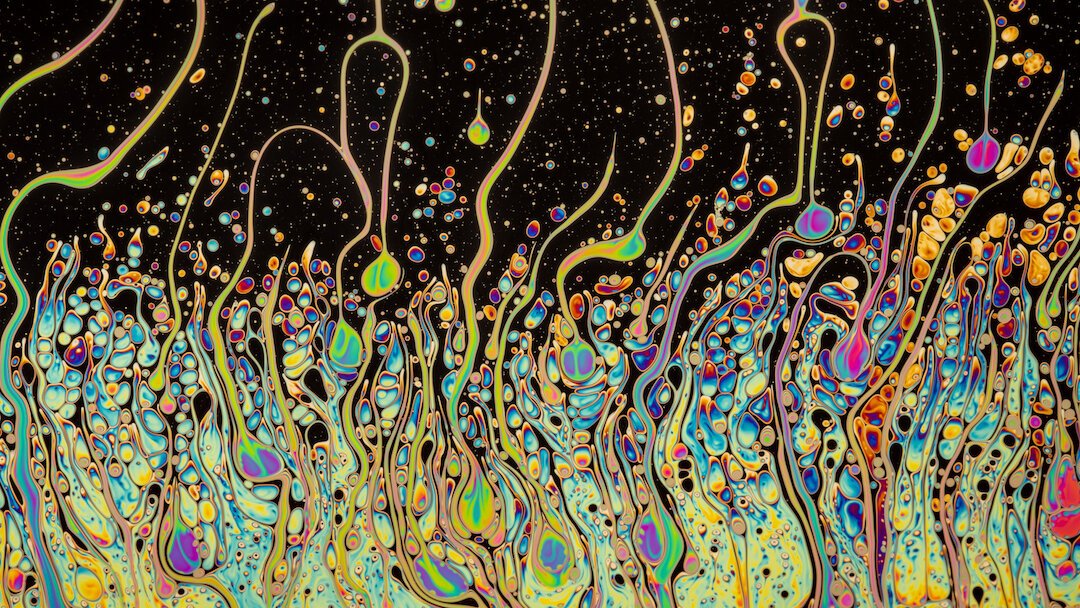
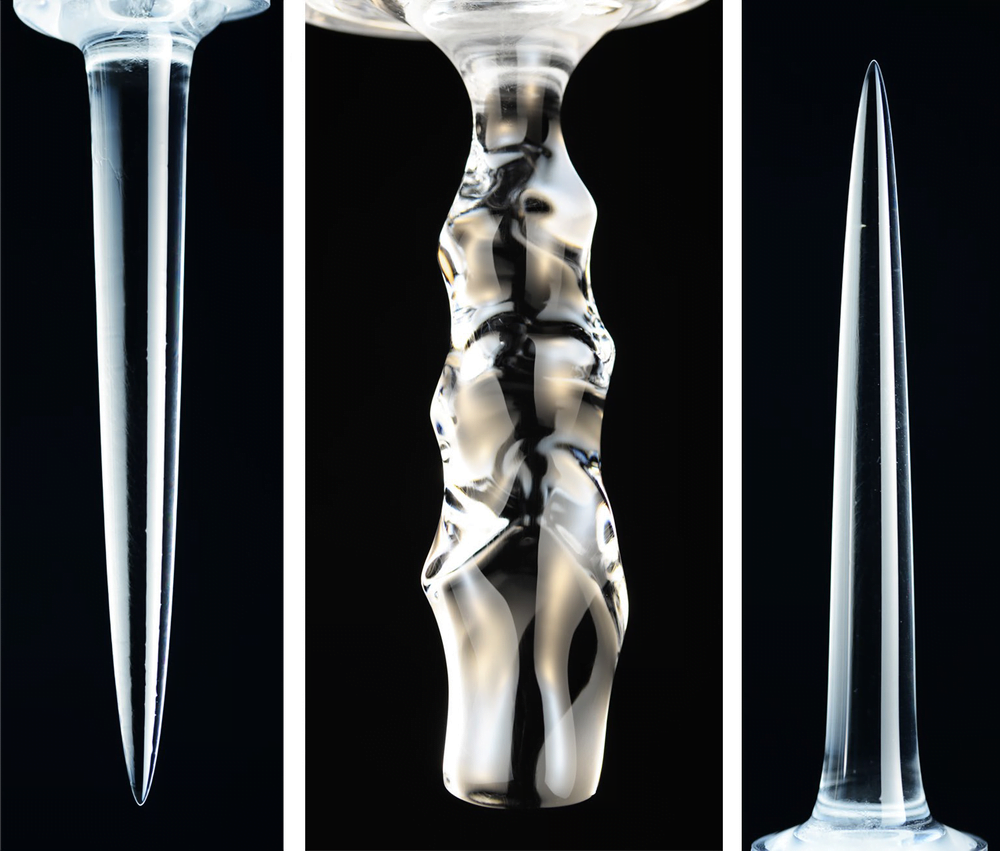
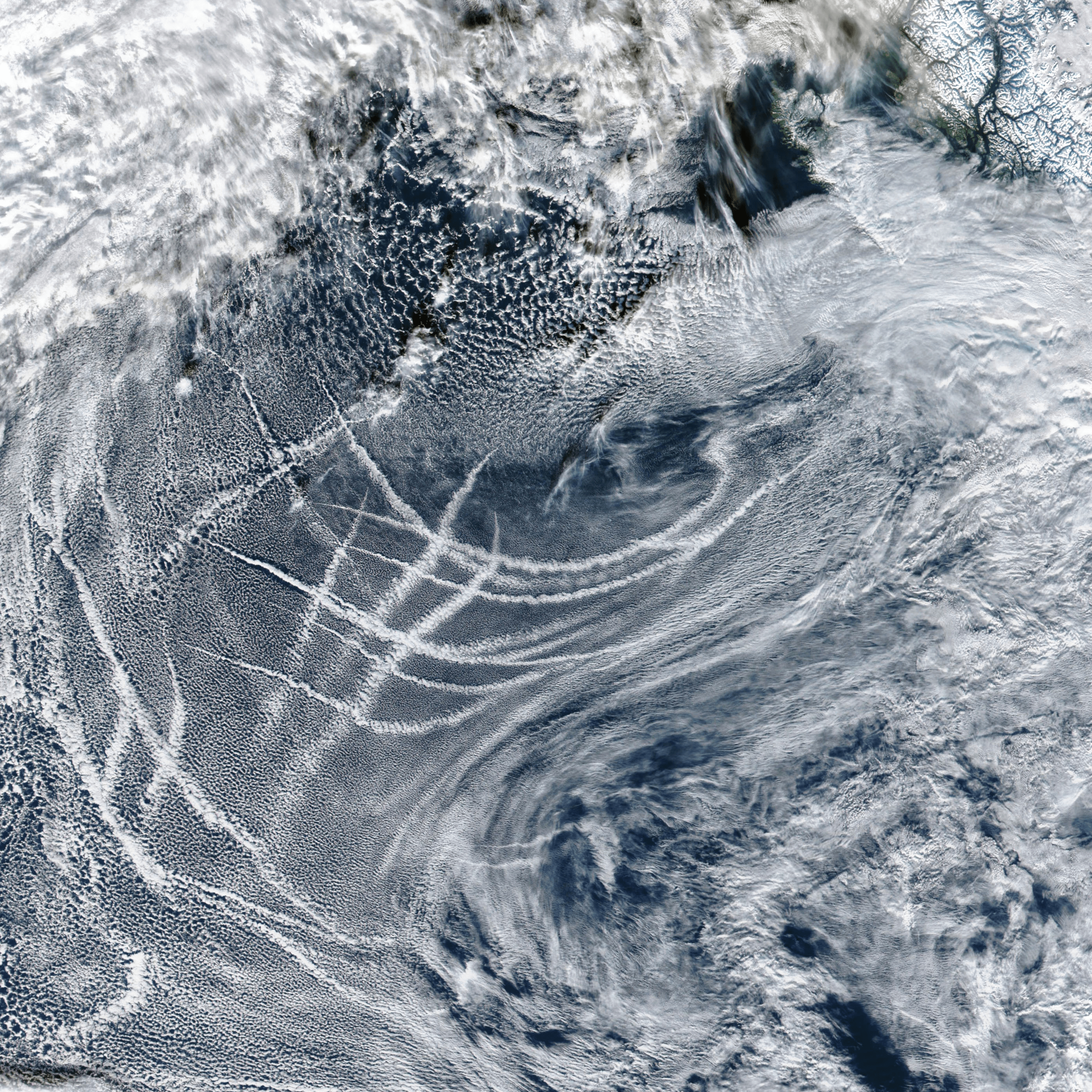
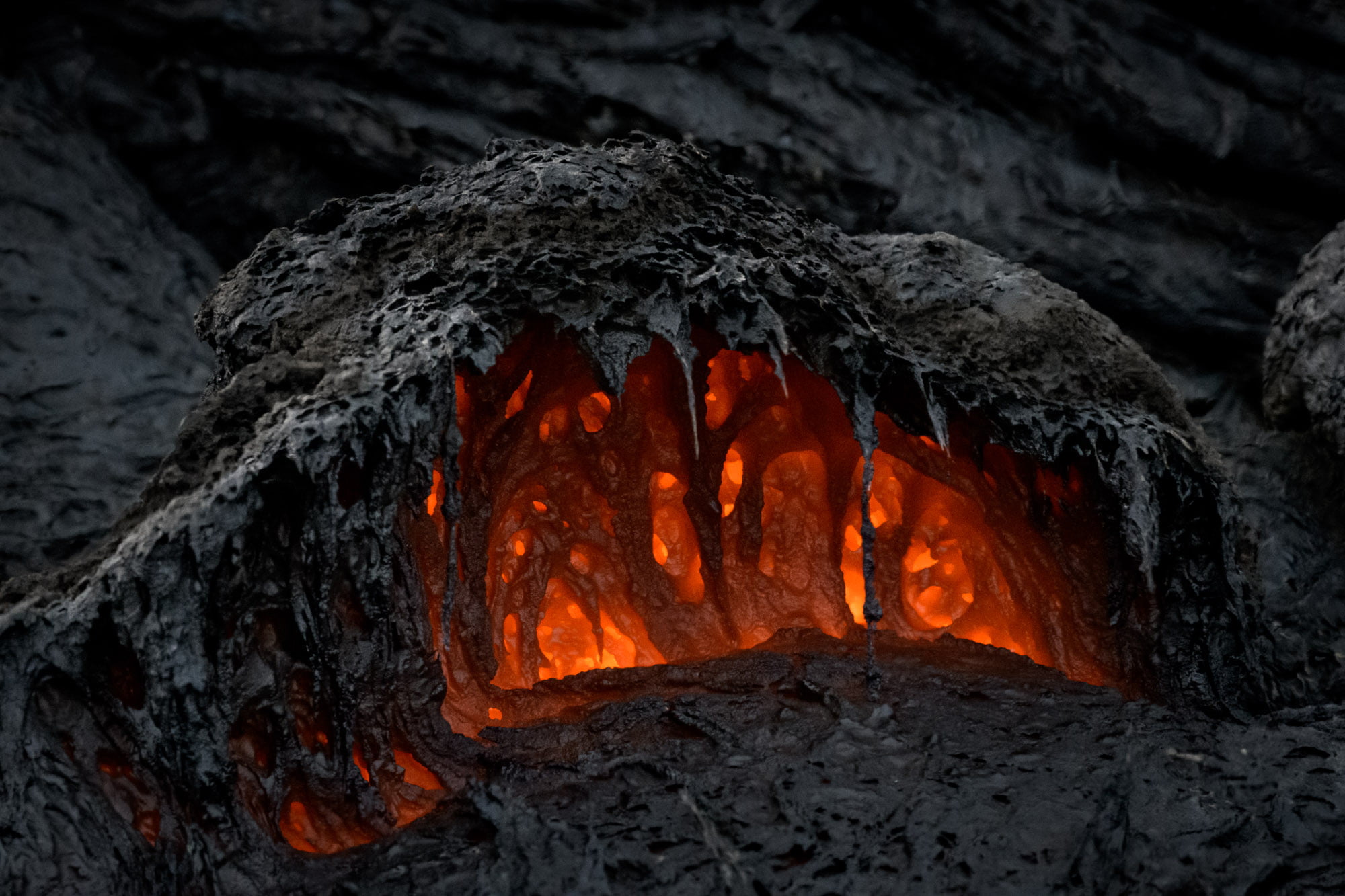
When a burst of air gets expelled into still surroundings — like when a person coughs — it forms a turbulent puff like the one seen here. Puffs can be surprisingly long-lasting, though these miniature clouds slow down and expand over time. How they behave is critical to understanding the spread of pollution as well as how respiratory illnesses like COVID-19 travel. In this study, researchers found that buoyancy is also a critical factor. When the puff is warmer than its surroundings, it rises higher, lasts longer, and travels further. That might help explain why respiratory illnesses like the flu spread more readily in the winter than in warmer months. (Image and research credit: A. Mazzino and M. Rosti; via Physics World; submitted by Kam-Yung Soh)
Tag: science

Bullseye
The Cumbre Vieja volcano in the Canary Islands began erupting in mid-September 2021. This satellite image, captured October 1st, shows a peculiar bullseye-like cloud over the volcano. Hot water vapor and exhaust gases rose rapidly from the erupting volcano until colliding with a drier, warmer air layer at an altitude of 5.3 kilometers. The warm upper layer, known as a temperature inversion, prevented the volcanic gases from rising any further, so they instead spread horizontally. The outflow from the volcano varies and is non-uniform, and its fluctuations generated gravity waves that are visible here as the expanding rings of clouds. (Image credit: L. Dauphin; via NASA Earth Observatory)

“Ruin of the Tides”
As tides and waves flow back and forth over a beach, they erode the sandy shore. Here photographer Michael Shainblum captures the streaks and rivulets left by a falling tide. These “ruins” resemble an extensive river delta viewed from above. I love the complicated branches carved by the water’s retreat. (Image credit: M. Shainblum)

Modelling Volcanic Bombs
When magma meets water on its journey to the surface, the two form a large, partially molten chunk known as a volcanic bomb. As you would expect from their name, these bombs can often be explosive, either in the air or upon impact. But a surprising number of these bombs never explode. Since catching volcanic bombs in action is far too dangerous, researchers modeled them instead to determine what makes a dud.

The type of volcanic bomb they were most interested in comes from Surtseyan eruptions, where the bombs travel through shallow sea or lake water, collecting moisture along the way. When the water reaches the molten interior of the volcanic bomb, it flashes into steam. That’s where the pressure to explode the bombs comes from. But the team found that the bombs are also extremely porous, thanks to bubbles created as the magma depressurizes on its trip to the surface. If the bomb is porous enough, steam escapes the rock before it can build to explosive pressures. (Image credit: top – NASA, others – E. Greenbank et al.; research credit: E. Greenbank et al.; via NYTimes; submitted by Kam-Yung Soh)

The Acoustics of Stonehenge
Stonehenge has long been an astronomical wonder, but did you know it’s an aural wonder as well? A team of acoustic engineers and an archaeologist constructed and tested a 1:12 scale model of the monument as it existed around 2200 B.C. Their model included 157 3D-printed stones (which took about nine months to print!), carefully engineered to reflect ultrasonic frequencies the way the full-size Stonehenge reflects frequencies in our auditory range. (Using the higher frequency sound at a smaller physical scale allows engineers to match the physics of the real henge.)
The team found that the stones of the henge amplified sound by about 4 decibels, enough to make a speaker’s voice easy to hear, even when facing a different direction. The structure also provided some reverberation that would enhance musical instruments or singing. Stonehenge had reverberation levels similar to a modern-day large movie theater, which is absolutely incredible for a prehistoric structure constructed in the open air.
For more interesting details on the model’s construction and testing, check out this article at Physics Today. (Image and research credit: T. Cox et al.)

Filming a Calving Glacier
The San Rafael Glacier, one of the fastest calving glaciers in the world, sits above a fjord in Patagonia. About 10 – 25 meters of the glacier is lost to calving every day. Here, filmmakers take you behind-the-scenes to show what it takes to film in such a remote, unpredictable, and dangerous environment. (Image and video credit: BBC Earth)

Fractal Frost
As nightly temperatures drop in the northern latitudes, many of us are beginning to wake up to frosty patterns on leaves, windows, and cars. Frost‘s spread is a complex dance between evaporation and nucleation, as seen in this recent study.
Here, researchers watched frost grow on a surface covered in 30-micrometer-wide micropillars. The pillars serve as anchor points for droplets, making frosting easier to observe. At low humidity levels (Image 1), droplets evaporate so quickly that frost regions remain isolated and do not interact. At high humidity levels (Image 3), on the other hand, the droplets evaporate so slowly that they’re able to poach water vapor from their neighbors to form frost spikes. When a spike touches another droplet, it freezes the region almost instantly. As a result, the frost spreads quickly and covers nearly every part of the surface. At intermediate humidity levels (Image 2), though, this frost chain reaction and evaporation compete, causing the frost to grow in fractals. (Image and research credit: L. Hauer et al.; via APS Physics)

Witch’s Broom
Known by many names — including the Witch’s Broom Nebula — NGC 6960 is part of a supernova remnant visible in the constellation Cygnus. The wisp-like filaments of the nebula are shock waves moving through the cloud of dust and ionized gas. Based on observations using the Hubble Space Telescope, the nebula is expanding at around 1.5 million kilometers per hour. When the original supernova exploded thousands of years ago, astrophysicists estimate it would have been bright enough to see during daytime! (Image credit: K. Crawford)

Solid, Liquid, Both?
Materials like oobleck — a suspension of cornstarch particles in water — are tough to classify. In some circumstances, they behave like a fluid, but in others, they act like a solid. Here researchers sandwiched a thin layer of oobleck between glass plates and injected air into the mixture. For a fluid, this setup creates a classic Saffman-Taylor instability where rounded fingers of air push their way into the more viscous fluid. And, indeed, for low air pressures and low concentrations of cornstarch, the oobleck forms these viscous fingers. You can see examples in the top row’s first and third image, the second row’s middle image, and the bottom row’s third image.
Injecting air at high pressures and high cornstarch concentrations fractures the oobleck like a solid (middle row, first and third images). At intermediate pressures and concentrations, the oobleck forms a pattern called dendritic fracturing, where new branches can grow perpendicularly to their parent branch. Examples of this pattern are in the top row’s second image and the bottom row’s first and second images. (Image and research credit: D. Ozturk et al.; via Physics Today)

Seeking Magma
In 2009, drillers seeking geothermal energy in Iceland accidentally pierced a hidden magma chamber. After a billowing pillar of steam and glass shards poured out from the hole, it created the hottest geothermal well ever, until the casing failed. Now drillers are preparing to return to the area, this time with the intention of reaching magma. Capturing a sample of magma before it rises to the surface (thereby losing its trapped gases) is something of a holy grail for geophysicists, who otherwise rely on seismic wave detections and observations of magma that’s reached the surface. Building a long-term magma observatory will be an enormous engineering challenge, but the technologies developed may help us explore other hellish environments like the surface of Venus. (Image credit: G. Fridleifsson/IDDP; via Science)