Tag: cats

  • Inside a Big Cat’s Roar

    Inside a Big Cat’s Roar

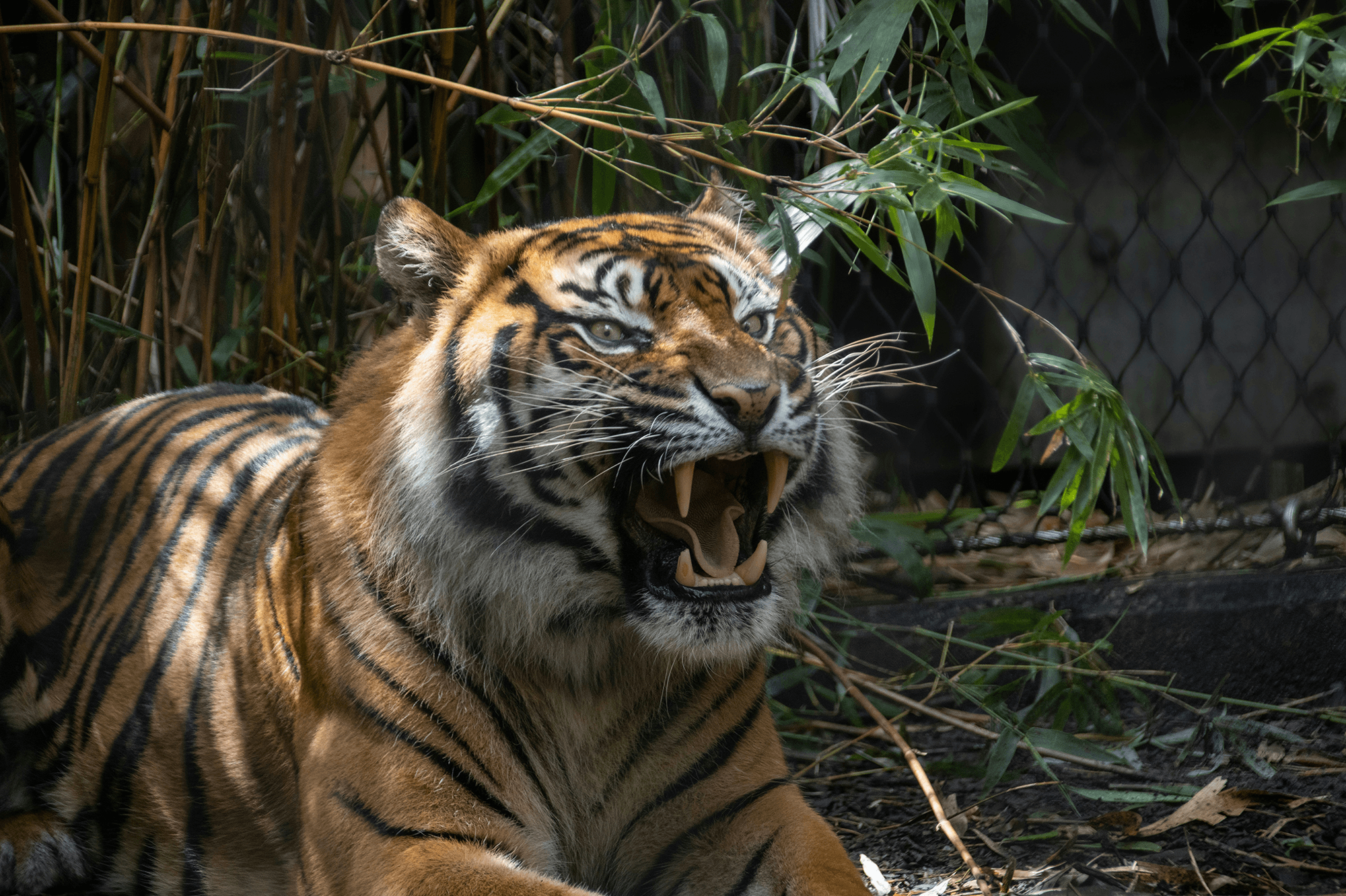
    The roars of big cats — tigers, lions, jaguars, and leopards — carry long distances. In part, this reflects the animals’ size: large lungs exhale lots of air through a large voice-box, whose vibrations resonate in a large throat. But size alone does not make the roar. Below are examples of two big cat voice-boxes. On the left is the nonroaring snow leopard; on the right is the voice-box of a roaring jaguar. The red boxes labeled “VF” mark each cat’s vocal folds. Nonroaring cats have triangular folds, while roaring ones have thick square or rectangular vocal folds. These rectangular folds are more aerodynamically efficient, allowing them to produce a wider range of output levels. They’re also more resilient to the intense forces of a roar, thanks to the cushioning effect of fat deposits inside them. If interested, you can learn more over at Physics Today. (Image credit: tiger – T. Myburgh, voice box – E. Walsh and J. McGee; research credit: E. Walsh and J. McGee)

    The vocal folds (VF) of nonroaring cats are triangular (left), whereas roaring cats have rectangular vocal folds (right).
    The vocal folds (VF) of nonroaring cats are triangular (left), whereas roaring cats have rectangular vocal folds (right).
  • Animals Lapping

    Animals Lapping

    Without full cheeks, cats, dogs, and many other animals cannot use suction to drink. Instead, these animals press their tongue against a fluid and lift it rapidly to draw up a column of liquid. They then close their mouth on the liquid before it breaks up and falls down. (Cats are a bit neater about it, but as the high-speed images above show, dogs use the same method.)

    A new study takes a look at the mathematics behind this feat, specifically how long it takes for the liquid column to break up. Normally, we describe that problem using the Plateau-Rayleigh instability, but in its usual form, the PR instability doesn’t account for the kind of acceleration drinking animals apply to the fluid. This new study modifies the equations to account for acceleration and finds that the predicted time it takes for breakup is consistent with the timing of animals closing their mouths on the water. In other words, cats and dogs are likely timing their lapping to maximize the amount of water they catch with each bite. (Image credits: top – C. van Oijen, others – S. Jung et al. 1, 2; research credit: S. Jung)

  • Featured Video Play Icon

    The Clever Cat’s Tongue

    Cats spend almost a quarter of their waking hours grooming, and their tongues are wonderfully specialized for this task, allowing them to clean, cool, and untangle themselves with ease. Anyone who’s ever been licked by a cat knows their tongues feel sandpaper-y. This is due to rear-facing hook-like structures called papillae that have a stiffness comparable to human fingernails.

    The papillae are hollow, and their U-shaped tip helps them wick up saliva, which the cat deposits deep into its undercoat when it licks. Although the papillae only hold about 5% of the volume of saliva on the cat’s tongue, this wicking action is key because most of the tongue surface can’t reach the inner coat; only the papillae do. The saliva that reaches these dense inner hairs is important not only for cleaning the fur, but for helping the cat cool off. As the saliva evaporates, it carries heat away with it, just like sweating does for us.

    The papillae are key to untangling fur, but their shape also makes it easy to remove hairs caught on the tongue. Researchers built a 3D-printed cat-inspired hair brush to show how efficient and easy to clean a cat’s tongue can be! (Video credit: Science; research credit: A. Noel and D. Hu)

  • Are Cats a Fluid?

    Are Cats a Fluid?

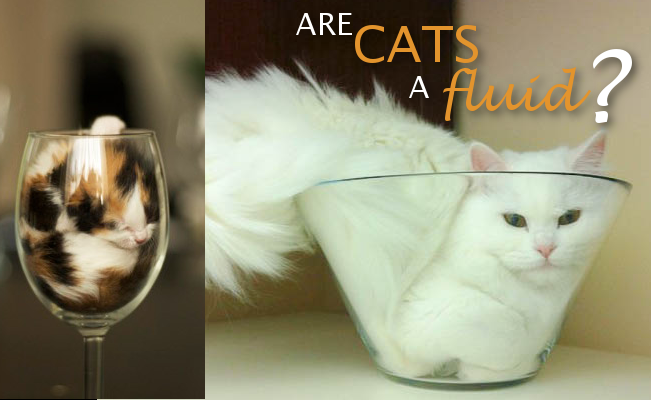
    Are cats a fluid? It’s a question that has inspired many a meme. There are a few common definitions as to what makes a fluid. One is that a fluid changes its shape to that of its container. Another more technical definition is that a fluid deforms continuously under shear forces. But the real picture is messier than these seemingly simple definitions allow for. On the Improbable Research podcast, I tackle the question of whether cats are a solid or a fluid and what fluid dynamics–specifically, the subject of rheology–has to teach us about the topic. Give it a listen! (Original image credits: Huffington Postimgur; research credit: M. A. Fardin, pdf – article begins on page 16)

    Post-Thanksgiving bonus: Today is the traditional Science Friday broadcast of this year’s (abridged) Ig Nobel Prize ceremony. Check your local NPR station for broadcast times or listen to it on their website. You’ll hear me deliver a 24/7 lecture on the subject of “Fluid Dynamics” (and you may find me cropping up elsewhere, too). Alternatively, you can check out the full ceremony video on YouTube.

  • How Dogs and Cats Drink

    How Dogs and Cats Drink

    We humans do our hands-free drinking via suction, using the shape of our lips and mouths to create low pressure that draws liquids in. Dogs and cats, on the other hand, have no cheeks and, therefore, no suction. Instead, both cats (top) and dogs (bottom) drink using adhesion, or the tendency of a liquid to stick to a surface. Both species flatten part of their tongue against the water surface, then pull it up rapidly. This draws a column of water up after their tongue, which they then snap their jaws closed around. Although they use the same method, cats are daintier drinkers than dogs, which sometimes leads to the misconception that the animals drink differently. (Image credits: NYTimes, source; research credit: S. Jung et al.)

  • How Cats Drink

    How Cats Drink

    While humans use suction and dogs scoop water using their tongues*, cats use a dainty fluid mechanism to drink. Researchers used high-speed video to find that cats drink by touching the surface of their tongue to the water and drawing their tongue rapidly back into their mouth. Friction between their tongue and the water creates a fluid column about which the cat closes its jaw before gravity breaks off the column. They also built an artificial tongue to test different frequencies and found an optimal lapping frequency dependent upon the mass of the feline.

    *ETA: More recent research show that dogs actually use the same technique as cats, not a scooping method.

    (Image credit: P. Reis et al.)