Tag: science

  • Why Creases Don’t Disappear

    Why Creases Don’t Disappear

    Flex your fingers and you’ll see your skin fold into well-defined creases. Many soft solids (including old apples) fold this way, and like your skin, the creases never fully disappear, even when the stress is removed. A recent study finds that surface tension and contact-line-pinning are critical to the irreversibility of these creases.

    The authors studied sticky polymer gel layers under a confocal microscope as the gel folded. In doing so, they found that surface tension dictates the microscopic geometry of a fold, causing the two sides of a surface to touch. They also found that completely unfolding a creased surface requires more energy than folding it in the first place did because the folded surfaces adhere to one another.

    When unfolded, the crease behaves somewhat like a droplet on a rough surface. Such droplets move in fits; their contact line stays pinned to the rough microscopic peaks of the surface until there’s enough energy to overcome that attachment and the contact line jumps to another position. Similarly, a creased surface cannot simply unfold smoothly. Adhesion ensures that part of the crease remains, serving as a starting point for the next fold-unfold cycle. (Image credit: C. Rainer; research credit: M. van Limbeek et al.; via APS Physics; submitted by Kam-Yung Soh)

  • Cleaning Up Combustion

    Cleaning Up Combustion

    In space, flames behave quite differently than we’re used to on Earth. Without gravity, flames are spherical; there are no hot gases rising to create a teardrop-shaped, flickering flame. In many ways, removing gravity makes combustion simpler to study and allows scientists to focus on fundamental behaviors. It’s no surprise, then, that combustion experiments are a long-standing feature on the International Space Station.

    In the photo above, we see a flame in microgravity studded with bright yellow spots of soot. Soot is a by-product of incomplete combustion; it’s essentially unburned leftovers from the chemical reaction between fuel and oxygen. In this experiment, researchers were studying how much soot is produced under different burning conditions, work that will help design flames that burn more cleanly in the future. (Image and video credit: NASA; submitted by @LordDewi)

  • Featured Video Play Icon

    Outtakes

    When filming, things don’t always go according to plan. Glasses break, splashes obscure your subject, and sometimes effects just don’t turn out the way you expect. But if you’re the Macro Room team, even those mistakes and outtakes are pretty darn fascinating to watch! I especially like some of the granular “splash” sequences here. (Image and video credit: Macro Room)

  • Spiral Shark Intestines

    Spiral Shark Intestines

    We’ve seen previously just how fluid dynamically impressive sharks are on the outside, but today’s study demonstrates that they’re just as incredible on the inside. Researchers used CT scans of more than 20 shark species to examine the structure of their intestines. Sharks have spiral intestines that come in four different varieties; two of those types look like a stacked series of funnels (either pointing upstream or downstream). These funnel-filled spirals, the researchers found, are incredibly good at creating uni-directional flow without any moving parts, much like a Tesla valve does. The spiral structure also seems to slow down digestion, which may factor into the shark’s ability to go long periods between meals. Incredibly, the fossil record indicates that spiral intestines — in some form — evolved in sharks about 450 million years ago — before mammals even existed! Clearly we engineers are way behind sharks when it comes to controlling flows!

    Animation of a 3D scan of a shark's intestine, showing the spiral internal structure.

    (Image credit: top – D. Torobekov, scan – S. Leigh; research credit: S. Leigh et al.; via NYTimes; submitted by Kam-Yung Soh)

  • Featured Video Play Icon

    “Feeding the Sea”

    It’s impressive when a microscopic organism is visible from space, but that’s a regular occurrence for phytoplankton, the tiny marine algae that feed much of the ocean. In this video from NASA Earth Observatory, we travel around the globe, observing phytoplankton blooms and learning about the ecosystems they feed — or destroy.

    Note that many of these satellite images have been color-enhanced to bring out the swirls and eddies of each bloom. The colors are enhanced but the patterns are real. (Image and video credit: NASA Earth Observatory)

  • Megaripples Beneath Louisiana

    Megaripples Beneath Louisiana

    Approximately 66 million years ago, a 10-km asteroid struck our planet near Chicxulub on the Yucatán Peninsula. The impact was globally catastrophic, causing tsunamis, wildfires, earthquakes, and so much atmosphere-clogging sediment that about 75% of all species on the planet — including the non-avian dinosaurs — died out. A new study points to another remnant of the impact: giant ripples buried in the sediment of Louisiana.

    Seismic data shows giant ripples left behind by the tsunami following the Chicxulub impact.

    Using seismic data collected by petroleum companies, the researchers describe the ripples as approximately 16 meters tall with a spacing around 600 meters, making them the largest known ripples on the planet. Currently, they are buried about 1500 meters underground, just below a layer of fine debris associated with the impact. The ripples show no evidence of erosion from storms or wind, leading the authors to conclude that they were deposited by an impact-associated tsunami and remained unaffected by smaller natural disasters before their burial. It’s very likely, according to the authors, that many other such megaripples exist, hidden away in proprietary petroleum data sets. (Image credits: top – D. Davis/SWRI, ripples – G. Kinsland et al.; research credit: G. Kinsland et al.; via Gizmodo)

  • Featured Video Play Icon

    Sandsculpting Bees

    Building sandcastles is more than a pastime for the bumblebee-mimic digger bee. This species of bee collects water into an abdominal pouch, then uses it to wet sand to help her sculpt her nest. She’ll use the material she digs out to create a protective turret over the nest’s entrance, and once her eggs are laid and stocked with food, she’ll deconstruct the turret to rebury the nest and keep her brood safely hidden. (Image and video credit: Deep Look)

  • Candy Clouds Mid-Storm

    Candy Clouds Mid-Storm

    There’s nothing quite like a towering storm cloud to showcase nature’s power. This gorgeous photo by Laura Rowe shows pastel clouds over West Texas in the middle of a thunderstorm. Despite the dusk at ground level, the height of the cloud keeps it lit by direct sunlight, giving its turbulent convection that colorful glow. Rowe, as it happens, is not a professional photographer, which is a good reminder to us all: it’s always worth looking up! You never know what beauty you’ll miss if you don’t. (Image credit: L. Rowe; via Colossal)

  • Hydrodynamic Spin Lattices

    Hydrodynamic Spin Lattices

    Droplets bouncing on a fluid bath display some strikingly quantum-like behaviors thanks to the interactions between a drop and its guiding surface wave. Here, researchers use submerged wells beneath the drop to confine each droplet into a space where it bounces in a clockwise or anticlockwise trajectory.

    (a) An illustration of the experimental set-up and (b) top-down image of the spin lattice.

    With an array of these wells, the droplets form a lattice. Each drop remains in its well, but its wave travels beyond and interacts with nearby wells. Through this interaction, the researchers found that lattices tended to synchronize, similar to the way groups of fireflies will synchronize their flashing. This sort of behavior is also observed in quantum systems, and the researchers hope that further studying their bouncing droplets will give insight into quantum spin systems and their behaviors. (Image and research credit: P. Saenz et al.; via Nature; submitted by Kam-Yung Soh)

  • Breaking Up Is(n’t) Hard to Do

    Breaking Up Is(n’t) Hard to Do

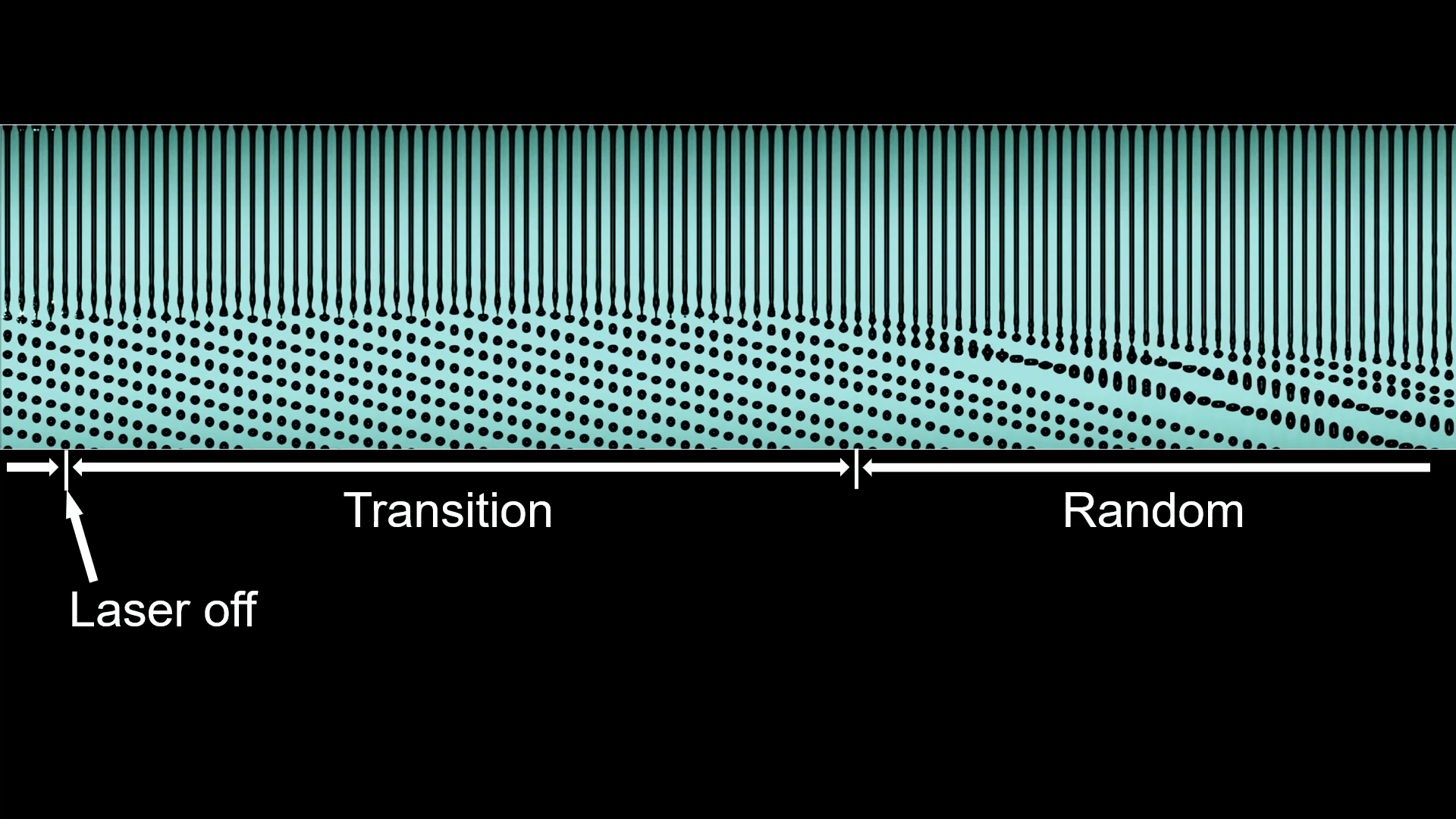
    Engineers often need to break a liquid jet up into droplets. To do so quickly, they surround the jet with a ring of fast-moving air in a set-up known as a coaxial jet. Shear between the gas and liquid creates instabilities that quickly distort the jet’s initial cylinder into sheets and ligaments. Those formations then undergo their own instabilities to break up into drops. The method is, as you can see in the high-speed images above, quite effective, though the breakup mechanism itself is tough to quantify. (Image credit: G. Ricard et al.)