If you have any leftover hard-boiled eggs, you can recreate this bit of fluid dynamical fun. Spin the egg through a puddle of milk, and you’ll find that the egg draws liquid up from the puddle and flights it out in a series of jets. As the egg spins, it drags the milk it touches with it. Points closer to the egg’s equator have a higher velocity because they travel a larger distance with each rotation. This variation in velocities creates a favorable pressure gradient that draws milk up the sides of the egg as it spins, creating a simple pump. To see the effect in action check out this Science Friday video or the BYU Splash Lab’s Easter-themed video. (Photo credit: BYU Splash Lab)
Tag: rotating flow

Spin-Up
With the Oscars just over, it seems like a good time for some movie-trailer-style fluid dynamics. This video shows a rotating water tank from the perspective of a camera rotating with the tank at 10 rpm. Initially, the tank and its contents are at rest. When the tank begins spinning, the fluid inside responds. Pink potassium permanganate crystals at the bottom of the tank show fluid motion as they dissolve, and food coloring is spread on the water’s surface to show motion there. Fluid near the edge of the tank reaches the tank’s rotational velocity fastest, due to friction with the wall, while fluid near the center of the tank takes longer to spin up to speed. This creates the spiral-galaxy-like shape in the dye. Eventually viscosity will transmit the effects of the wall’s motion even into the center of the tank. (Video credit: UCLA Spinlab)
Pancake Vortex
In large-scale geophysical flows, rotation and density gradients often play major roles in the structures that form. Here the UCLA SPINLab demonstrates how large, essentially flat vortices–pancake vortices–form in rotating, stratified fluids. The stratification, in this case, is due to the density difference between salt water and fresh water; salt water is denser and therefore less buoyant, so it sinks toward the bottom of the tank. Note how the pancake vortex only forms when the fluid is both stratified and rotating. If it lacks one of the two, the structures will be very different. (Video credit: O. Aubert et al./SPINLab UCLA)

Swirling Jets
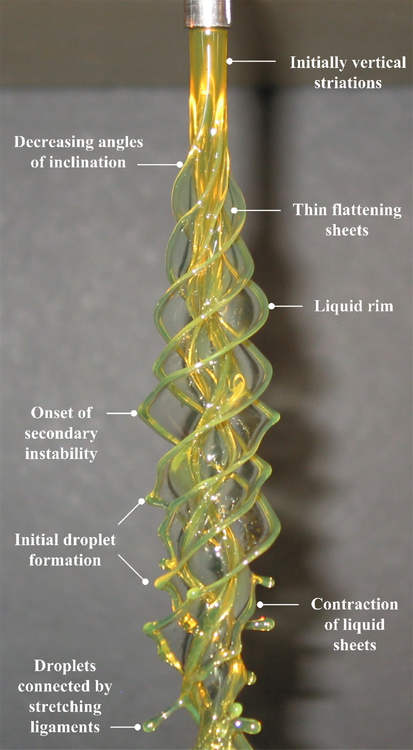
In fluid dynamics, we like to classify flows as laminar–smooth and orderly–or turbulent–chaotic and seemingly random–but rarely is any given flow one or the other. Many flows start out laminar and then transition to turbulence. Often this is due to the introduction of a tiny perturbation which grows due to the flow’s instability and ultimately provokes transition. An instability can typically take more than one form in a given flow, based on the characteristic lengths, velocities, etc. of the flow, and we classify these as instability modes. In the case of the vertical rotating viscous liquid jet shown above, the rotation rate separates one mode (n) from another. As the mode and rotation rate increase, the shape assumed by the rotating liquid becomes more complicated. Within each of these columns, though, we can also observe the transition process. Key features are labeled in the still photograph of the n=4 mode shown below. Initially, the column is smooth and uniform, then small vertical striations appear, developing into sheets that wrap around the jet. But this shape is also unstable and a secondary instability forms on the liquid rim, which causes the formation of droplets that stretch outward on ligaments. Ultimately, these droplets will overcome the surface tension holding them to the jet and the flow will atomize. (Video and photo credits: J. P. Kubitschek and P. D. Weidman)

Shark-Tooth Instability
A viscous fluid inside a horizontally rotating circular cylinder forms a shark-tooth-like pattern along the fluid’s free surface. This is one of several patterns observed depending on the fluid’s viscosity and surface tension and the rotational rate of the cylinder. (Photo credit: S. Thoroddsen and L. Mahadevan; for more, see Thoroddsen and Mahadevan 1996 and 1997)
Atmospheric Dynamics in the Lab
One way to explore some of the large-scale atmospheric dynamics we observe here on earth is through table-top demonstrations such as this one. Here a platform with a water tank is rotating at a constant velocity. The camera rotates with the tank; this is why the hand in the video seems to spin. At the center of the tank, ice in a can cools the water, while the warmer air along the periphery provides heating. The green dye marks initially cooler fluid while the red dye marks the warmer fluid from the outside of the tank. The dense cooler fluid sinks and moves outward while warmer water moves in to replace it. This creates radial circulation; the thermal gradients and rotation cause the eddies and jets seen from this top view, in much the same way that they form in the mid-latitudes of earth’s atmosphere. (Video credit: Marshall Lab, MIT)
Rotating or Not-Rotating?
Rotating a fluid often produces different dynamical behavior than for a non-rotating fluid. Here this concept is demonstrated by dropping creamer into a tank of water. Both experiments produce a turbulent plume, but the way the plume spreads and diffuses is much different in the case of the rotating tank, thanks to the Coriolis effect. (Video credit: SPINLab UCLA)
Recreating Saturn’s Hexagon
In the 1970s, the Voyager spacecraft discovered a hexagon near Saturn’s north pole that defied explanation for years. However, researchers have since simulated the shape in a laboratory by placing a fast-spinning ring on the top surface of a slowly spinning column of fluid. Fluorescent dye is used to visualize the flow pattern. #