Tag: rotating flow

  • Liquid Sunbursts

    Liquid Sunbursts

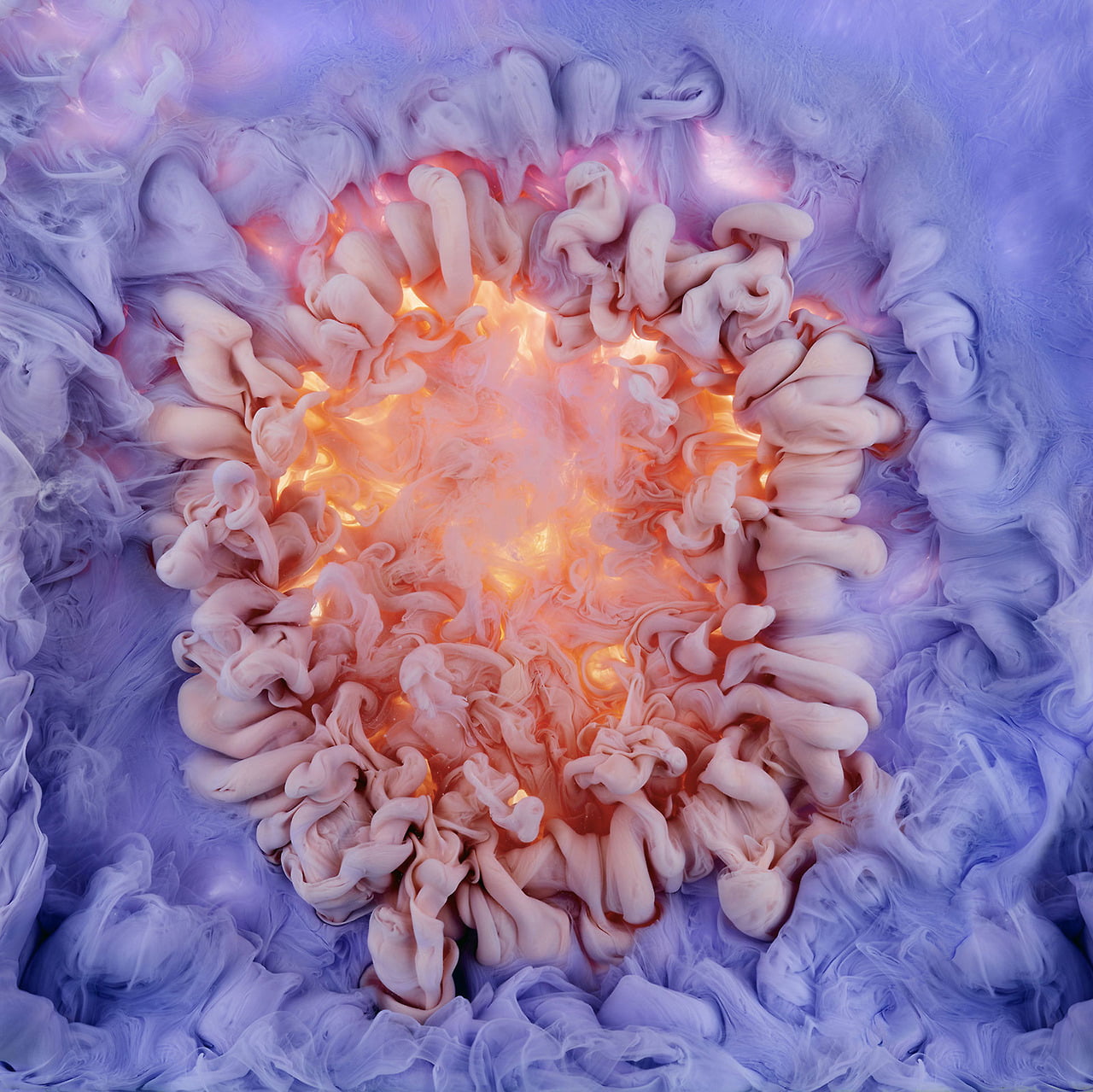
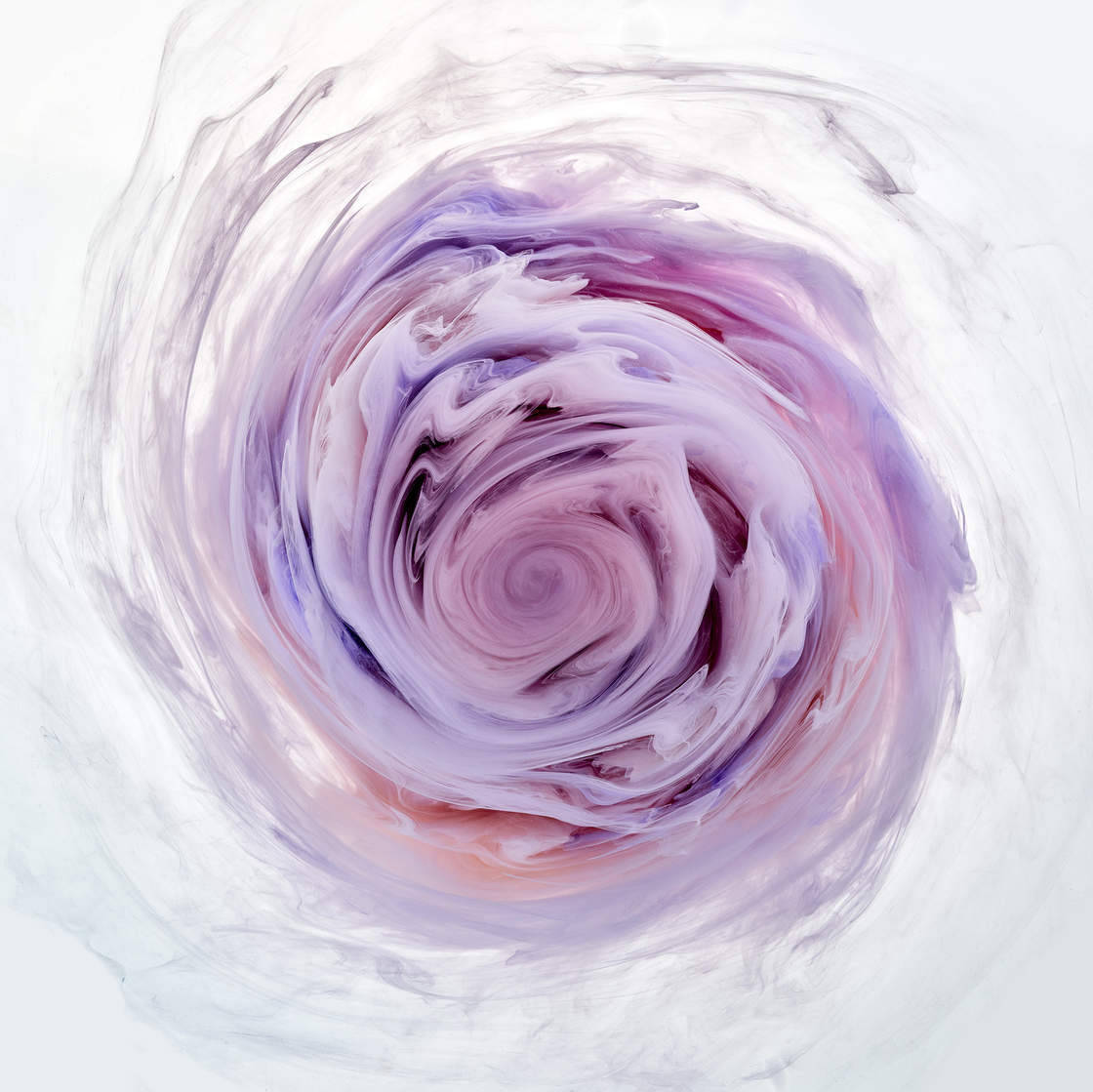
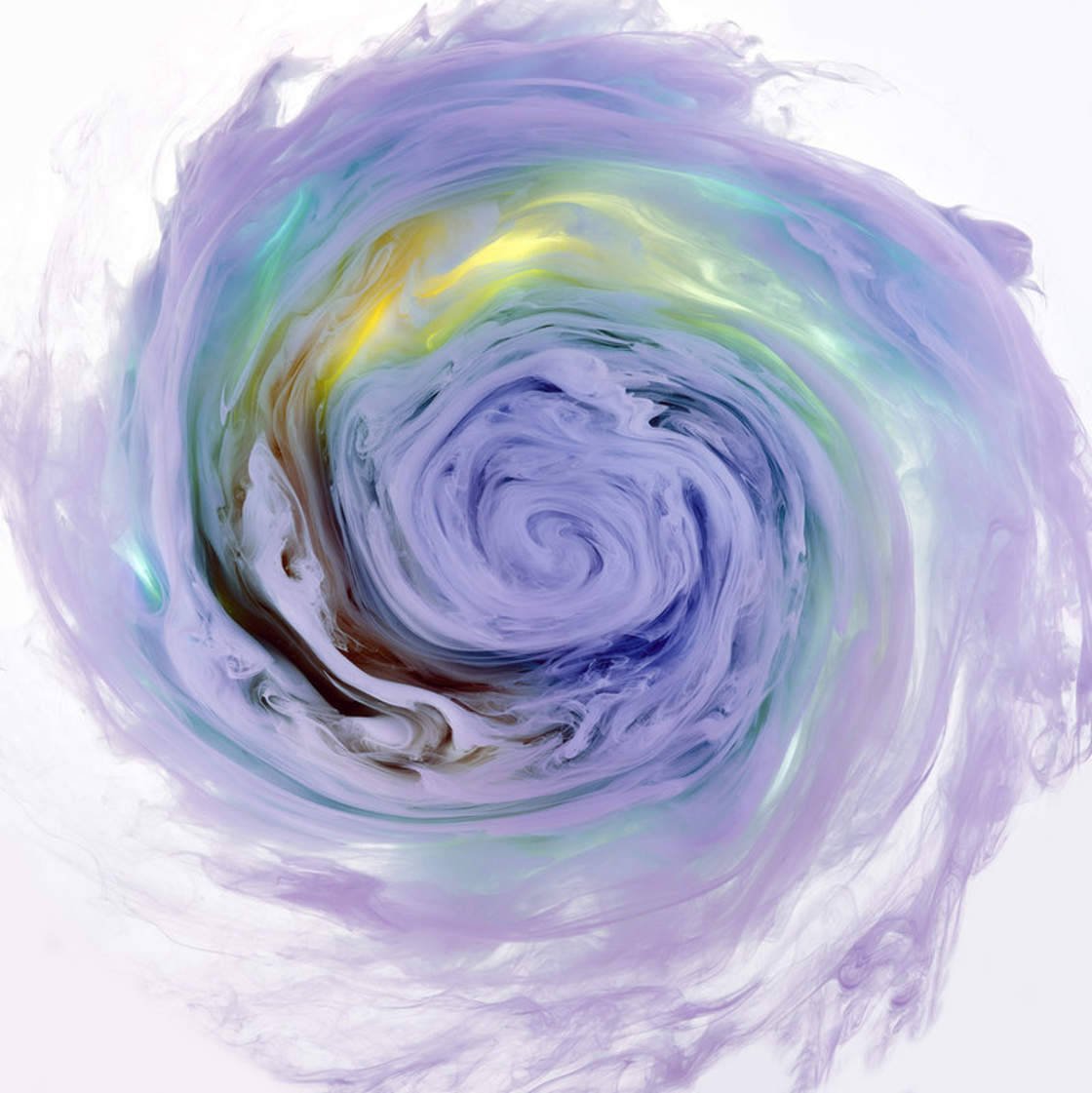
    Liquid sunbursts and swirling aquatic roses abound in photographer Mark Mawson’s work. Images like these are created from dropping ink into water and photographing it as it diffuses. For the roses, the tank is additionally stirred or spinning to create the vortex-like appearance. Check out his website for more striking images, including more billowing ink, some great splashes and beautiful turbulent mixing between coffee and milk. (Image credit: M. Mawson; submitted by clogwog)

  • Shark Tooth Instability

    Shark Tooth Instability

    Imagine that you partially fill a horizontal cylinder with a viscous fluid, like corn syrup or honey. If that cylinder is still, the fluid will simply pool along the bottom. On the opposite extreme, if you spin it very fast, that cylinder will become coated in an even layer of fluid that rotates along with the cylinder thanks to centrifugal force. Between those two extremes in rotational velocity, some interesting fluid behaviors occur. Start spinning the cylinder and some of the pooled fluid will be pulled up the sides, eventually forming a thicker film with a straight front along the bottom of the cylinder. Spin faster and that straight front starts to break down, forming sharper cusp-like waves known as shark teeth. (Image credit: S. Morris et al., source; research credit: S. Thoroddsen and L. Mahadevan)

  • Rotating Jet

    Rotating Jet

    This photo, one of the winners of the Engineering and Physical Sciences Research Council’s (EPSRC) annual photography contest, shows a rotating viscoelastic jet. Rotating liquid jets are common to many manufacturing processes, and their sometimes-wild appearance comes from a balance of gravitational forces and centrifugal force against surface tension. But because this fluid contains a small amount of polymer additive, surface tension has the additional aid of some elasticity to help hold the jet together and keep the globules and ligaments you see from flying off. As centrifugal forces fling the fluid outward, it stretches the polymer chains within the fluid, and they pull back against that tension like a stretched rubber band. To see some of the other contest winners–including other fluids entries!–check out the Guardian’s run-down. (Image credit and submission: O. Matar et al., ICL press release)

  • Featured Video Play Icon

    Suppressing Instability

    The Rayleigh Taylor instability is a common fluid phenomenon in which the interface between fluids of differing densities becomes unstable. It’s what’s responsible for all those awesome pictures of milk in ice coffee. For many years, fluid dynamicists theorized that the instability might be inhibited by rotation, which tends to suppress velocity changes along the axis of rotation. But actually creating an experiment demonstrating the effect was extremely difficult because any attempts to set a denser fluid over a lighter one before rotating it would kick off the instability. Recently, however, researchers succeeded in creating an experimental demonstration, seen in the video above. They did so by using magnetism. The initial set-up consists of two fluids of similar densities – a heavier, diamagnetic fluid on the bottom and a lighter, paramagnetic fluid floating on top. The tank was then spun up until both fluids were rotating like a rigid body. Then, the entire set-up was lowered into a vertically-oriented magnetic field. The paramagnetic fluid on top was attracted by the field while the diamagnetic fluid on the bottom was repelled. The end result is that the magnetic field created the effect of the upper fluid being heavier, thereby initiating the Rayleigh-Taylor instability. As you can see in the video, rotation does slow down–but not prevent–the instability. But it took some very clever and careful experimental design to show!  (Video credit: K. Baldwin et al.)

    ——————

    Don’t forget about our FYFD survey! I’ve teamed up with researcher Paige Brown Jarreau to create a survey of FYFD readers. By participating, you’ll be helping me improve FYFD and contributing to novel academic research on the readers of science blogs. It should only take 10-15 minutes to complete. You can find the survey here. Please take a few minutes to participate and share!

  • Featured Video Play Icon

    Turning Into 2D

    UCLA Spinlab has another great video demonstrating the effects of rotation on a fluid. In a non-rotating fluid, flow over an obstacle is typically three-dimensional, with flow moving over as well as around the object. But in a steadily rotating fluid, as shown in the latter half of the video, the flow only moves around the obstacle, not over it. This non-intuitive behavior is part of the Taylor-Proudman theorem, which shows that flow around an obstacle in a rapidly rotating fluid will be two-dimensional and confined to planes perpendicular to the axis of rotation. (For the mathematically-inclined, Wikipedia does have a short derivation.) This 2D flow creates what are called Taylor columns over the obstacle. The Taylor column is like an imaginary extension of the original obstacle, turning the puck into a tall cylinder, and it’s real enough to flow, which diverts around it as though the column were there. (Video credit: UCLA Spinlab)

  • Featured Video Play Icon

    Rotational Effects

    Rotation can cause non-intuitive effects in fluid dynamical systems. UCLA Spinlab’s newest video tackles the problem using four demonstrations. The first two deal with droplets released in air, first in a non-rotating environment and then in a rotating one. As one would expect, in a non-rotating environment, droplets fall through the tank in a straight line. When rotating, though, the droplets follow a deflected, straight-line path due to centrifugal effects. This is the same as the way passengers in a car feel like they’re being thrown to the outside of a turn on a curvy road. When the experiment is repeated with a tank of water instead of air, the results are different. The densities of the creamer and water are much closer to one another, so the droplet falls much slower than before. The tank now rotates faster than time it takes the drop to fall. This smaller timescale means that the droplet experiences more acceleration from Coriolis forces than centrifugal forces in the rotating tank of water. Thus, instead of being thrown outward, the drop now forms a column aligned with the axis of rotation. (Video credit: UCLA Spinlab; submitted by Jon B.)

  • Spinning Polygons

    Spinning Polygons

    Nature is full of surprising behaviors. If one imagines putting a bucket of water on a rotating plate and spinning it, one would expect the water’s free surface to take on a curved, axially symmetric shape. The photos above are from a similar experiment, but instead of the entire container rotating, only the bottom plate spins. Surprisingly, the water’s surface does not remain symmetric around the axis of rotation. Instead, the water forms stable polygon shapes that rotate slower than the spinning plate. As the plate’s rotation speed increases, the number of corners in the polygon increases. Shapes up to a hexagon were observed in the experiment. Photos of the set-up and more experimental results are available, as is the original research paper. Symmetry breaking and polygons can also be found in hydraulic jumps and bumpsliquid sheets, and planetary polar vortices. (Photo credit: T. Jansson et al.; research paper)

  • Bubble Vortices

    Bubble Vortices

    Vortices appear in scales both large and small, from your shower and the flap of an insect’s wing to cyclones and massive storms on other planets. Especially with these large-scale vortices, it can be difficult to understand the factors that affect their trajectories and intensities over time. Here researchers have studied the vortices produced on a heated half bubble for clues as to their long-term behavior. Heating the base of the bubble creates large thermal plumes which rise and generate large vortices, like the one seen above, on the bubble’s surface. Researchers observed the behavior of the vortices with and without rotation of the bubble. They found that rotating bubbles favored vortices near the polar latitudes of the bubble, just as planets like the Earth and Saturn have long-lived polar vortices. They also found that the intensification of both bubble vortices and hurricanes was reasonably captured by a single time constant, which may lead to better predictions of storm behaviors. Their latest paper is freely available here. (Image credit: H. Kellay et al.; research credit: T. Meuel et al.; via io9)

  • The Bathtub Vortex

    The Bathtub Vortex

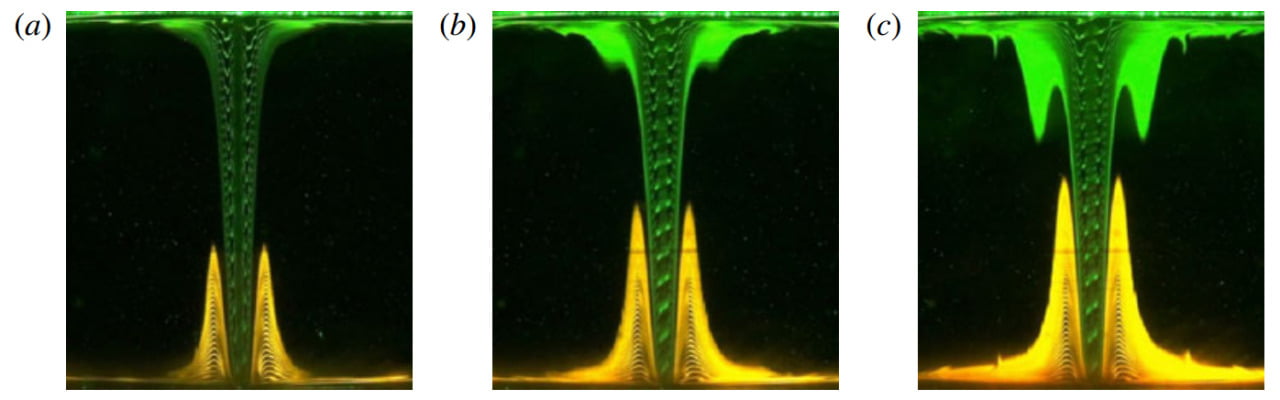
    If you’ve ever watched a swirling vortex disappear down the drain of your bathtub and wondered what was happening, you’ll appreciate these images. This dye visualization shows a one-celled bathtub vortex, created by rotating a cylindrical tank of water until all points have equal vorticity before opening a drain in the bottom of the tank. A recirculating pump feeds water back in to keep the total fluid mass constant. Once a steady vortex is established, green dye is released from the top plate of the tank and yellow dye from the bottom. The green dye quickly marks the core of the vortex. Ekman layers–similar to the boundary layers of non-rotating flows–form along the top and bottom surfaces, and the yellow dye is drawn upward in a region of upwelling driven by Ekman pumping. (Photo credit: Y. Chen et al.)

    Just a reminder for those at Texas A&M University: I will be giving a talk today Wednesday, October 2nd entitled “The Beauty of the Flow” as part of the Applied Mathematics Undergraduate Seminar series at 17:45 in BLOC 164.

  • Egg-Spinning Fun

    Egg-Spinning Fun

    If you have any leftover hard-boiled eggs, you can recreate this bit of fluid dynamical fun. Spin the egg through a puddle of milk, and you’ll find that the egg draws liquid up from the puddle and flights it out in a series of jets. As the egg spins, it drags the milk it touches with it. Points closer to the egg’s equator have a higher velocity because they travel a larger distance with each rotation. This variation in velocities creates a favorable pressure gradient that draws milk up the sides of the egg as it spins, creating a simple pump. To see the effect in action check out this Science Friday video or the BYU Splash Lab’s Easter-themed video. (Photo credit: BYU Splash Lab)