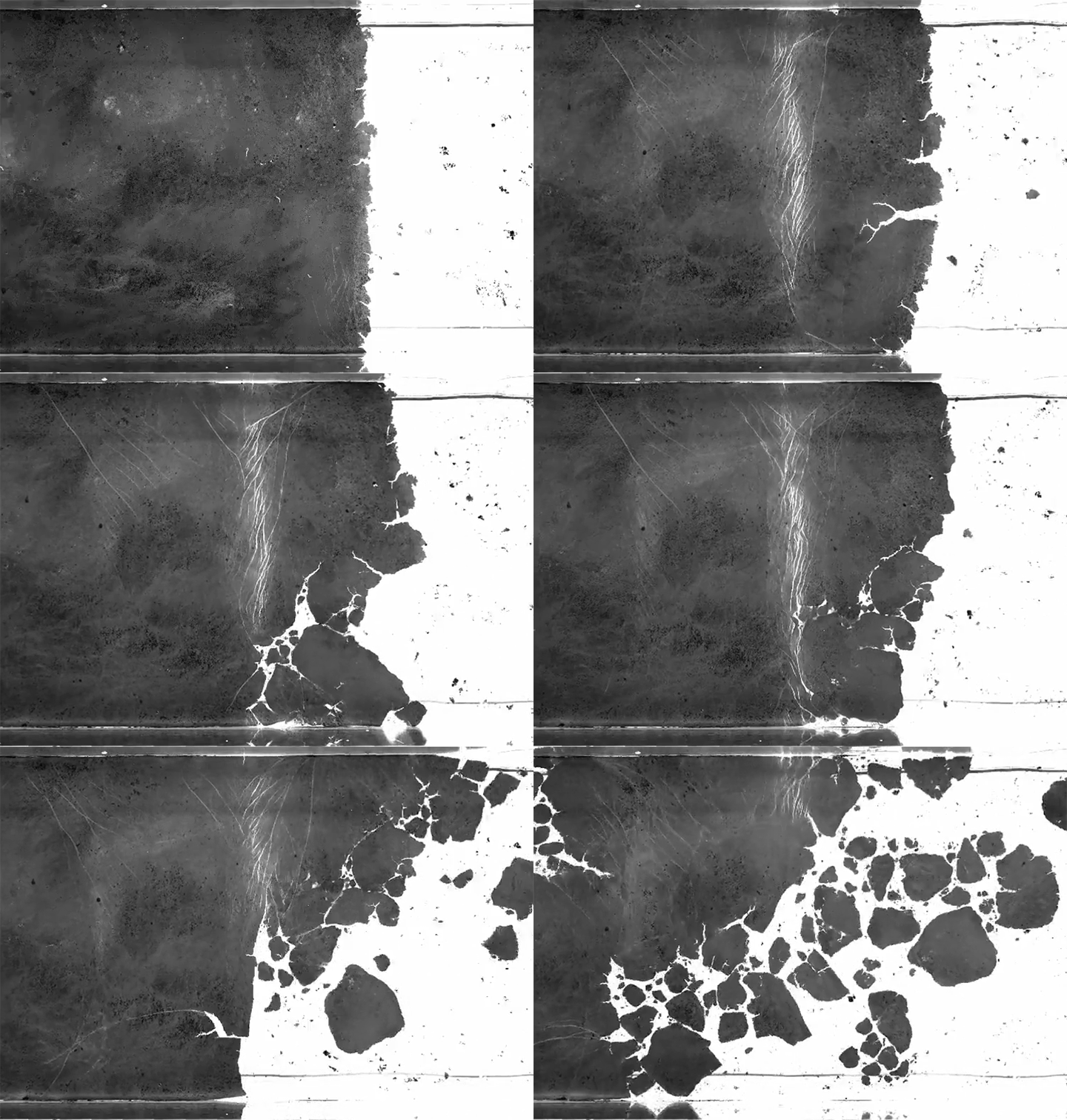
For this latest experimental film, artist Roman De Giuli provides a glimpse of the unique fluid art machine he’s built over the last 3.5 years. With 10 channels driven by peristasltic tube pumps and stepper motors, his “printer” drips up to 10 colors on a paint-covered, tilted canvas to create these beautiful images. As he says in his description of the invention, the set-up produces paint layering that’s almost impossible to create by hand. Fluid dynamically speaking, we’re seeing gravity currents like a lava flow or avalanche that are mixing together viscously. There’s also some added effects from density differences between different layered paint colors. Artistically, this machine offers an infinite palette of visual opportunities; financially, though, De Giuli admits its an absolute beast at consuming paint! (Image and video credit: R. De Giuli)
Tag: physics

Viscous Fireworks
Inject a less viscous fluid into a gap filled with a more viscous fluid, and you’ll get finger-like patterns spreading radially. Here, researchers put a twist on this viscous fingering by taking turns injecting different liquids. Each injection cycle disrupts what came before, layering fingering patterns on fingering patterns. The results resemble fireworks. Happy 4th of July! (Image credit: C. Chou et al.)

Fish Ladders Keep Species Swimming
Dams often use fish ladders to help migratory species make their way upstream without interruption. In this video, Grady from Practical Engineering discusses some of the considerations that go into this special infrastructure and what kinds of designs work for different species. The first challenge for any dam is attracting fish to the ladder, which is often done by regulating the water flow at the entrance to create the velocity and turbulence that fish look for when going upstream.
Once fish are in the ladder, they travel up a series of jumps that break the dam’s elevation into manageable steps. Different dams use various baffle designs to create jumps suited to their local species and the way they like to swim. Calmer spots in each section give fish a spot to rest before they carry on. In well-designed systems, the vast majority (97%!) of fish that enter a ladder make it through to the other side. (Video and image credit: Practical Engineering)

Sensing Sound Like Spiderwebs
Most microphones — like our ears — work by sensing the tiny pressure changes caused by a sound wave‘s passing. But for microphones built this way, the smaller they get, the more sensitive they are to thermal noise. That’s one reason that the tiny microphones in a laptop or webcam just don’t sound as good as larger mics.
Researchers turned to nature to look for alternative ways to measure sound and zeroed in on the mechanism spiders use. Spiders “listen” to their web’s vibrations; the tiny strands of silk quiver as air flow from a sound moves past. Instead of being pressure-based, this mechanism uses viscous drag to register a sound.
The team fabricated an array of microbeams to test the concept of a viscosity-based microphone and found that tiny beams sensed sounds just as well as larger ones. That means these microphones can get smaller without sacrificing performance. For now, they’re not as sensitive as conventional microphones, but that’s not surprising, given that engineers have been improving pressure-based microphones for 150 years. It’s a promising start for a new technology, though. (Image credit: N. Fewings; research credit: J. Lai et al.; via APS Physics)

Ancient River Branch Discovered Near Giza Pyramids
Today the pyramid complex at Giza sits kilometers from the Nile River, raising longstanding questions about how ancient builders moved the enormous stones that make up each structure. A new study using radar satellite imagery, geophysical data, and deep soil coring identified a previously unknown ancient branch of the Nile that ran alongside the Giza Pyramids as well as pyramids at sites to the south. The team’s data indicate that, during the era of the pyramids’ construction, the river would have flowed for over 60 kilometers with a maximum width of nearly 700 meters. Having such a substantial waterway right next to the pyramid sites would have drastically simplified the logistics of moving stones and workers during construction. (Image credit: A. Bichler; research credit: E. Ghoneim et al.; via My Modern Met)

“Through the Bubbles”
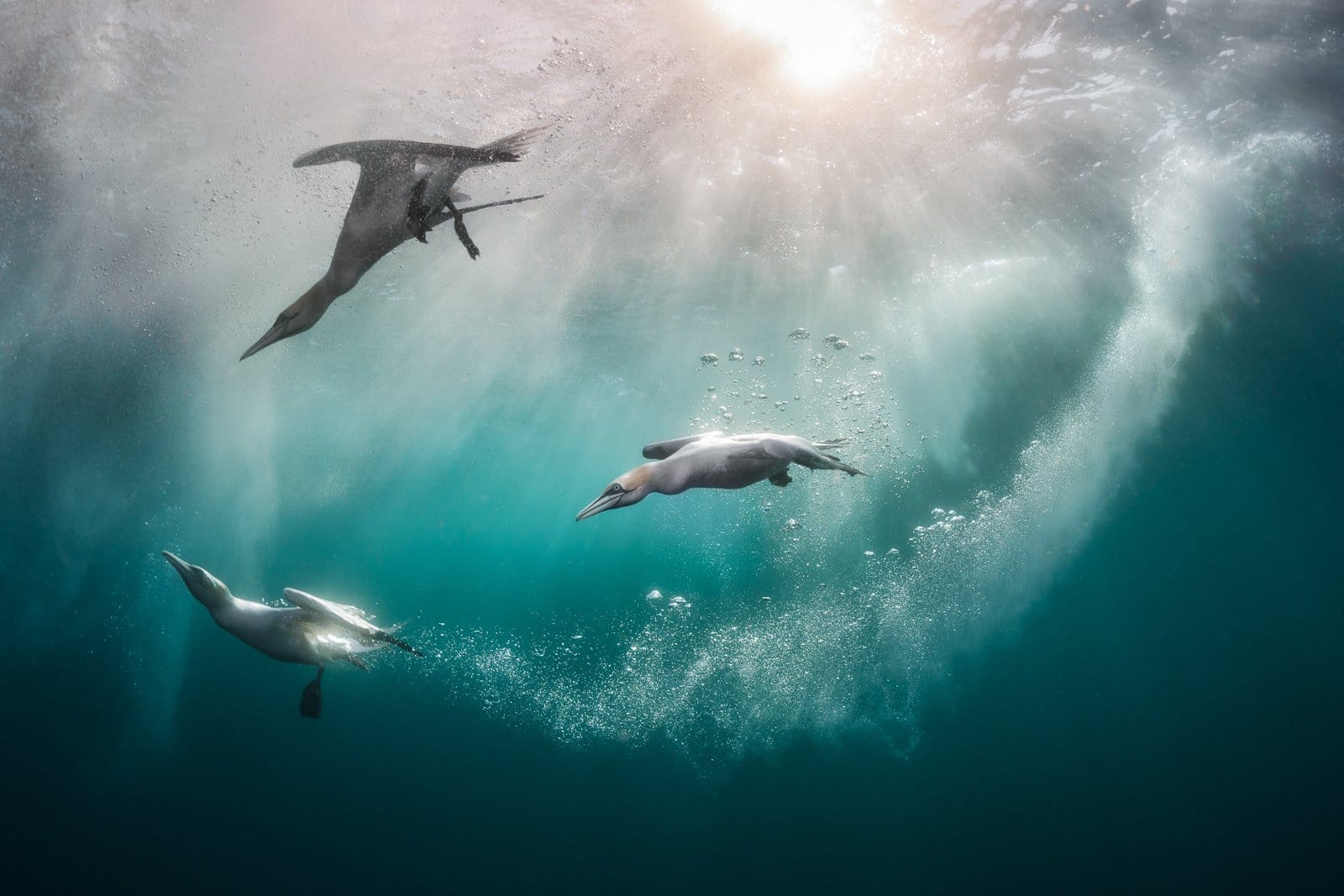
Many seabirds catch their prey through plunge diving, where they fly to a particular height, then fold their wings, and dive into the ocean. In busy waters, bubbles from all this diving can help obscure the birds from hapless fish. Some birds even use bubbles to escape from their own predators; some penguin species, for example, release trapped air from beneath their feathers as they surface, creating a flurry of bubbles that reduce the drag they have to overcome as they make their exit from the water. The fast exit and bubbly wake help them escape prowling seals. (Image credit: H. Spiers; via BWPA)

Star-Birthing Shock Waves
Although the space between stars is empty by terrestrial standards, it’s not devoid of matter. There’s a scattering of cold gas and dust, pocked by areas known as prestellar cores with densities of a few thousand particles per cubic centimeter. This is just enough matter to help gravity eventually win its tug of war with the forces that would drive molecules apart.
When shock waves pass through these regions — whether thrown off a dying star or a newly birthed one — they compress the material, kickstarting the process of stellar formation. Passing shock waves can also shake loose molecules stuck to the dust, providing key tracer elements that astronomers can use to visualize shock waves and the areas they affect. To learn more, see this article over at Physics Today. (Image credit: NASA/ESA/CSA/STSCI/K. Pontoppidan/A. Pagan; see also Physics Today)

Warming Temperatures Increase Turbulence
After multiple high-profile injuries caused by atmospheric turbulence, you might be wondering whether airplane rides are getting rougher. Unfortunately, the answer is yes, at least for clear-air (i.e., non-storm-related) turbulence in the North Atlantic region. It seems that climate change, as predicted, is increasing the bumpiness of our atmosphere. There are a couple of mechanisms at play here.
The first is that warming temperatures fuel thunderstorms. When ground-level temperatures and water temperatures are warmer, that provides more warm, moist air rising up and feeding atmospheric convection. Especially in the summertime, that translates into stronger, more frequent thunderstorms; even with flights avoiding the storms themselves, there’s greater turbulence surrounding them.
The second mechanism relates to wind, specifically in the mid-latitudes. In general, a temperature difference between two regions causes stronger winds. (Think about the windy conditions that accompany an incoming cold front.) At the mid-latitudes, the difference between cold polar regions and warmer equatorial ones creates a strong wind, known as the jet stream. Now, as temperature gradients increase at cruising altitudes, the jet stream gets stronger, which means bigger changes in wind speed with altitude. And its those wind speed differences at different heights that drive turbulence.
So, yes, we’re likely to see more turbulent flights now and in the future. But, fortunately, there’s a simple way to avoid injuries from that bumpiness: buckle up! If you keep your seat belt fastened while you’re seated, you can avoid getting tossed around by unexpected G-forces. (Image credit: G. Ruballo; see also Gizmodo)

Dripping Viscoelastics
An ultrasoft viscoelastic fluid drips in this research poster from the Gallery of Soft Matter. Complex materials like this one have stretchy, elastic behaviors typical of a solid along with the flowing, viscous properties of a fluid. Here, gravity overcomes the material’s elasticity, leaving it to sag and flow. As that happens, the fluid must slide past air, and the density difference between the two fluids creates the small distortions seen on the liquid sheet. This is an example of a Rayleigh-Taylor instability. (Image credit: J. Hwang et al.)