The Grand Canyon is a monument to the power of water, air, and time. In this video from It’s Okay To Be Smart, Joe Hanson describes the formation of the Grand Canyon – from the ancient oceans that created its many layers to the tectonic upthrusts that eventually created the Colorado River that continues to cut through the Canyon’s rocks today. Fluid dynamics play a major role in the geology of the Grand Canyon, whether it’s in the mantle convection that helps drive plate tectonics or the sedimentation that builds and erodes rock layers. (Video credit: It’s Okay To Be Smart)
Tag: physics

Breaking Jets Into Drops
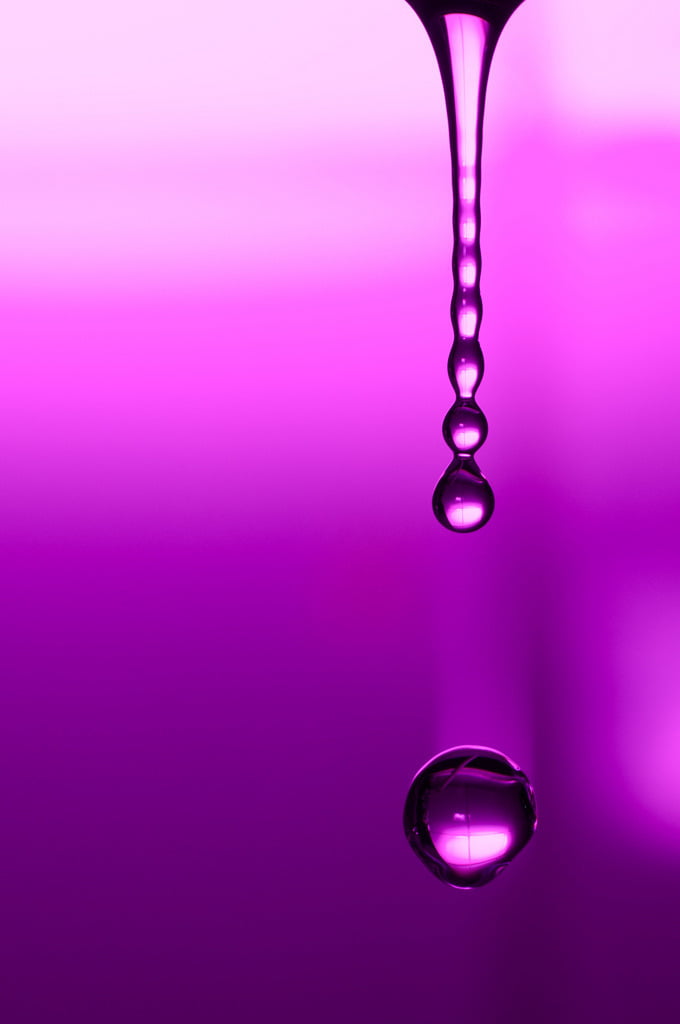
A falling stream of water will break into droplets due to the Plateau-Rayleigh instability. Small disturbances can create a wavy perturbation in the falling jet. Under the right conditions, the pressure caused by surface tension will be larger in the narrower regions and smaller in the wider ones. This imbalance will drive flow toward the wider regions and away from the narrower ones, thereby increasing the waviness in the jet. Eventually, the wavy jet breaks into droplets, which enclose the same volume of water with less surface area than the perturbed jet did. The instability is named for Joseph Plateau and Lord Rayleigh, who studied it in the late 19th century and showed that a falling jet of a non-viscous fluid would break into droplets if the wavelength of its disturbance was larger than the jet’s circumference. (Image credit: N. Morberg)

Air Pressure in Flight
We live at the bottom of a sea of air, surrounded by a constant pressure equal to 101 kPa (14.7 psi) over our entire bodies. For the most part, we don’t notice the pressure air exerts on us. But if you’ve flown on a commercial airplane, you may have noticed some of the effects of changing that air pressure. Flexible sealed containers, like bags of chips or bottles of water, change their shape dramatically over the course of a flight because the air pressure inside them can be greater than the air cabin pressure at altitude. In the video above, Nick Moore measured his in-flight cabin pressure as 84 kPa (12psi), which is equivalent to about 1500 m (5000 ft) above sea level. Why do airlines keep the cabin pressure lower in flight? The biggest reason is because the airplane, like the in-flight snack, is a pressure vessel. At cruising altitudes the outside air pressure is about 24 kPa (3.5 psi). To keep the interior of the cabin habitable, the fuselage of the airplane has to hold a higher pressure. The larger the difference between the interior and exterior pressures, the greater the stress the airplane must withstand. Keeping the air pressure in flight a little lower makes the engineering a little easier and does the occupants no harm. (Video credit: N. Moore)

Sharkskin Instability
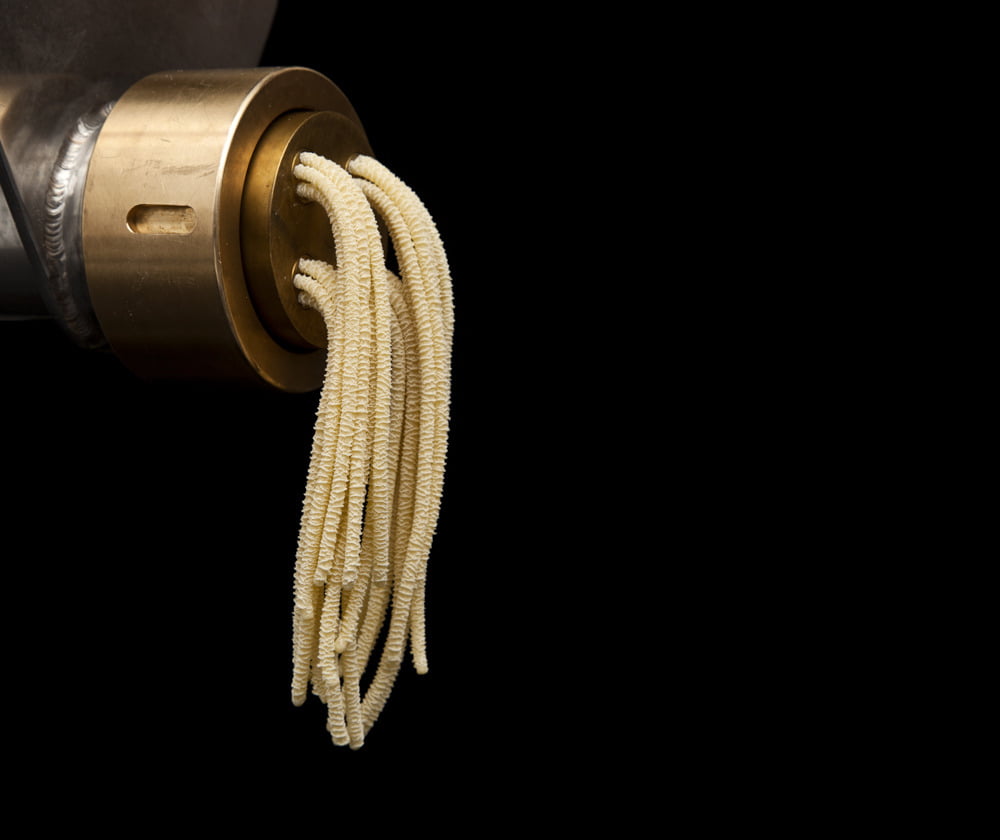
Homemade spaghetti noodles exhibit a roughened surface that’s the result of viscoelastic behavior known as the sharkskin instability. It’s usually observed in the industrial extrusion of polymer plastics. In the case of spaghetti, the long, complex polymer molecules necessary for the instability come from the proteins in eggs. The characteristically rough surface of the extruded material is caused by the transition from flow through the die to air. Inside the die, friction from the walls exerts a strong shear force on the outer part of the fluid while the inner portion flows freely. When the material exits the die, the sudden lack of friction on the outer portion of the fluid causes it to accelerate to the same velocity as the middle of the flow. This acceleration stretches the polymers until they snap free of the die; after the strained polymers relax, the material keeps a rough, saw-tooth pattern. In industry, the sharkskin instability can be prevented by regulating temperature or flow speed. In the case of spaghetti, though, Modernist Cuisine suggests the roughness is desirable because it helps trap the pasta sauce. Bon appetit! (Image credit: Modernist Cuisine)
“En Plein Vol”
Artist Antoine Terrieux’s “En Plein Vol” exhibit shows off the power of hair dryers. Parts of the exhibit, like the floating ball at 0:16, rely on Bernoulli’s principle and the moving stream of air the dryers generate. Others, like the smoke tornado at 0:39 or the (suspended) paper airplane at 0:56, use the hair dryers to generate vorticity essential to the installation. It’s a neat concept and very well executed. (Video credit: A. Terrieux; via io9; submitted by Joseph S. and Eliza M.)

Spinning Paint
Fluid dynamical behaviors are often the result of competing forces. Here paint flung from a spinning rod illustrates the effects of adhesion, surface tension, and centrifugal force. In general, surface tension tries to hold a fluid together, and adhesion allows it to stay attached to a surface. Centrifugal force, on the other hand, tends to push the fluid outward. As the spinning rod accelerates, centrifugal force wins over adhesion and the paint spirals outward. For awhile, surface tension manages to hold the paint together, stretching it into spiraling ligaments of fluid. But when centrifugal force overpowers surface tension as well, the ligaments of paint snap into smaller droplets, still flying outward. Check out the full video for more great slow motion shots, and be sure to look at photographer Fabian Oefner’s “Black Hole“ series, which inspired the video. (Image credit: BBC Earth Unplugged, source video)
Underwater Explosions
As dangerous as explosions are in air, they are even more destructive in water. Because air is a compressible fluid, some part of an explosion’s energy is directed into air compression. Water, on the other hand, is incompressible, which makes it an excellent conductor of shock waves. In the video above we see some simple underwater explosions using water bottles filled with dry ice or liquid nitrogen. The explosions pulsate after detonation due to the interplay between the expanding gases and the surrounding water. When the gases expand too quickly, the water pressure is able to compress the gases back down. When the water pushes too far, the gases re-expand and the cycle repeats until the explosion’s energy is expended. This pulsating change in pressure is part of what makes underwater explosions so dangerous, especially to humans. Note in the video how the balloons ripple and distort due to the changing pressure. Those same changes in pressure can cause major internal damage to people. (Video credit: The Backyard Scientist; submitted by logicalamaze)

Bubble Rupture
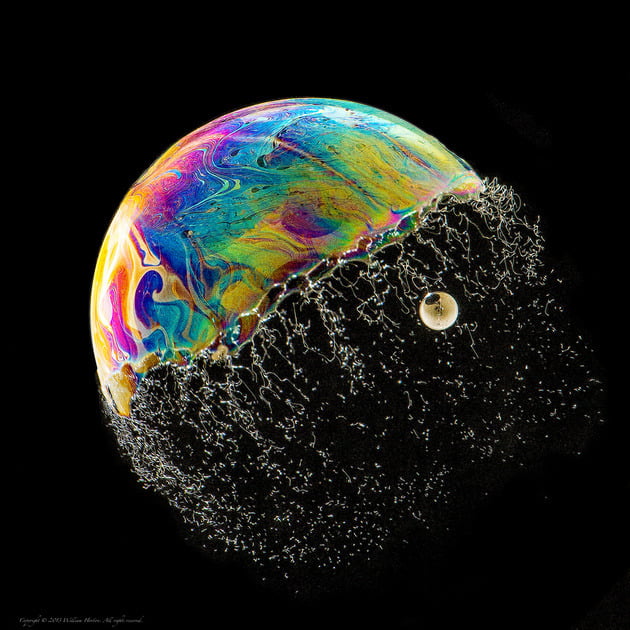
Surface tension draws bubbles into spheres, but the balance of forces holding the sphere together is delicate. When pierced by a projectile, sometimes soap films can heal themselves, but often the film ruptures. Once a hole forms in the bubble, the film’s integrity is lost. Instead of holding the bubble together, surface tension pulls the soap film apart in a spray of thread-like ligaments that break into droplets. In the blink of an eye, the bubble is gone. (Image credit: W. Horton)
Calbuco
Filmmaker Martin Heck captured incredible timelapse footage of the Chilean volcano Calbuco erupting earlier this year. Fluid dynamics on these enormous geophysical scales is always awe-inducing. In the beginning, clouds bob gently and flow around the landscape. Then the volcano erupts, and the towering ash cloud of the eruption roils with turbulence, displaying eddies with length scales from hundreds of meters down to centimeters. And when the hot ash has risen and cooled, it forms a cap that spreads horizontally. Nature is a wonderful demonstrator of fluid dynamics, but what always amazes me is how very alike flows are whether they are confined to a laboratory or take up an entire planet. (Video credit: M. Heck; via It’s Okay To Be Smart)
Water in Oil
Pouring water on an oil fire is a quick way to cause almost explosive results. Since water is denser than oil, it quickly sinks to the bottom of a container, heating up as it does. When the water reaches its boiling point, it evaporates and expands as steam. That phase change involves a huge change in volume, a fact made especially clear in the video below. The steam expands and rises, throwing droplets of oil upward and outward. These smaller atomized droplets are easier to combust, which, in the case of the video above, causes a veritable cloud of flames if a fire has already started.
(Video credits: The Slow Mo Guys and N. Moore)