Tag: numerical simulation

  • Marshland Wave Damping

    Marshland Wave Damping

    Coastal marshes are a critical natural defense against flooding. The flexible plants of the marsh both slow the water’s current and help damp waves. As a result of that hydrodynamic dissipation, marshes help protect against erosion and reduce the magnitude of flooding events. But coastal managers looking to maintain or improve their marshes in order to mitigate climate-change-driven storms need to be able to predict what level of vegetation they need.

    To that end, a team of researchers has built a new model to better capture the flow effects of marsh grasses. Building from an individual, flexible plant (as opposed to a rigid cylinder, as grass is often represented), the authors constructed a model able to predict wave dissipation for many marsh configurations, which should help better predict the infrastructure changes needed in different coastal regions. (Image credit: T. Marquis; research credit: X. Zhang and H. Nepf; via APS Physics)

  • Superfluid Instabilities

    Superfluid Instabilities

    Superfluids — like Bose-Einstein condensates — are bizarre compared to fluids from our everyday experience because they have no viscosity. Without viscosity, it’s no surprise that they behave in unusual ways. Here, researchers simulated superfluids moving past one another. In each of these images, the blue fluid is moving to the left, and the red fluid is moving to the right. In a typical fluid, such motion causes ocean-wave-like curls due to the Kelvin-Helmholtz instability.

    Instead, with a low relative velocity and high repulsion between atoms of the two layers, the superfluids form a tilted, finger-like interface (Image 1) that the authors refer to as a flutter-finger pattern. (Repulsion essentially sets the miscibility between the superfluids. With a high repulsion, the superfluids resist mixing.)

    With a higher relative velocity (Image 2), the wavelength of the ripples becomes comparable to the thickness of the interface, and the superfluids take on a very different, zipper-like pattern. Note how the tips detach and reconnect to the neighboring finger!

    With lower repulsion, the interface between the two liquids is thicker and breaks down quickly (Image 3). The authors call this a sealskin pattern. (Image credits: water – M. Blažević, simulations – H. Kokubo et al.; research credit: H. Kokubo et al.; via APS Physics)

  • Sea Sponge Hydrodynamics

    Sea Sponge Hydrodynamics

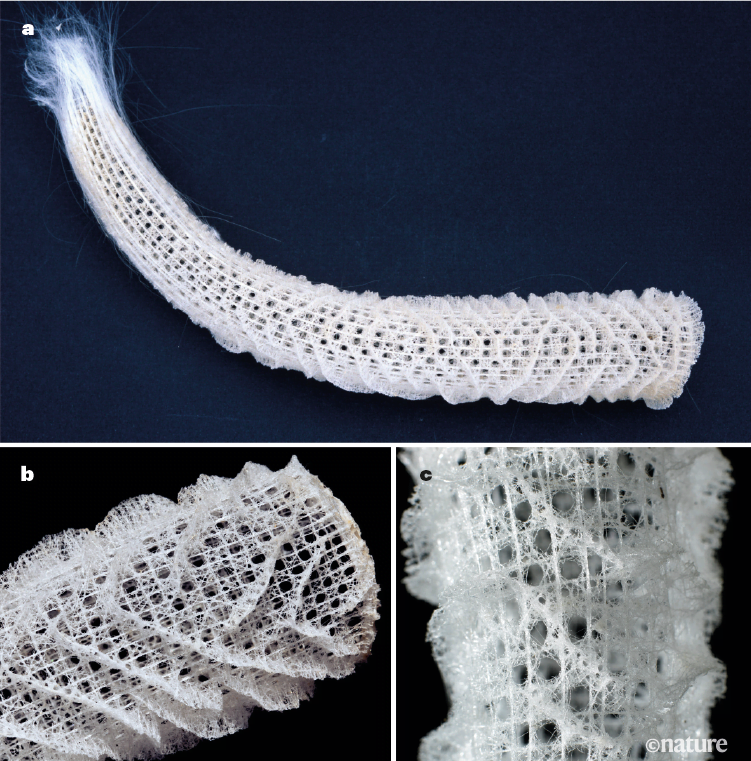
    The Venus’s flower basket is a sea sponge that lives at depths of 100-1000 meters. Its intricate latticework skeleton has long fascinated engineers for its structural mechanics, but a new study shows that the sponge’s shape benefits it hydrodynamically as well.

    The sea sponge’s skeleton is predominantly cylindrical, with tiny gaps that allow water to flow through it and helical ridges alongside its outer surface to strengthen it against the deep-sea currents surrounding it. Through detailed numerical simulations, researchers found that both of these features — the holes and the ridges — serve fluid mechanical purposes for the sponge. The porous holes of the sea sponge drastically reduce flow in the sponge’s wake (third image), which provides major drag reduction for the sea sponge. That drag reduction makes it easier for the sponge to stay rooted to the ocean floor.

    The helical ridges, on the other hand, create low-speed vortices within the sea-sponge’s body cavity (second image). Such vortices increase the time water spends inside the sponge, likely helping it to filter-feed more efficiently. The additional vorticity comes at the cost of slightly increased drag but not enough to outweigh the savings from its porosity. (Image and research credit: G. Falcucci et al.; via Nature; submitted by Kam-Yung Soh)

  • Controlling Aerosols Onstage

    Controlling Aerosols Onstage

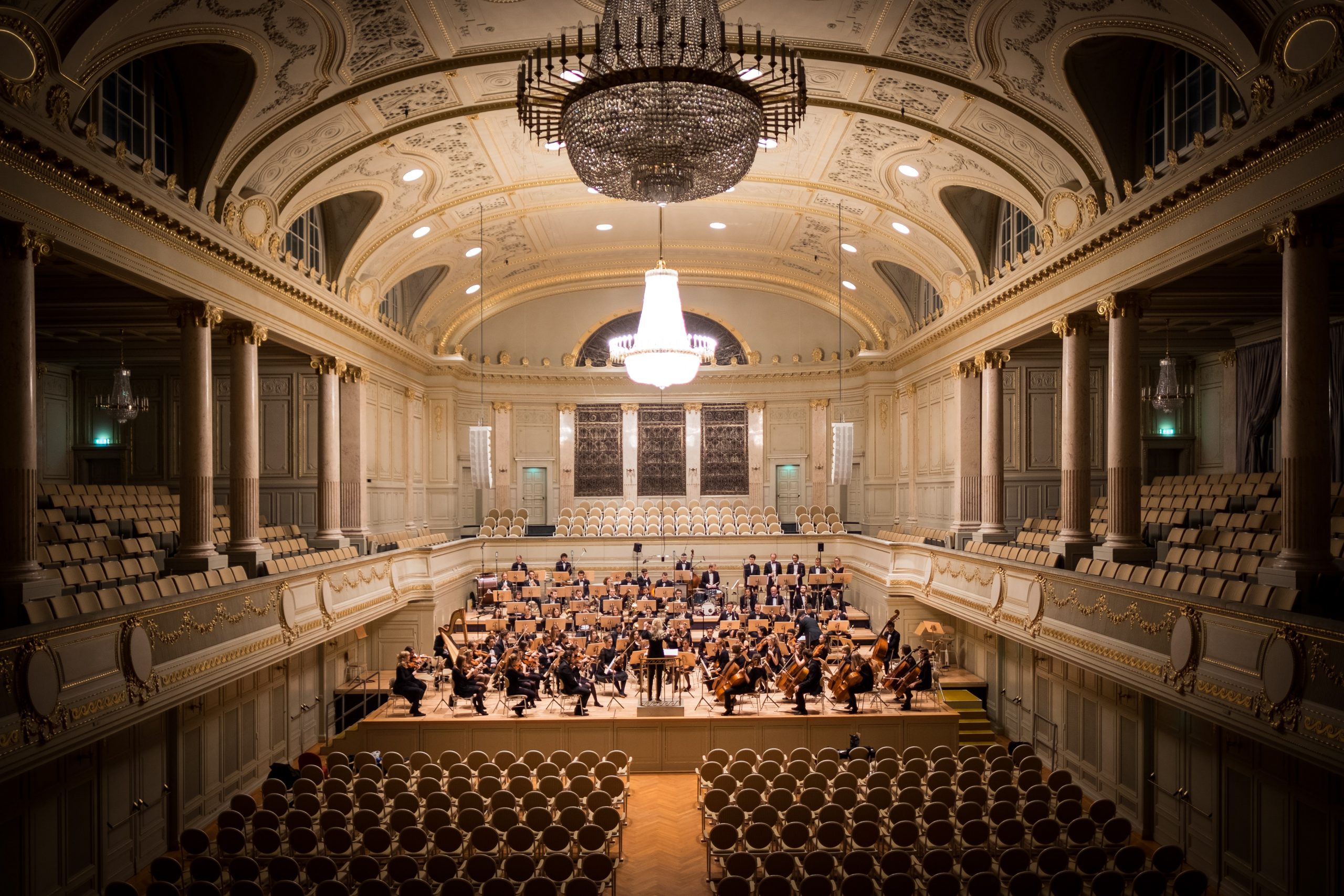
    Few industries saw more disruption from the pandemic than the performing arts. To help orchestras return to the concert hall in a way that keeps performers and audience members safe, researchers have simulated air flow and aerosols around musicians onstage. Some instruments — like the trumpet — are super-spreaders when it comes to aerosol production, and, in the conventional organization of orchestras, those aerosols have to travel through other sections of the orchestra before reaching air vents, putting more musicians at risk.

    (Upper left) Aerosol concentration for an orchestra performing in their original arrangement, with doors to the hall closed; (Upper right) Aerosol concentration in the modified musician arrangement, with doors open; (Bottom row) Time-averaged aerosol concentration in the breathing zone of performers for (left) the original arrangement and (right) with modified seating.
    (Upper row) Aerosol concentration for the orchestra’s original seating arrangement (left) and in the modified arrangement (right). (Bottom row) Time-averaged concentration of aerosol particles in the breathing zone of each musician in the original (left) and modified arrangements (right).

    Using Large Eddy Simulation, researchers looked at alternate seating arrangements for the Utah Symphony that could mitigate these risks. By rearranging the musicians so that instruments that produce lots of aerosols are closer to the air vents and open doors, the team reduced the average concentration of aerosols around musicians by a factor of 100, giving the performers a chance to return to the stage far more safely. (Image credit: top – M. Nägeli, simulation – H. Hedworth et al.; research credit: H. Hedworth et al.; via NYTimes; submitted by Kam-Yung Soh)

  • Betelgeuse’s Flickering

    Betelgeuse’s Flickering

    Between November 2019 and March 2020 Betelgeuse, the red supergiant star in the constellation Orion’s left shoulder, experienced what’s being called the Great Dimming. Usually, the star is one of the ten brightest stars in the sky, often visible even in the suburban sprawl. But as of February 2020, it had dimmed by a factor of 2.5.

    Observers speculated all sorts of causes, including the idea that this was a precursor to a supernova explosion. Instead, it’s a relatively normal occurrence for a star like Betelgeuse. The image above is from a numerical simulation of the star, and it shows approximately what it would look like to the human eye over a 7.5 year time span. As you can see, its brightness varies noticeably, and its surface seems almost to boil. This has to do with convection in the star. Compared to a star like our sun, Betelgeuse has fewer — and much larger — convection cells.

    With a little more time and data, astronomers pinned down the exact source of Betelgeuse’s flickering during the Great Dimming. The year before the star belched an enormous bubble of gas into space. Then, when part of the star cooled in the aftermath, that gas condensed and formed a dust cloud which partially obscured the star. You can see an artist’s conception of the situation in the video below. (Image and research credit: B. Freytag; research credit: M. Montargès et al.; video credit: ESO/L. Calçada)

  • Iceberg Melting Depends on Shape

    Iceberg Melting Depends on Shape

    Not all icebergs melt equally. Through a combination of experiment and numerical simulation, researchers have shown that an iceberg’s shape underwater strongly affects how it melts. Specifically, icebergs in a flow melt more quickly on the front and side surfaces and slower on the underside. This means that narrow icebergs that project deep into the water will melt faster than wider, shallow ones. Currently, climate models don’t account for this variation, but the researchers hope their work will help build more accurate models for future studies. (Image credit: iceberg – C. Matias, experiment – E. Hester et al.; research credit: E. Hester et al.; see also APS Physics)

    Snapshots of a model iceberg as it melts.
  • Spiderwebs and Stratocumulus Clouds

    Spiderwebs and Stratocumulus Clouds

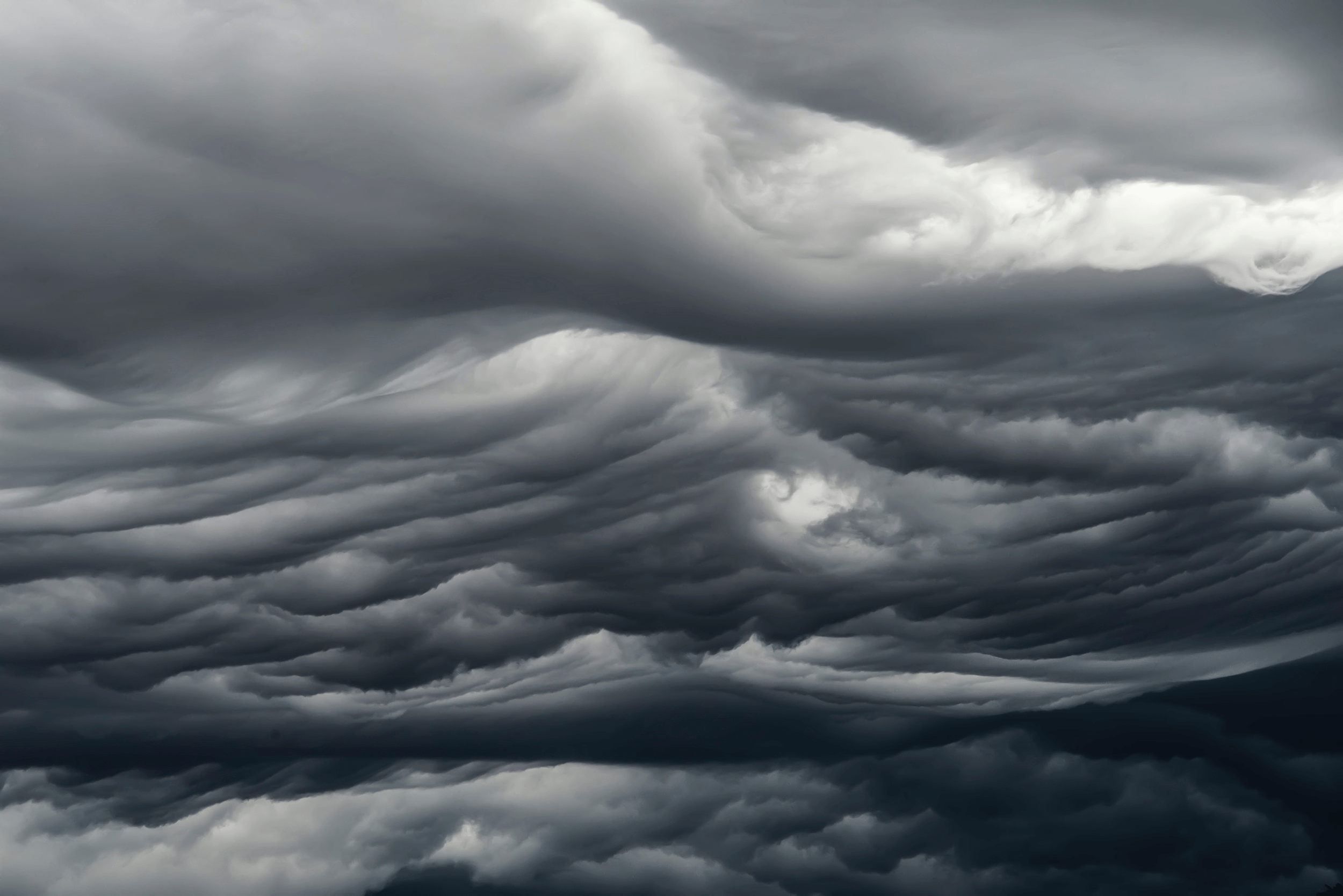
    Stratocumulus clouds cover about 20% of Earth’s surface at any given time, and they form distinctive patterns of lumpy cells separated by thin slits. Because of their interconnectedness, researchers nicknamed these narrow regions spiderwebs. New simulations show that evaporative cooling along the cloud tops drives the formation of these spiderwebs (Image 2). Without it (Image 3), the cloud pattern looks very different. (Image credits: featured image – L. Dauphin/MODIS, others – UConn ME 3250; research credit: G. Matheou et al.)

  • Cutting Coronavirus Risk in Cars

    Cutting Coronavirus Risk in Cars

    Even in a pandemic, it’s sometimes necessary to share a car with someone outside one’s bubble. When that’s the case, it’s important to know how to limit risks of coronavirus exposure. For this study, researchers used computational fluid dynamics to simulate flow around and inside a Prius-like four-door sedan with a driver and a single passenger located in the rear passenger-side seat. Assuming the air conditioner was on and the car was moving at 50 miles per hour, the researchers found that the baseline flow of air inside the car moves from the back of the cabin toward the front. With the windows closed, the simulation suggested that 8-10% of the aerosol particles exhaled by one passenger could reach the other.

    Opening the car’s windows increases the ventilation and reduces exposure risk. The best configuration the researchers found opened two windows: the front passenger-side window and the rear driver-side window. By opening the window opposite each person, the airflow in the car creates a sort of curtain between the two that reduces aerosol exposure to only 0.2-2% of what’s exhaled by the other occupant. (Image credit: rideshare – V. Xok, CFD – V. Mathai et al.; research credit: V. Mathai et al.; via NYTimes; submitted by Kam-Yung Soh)

    Computed streamlines for flow through a sedan with a driver and one rear passenger, with each opposite window opened.
  • Featured Video Play Icon

    Recreating Acoustics

    The cultural heritage of a site is made up of more than its appearance; its soundscape is vital, as well. Acousticians and historians work together to preserve and recreate the auditory landscape of important sites through acoustical measurements and digital reconstructions based on architecture and building materials. Thanks to projects like these, researchers can achieve feats like recreating a concert within the Notre Dame Cathedral as it was before the 2019 fire. To learn more about the technologies behind these feats, check out this Physics Today article. (Image and video credit: Ghost Orchestra; for more, see Physics Today)

  • Hammerhead Hydrodynamics

    Hammerhead Hydrodynamics

    Hammerhead sharks have some of the most distinctive craniums in the ocean, which begs the question: how do they swim with that head? New computational fluid dynamics studies suggest that their long foil-shaped heads help the sharks maneuver swiftly, but they come at the cost of substantially higher drag. The researchers found that drag on the hammerhead’s cranium required energy expenditures more than 10 times higher than other sharks, but since the study looked at heads only, it’s possible that the rest of the shark’s positioning helps mitigate that cost. (Image credit: shark – J. Allert, CFD – M. Gaylord et al.; research credit: M. Gaylord et al.; via NYTimes; submitted by Kam-Yung Soh)

    Pressure contours and streamlines around a hammerhead shark head.