Tag: numerical simulation

  • Martian Glaciers

    Martian Glaciers

    On Earth, glaciers slide on lubricating layers of water, leaving complex landscapes like fjords and drumlins in their wake. Mars — though once home to enormous ice masses — lacks those geological features. Scientists assumed, therefore, that Martian ice stayed frozen and unmoving. But a new study demonstrates that is not the case.

    Researchers used computational modeling to simulate two identical glaciers: one under Earth-like conditions and one under the lower gravity of Mars. They found that Martian glaciers did indeed move, but Mars’s lower gravity, combined with better water drainage beneath the ice, meant that they moved exceedingly slowly. Martian glaciers did erode the landscape but into different features than on Earth. Instead of forming moraines and drumlins, a large Martian glacier would instead carve channels and eskar ridges, geological features found on Mars today. (Image credit: NASA/JPL-CalTech/Uni. of Arizona; research credit: A. Grau Galofre et al.; via AGU; submitted by Kam-Yung Soh)

  • Rising Through Turbulence

    Rising Through Turbulence

    Plankton — microscopic creatures with often limited swimming abilities — can face daily journeys of hundreds of vertical meters in the ocean. That’s a daunting prospect for any tiny swimmer. A new mathematical model suggests that plankton can have an easier time of it, though, by riding turbulent currents.

    The researchers modeled an individual planktar (singular of plankton) capable of sensing nearby velocity gradients and rotating its body to control its swimming direction. With this simple set of controls, their simulated planktar was able to “surf” turbulent currents, covering vertical distances at twice its normal swimming speed despite its curvy path.

    Currently, there’s no direct experimental evidence that plankton do this, but it does seem to make sense of experimenters’ observations. With the model’s results to guide them, experimentalists are looking for microswimmers actively orienting themselves based on turbulence. (Image credit: top – B. de Kort, illustration – R. Monthiller et al.; research credit: R. Monthiller et al.; via APS Physics)

  • Bubbles in Turbulence

    Bubbles in Turbulence

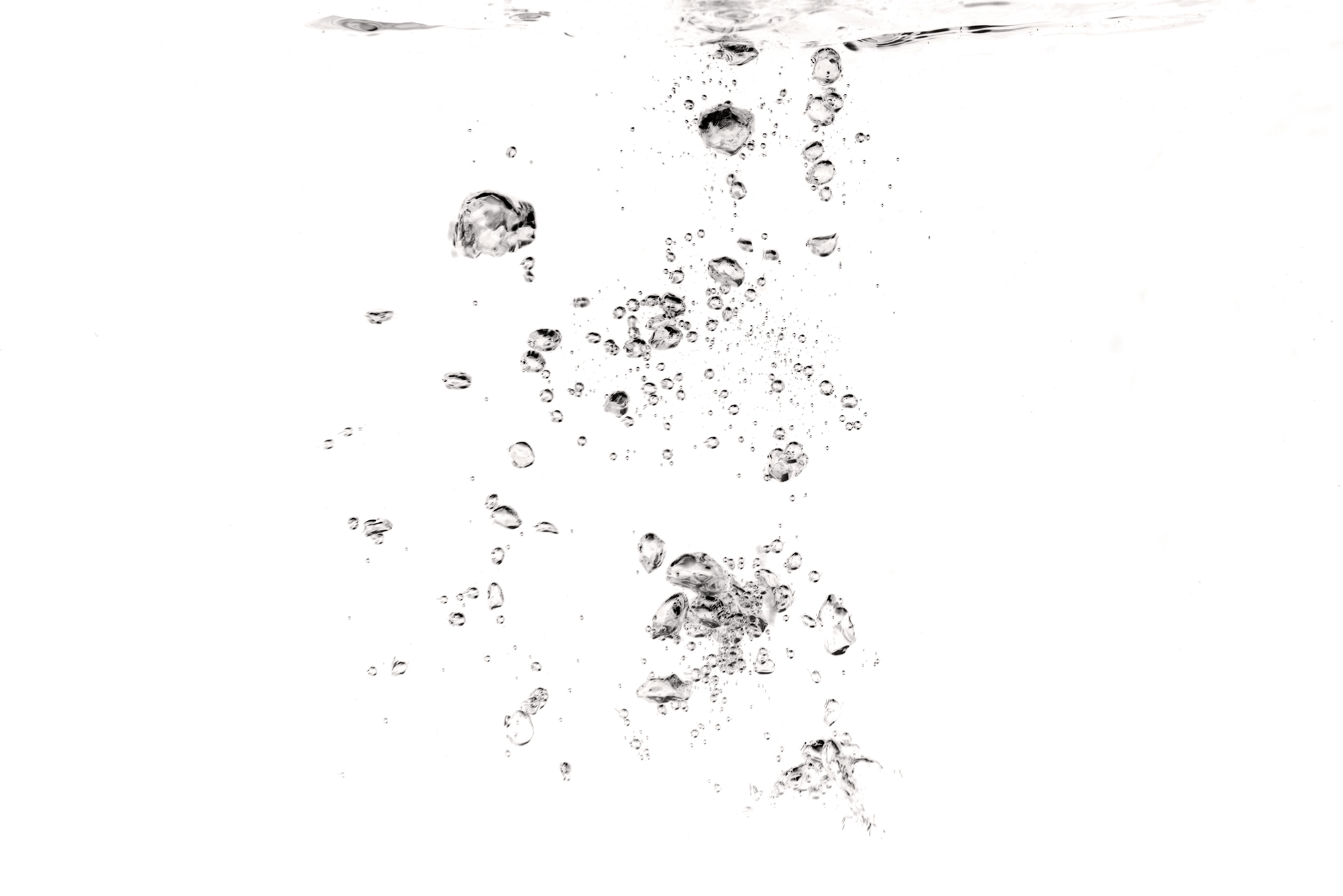
    In nature and industry, swarms of bubbles* often encounter turbulence in their surrounding fluid. To study this situation, researchers used numerical simulation to observe bubbles across a range of density, viscosity, and surface tension values relative to their surroundings. They found that density differences between the two fluids made negligible changes to the way bubbles broke or coalesced.

    In contrast, viscosity played a much larger role. More viscous bubbles were less likely to deform and break, thanks to their increased rigidity. When looking at small deformations along the bubble interface, both density and viscosity had noticeable effects. With increasing bubble density, they observed more dimples on the interface; increasing the viscosity had the opposite effect, making the bubbles smoother. (Image credit: Z. Borojevic; research credit: F. Mangani et al.)

    *We usually think of bubbles as air or another gas contained within a liquid. But this study’s authors use the term “bubble” more broadly to mean any coherent bits of fluid in a different surrounding fluid. Colloquially, this means their results apply to both bubbles and drops.

  • Extreme Weather

    Extreme Weather

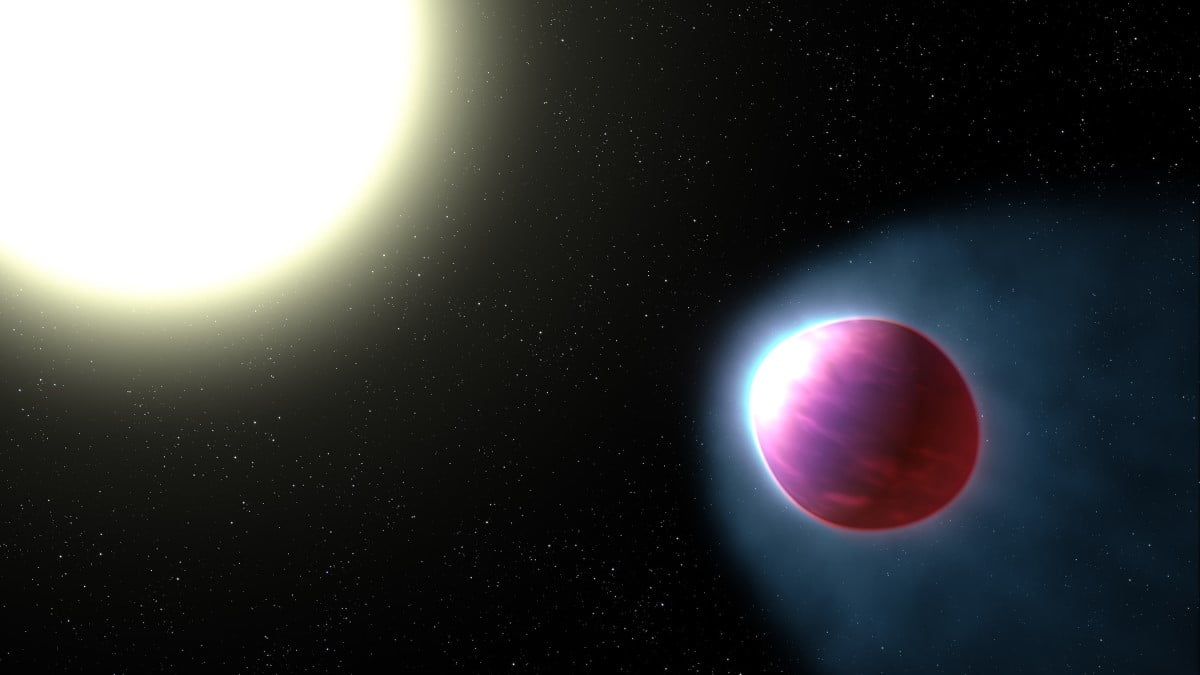
    Many of the exoplanets we’ve observed so far are extreme environments. WASP-121b is known as a hot Jupiter, a gas giant so close to its star that it orbits in just 30 hours. The exoplanet is tidally-locked to its star, meaning that one side always faces toward the star and the other faces away. This constant sunlight makes the daytime side of the planet hot enough to vaporize metals. A recent study combined observations of the exoplanet with numerical simulations to model both the daytime and nighttime atmosphere of the exoplanet. The results are pretty wild. The authors found evidence of 18,000 km/h winds that blow hot gases from the dayside to the nightside, where temperatures cool enough for some metals — primarily corundum — to rain out of the atmosphere. Given the trace amounts of other elements available in the atmosphere, the authors posit that the nightside of the planet may have rainfall of liquid rubies and sapphires. (Image credit: NASA/ESA; research credit: T. Mikal-Evans et al.; via Physics World)
  • Sonic Booms and Urban Canyons

    Sonic Booms and Urban Canyons

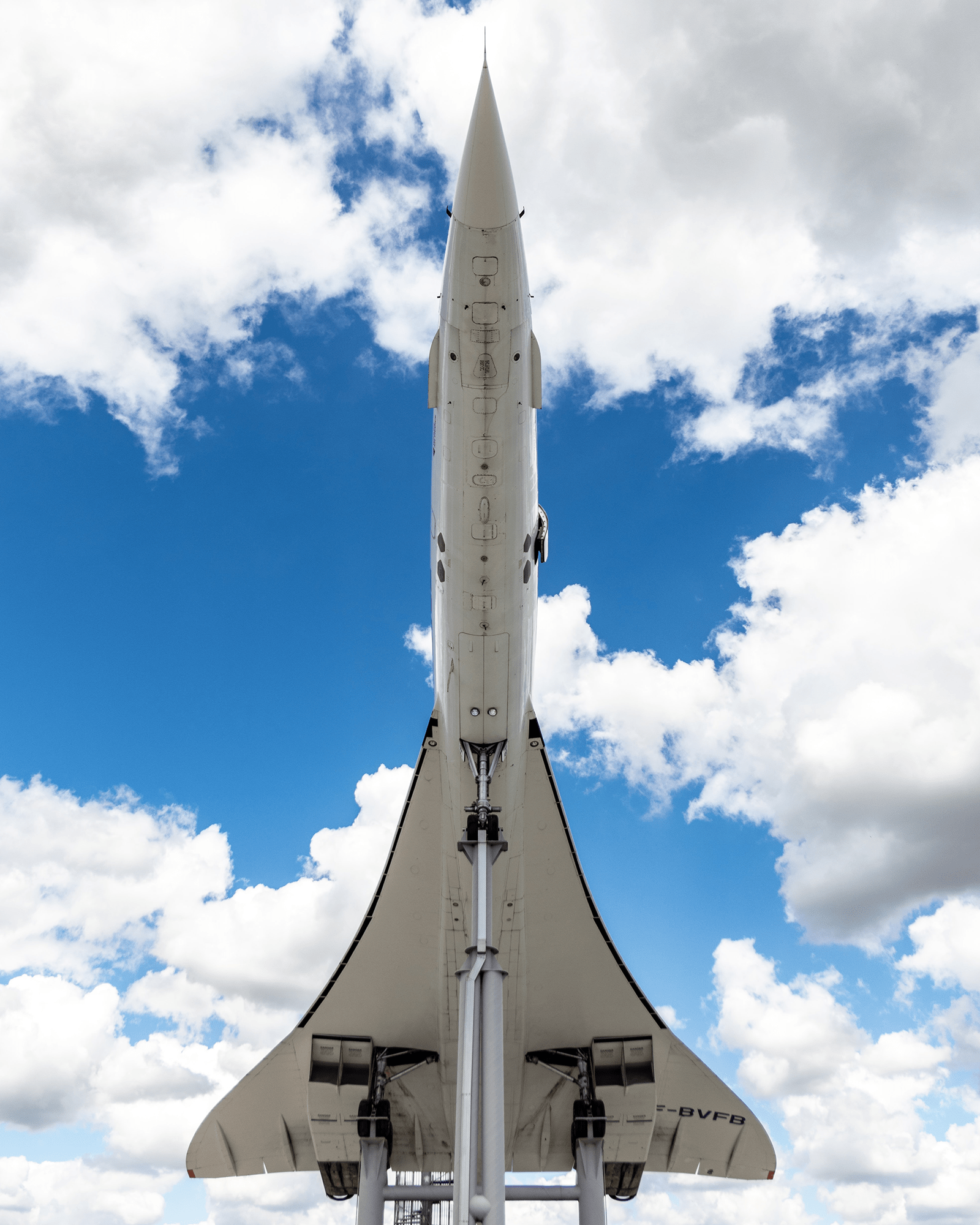
    In the days of the Concorde — thus far the world’s only supersonic passenger jet — noise complaints from residents kept the aircraft from faster-than-sound travel except over the open ocean. With many pursuing a new generation of civil supersonic aircraft, researchers are looking at how those sonic booms could interact with those of us on the ground.

    In this study, researchers simulated the shock waves from aircraft interacting with single and multiple buildings on the ground. They found that the presence of a building increases the perceived sound level of the boom by about 7 dB at the most. But the most interesting results are what happens between multiple buildings.

    If the street between buildings is wide enough, they each act independently, as if they were single buildings. But for narrower streets, the acoustics waves reflect and diffract between the buildings, creating a resonance that makes the acoustic echoes last longer. The effect is especially pronounced for a sonic boom traveling across a series of buildings, which mimics the layout of a dense city full of urban canyons. (Image credit: Concorde – M. Rochette, simulation – D. Dragna et al.; research credit: D. Dragna et al.)

    Acoustic waves reflect and propagate through 2D urban canyons with widths of 10 meters (top), 20 meters (middle), and 30 meters (bottom).
    Acoustic waves reflect and propagate through 2D urban canyons with widths of 10 meters (top), 20 meters (middle), and 30 meters (bottom).
  • Inside a Champagne Pop

    Inside a Champagne Pop

    When the cork pops on a bottle of champagne, the physics is akin to that of a missile launch in more ways than one. In this study, researchers used computational fluid dynamics to closely examine the gases that escape behind the cork. They identified three phases to the flow. In the first, the exhaust gases form a crown-shaped expansion region, complete with shock diamonds. Once the cork has moved far enough downstream, the axial flow accelerates to supersonic speeds and a bow shock forms behind the cork. Finally, the pressure in the bottle drops low enough that supersonic conditions cannot be maintained and the flow becomes subsonic. (Image credit: top – Kindel Media, simulation – A. Benidar et al.; research credit: A. Benidar et al.; via Ars Technica; submitted by Kam-Yung Soh)

    A numerical simulation showing the ejection of a champagne cork from a bottle. The colors indicate the speed of gases escaping from the bottle.
    A numerical simulation showing the ejection of a champagne cork from a bottle. The colors indicate the speed of gases escaping from the bottle.
  • Asperitas Formation

    Asperitas Formation

    In 2017, the World Meteorological Organization named a new cloud type: the wave-like asperitas cloud. How these rare and distinctive clouds form is still a matter of debate, but this new study suggests that they need conditions similar to those that produce mammatus clouds, plus some added shear.

    Using direct numerical simulations, the authors studied a moisture-filled cloud layer sitting above drier ambient air. Without shear, large droplets in this cloud layer slowly settle downward. As the droplets evaporate, they cool the area just below the cloud, changing the density and creating a Rayleigh-Taylor-like instability. This is one proposed mechanism for mammatus clouds, which have bulbous shapes that sink down from the cloud.

    When they added shear to the simulation, the authors found that instead of mammatus clouds, they observed asperitas ones. But the amount of shear had to be just right. Too little shear produced mammatus clouds; too much and the shear smeared out the sinking lobes before they could form asperitas waves. (Image credit: A. Beatson; research credit: S. Ravichandran and R. Govindarajan)

  • Re-Entry For X-Wings

    Re-Entry For X-Wings

    Fans of sci-fi and fantasy have a long-standing tradition of exploring the physics and/or practicality of creations in their fandom, and Star Wars fans are no exception. Here engineers ask whether Luke Skywalker’s X-wing fighter could survive the descent through Dagobah’s atmosphere as he searched for Master Yoda. Their results are based on a numerical simulation, with some assumptions about the spacecraft’s descent path and design as well as the planet’s atmosphere. Fans of the Jedi will be glad to hear that the X-wing can survive its supersonic descent intact, delivering the last Jedi safely to his mentor. (Image credit: Y. Ling et al.)

  • Featured Video Play Icon

    Burning Virtual Forests

    Wildfires are growing ever more frequent and more destructive as the climate crisis worsens. Unfortunately, simulating and predicting the course of these fires is incredibly difficult, requiring a combination of ecology, meteorology, combustion science, and more. To handle so many variables, model builders often turn to statistics that allow them to simulate an entire forest but at the cost of representing individual trees as a few pixels or a cone.

    In this video, researchers show a new wildfire simulation based on a computationally efficient but more realistic depiction of trees. With individual, three-dimensional trees, the simulation can capture effects that are otherwise hard to examine – like the difference in burn rate for coniferous and deciduous forests and the likelihood that a fire can jump a firebreak of a given size. Their weather, fire, and atmospheric models are even able to simulate the birth of fire-generated clouds! Check out the full video to see more and then head over to their site if you’d like to dig into the methodology. (Video and research credit: T. Hädrich et al.; see also)

  • Inside a Coronavirus Aerosol

    Inside a Coronavirus Aerosol

    This is a glimpse inside a tiny aerosol droplet with a single SARS-CoV-2 coronavirus inside it. The numerical simulation required a team of 50 scientists, 1.3 billion atoms, and the second most powerful supercomputer in the world. By simulating every atom, the researchers hope to observe what happens to a coronavirus in these micron-sized, long-lasting droplets. Does the virus survive? How do variants fare?

    Their simulation shows that the positive charge of the coronavirus’s spike proteins helps attract mucins that shield the virus and protect it from the droplet interface where evaporation could destroy it. Variants like Delta and Omicron have even more positive charge to their spike proteins, giving themselves a better cloak of mucins and potentially making them all the more infectious. Definitely check out the full New York Times write-up for more spectacular visualizations from the work. (Image and research credit: R. Amaro et al.; via NYTimes; submitted by Kam-Yung Soh)