Tag: mixing

  • Swirling Blooms

    Swirling Blooms

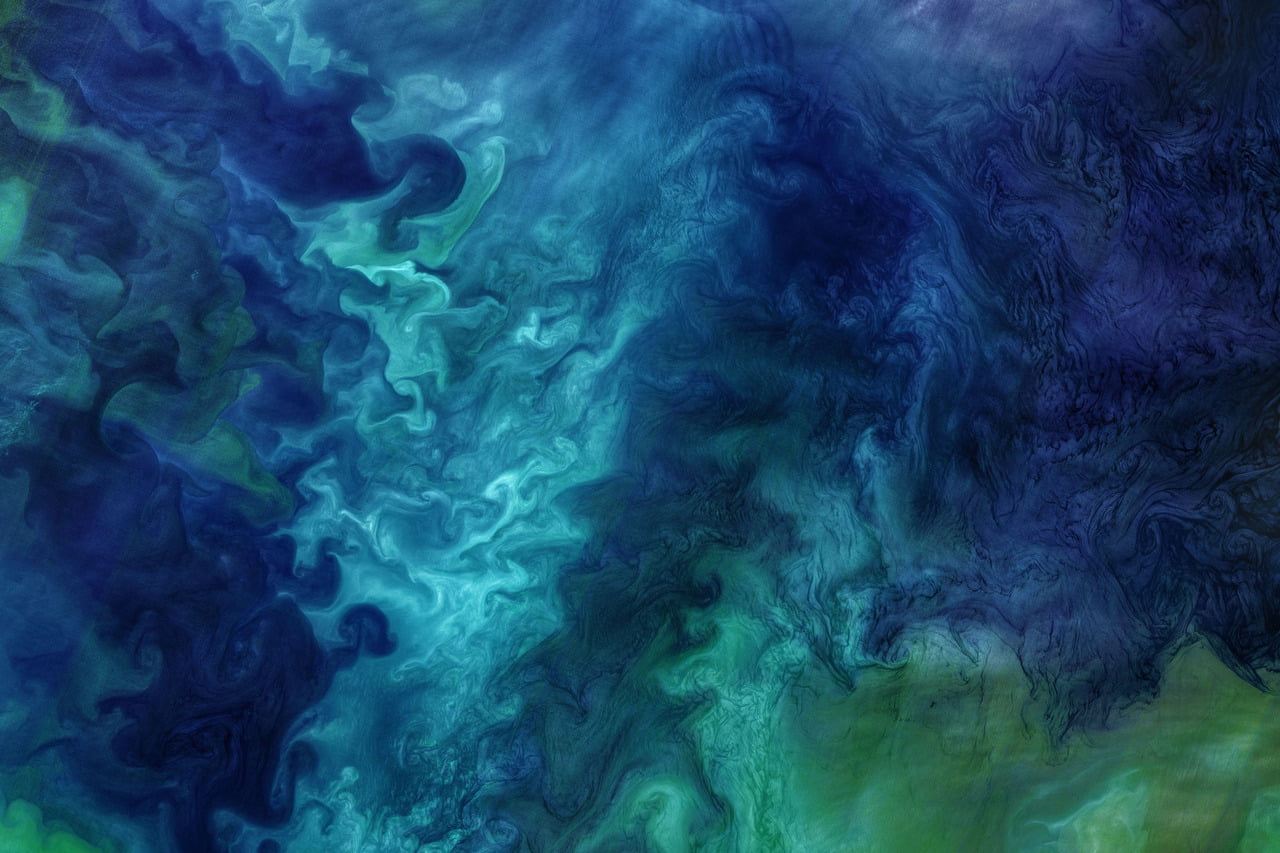
    Every summer, as the ice melts, the waters of the Chukchi Sea off the Alaskan coast come alive with phytoplankton blooms. In satellite images like this one, they can look like abstract paintings formed from swirling colors. In the Chukchi Sea, two main currents collide. One, water from the Bering Sea, is cold, salty, and nutrient-rich. This is the preferred home to phytoplankton known as diatoms, which are responsible for some of the greenish hues seen here.

    Coccolithophores, another variety of phytoplankton, prefer the warmer, less salty Alaskan coastal waters. Despite a relative lack of nutrients, the  coccolithophores thrive, creating the milky turquoise color seen in the image. Knowing these characteristics of the phytoplankton, observing the growth of blooms over time may tell scientists about how the flows in these areas shift and change from year to year. (Image credit: NASA; via NASA Earth Observatory)

  • Manipulating Droplets Remotely

    Manipulating Droplets Remotely

    Using acoustic levitation and an array of carefully-placed speakers, researchers can manipulate droplets without touching them. This lets scientists study the physics of droplet coalescence (top) without interference from solid surfaces, but it also provides opportunities for mixing two different substances in the final droplet. 

    On the bottom left, we see a droplet formed from the coalescence of a dyed droplet (visible as gray) and an undyed droplet. The swirling and mixing in the levitating droplet is fairly slow. By contrast, the droplet on the right is vibrated by manipulating the sound waves holding it aloft. This mixes the droplet quite efficiently, allowing it to reach a uniform state more than six times faster than the other droplet. (Image and research credit: A. Watanabe et al., source)

  • Sunset Flow

    Sunset Flow

    Day and night mix in this flow visualization of watercolor pigments and ferrofluid. The former, as suggested by their name, are water-based, whereas ferrofluids typically contain an oil base. This means the two fluids are immiscible. Like oil and vinegar in salad dressing, the only way to mix them is to break one into tiny droplets floating in the other. This is what happens near their boundary, where brightly-colored paint droplets float in a network of dark channels. To the right, the paint and ferrofluid have been swirled around to create viscous mixing patterns among the paint colors with occasional intrusions of thin ferrofluid fingers. (Image credit: G. Elbert)

  • Peering Between Particles

    Peering Between Particles

    Turbulence is not the only way to mix fluids. Even a steady, laminar flow can be an effective mixer if geometry lends a hand. Above, two dyes, fluorescein (green) and rhodamine (red), are injected into a porous flow through packed spheres. The flow runs from bottom to top in both images. Seeing the flow in such a crowded geometry is challenging. Here researchers used spheres with an index of refraction that matches water – that helps them avoid refraction that would prevent them from looking through spheres to the flow on the other side. They also lit a narrow plane of the flow using a laser sheet to isolate it. Together, this allowed the researchers to track the mixing of the two initially separate streaks of dye as they randomly mix in the spaces between spheres. (Image and research credit: M. Kree and E. Villermaux)

  • Featured Video Play Icon

    “Macrocosm”

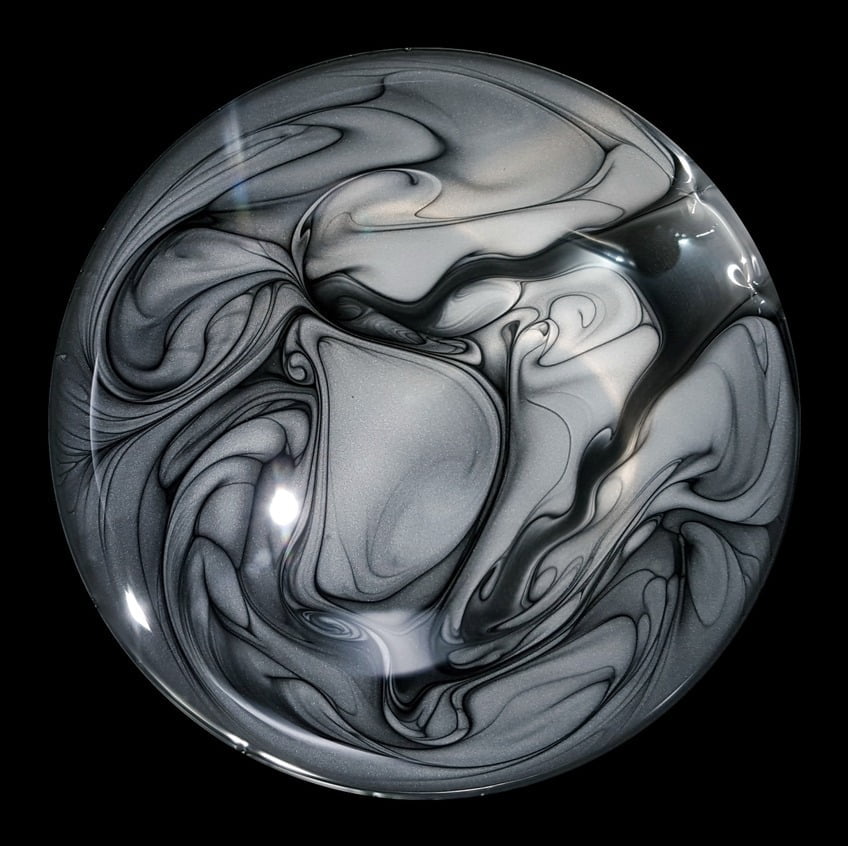
    In “Macrocosm” artist Susi Sie explores a liquid world of black and white. The two colors diffuse and mix to a soundtrack of “space sounds” recorded by NASA. (Most of these are probably ionic sound rather than sound as we’re used to, but even that is somewhat fluid dynamical.) The result is beautiful, surreal, and more than a little creepy. Happy Halloween! (Video and image credit: S. Sie)

    image
  • Featured Video Play Icon

    “Galaxy Gates”

    Viewing fluids through a macro lens makes for an incredible playground. In “Galaxy Gates”, Thomas Blanchard and the artists of Oilhack explore a colorful and dynamic landscape of paint, oil, and glitter. The nucleation of holes and the breakdown of sheets to filaments and droplets plays a major role in the visuals. The surface layer is constantly peeling away to reveal what’s going on underneath. In many cases this initial motion settles into a field of oil-rimmed droplets floating like planets against a colorful galactic backdrop. Watch carefully in the second half of the video, and you can even catch a few instances of a stretched ligament of fluid breaking into a string of satellite drops, like at 1:51. Check out some of Blanchard’s previous work here and here. (Video credit: Oilhack and T. Blanchard; GIFs and h/t to Colossal)

     
  • Graphene Swirls

    Graphene Swirls

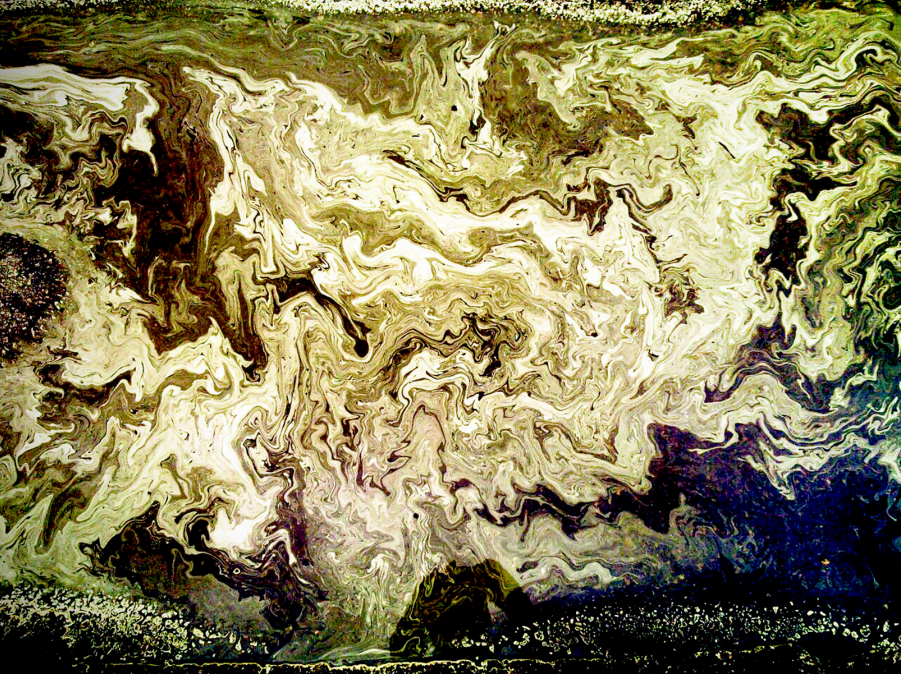
    Graphene powder swirls in alcohol in this prize-winning photo from this year’s Engineering and Physical Sciences Research Council photography competition in the UK. The image was captured while producing graphene ink that can print circuits directly onto paper. According to the researcher’s description, this ink is forced through micrometer-sized capillaries at high pressure to rip the layers apart and produce a smooth, conductive ink in solution. In this photo, we seem to see more conventional mixing driven by the powder’s injection and the variations in surface tension due to the alcohol and its evaporation. The graphene leaves behind beautiful streaklines that highlight its path as it mixes. (Image credit: J. Macleod; via Discover)

  • When Chaos is Not So Chaotic

    When Chaos is Not So Chaotic

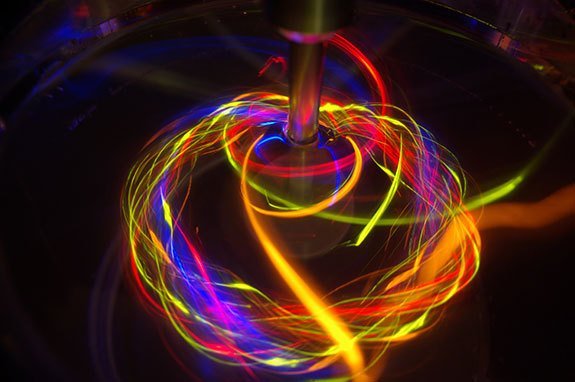
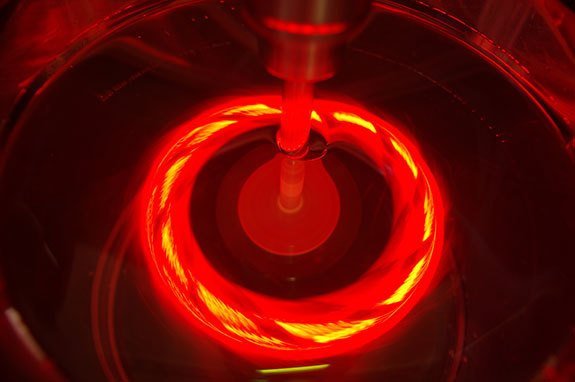
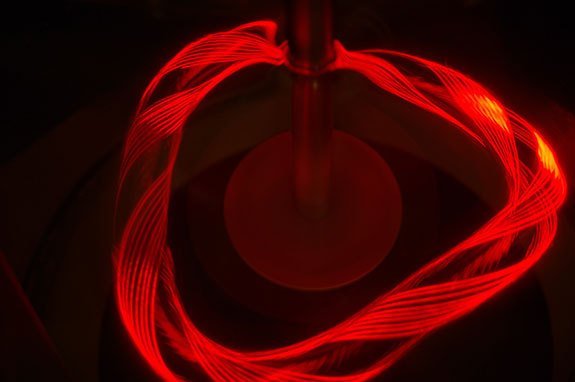
    In industry, tanks are often agitated or stirred to mix different elements. The goal is to create a laminar but chaotic flow field throughout the mixture. Introducing particles to such a system reveals that things are not quite as chaotic as they might seem. The photographs above show the pathlines of various large, glowing particles initially poured into the tank from above. Over time, the particles scatter off of structures in the mixed sections of the tank and end up trapped in vortex tubes that form above and below the agitator. Once trapped in the vortex tube, the particles follow helical paths inside the tube, creating patterns like those seen in the lower two photos. (Image and research credit: S. Wang et al., 1, 2, 3)

  • Swirling Pollen

    Swirling Pollen

    This photo captures the chaotic mixing present in a simple puddle. Pine pollen strewn across the puddle’s surface acts as tracer particles, revealing some of the motion of the underlying water. As wind blows across the puddle, it moves the water through the formation of ripples and by shearing the surface. That deformation on the top of the puddle will cause further motion beneath the surface. With time and changing wind direction, the resulting pattern of flow can be very complex! (Photo credit: K. Jensen, original)

  • Inside a Supernova

    Inside a Supernova

    During a supernova, shock waves moving outward push denser material into less dense plasma and gas. This causes what is known as a RichtmyerMeshkov instability, where the interface between the two fluids first becomes wavy and then develops finger-like intrusions. Those too break down, as seen in the simulation above, causing large-scale mixing between the different fluids.

    Here on Earth this instability shows up in the process of inertial confinement fusion. In that case, the outer shell material is denser than the fuel core and the instability is triggered during the implosion process. As the fusion material is suddenly compressed, waviness and mixing occurs along the interface between the shell and the fuel. That’s undesirable because it reduces the efficiency of the fusion reaction.  (Image credit: E. Evangelista et al.)