Tag: mixing

  • Featured Video Play Icon

    The Epic Migration of Plankton

    Zooplankton are tiny creatures found throughout Earth’s oceans. During the daytime, they linger in the twilight depths, where they are harder for predators to spot. But once the sun sets, zooplankton migrate hundreds of meters upward to reach the abundant food near the surface. When sunrise comes, they migrate back downward. Given their size, this feat is astounding; equivalent to a human running two 10-kilometer races a day at Olympic marathon speeds. And, despite their tiny size, these motions leave a mark; researchers have shown that the collective action of all these tiny swimmers is large-scale turbulence with serious mixing potential. (Video and image credit: Be Smart)

  • Turning the Beach Pink

    Turning the Beach Pink

    Lab experiments and numerical simulations can only take us so far; sometimes there’s no substitute for getting out into the field. That’s why a beach in San Diego turned pink this January and February, as researchers released a safe, non-toxic dye into an estuary. The goal is to understand how small freshwater sources mix with colder, saltier ocean waters when they meet in the surf zone. Differences in temperature and salinity both affect the waters’ density and, therefore, how they’ll combine, especially in the face of the turbulent surf. Using drones, distributed sensors, and a specially-outfitted jet ski, the researchers collect data about how the dye (and therefore the estuary’s water) spreads over the 24 hours following each dye release. Check out their experiment’s site to learn more. (Image credits: E. Jepsen/A. Simpson/UC San Diego; via SFGate; submitted by Emily R.)

  • Mixing With E. Coli

    Mixing With E. Coli

    What happens when a flow meets swimming micro-organisms? Does the flow affect the swimmers? And how do the swimmers affect the flow in turn? Those are the questions behind the experiment seen here. The apparatus contains a thin layer of saline water with swimming E. coli. Electromagnetism is used to mix the fluid in an array-like pattern that triggers chaotic mixing. To visualize what’s going on, dye is introduced into the right half of the image, while the left half remains undyed.

    On the right side of the image, bright blue and white mark areas of high dye concentration, where strong mixing occurs. On the undyed left side of the image, pale blue streaks mark areas where E. coli are clustered. By comparing the two, we see that the micro-swimmers are clustered in the very same regions of flow marked by strong mixing. This result suggests strong interactions and the potential for feedback between the mixing flow and the swimmers. (Image and research credit: R. Ran et al.; see also 1 and 2)

  • Mixing in a Winter Lake

    Mixing in a Winter Lake

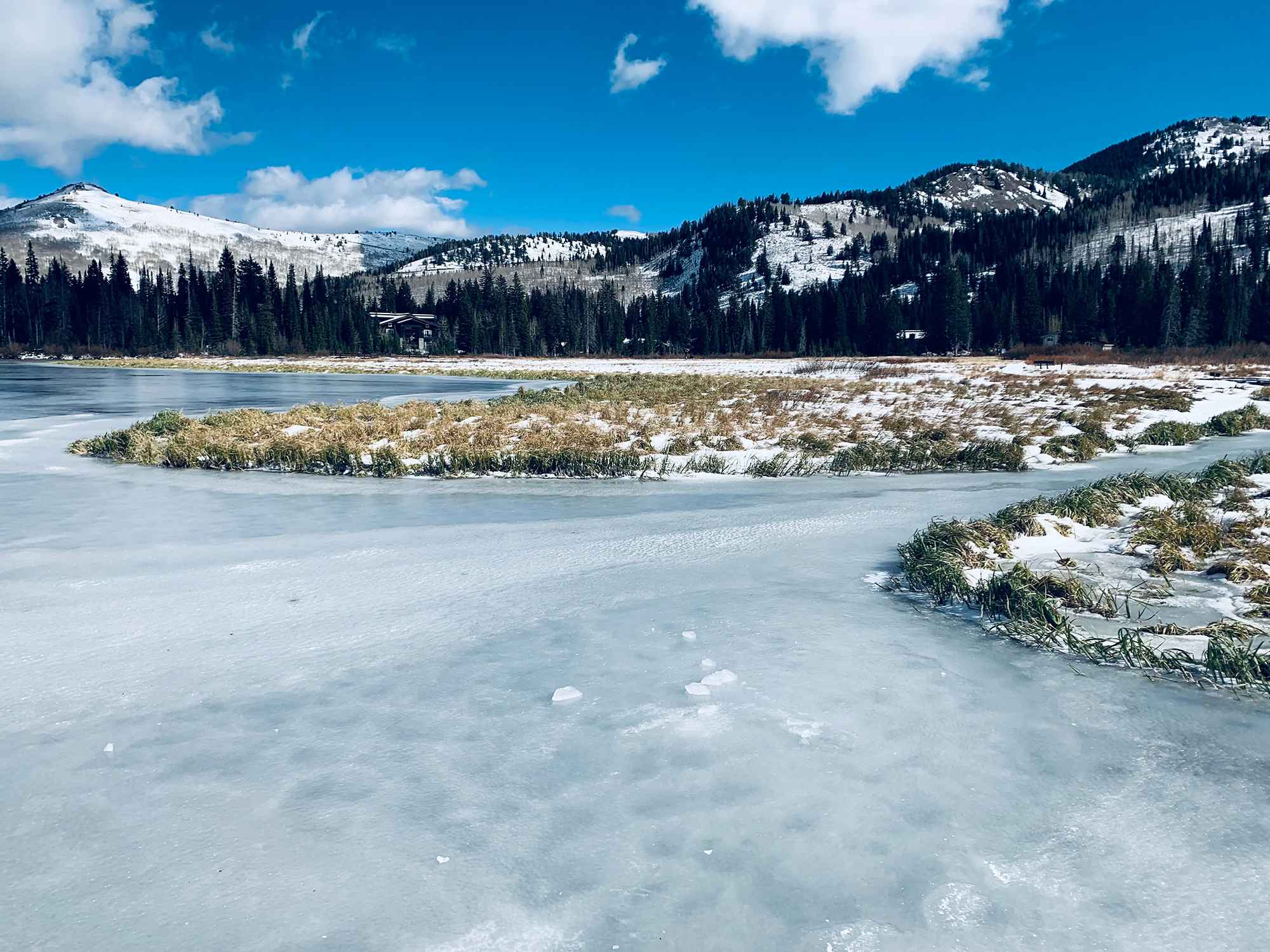
    A frozen winter lake can hide surprisingly complex flows beneath its placid surface. Since water is densest at 4 degrees Celsius — just above the freezing point — mixing two water sources can lead to counterintuitive effects. A cold lake, for example, may contain water below 4 degrees Celsius, while a stream running into the lake is a bit warmer than 4 degrees Celsius. When the two parcels of water meet, they mix to form water at an intermediate temperature. But because of water’s density anomaly, that mixed water can wind up denser than the average of its parents. This is known as cabbeling.

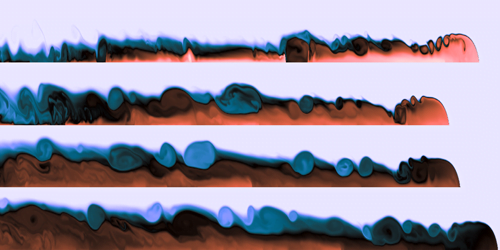
    Mixing patterns within a cold lake with a slightly warmer inflow. Image from A. Grace et al.
    Mixing patterns within a cold lake with a slightly warmer inflow. Image from A. Grace et al.

    As shown in a recent study, this newly mixed water sinks to the bottom of the lake, forming a warm current that heats the lake from below. The researchers were able to model this current and its behavior over a range of conditions. Understanding these winter circulation patterns is key to tracking both nutrient transport and how pollutants spread in the ecosystem. (Image credit: lake – G. Murry, simulation – A. Grace et al.; research credit: A. Grace et al.; via APS Physics)

  • Mixing Effectively

    Mixing Effectively

    Mixing two fluids is a tougher task than you might think. One of my favorite asides from a fluids lecture concerned how to mix fruit into yogurt in an industrial setting. Mix too quickly, and you’ll obliterate the yogurt’s consistency, but mix too little and you may as well sell it as fruit-on-the-bottom. Apparently that particular problem got solved by sending the fruit and yogurt flowing through a series of specially-shaped ducts to slowly and carefully mix them together.

    In this study, researchers tackle a similar problem — mixing two fluids in a circular cross-section — through optimization. As you can see above, circular stirrers on their own don’t do a great job of mixing. So the researchers searched for the right combination of stirrer shape, mixing speed, and mixing trajectory to give the best mixing for a set mixing time and energy input. Their final stirrer shapes are anything but circular and often move in jerks and fits to help shed vortices that do the actual job of mixing. (Image and research credit: M. Eggl and P. Schmid; via APS Physics)

  • Moving By (Intestinal) Wave

    Moving By (Intestinal) Wave

    A word of warning: today’s post includes visuals of digestion taking place in (non-human) embryonic intestines.

    Our bodies rely on waves driven by muscle contractions to move both fluids and solids, whether through the esophagus, the ureter, the fallopian tubes, or the intestines. In areas where mixing is unnecessary, those waves move in a single direction, transporting the contents one-way. But in the intestines, mixing is critical to enhancing nutrient absorption, so mammal intestines have wave trains that move both forwards and backwards.

    The majority of waves move downstream, carrying waste toward its exit (Images 1 and 2). But occasionally, upstream waves collide with their downstream counterparts to force material together, both mixing and delaying progress in order to allow better nutrient uptake along the intestinal walls (Image 3). (Image credits: top – S. Bughdaryan, others – R. Amedzrovi Agbesi and N. Chavalier; research credit: R. Amedzrovi Agbesi and N. Chavalier; via APS Physics)

  • Featured Video Play Icon

    Double Diffusive Flow

    Diffusion is the tendency for differences in a fluid — in density, temperature, or concentration — to even out over time. Think about a drop of food coloring in a glass of water. Even without stirring, that dye will eventually disperse throughout the glass through diffusion. But when there is more than one factor controlling diffusion — like temperature and salinity — things get more complicated. In the ocean, for example, this double-diffusion causes salt fingers like those shown in the first image.

    But what happens when the two diffusing fluid layers are flowing? That’s the question at the heart of this video, which explores the intricate mixing that takes place between doubly-diffusing liquids in a channel. (Video and image credit: A. Mizev et al.)

  • Mixing the Immiscible

    Mixing the Immiscible

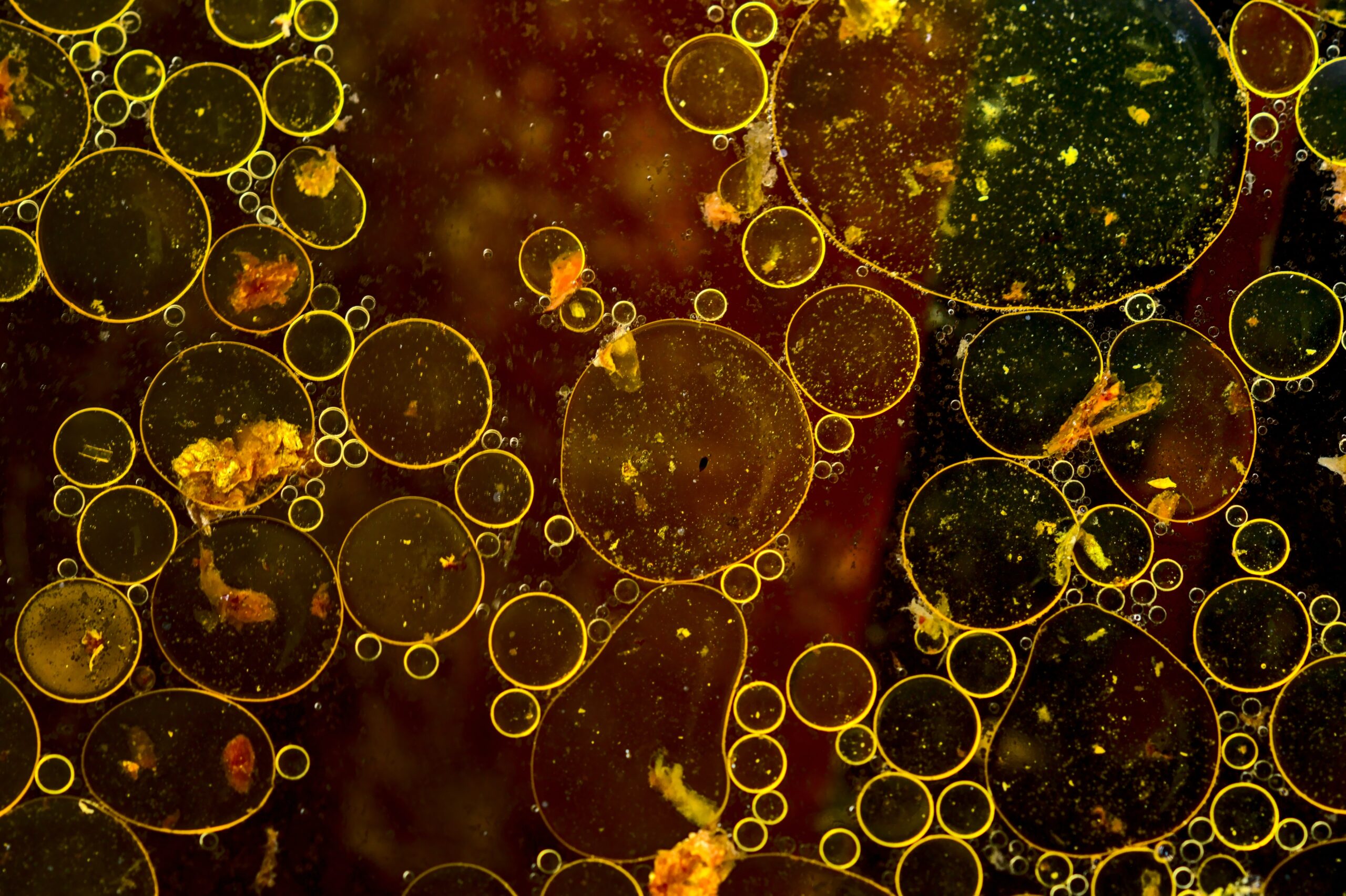
    Immiscible liquids — like oil and water — do not combine easily. Typically, with enough effort, you can create an emulsion — a mixture formed from droplets of one liquid suspended in the other — like the one above. But a team of researchers have taken mixing immiscible liquids to a new level using their Vortex Fluid Device (VFD).

    Longtime readers may remember the group from their Ig-Nobel-winning demonstration of unboiling an egg, but this time the team is used the VFD to mix and de-mix immiscible liquids. As shown in the video below, the VFD is essentially a fast-spinning tube tilted at a 45-degree angle. As it spins, the liquids inside are forced into thin films with very high shear rates — high enough that immiscible liquids like water and toluene are forced together without forming an emulsion. Essentially, the mechanical forces mixing the liquids are strong enough to overcome the chemistry that typically keeps them apart.

    Impressively, the device manages this without using harsh surfactants or catalysts that other methods rely on. As a result, the technique offers a greener method for mixing chemicals for pharmaceuticals, cosmetics, food processing, and more. (Image credit: pisauikan; research credit: M. Jellicoe et al.; video credit: Flinders University; submitted by Marc A.)

  • Featured Video Play Icon

    Fun From the Beach

    Here’s a neat bit of fluid dynamics derived from a day at the beach! Our experiment begins with well-mixed (and likely compacted) sand grains and sea water in a bottle. When flipped, the sand layer sits at the top of the bottle with the water layer beneath.

    Very quickly new layers establish themselves in the bottle. The lower half of the bottle turns into a turbulent churn of water and sand, topped by a thin air bubble, then the thick sand layer, and finally, a layer of filtered water. That air bubble beneath the sand means that the sand layer is compacted enough that surface tension keeps the air from being able to squeeze through the grains. On the other hand, water is able to filter through, eventually making it into that upper region. The compact layer of sand is supported in the bottle by force chains running through the largest grains, which is why only fine sediment settles down through the turbulent layer at this point.

    Eventually, the top sand layer erodes enough that it can no longer support its weight, and the sand collapses. As the grains settle out, we end up with fine sediment on the bottom (as previously discussed), followed by a layer of coarse sand from the erosion and collapse of the sand layer, topped with a layer of very fine grains that — due to their light weight — are the very last to settle out of the water. I love that such a simple seaside experiment contains such scientific depth! (Video and submission credit: M. Schich; special thanks to Nathalie V. for helpful input)

  • Meeting Without Mixing

    Meeting Without Mixing

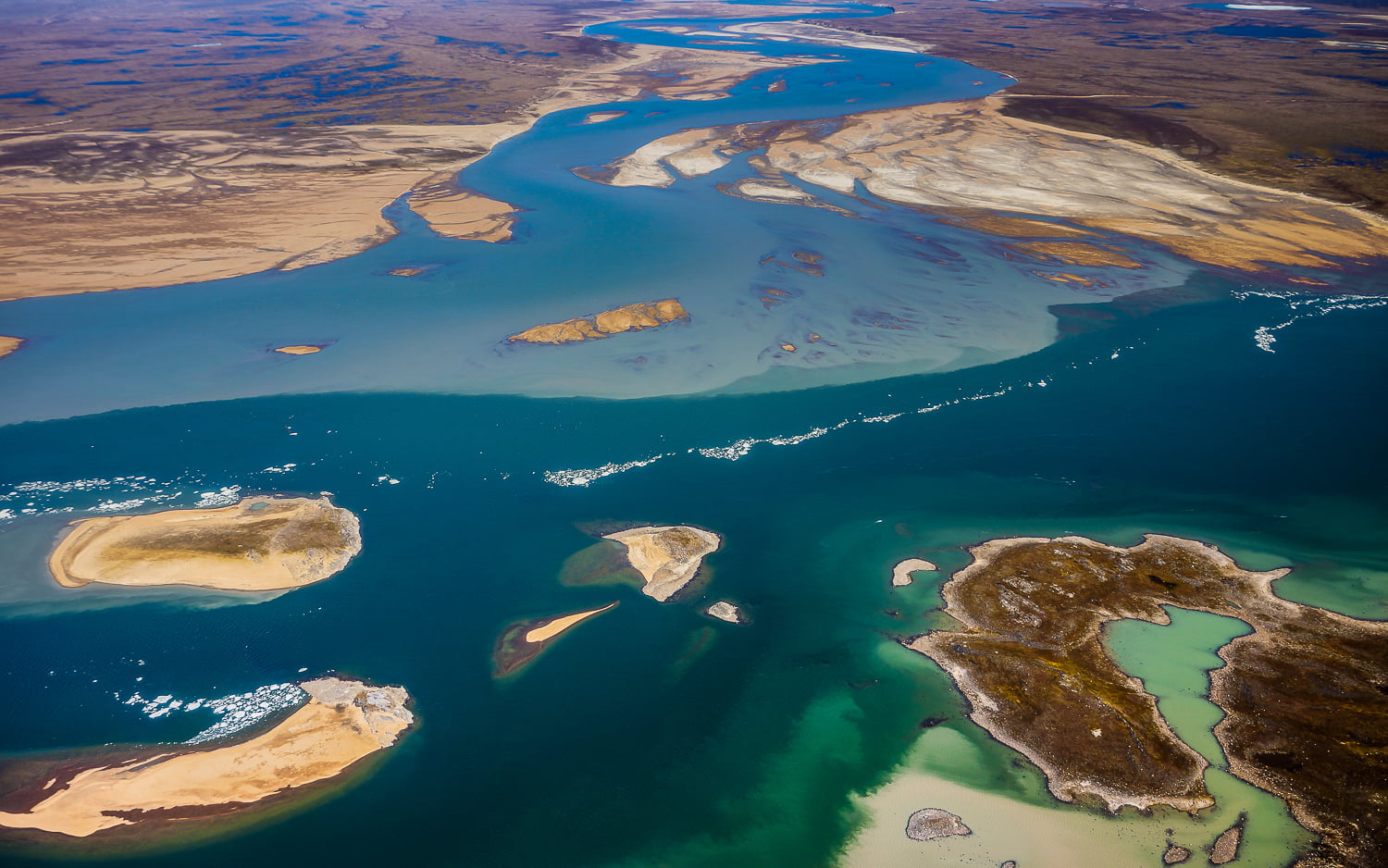
    When bodies of water meet, they don’t always mix right away. Here we see the confluence of the Back and Hayes Rivers in the Canadian Arctic. The Back River appears as a darker blue-green color compared to the light turquoise Hayes River. The different colors reflect the levels of algae and sediment carried in their waters. As seen in both the aerial and satellite photos here, there’s a distinct line where the two waters meet without mixing, and that line persists for kilometers beyond their initial confluence. Typically, this lack of mixing between bodies of water is caused by differences in temperature, salinity, and turbidity (amount of sediment) that make the density of each river’s water different. (Image credit: top – R. Macdonald/Univ. of Manitoba, bottom – J. Stevens/USGS; via NASA Earth Observatory)

    A satellite photo of the Back and Hayes Rivers shows their distinctly different colors persisting for 10+ kilometers after their confluence.