Tag: magnetohydrodynamics

  • Coronal Heating

    Coronal Heating

    Compared to its interior, the surface of our sun is a cool 6,000 degrees Celsius. But beyond the surface, the sun’s corona heats up dramatically through interactions between plasma and strong magnetic fields. The exact mechanisms of this interaction have been mostly theoretical thus far, but a recent laboratory experiment has validated a part of that theory.

    One explanation for coronal heating posits that the strong magnetic fields can accelerate magnetohydrodynamic waves called Alfvén waves to speeds faster than sound, and that at this crossover point, changes occur in the waves’ behavior. Using liquid rubidium, researchers were able to observe this crossover under laboratory conditions, confirming that the Alfvén waves change at the speed of sound in exactly the manner predicted by theory. (Image credit: NASA SDO; research credit: F. Stefani et al.; via Physics World)

  • Featured Video Play Icon

    “One Month of Sun”

    Get lost in the beauty of our star with Seán Doran‘s film “One Month of Sun”. Constructed from more than 78,000 NASA Solar Dynamics Observatory images, the video shows solar activity from August 2014, particularly the golden coronal loops that burst forth from the sun’s visible surface. These bursts of hot plasma follow the sun’s magnetic field lines, often emerging from sunspots. (Image and video credit: S. Doran, using NASA SDO data; via Colossal)

    Golden coronal loops spring from the sun's photosphere.
    Plasma follows the magnetic field lines of the sun in this coronal loop.
  • Ferrofluid in a Cell

    Ferrofluid in a Cell

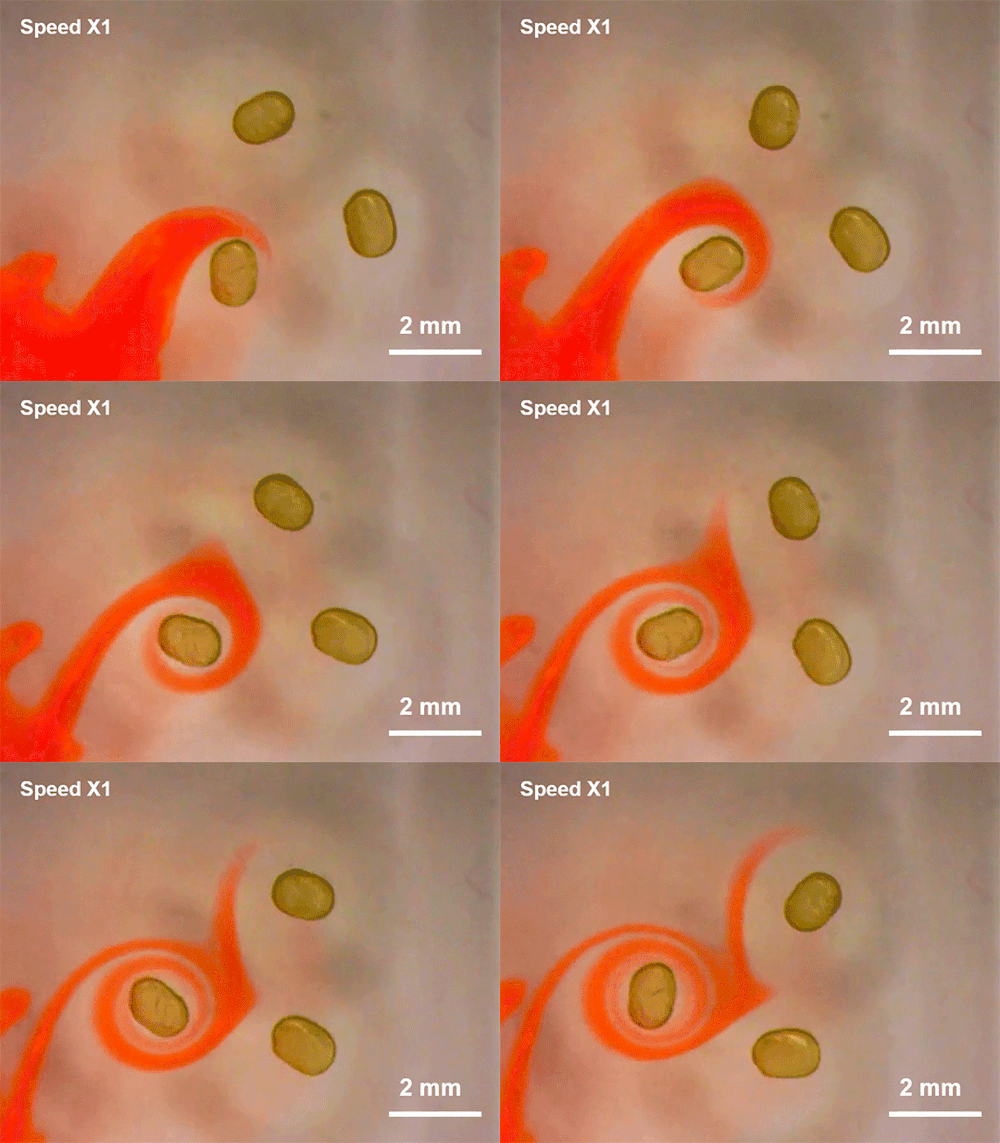
    Ferrofluids are a colloid consisting of magnetically sensitive nanoparticles suspended in a carrier liquid, like oil. They’re often associated with a distinctive spiky appearance when exposed to a magnet, but this isn’t their only magnetic response. Above we see a ferrofluid confined to a Hele-Shaw cell – essentially two glass plates with a small gap between them. In the upper image, the ferrofluid is exposed first to an axial magnetic field, which stretches it to form spidery arms. Then the magnetic field switches to a rotating configuration, which curls the arms around and causes the ferrofluid to slowly rotate.

    In the lower image, you see the reverse. First, the ferrofluid feels a rotating magnetic field. When this is changed to an axial field, the ferrofluid bursts into a cell-like center with straight arms. As the magnitude of the axial field increases further, the arms begin to curl. For more fantastical ferrofluid formations, check out these previous posts featuring artists Linden Gledhill and Fabian Oefner. (Image credit: M. Zahn and C. Lorenz, source; via Ashlyn N.)

  • Grayscale Aurora

    Grayscale Aurora

    This swirling grayscale image shows a spring aurora over the Hudson Bay, as seen by the Suomi NPP satellite. As energetic particles from the sun zip past Earth, they interact with our magnetosphere, which tends to channel particles toward the poles. At these higher latitudes, some of the particles get trapped along Earth’s magnetic field lines and crash into the upper atmosphere where they excite oxygen and nitrogen molecules. It’s this molecular bombardment that creates the distinctive colors of the aurora. (Image credit: J. Stevens; via NASA Earth Observatory)
  • Plasma Shock Waves

    Plasma Shock Waves

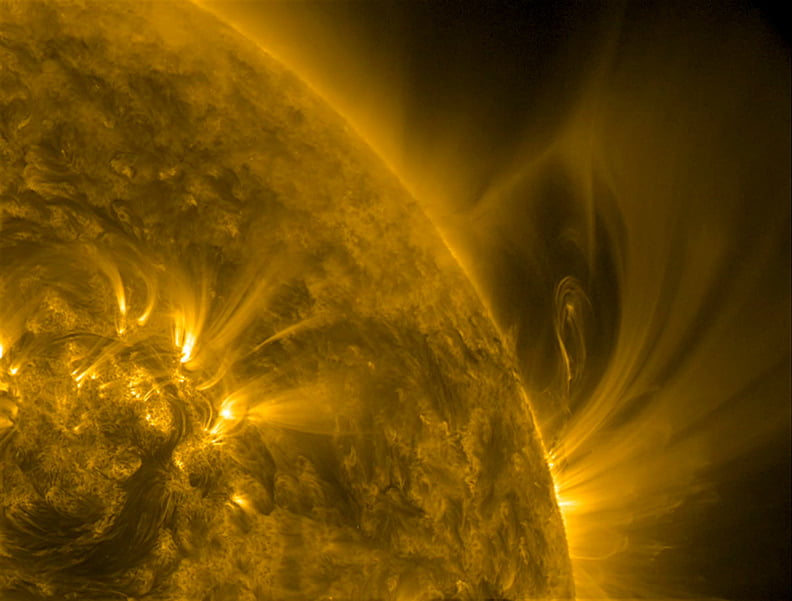
    Solar flares and coronal mass ejections send out shock waves that reverberate through our solar system. But shock waves through plasma – the ionized, high-energy particles making up the solar wind – do not behave like our typical terrestrial ones. Instead of traveling through collisions between particles, these astrophysical shock waves are driven by interactions between moving, charged particles and magnetic fields. 

    A driving burst of plasma accelerated into ambient plasma creates electromagnetic forces that accelerate ambient ions to supersonic speeds, pushing the shock wave onward even without particles directly colliding. Thus far, piecing together the physics of these interactions has been a challenge because spacecraft are limited in what and where they can measure. But a group here on Earth has now recreated and observed some of this process in the lab. (Image credit: NASA Solar Dynamics Observatory; research credit: D. Schaeffer et al.; via phys.org)

  • Liquid Magnets

    Liquid Magnets

    Ferrofluids – those distinctively spiky liquids – are made up of magnetically sensitive nanoparticles in a carrier liquid, and although they respond to applied magnetic fields, they retain no magnetism outside of that field. But researchers have now succeeded in making actual liquid magnets. Shown above, these drops also contain ferromagnetic nanoparticles. But unlike traditional ferrofluids, in these drops the nanoparticles are not entirely free to move. They’re jammed together at the interface, so when a magnetic field is applied, the nanoparticles will align like tiny bar magnets. When that magnetic field is removed, though, the nanoparticles cannot easily reconfigure, so they remain aligned and the drops continue being magnetic. 

    Researchers hope these ultrasoft magnets, which can be manipulated remotely through magnetic fields, will be useful in the future for applications like targeted drug delivery. In theory one could introduce, say, chemotherapy drugs into one of these liquid magnets, then use magnetic fields to guide it directly to a cancerous tumor. (Image and research credit: X. Liu et al.; via Science News; submitted by Kam-Yung Soh)

  • Magnetic Storms

    Magnetic Storms

    Periodically, our sun releases plasma in a coronal mass ejection. Afterwards, the local magnetic field lines shift and reorganize. We can see that process in action here because charged particles spin along the magnetic lines, outlining them as bright loops in this imagery. This sequence – one of the best examples of this phenomenon to date – was captured by NASA’s Solar Dynamics Observatory in early 2017. To understand behaviors like these, scientists use magnetohydrodynamics, a marriage of the equations of fluid mechanics with Maxwell’s equations for electromagnetism. (Image credit: NASA SDO, source)

  • Astrophysical Turbulence

    Astrophysical Turbulence

    Subsonic turbulence – like the random and chaotic motions of air and water in our everyday lives – is something we have only a limited understanding of. Our knowledge of supersonic turbulence, where shock waves and compressibility rule, is even more tenuous. In part this is because, although we can observe snapshots of supersonic turbulence in astronomical settings like the Orion Nebula shown above, we cannot watch it evolve. On these scales, features simply don’t change appreciably on human timescales.

    This has limited scientists to mostly numerical and theoretical studies of supersonic turbulence, but that is starting to change. Researchers are now building experimental set-ups that collide laser-driven plasma jets to generate boundary-free turbulence at Mach 6. Thus far, the observations are consistent with what’s been seen in nature: at low speeds, the turbulence is consistent with Kolmogorov’s theories, with energy cascading from large scales to smaller ones predictably. But as the Mach number increases, the nature of the turbulence shifts, moving toward the large density fluctuations seen in nebulae and other astrophysical realms. (Image credit: F. Battistella; research credit: T. White et al.; see also Nature Astronomy; submitted by Kam-Yung Soh)

  • Simulating Solar Flares

    Simulating Solar Flares

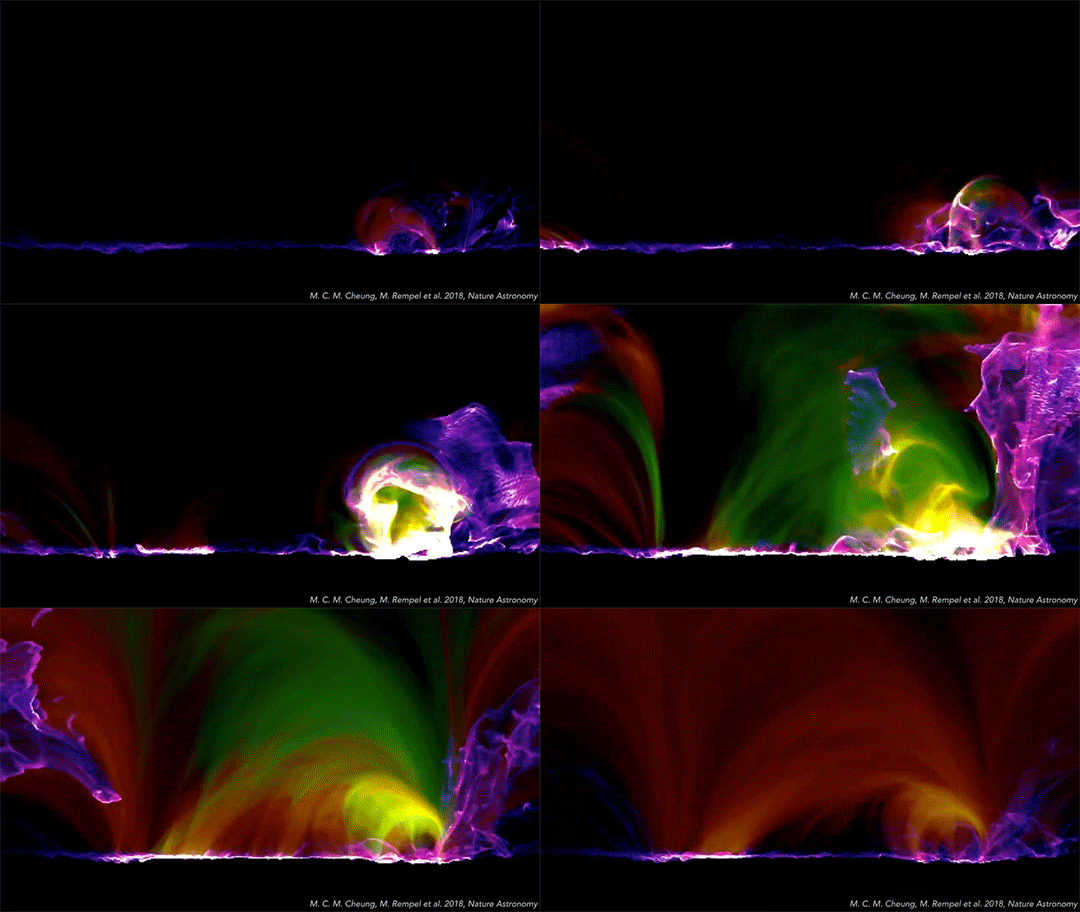
    Few topics in fluid dynamics are more mathematically complicated than magnetohydrodynamics – the marriage between electromagnetism and fluids. That mathematical complexity, along with the vast range of scales necessary to describe physical systems like our sun, means that, until now, researchers had to simplify their assumptions when simulating solar physics. But now, for the first time, a group has built a comprehensive, three-dimensional simulation capable of generating realistic solar flares. This is what you see above.

    Solar flares occur when a tangle of magnetic loops near the sun’s surface break and reconnect, releasing enormous magnetic energy and spewing a fountain of ionized plasma into the corona. They’re a danger particularly to satellites in orbit, so being able to simulate these events realistically is a major advance toward understanding the physics of space weather. (Image and video credit: NCAR & UCAR Science; research credit: M. Cheung et al.; via Bad Astronomy; submitted by Kam-Yung Soh)

  • Solar Prominence

    Solar Prominence

    Near the surface of the sun, the interplay of magnetic fields and plasma flow creates solar prominences that appear to dance. The prominence shown here was recorded in 2012 by the NASA Solar Dynamics Observatory, and its arc is large enough to easily surround the Earth. This is fluid dynamics – specifically magnetohydrodynamics – on a scale difficult for us earthbound humans to imagine. Scientists are still working to understand the complex processes that drive flows like this one. Fortunately, we can appreciate their beauty regardless. (Image credit: NASA SDO, source; via APOD; submitted by jpshoer)