Near the surface of the sun, the interplay of magnetic fields and plasma flow creates solar prominences that appear to dance. The prominence shown here was recorded in 2012 by the NASA Solar Dynamics Observatory, and its arc is large enough to easily surround the Earth. This is fluid dynamics – specifically magnetohydrodynamics – on a scale difficult for us earthbound humans to imagine. Scientists are still working to understand the complex processes that drive flows like this one. Fortunately, we can appreciate their beauty regardless. (Image credit: NASA SDO, source; via APOD; submitted by jpshoer)
Tag: magnetohydrodynamics

Merging Black Holes
At the heart of many galaxies, including our own, lies a supermassive black hole millions of times the mass of our sun. Scientists have yet to observe the merger of two such black holes, but using simulations, they are trying to learn what such collisions might look like. Simulations like the one shown here require combining relativity, electromagnetism, and, yes, fluid dynamics to capture what happens during the in-spiral.
Supermassive black holes like these are surrounded by gas disks that flow around them. Magnetic and gravitational forces heat the gas, causing it to emit UV light and, at times, high energy X-rays, both of which may be observable.
Gravitational wave detectors, similar to LIGO, may also measure evidence of supermassive black hole mergers, but physicists expect that will require a next-generation observatory, like the space-based LISA to be launched in the 2030s. (Image and video credit: NASA Goddard; research credit: S. d’Ascoli et al.; submitted by @lh7)

Shock Waves in the Solar Wind
The empty space of our solar system is not truly empty, as we’ve discussed previously. For one, there’s a fast-moving flux of charged particles – the solar wind – that flows constantly from the Sun. Sometimes these solar wind particles encounter their interstellar equivalents – charged ions from outside our solar system – and exchange energy.
One predicted mechanism for this energy swap is a solar wind shock wave, which occurs when a faster-moving clump of charged particles plows into a slower-moving one. Scientists hypothesized in the mid 1990s that far from the Sun, solar wind shock waves would lose their energy by passing it to these interstellar ions, in a process known as pickup. Data from the New Horizons spacecraft has finally provided evidence for this theory.
In October 2015, instruments on the spacecraft recorded a shock wave when the speed of solar wind ions nearby jumped from 380 km/s to 440 km/s. Comparing the energies of solar and interstellar ions before and after the event, researchers found that interstellar pickup ions became 30% more energetic while solar ions lost 85% of their energy. It’s an important confirmation of theoretical predictions and should help us better understand high-energy particle physics at the edges of our solar system. (Image credit: NASA; research credit: E. Zirnstein et al., via J. Ouellette)

Zones and Stars
Large-scale rotating flows, like planetary atmospheres, tend to organize themselves into zones. Within a zone, flow remains essentially in an east-west direction and serves as a barrier that keeps heat or other elements from mixing from one zone to another. This is, for example, how the tropical trade winds work here on Earth.
Stars, on the other hand, don’t show this kind of zonal behavior. The reason, it turns out, is their magnetic fields. When there’s no magnetic influence, even weak shear in a rotating flow is enough to start organizing turbulent fluctuations and grow a zonal flow. This tendency toward growth is known as the zonostrophic instability. But when you add a magnetic field, instead of organizing the hydrodynamic disturbances, that weak shear strengthens the magnetic ones, which in turn suppress the flow fluctuations. As a result, the hydrodynamic disturbances cannot grow and no zonal flow forms.
Researchers think this mechanism can explain both why stars have no zonal flows and just how deep zones can penetrate inside the atmospheres of gas giants like Jupiter and Saturn before their planet’s magnetic field suppresses them. (Image credit: NASA; research credit: N. Constantinou and J. Parker, arXiv; via LLNL News; submitted by Stephanie N.)

Plasma From a Jet of Water
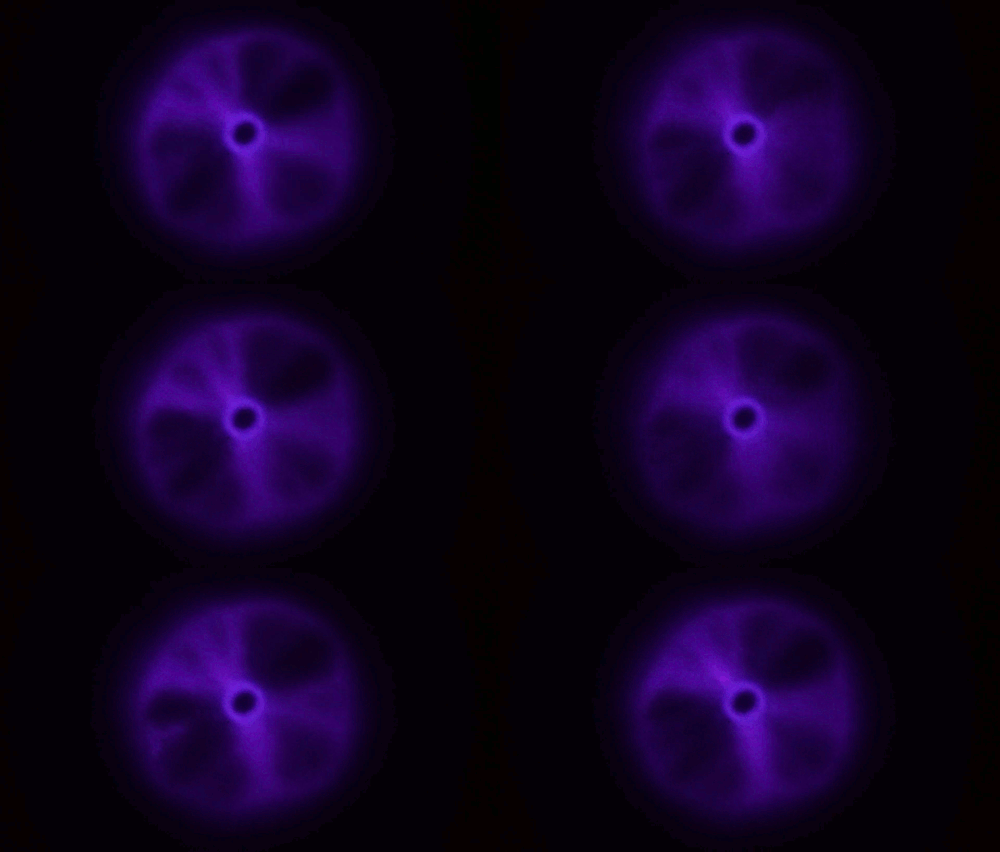
There aren’t many naturally occurring plasmas in our daily lives; by far the most common one is lightning. So it’s something of a surprise that a stream of water hitting a material like glass is able to produce a toroid of plasma like the one above. The key here, though, is that the jet has to be fast – to the tune of 200 meters per second or faster. When a jet of deionized water strikes a surface at that speed, the water has to take a very sharp, 90-degree turn, and, thanks to the polar nature of water, this causes a (negative) charge to build up at that turn. It’s akin to rubbing a balloon to build up a static charge, and it’s known as a triboelectric effect. At rest (and without high shear rates), water and glass in contact tend to create in a positive charge in the water. The plasma is created when an arc forms through air between those two charged areas.
Experiments in helium environments create a different color of plasma, confirming that the arc definitely travels through the gas. Similarly, if you use regular water instead of deionized water, the conductivity of the dissolved salts in the water is enough to prevent the necessary build up of charge. (Image and research credit: M. Gharib et al.; video credit: Applied Science; submitted by Kam-Yung Soh)

Auroras


Beautiful auroras are the result of ions in the solar wind exciting atoms in our atmosphere. This example of magnetohydrodynamics is typically only visible in the far northern and southern reaches of the globe. But in recent years, citizen scientists noticed a new aurora outside the polar regions. It looked like a narrow purple streak with occasional fingers of green. It got nicknamed Steve. Recent satellite measurements show that the aurora seems to be a visible emission from a known phenomenon, subauroral ion drift, which features a rapid flow of charged ions. In Steve’s case, this flow moves nearly 6 km/s and is around 6000 degrees Celsius. Scientists have dubbed the aurora S.T.E.V.E., Strong Thermal Emission Velocity Enhancement, to honor the original nickname. Learn more from NASA and Science magazine. (Image credit: K. Trinder; NASA GSFC/CIL/K. Kim, source)

Inside Earth’s Core
Without our magnetic field, life as we know it could not exist on Earth. Instead, our atmosphere would be stripped away and the surface would be bombarded by charged particles in the solar wind. Relatively little is known about the dynamo process that governs our magnetic field, though it’s thought to be the result of liquid iron moving in the Earth’s outer core. The video above shows a slice of a recent 3D simulation of this liquid iron segment of our core. The colors show variations in the temperature, revealing vigorous convection in the core. This motion, combined with the spinning of the Earth, is the likely source of our magnetic field. Researchers hope that simulations like these can help us understand features we observe in our magnetic field – like local variations in field strength and the pole reversals in our geological record. (Video credit: N. Schaeffer et al.; CNRS via Gizmodo)
Where Does the Sun End?
How do you define the edge of our sun? There’s a distinct surface to it, but our star is also surrounded by the corona, an even hotter region of plasma twisted by magnetic fields. The corona is sort of like the sun’s atmosphere. Farther out in the solar system, we receive a constant barrage of charged particles, known as the solar wind, that streams out from the sun. So where does the corona end and the solar wind begin?
Scientists have been studying the flow structure of the solar wind in search of an answer to this question, and they’ve found that there’s a clear transition point about 32 million kilometers from the sun. At this distance, the sun’s magnetic field weakens to the point where it no longer exerts the same hold on the solar particles and they begin to move turbulently, behaving more like a gas than a plasma. With special measurements and image processing, scientists were able to actually see this flow change in the solar wind! (Video/image credit: NASA; research credit: C. DeForest et al.; via FlowViz)


Turbulence in the Solar Wind
One of the key features of turbulent flows is that they contain many different length scales. Look at the plume from an erupting volcano, and you’ll see eddies that are hundreds of meters across as well as tiny ones on the order of millimeters. This enormous difference in scale is one of the major challenges in simulating turbulent flows. Since energy enters at the large scale and is passed to smaller and smaller scales before being dissipated at the tiniest scales of the flow, properly simulating a turbulent flow requires resolving all of these length scales. This is especially challenging for applications like the solar wind – the stream of charged particles that flows from the sun and gets diverted around the Earth by our magnetic field. The image above shows some of the turbulence in our solar wind. The structures seen in the flow range from the size of the Earth all the way to the scale of electrons! (Image credit: B. Loring, Berkeley Lab)
Auroras From Space
NASA has released a jaw-dropping new compilation of Earth’s auroras viewed from the International Space Station. It’s available in up to 4K resolution, and I heartily recommend watching it fullscreen at the highest resolution you can comfortably manage. (To paraphrase: this is ultra high definition – it’s better resolution than real life!) I don’t think I’ve ever seen aurora footage that so clearly showed the fluid behavior of auroras when viewed from space. This flow-like quality is to be expected since the auroras occur due to ionized particles from the solar wind exciting atoms in our upper atmosphere in a magnetohydrodynamic dance that never gets too old to watch. (Video credit: NASA; via Gizmodo)
Boston area FYFDers: I’m giving a talk at Harvard tomorrow afternoon on science communication – Wed. April 20th, 4pm, Maxwell Dworkin, G115.