Tag: magnetohydrodynamics

  • “Emerald Roots”

    “Emerald Roots”

    As charged particles from the solar wind bombard the upper atmosphere, a glowing plasma forms and dances in the sky. The green light of the plasma reflects off moistened sand, rippled by the passage of wind and tide. Each component seems simple, but this striking image contains hidden depths of fluid dynamics. Magnetohydrodynamics govern the aurora’s dance; the sand’s self-organization mirrors dune physics; and even the rocky outcropping in the background was carefully shaped by erosive forces from wind and water. Truly, fluid dynamics are found everywhere. (Image credit: L. Tenti; via 2023 Astronomy POTY)

  • “A Sun Question”

    “A Sun Question”

    The sun‘s surface and atmosphere are endlessly dynamic, with magnetic lines, plasma, and convection creating a constant churn. In this photo by astrophotographer Eduardo Schaberger Poupeau, a curving question-mark-like filament appears above the sun’s surface. Even with decades of high-resolution data from recent solar probes, we struggle to understand the complex physics that feed structures like these. (Image credit: E. Poupeau; via 2023 Astronomy POTY)

  • Vivid Auroras Over Iceland

    Vivid Auroras Over Iceland

    When solar storms in late February sent energetic particles toward Earth, photographer Cari Letelier ventured to the remote northern edge of Iceland to capture the resulting auroras. When fast-moving, high-energy particles from the solar wind meet Earth’s magnetosphere, they’re directed toward the poles. There the particles slam into Earth’s upper atmosphere, exciting atoms that glow in greens, reds, and pinks. Curtains of light dance across the sky as a result. February’s show was particularly stunning, as captured by Letelier at Arctic Henge. (Image credit: C. Letelier; via Colossal)

  • Forming Zigzags

    Forming Zigzags

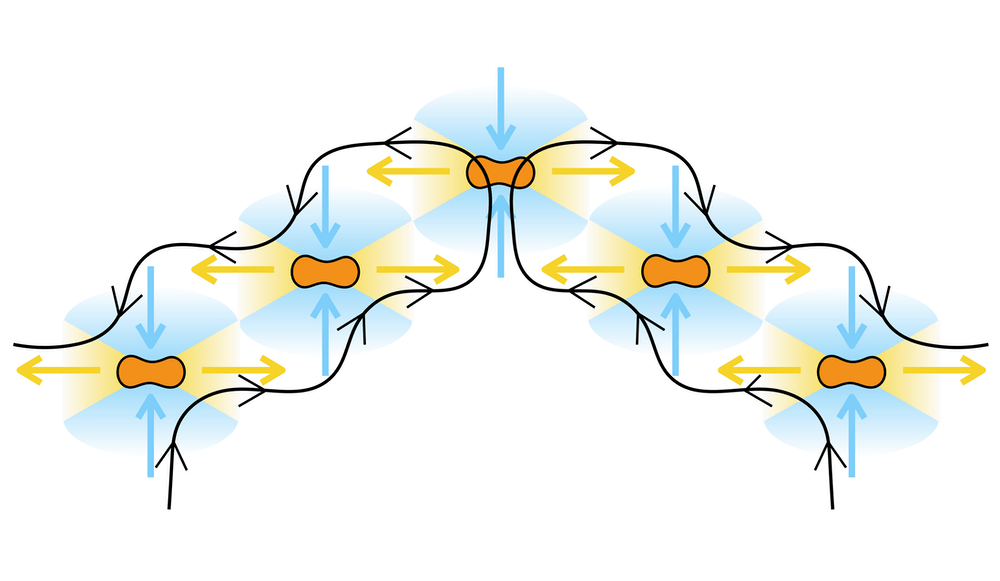
    Scientists are fascinated by the organized patterns that can emerge from non-living systems. Here, researchers study micron-sized magnetic particles, immersed in a viscoelastic fluid and subjected to an oscillating magnetic field. The peanut-shaped particles roll around their long axis and assemble to form millimeter-sized bands of zigzags. These patterns, the researchers found, do not depend on the particles’ specific shape or on the details of the applied magnetic field. Instead, the zigzags depend only on the symmetry of the flow generated around each particle. In their system, illustrated above, each particle pushed fluid away along their long axis and drew in fluid toward their waist; as a result, particle pairs would attract or repel, depending on their relative orientation. That interparticle force ultimately caused the particles to self-organize into zigzags. (Image, video, and research credit: G. Junot et al.; via APS Physics)
    This sped-up animation shows the zig-zag pattern that the particles self-organization into.
    This sped-up animation shows the zigzag pattern that the particles self-organization into.
  • Solar Coronal Heating

    Solar Coronal Heating

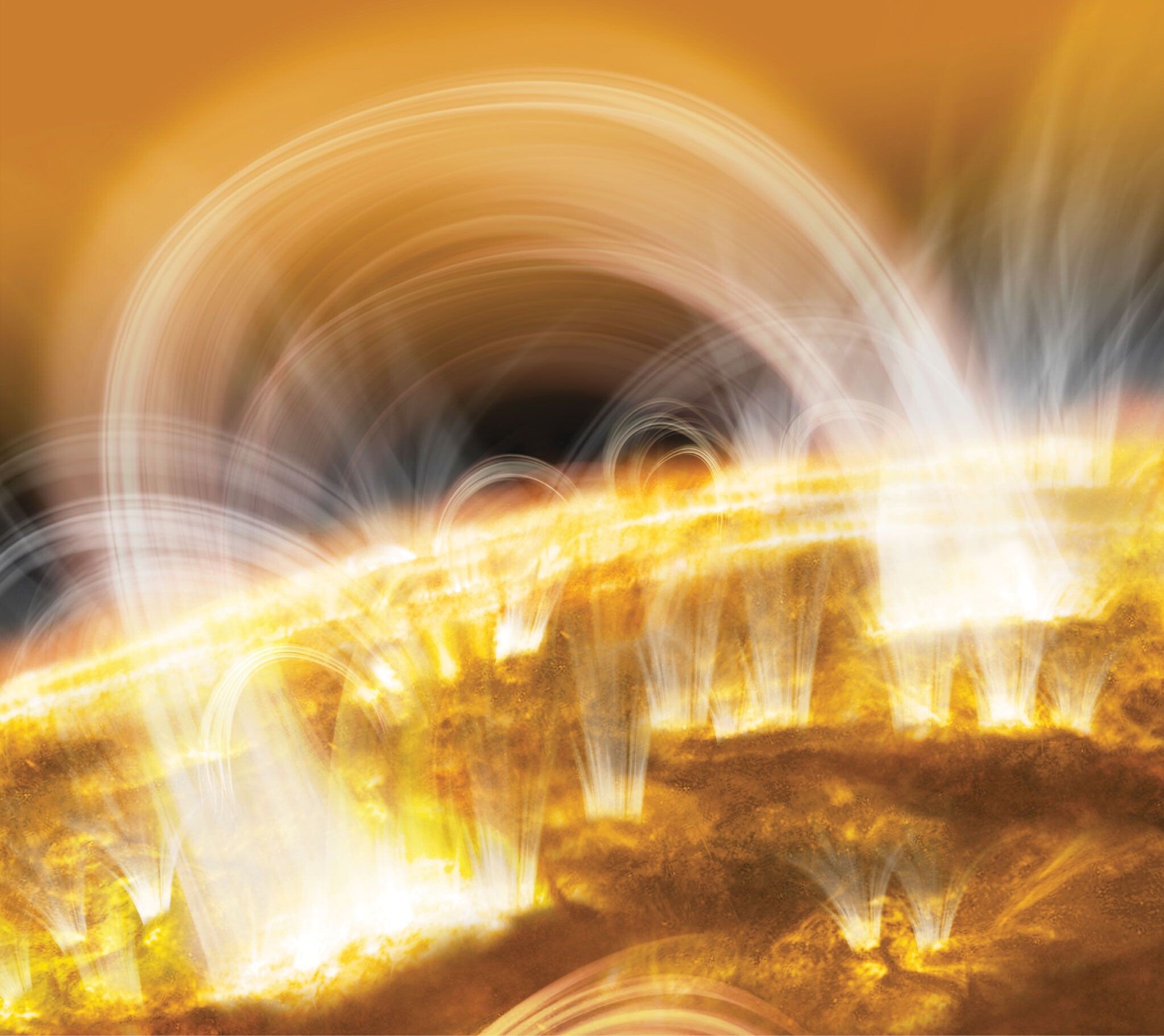
    Our Sun‘s visible surface, the photosphere, is about 5800 Kelvin, but the temperature of the wispy corona is far hotter, reaching a million Kelvin in some places. Why the corona is so hot remains something of a mystery. Scientists have theorized multiple culprits for the extreme temperatures found in the corona, but the full details of the phenomenon are still unclear.

    Recent solar missions and observations are increasingly identifying small but widespread solar activities, like the nanoflares shown above. Unlike the monstrous coronal loops researchers focused on previously, these flares are tiny and occur in regions without discernible solar flare activity. The nanoflares are brief but they can reach temperatures above a million Kelvin. Since nano- and even picoflares have been observed across the full Sun, they likely play a significant role in the overall picture of coronal heating. (Image credit: ISAS/JAXA; see also L. Sigalotti and F. Cruz)

  • Featured Video Play Icon

    Magnetic Soap Films

    Soap films naturally thin over time as fluid evaporates and differences in film thickness cause surface-tension-driven flows. In this video, researchers experiment with adding magnetic nanoparticles to the soap film. In the second image, the white structures near the center of the film contain nanoparticles, and they’re drawn toward the magnet that sits (out-of-frame) to the left of the film. With more nanoparticles and a stronger magnetic field (Image 3), the entire soap film takes on a distinctive profile that thins from left to right. The effect is so strong that the film quickly thins to the point of rupture. (Image and video credit: N. Lalli et al.)

  • Mixing With E. Coli

    Mixing With E. Coli

    What happens when a flow meets swimming micro-organisms? Does the flow affect the swimmers? And how do the swimmers affect the flow in turn? Those are the questions behind the experiment seen here. The apparatus contains a thin layer of saline water with swimming E. coli. Electromagnetism is used to mix the fluid in an array-like pattern that triggers chaotic mixing. To visualize what’s going on, dye is introduced into the right half of the image, while the left half remains undyed.

    On the right side of the image, bright blue and white mark areas of high dye concentration, where strong mixing occurs. On the undyed left side of the image, pale blue streaks mark areas where E. coli are clustered. By comparing the two, we see that the micro-swimmers are clustered in the very same regions of flow marked by strong mixing. This result suggests strong interactions and the potential for feedback between the mixing flow and the swimmers. (Image and research credit: R. Ran et al.; see also 1 and 2)

  • Turbulence in Accretion Disks

    Turbulence in Accretion Disks

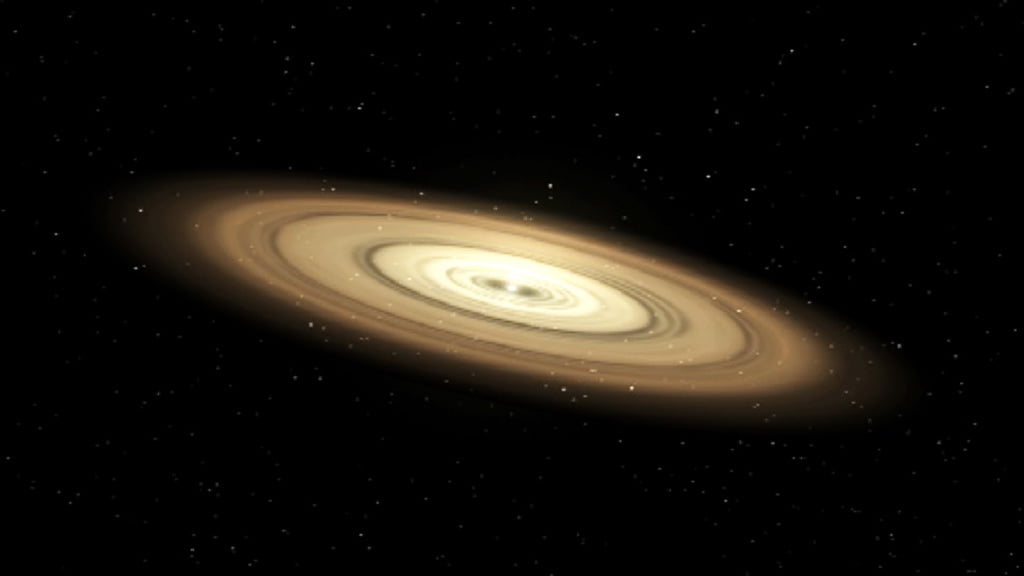
    Accretion disks form everywhere, from around young, planet-building stars to massive black holes. As matter circles in the disk, it slowly loses angular momentum and falls inward toward the central gravitational body. But the details of this process have long vexed astronomers. The low-viscosity environment of gas and dust in accretion disks simply is not sufficient to account for the level of angular momentum lost. Turbulence is expected to provide a boost to the effect, but neither astronomical observations or Taylor-Couette experiments have shown how.

    A new study uses a liquid metal, confined in a disk using radial and vertical electrical fields. Unlike prior experiments, this set-up creates a more gravity-like force to rotate the liquid. With it, researchers can tune both the rotation speed and the level of turbulence. They found that turbulence is, indeed, responsible for the loss of angular momentum that transports mass inward — even at the limit of zero intrinsic viscosity.

    Unfortunately, the apparatus isn’t a perfect analog for astrophysical disks; in the experiment, the turbulence originates from secondary flows that aren’t present in real systems. So while the team demonstrated that turbulence can drive the accretion disk’s behavior, it can’t pinpoint where that turbulence originates in real accretion disks. (Image credit: NASA; research credit: M. Vernet et al.; via Physics World)

  • Featured Video Play Icon

    Contactless Bending

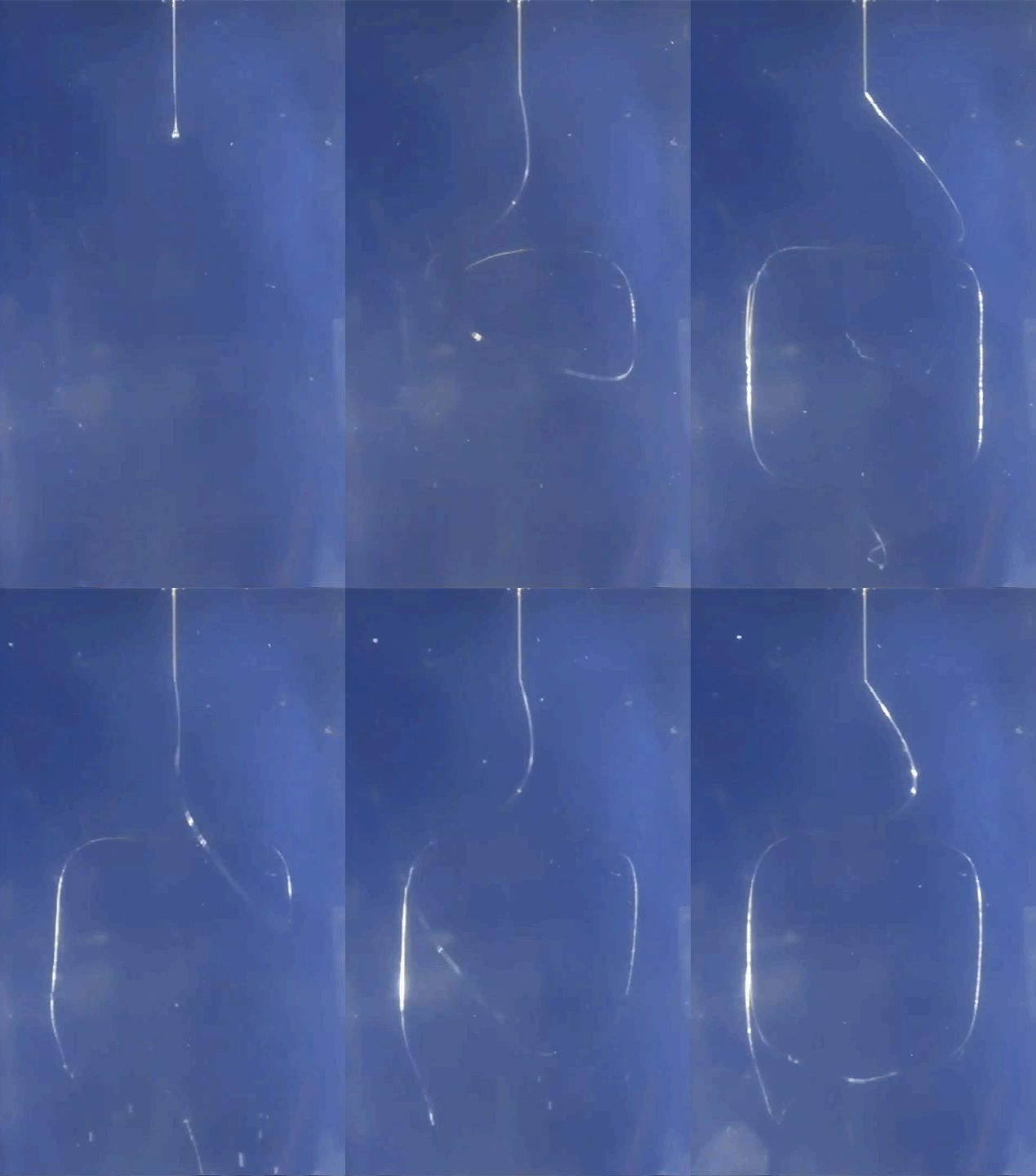
    Using electromagnetism, researchers are bending and shaping soft liquid wires even against gravity. The team used galinstan — an alloy of gallium, indium, and tin that remains liquid at room temperature. On its own, galinstan has a high surface tension and forms droplets. But with a voltage applied, that surface tension is suppressed, making the liquid form a long, thin, still-liquid wire. Adding a magnetic field allowed the researchers to manipulate the falling stream of liquid, even levitating loops of the metal against the force of gravity! (Image, video, and research credit: Y. He et al.; via Cosmos; submitted by Kam-Yung Soh)

  • Brilliant Auroras

    Brilliant Auroras

    Glowing auroras billow across Canada in this satellite image from a recent geomagnetic storm. As our sun enters a more active part of its solar cycle, we can expect more space weather as the high-energy particles of the solar wind interact with our planet’s magnetic field. The auroras themselves are light released by energetically excited atoms of oxygen and nitrogen high in the upper atmosphere.

    Earth is not the only place in the solar system to experience these light shows. With their strong magnetic fields, Jupiter and Saturn have auroras that make Earth’s look paltry in comparison. (Image credit: J. Stevens; via NASA Earth Observatory)