Sometimes fluids are slow-moving enough that it takes timelapse techniques to reveal the flow. Fog is one example, and, as seen above, magnetic silly putty is another. The putty is an unusual fluid in a couple of ways. First, having been impregnated with ferromagnetic nanoparticles, it is sensitive to magnetic fields, making it a sort of ferrofluid. And secondly, being silly putty, it’s a non-Newtonian fluid, meaning that it has a nonlinear response to deformation – a fact that will be familiar to anyone who has tried to knead putty versus striking it. With a strong enough magnet, the putty makes for an impressively tenacious creeping flow. (Video credit: I. Parks; via io9; submitted by Chad W.)
Tag: magnetohydrodynamics

5 Years of SDO
NASA’s Solar Dynamics Observatory (SDO) is our premiere source for data on the sun. In honor of its five-year anniversary, NASA released this beautiful video compiling some of the highlights among the 2600 terabytes of data the spacecraft has recorded. SDO has captured some truly stunning footage over the years of sunspots, prominences, and eruptions. The latter two are examples of plasma flows and visible magnetohydrodynamics. SDO’s observations are also helping researchers determine what goes on just beneath the sun’s surface, where convection and buoyancy are major forces in the transport of heat generated from fusion in the star’s core. Incidentally, SDO’s launch featured some uncommonly stunning fluid dynamics as well. (Video credit: NASA Goddard)
Plasma
For those of us who are Earthbound, it’s easy to think of liquids and gases as being the most common fluids. But plasma–the fourth state of matter–is a fluid as well. Plasmas are essentially ionized gases, which, thanks to their freely flowing electrons, are electrically conductive and sensitive to magnetic fields. Their motions are described by a combination of the Navier-Stokes equations–the usual equations of motion for a fluid–and Maxwell’s equations–the equations governing electricity and magnetism. Studies of plasma motion often fall under the subject of magnetohydrodynamics and can include topics like planetary auroras, sunspots, and solar flares. (Video credit: SciShow)

Saturnian Auroras

Earth is not the only planet in our solar system with auroras. As the solar wind–a stream of rarefied plasma from our sun–blows through the solar system, it interacts with the magnetic fields of other planets as well as our own. Saturn’s magnetic field second only to Jupiter’s in strength. This strong magnetosphere deflects many of the solar wind’s energetic particles, but, as on Earth, some of the particles get drawn in along Saturn’s magnetic field lines. These lines converge at the poles, where the high-energy particles interact with the gases in the upper reaches of Saturn’s atmosphere. As a result, Saturn, like Earth, has impressive and colorful light displays around its poles. (Image credit: ESA/Hubble, M. Kornmesser & L. Calçada, source video; via spaceplasma)

Aurora From Space
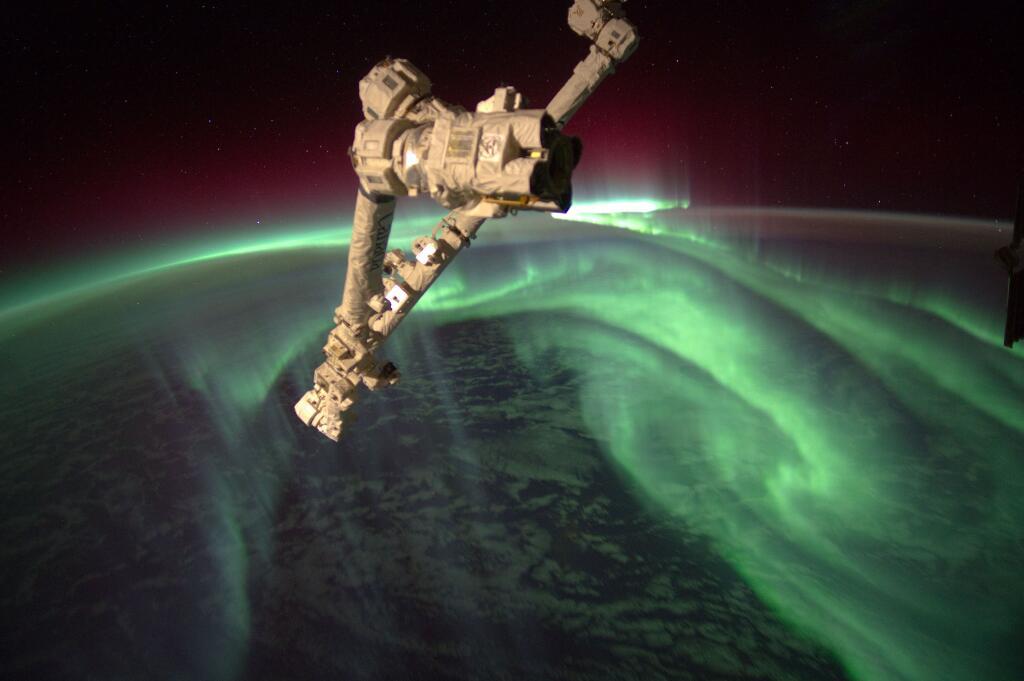
An aurora, as seen from the International Space Station, glows in green and red waves over the polar regions of Earth. These lights are the result of interactions between the solar wind–a stream of hot, rarefied plasma from the sun–and our planet’s magnetic field. A bow shock forms where they meet, about 12,000-15,000 km from Earth. The planet’s magnetic field deflects much of the solar wind, but some plasma gets drawn in along field lines near the poles. When these energetic particles interact with nitrogen and oxygen atoms in the upper atmosphere, it can excite the atoms and generate photon emissions, creating the distinctive glow. Similar auroras have been observed on several other planets and moons in our solar system. (Photo credit: NASA)

Fluid Dynamics and the Nobel Prize

Last night marked the 2013 Ig Nobel Prize Award Ceremony, in which researchers are honored for work that “makes people LAUGH and then THINK”. Historically, the field of fluid dynamics has been well-represented at the Ig Nobels with some 13 winners across the fields of Physics, Chemistry, Mathematics, and–yes–Fluid Dynamics since the awards were introduced in 1991. This is in stark contrast to the awards’ more famous cousins, the Nobel Prizes.
Since the introduction of the Nobel Prize in 1901, only two of the Physics prizes have been fluids-related: the 1970 prize for discoveries in magnetohydrodynamics and the 1996 prize for the discovery of superfluidity in helium-3. Lord Rayleigh (a physicist whose name shows up here a lot) won a Nobel Prize in 1904, but not for his work in fluid dynamics. Another well-known Nobel laureate, Werner Heisenberg, actually began his career in fluid dynamics but quickly left it behind after his doctoral dissertation: “On the stability and turbulence of fluid flow.”
This is not to suggest that no fluid dynamicist has done work worthy of a Nobel Prize. Ludwig Prandtl, for example, revolutionized fluid dynamics with the concept of the boundary layer (pdf) in 1904 but never received the Nobel Prize for it, perhaps because the committee shied from giving the award for an achievement in classical physics. General consensus among fluid dynamicists is that anyone who can prove a solution for turbulence using the Navier-Stokes equation will likely receive a Nobel Prize in addition to a Millennium Prize. In the meantime, we carry on investigating fluids not for the chance at glory, but for the joy and beauty of the subject. (Image credits: Improbable Research and Wikipedia)

Convection on the Sun

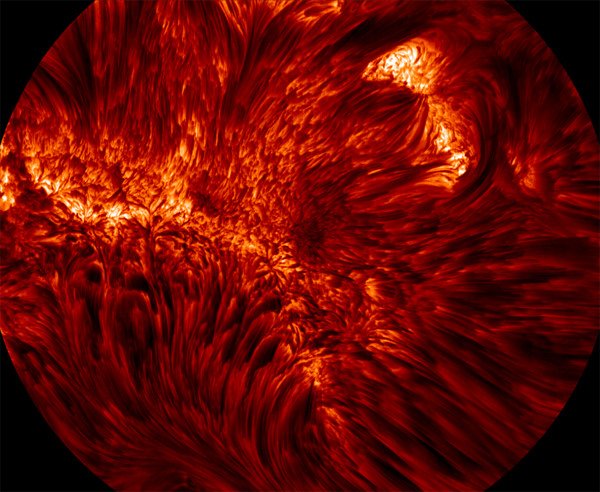
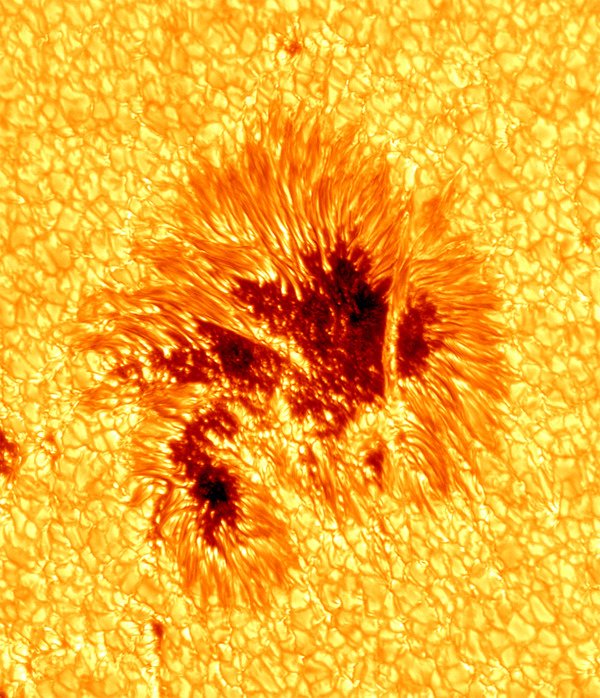
New photographs showing ultra-fine structure in the sun’s chromosphere and photosphere have been released. They offer a fascinating view into the magnetohydrodynamics of the sun, where the fluid behaviors of plasma are constantly modified by the sun’s magnetic field. The left image shows fine-scale magnetic loops rooted in the photosphere, while the right image shows our clearest photo yet of a sunspot. The dark central portion is the umbra, where magnetic field lines are almost vertical; it’s surrounded by the penumbra, where field lines are more inclined. Further out, we see the regular convective cell structure of the sun. (Photo credit: Big Bear Solar Observatory/NJIT; via io9 and cnet)

Turbulence and Magnetic Field Lines
During a solar flare, magnetic field lines on the sun are often visible due to the flow of plasma–charged particles–along the lines. According to theory, these magnetic lines should remain intact, but they are sometimes observed breaking and reconnecting with other lines. An interdisciplinary team of researchers suggests that turbulence may be the missing link. In their magnetohydrodynamic simulation, they found that the presence of chaotic turbulent motions made the magnetic line motion entirely unpredictable, whereas laminar flows behaved according to conventional flux-freezing theory. (Photo credit: NASA SDO; Research credit: G. Eyink et al.; via SpaceRef; submitted by jshoer)
Breaking Up a Ferrofluid
Ferrofluids are known for their fascinating behaviors when subjected to magnetic fields, especially for the distinctive peaks they can form. In this video, we see a very thin ferrofluid drop on a pre-wetted surface just as a uniform perpendicular magnetic field is applied. Immediately the droplet breaks up into tiny isolated peaks that migrate out to the circumference. The interface breaks down from center, where the drop height is largest, and moves outward. Simultaneously, the diffusion of ferrofluid from the circumferential droplets into the surrounding fluid lowers the magnetization of those droplets, making it more difficult for them to repel their neighbors. As a result, they drift outward more slowly and get caught by the faster-moving droplets from within. (Video credit: C. Chen)
Magnetic Putty
For a little Friday fun, enjoy this timelapse of magnetic putty consuming magnets. Really this is a bit of slow-motion magnetohydrodynamics. The magnet’s field exerts a force on the iron-containing putty, which, because it is a fluid, cannot resist deformation under a force. As a result, the putty will flow around the magnet, eventually coming to a stop once it reaches equilibrium, with its iron equally distributed around the magnet. Assuming the putty is homogeneously ferrous (i.e. the iron is mixed equally in the putty), that means the putty will stop moving when the magnet is at its center of mass. (Video credit: J. Shanks; submitted by Neil K.)