Tag: magnetic field

  • Zones and Stars

    Zones and Stars

    Large-scale rotating flows, like planetary atmospheres, tend to organize themselves into zones. Within a zone, flow remains essentially in an east-west direction and serves as a barrier that keeps heat or other elements from mixing from one zone to another. This is, for example, how the tropical trade winds work here on Earth.

    Stars, on the other hand, don’t show this kind of zonal behavior. The reason, it turns out, is their magnetic fields. When there’s no magnetic influence, even weak shear in a rotating flow is enough to start organizing turbulent fluctuations and grow a zonal flow. This tendency toward growth is known as the zonostrophic instability. But when you add a magnetic field, instead of organizing the hydrodynamic disturbances, that weak shear strengthens the magnetic ones, which in turn suppress the flow fluctuations. As a result, the hydrodynamic disturbances cannot grow and no zonal flow forms.

    Researchers think this mechanism can explain both why stars have no zonal flows and just how deep zones can penetrate inside the atmospheres of gas giants like Jupiter and Saturn before their planet’s magnetic field suppresses them. (Image credit: NASA; research credit: N. Constantinou and J. Parker, arXiv; via LLNL News; submitted by Stephanie N.)

  • Featured Video Play Icon

    Inside Earth’s Core

    Without our magnetic field, life as we know it could not exist on Earth. Instead, our atmosphere would be stripped away and the surface would be bombarded by charged particles in the solar wind. Relatively little is known about the dynamo process that governs our magnetic field, though it’s thought to be the result of liquid iron moving in the Earth’s outer core. The video above shows a slice of a recent 3D simulation of this liquid iron segment of our core. The colors show variations in the temperature, revealing vigorous convection in the core. This motion, combined with the spinning of the Earth, is the likely source of our magnetic field. Researchers hope that simulations like these can help us understand features we observe in our magnetic field – like local variations in field strength and the pole reversals in our geological record. (Video credit: N. Schaeffer et al.; CNRS via Gizmodo)

  • Featured Video Play Icon

    Glow-Stick Ferrofluids

    Ferrofluids create all kinds of fascinating shapes when exposed to magnetic fields. In this video, Dianna from Physics Girl shows off what happens when you combine a ferrofluid with glowsticks and explains how ferrofluids get some of their unique properties. Ferrofluids consist of tiny nanoparticles of magnetic material that are surrounded by surfactants and suspended in a carrier fluid. This creates a fluid whose shape depends on gravity, surface tension, and the local magnetic field. By manipulating the relative strength of these forces, you can create everything from spikes to maze-like patterns to whatever this is. (Video credit and submission: Physics Girl)

  • Featured Video Play Icon

    Magnetic Putty

    Sometimes fluids are slow-moving enough that it takes timelapse techniques to reveal the flow. Fog is one example, and, as seen above, magnetic silly putty is another. The putty is an unusual fluid in a couple of ways. First, having been impregnated with ferromagnetic nanoparticles, it is sensitive to magnetic fields, making it a sort of ferrofluid. And secondly, being silly putty, it’s a non-Newtonian fluid, meaning that it has a nonlinear response to deformation – a fact that will be familiar to anyone who has tried to knead putty versus striking it. With a strong enough magnet, the putty makes for an impressively tenacious creeping flow. (Video credit: I. Parks; via io9; submitted by Chad W.)

  • Saturnian Auroras

    Saturnian Auroras

    Earth is not the only planet in our solar system with auroras. As the solar wind–a stream of rarefied plasma from our sun–blows through the solar system, it interacts with the magnetic fields of other planets as well as our own. Saturn’s magnetic field second only to Jupiter’s in strength. This strong magnetosphere deflects many of the solar wind’s energetic particles, but, as on Earth, some of the particles get drawn in along Saturn’s magnetic field lines. These lines converge at the poles, where the high-energy particles interact with the gases in the upper reaches of Saturn’s atmosphere. As a result, Saturn, like Earth, has impressive and colorful light displays around its poles. (Image credit: ESA/Hubble, M. Kornmesser & L. Calçada, source video; via spaceplasma)

  • Featured Video Play Icon

    “The Flow II”

    The Flow II” film by Bose Collins and colleagues features a ferrofluid, a magnetically-sensitive liquid made up of a carrier fluid like oil and many tiny, ferrous nanoparticles. Although ferrofluids are known for many strange behaviors, their most distinctive one is the spiky appearance they take on when exposed to a constant magnetic field. This peak-and-valley structure is known as the normal-field instability. It’s the result of the fluid attempting to follow the magnetic field lines upward. Gravity and surface tension oppose this magnetic force, allowing the fluid to be drawn upward only so far until all three forces balance.  (Video credit: B. Collins et al.)

  • Aurora From Space

    Aurora From Space

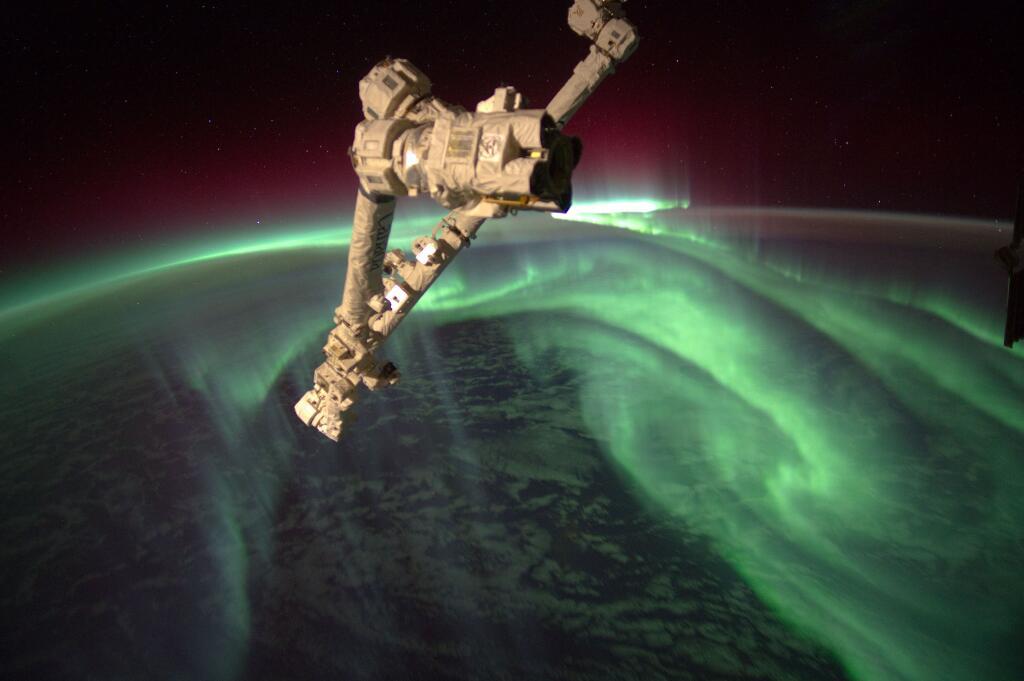
    An aurora, as seen from the International Space Station, glows in green and red waves over the polar regions of Earth. These lights are the result of interactions between the solar wind–a stream of hot, rarefied plasma from the sun–and our planet’s magnetic field. A bow shock forms where they meet, about 12,000-15,000 km from Earth. The planet’s magnetic field deflects much of the solar wind, but some plasma gets drawn in along field lines near the poles. When these energetic particles interact with nitrogen and oxygen atoms in the upper atmosphere, it can excite the atoms and generate photon emissions, creating the distinctive glow. Similar auroras have been observed on several other planets and moons in our solar system. (Photo credit: NASA)

  • Featured Video Play Icon

    Fluctuating Ferrofluids

    https://youtu.be/MU7wiveVCbg

    Ferrofluids–liquids seeded with magnetically sensitive ferrous nanoparticles–demonstrate some beautiful and bizarre behaviors when exposed to magnetic fields. This video shows the reaction of a pool of ferrofluid to the magnetic field generated by an alternating current through a simple wire coil. At 1 Hz, the fluid response is not unlike the normal-field instability–the characteristic spikes–the fluid develops when exposed to a permanent magnet. But because field is fluctuating, the spikes pop out and fade again. At 10 Hz, the behavior gets even more interesting. As the frequency of the magnetic field’s oscillation increases, the time the fluid has to respond to changes in the magnetic field decreases. Eventually, one can imagine a point where the magnetic field oscillates faster than the molecules in the fluid can rearrange themselves to respond. It’s unclear if such a mismatch in timescales is the cause of the increasing violence of the ferrofluid’s response in the later clips or whether this results from an unmentioned change to the current through the coil. For something even wilder, check out Nick’s video of the ferrofluid’s response to music. (Video credit: N. Moore)

  • Featured Video Play Icon

    The Cheerios Effect and Tiny Swimmers

    Anyone who has eaten a bowl of Cheerios is familiar with the way solid objects floating on a liquid surface will congregate. This is a form of capillary force driven by the wetting of the particles, surface tension, and buoyancy. Using ferromagnetic particles and a vertical magnetic field, one can balance capillary action and lock the particles into a fixed configuration relative to one another. By adding a second, oscillating magnetic field, it’s possible to make the beads dance and swim together. Like all of this week’s videos, this video is an entry in the 2013 Gallery of Fluid Motion. (Video credit: M. Hubert et al.)

  • Ferrofluid Thrusters

    Ferrofluid Thrusters

    Ferrofluids–magnetically-sensitive fluids made up of a carrier liquid and ferrous nanoparticles–may soon have a new application as a miniature thruster on nanosatellites. Microspray thrusters use tiny hollow needles to electrically spray jets of liquid that propel a satellite. But manufacturing the fragile microscopic needles used to disperse the propellant is expensive. Instead researchers are now using ferrofluids to create both the needle-like structures and to serve as the propellant. A ring of ferrofluid is placed on the thruster surface and a magnetic field applied to create the ferrofluid’s distinctive spikes. Then, when an electric force is applied, tiny jets of ferrofluid spray out from each tip, creating thrust. Unlike the conventional needles, the ferrofluid spikes are robust and can reform after being disturbed. (Photo credit: L. B. King et al.; submitted by jshoer)