Tag: magnetic field

  • Artificial Microswimmers

    Artificial Microswimmers

    Tiny organisms swim through a world much more viscous than ours. To do so, they swim asymmetrically, often using wave-like motions of tiny, hair-like cilia along their bodies. Mimicking this behavior in artificial swimmers is tough; how would you actuate so many micro-appendages? A new study offers a different method: inducing cilia-like waves using magnetic fields.

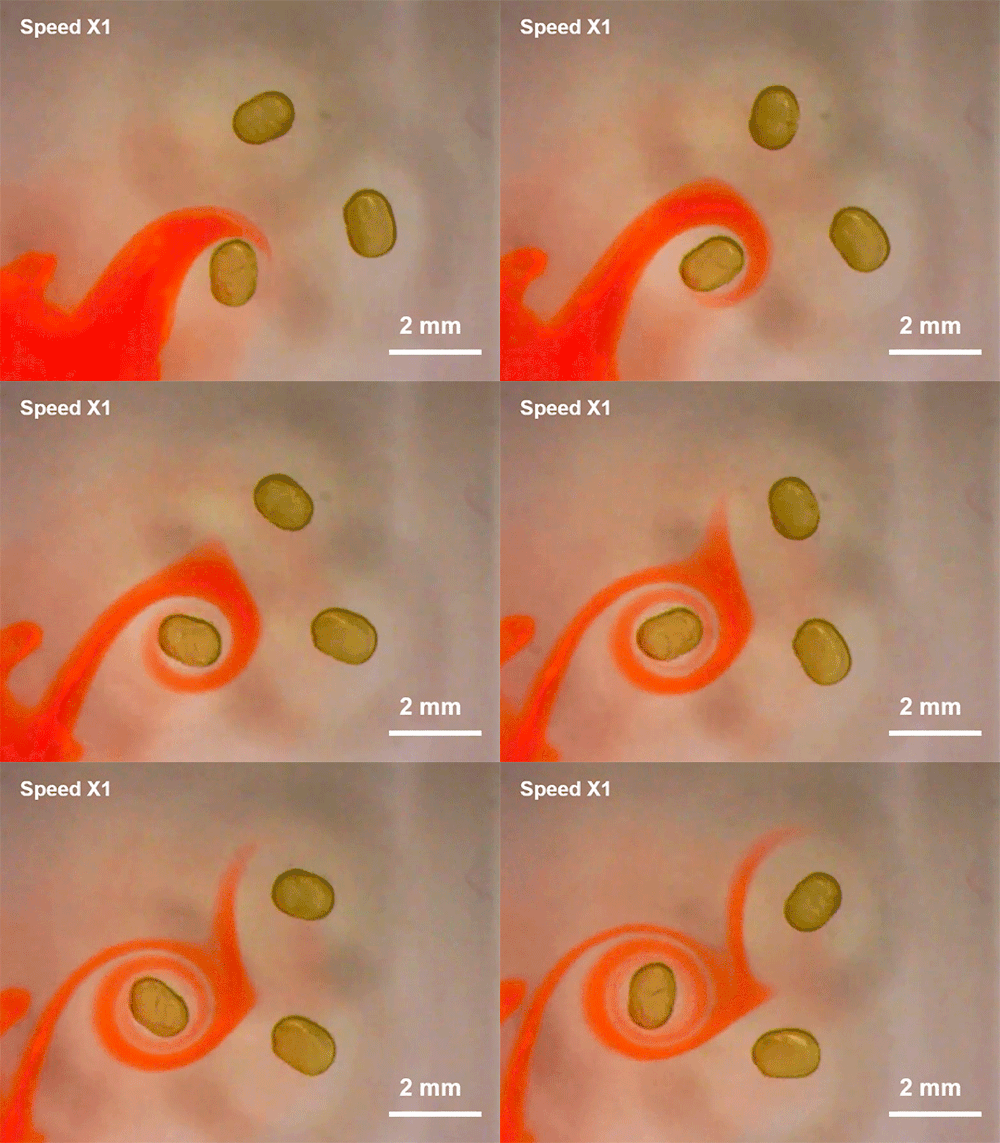
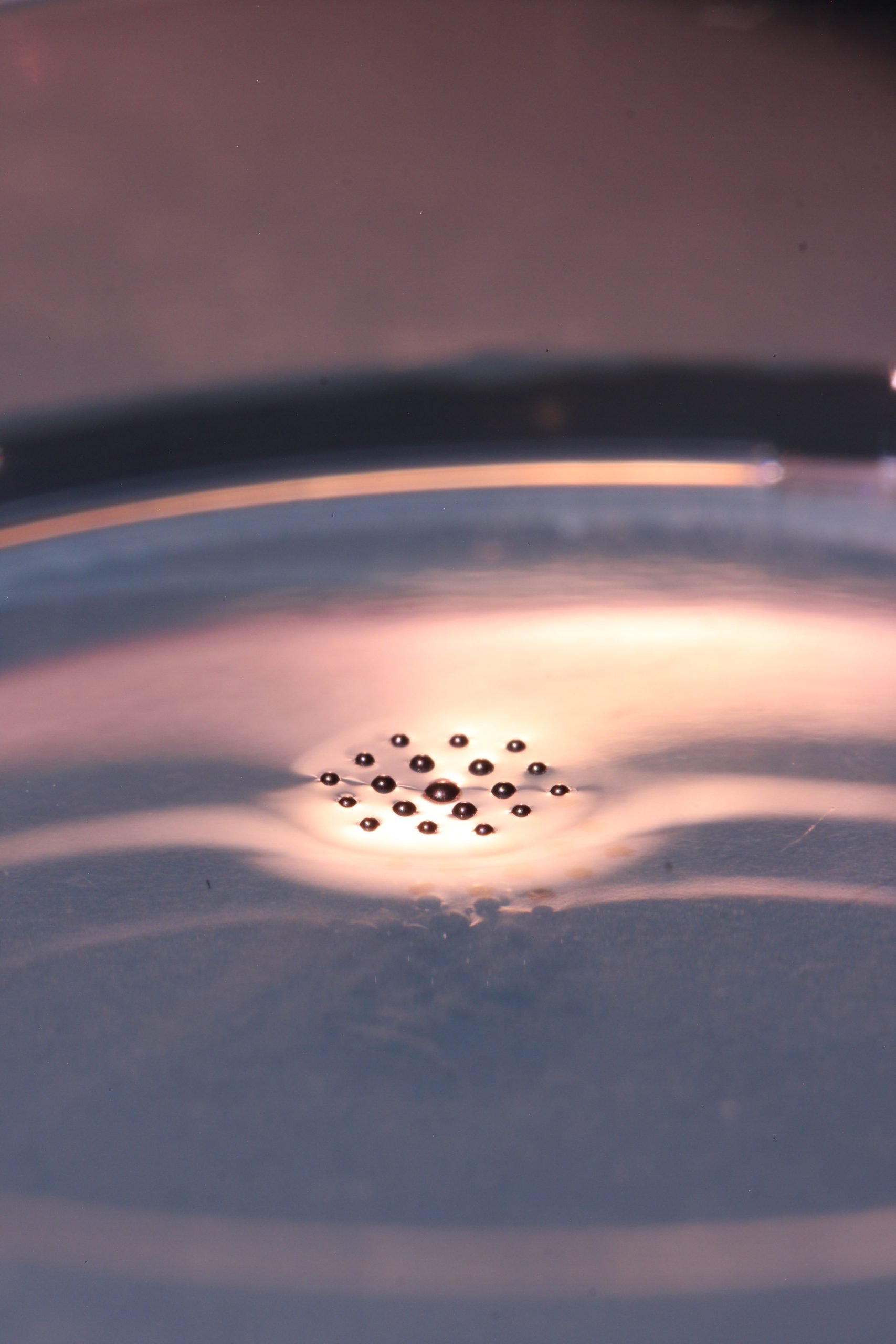
    The researchers’ microswimmers are actually arrays of ferromagnetic particles. The Cheerios effect helps draw the particles together, while magnetic repulsion pushes them apart. Together, these forces help the particles assemble into crystal-like arrays.

    To make the particles swim, the researchers shift the magnetic field. All of the outer particles of the array behave like individual cilia. As the magnetic field moves, the cilia-particles move in waves, much like their natural counterparts. Using this technique, the researchers were able to demonstrate both rotational and straight-line (translational) swimming. (Image, research, and submission credit: Y. Collard et al.)

  • New Details on the Sun’s Surface

    New Details on the Sun’s Surface

    As part of its shakedown, the new Inouye Solar Telescope has captured the surface of the sun in stunning new detail. Seen here are some of the sun’s turbulent convection cells, each about the size of the state of Texas. Hot plasma rises in the center of each cell, cools, and then sinks near the dark edges. Also visible within these dark borders are bright spots thought to mark magnetic fields capable of channeling energy out into the corona. Researchers hope the new telescope will help them uncover the physics behind these processes. (Image and video credit: Inouye Solar Telescope)

    Convection cells on the sun.

    Editor’s note: Like several other telescopes located in Hawai’i, the Inouye Solar Telescope was built against the wishes of many native Hawaiians. Although FYFD supports scientific progress, it is my personal belief that scientific advances should not come at the expense of indigenous populations. I strongly urge my scientific colleagues to listen to and work alongside those with concerns about future facilities.

  • Featured Video Play Icon

    “Emergence”

    Artist Susi Sie explores fluidic worlds through her macro lens. In “Emergence,” her focus is on ferrofluids immersed in other liquids. Beginning with tiny droplets traversing the thin fluid channels of a foam, she allows the unique qualities of ferrofluids to slowly take center stage. Dark blobs grow into curvy labyrinths as a magnetic fields come into play. Until ultimately the magnetic nature of the fluid becomes undeniable as scattered droplets elongate into miniature compass needles and swing around to follow the field lines. (Video and image credit: S. Sie)

  • Ferrofluid in a Cell

    Ferrofluid in a Cell

    Ferrofluids are a colloid consisting of magnetically sensitive nanoparticles suspended in a carrier liquid, like oil. They’re often associated with a distinctive spiky appearance when exposed to a magnet, but this isn’t their only magnetic response. Above we see a ferrofluid confined to a Hele-Shaw cell – essentially two glass plates with a small gap between them. In the upper image, the ferrofluid is exposed first to an axial magnetic field, which stretches it to form spidery arms. Then the magnetic field switches to a rotating configuration, which curls the arms around and causes the ferrofluid to slowly rotate.

    In the lower image, you see the reverse. First, the ferrofluid feels a rotating magnetic field. When this is changed to an axial field, the ferrofluid bursts into a cell-like center with straight arms. As the magnitude of the axial field increases further, the arms begin to curl. For more fantastical ferrofluid formations, check out these previous posts featuring artists Linden Gledhill and Fabian Oefner. (Image credit: M. Zahn and C. Lorenz, source; via Ashlyn N.)

  • Grayscale Aurora

    Grayscale Aurora

    This swirling grayscale image shows a spring aurora over the Hudson Bay, as seen by the Suomi NPP satellite. As energetic particles from the sun zip past Earth, they interact with our magnetosphere, which tends to channel particles toward the poles. At these higher latitudes, some of the particles get trapped along Earth’s magnetic field lines and crash into the upper atmosphere where they excite oxygen and nitrogen molecules. It’s this molecular bombardment that creates the distinctive colors of the aurora. (Image credit: J. Stevens; via NASA Earth Observatory)

  • Liquid Magnets

    Liquid Magnets

    Ferrofluids – those distinctively spiky liquids – are made up of magnetically sensitive nanoparticles in a carrier liquid, and although they respond to applied magnetic fields, they retain no magnetism outside of that field. But researchers have now succeeded in making actual liquid magnets. Shown above, these drops also contain ferromagnetic nanoparticles. But unlike traditional ferrofluids, in these drops the nanoparticles are not entirely free to move. They’re jammed together at the interface, so when a magnetic field is applied, the nanoparticles will align like tiny bar magnets. When that magnetic field is removed, though, the nanoparticles cannot easily reconfigure, so they remain aligned and the drops continue being magnetic. 

    Researchers hope these ultrasoft magnets, which can be manipulated remotely through magnetic fields, will be useful in the future for applications like targeted drug delivery. In theory one could introduce, say, chemotherapy drugs into one of these liquid magnets, then use magnetic fields to guide it directly to a cancerous tumor. (Image and research credit: X. Liu et al.; via Science News; submitted by Kam-Yung Soh)

  • Magnetic Storms

    Magnetic Storms

    Periodically, our sun releases plasma in a coronal mass ejection. Afterwards, the local magnetic field lines shift and reorganize. We can see that process in action here because charged particles spin along the magnetic lines, outlining them as bright loops in this imagery. This sequence – one of the best examples of this phenomenon to date – was captured by NASA’s Solar Dynamics Observatory in early 2017. To understand behaviors like these, scientists use magnetohydrodynamics, a marriage of the equations of fluid mechanics with Maxwell’s equations for electromagnetism. (Image credit: NASA SDO, source)

  • Simulating Solar Flares

    Simulating Solar Flares

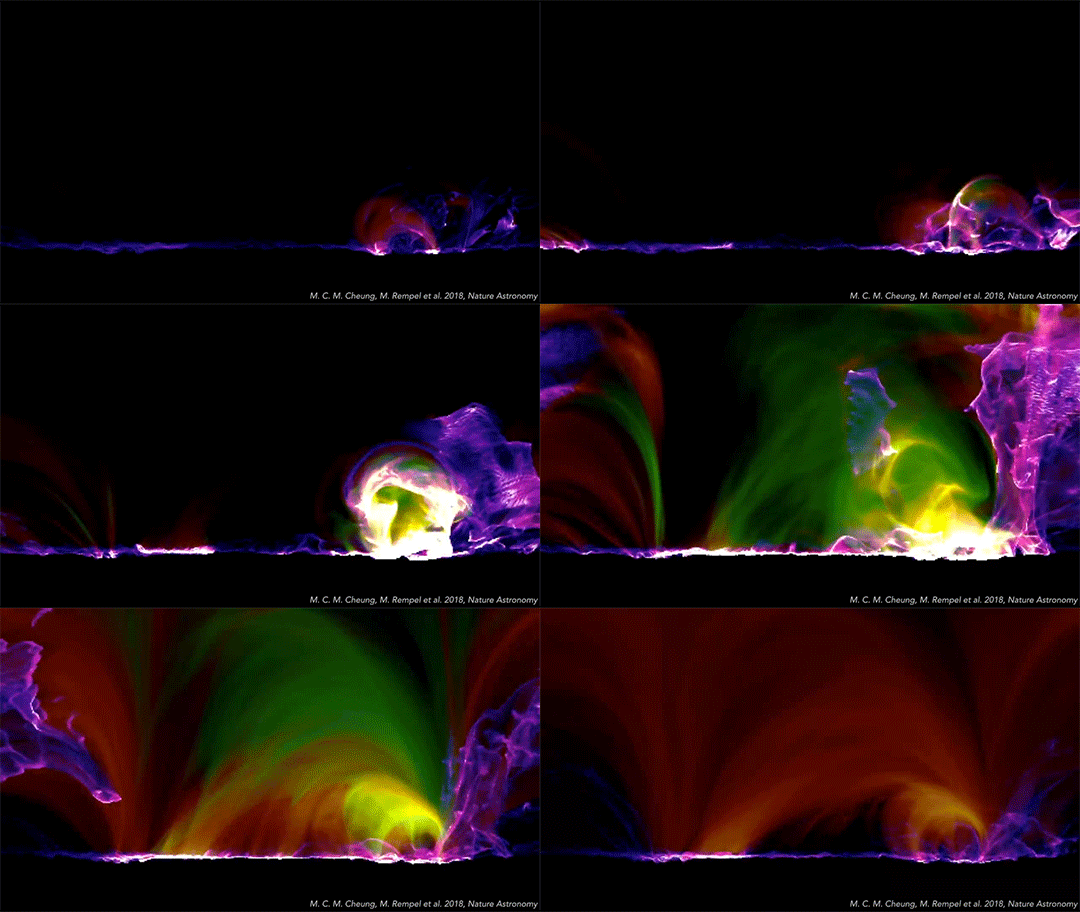
    Few topics in fluid dynamics are more mathematically complicated than magnetohydrodynamics – the marriage between electromagnetism and fluids. That mathematical complexity, along with the vast range of scales necessary to describe physical systems like our sun, means that, until now, researchers had to simplify their assumptions when simulating solar physics. But now, for the first time, a group has built a comprehensive, three-dimensional simulation capable of generating realistic solar flares. This is what you see above.

    Solar flares occur when a tangle of magnetic loops near the sun’s surface break and reconnect, releasing enormous magnetic energy and spewing a fountain of ionized plasma into the corona. They’re a danger particularly to satellites in orbit, so being able to simulate these events realistically is a major advance toward understanding the physics of space weather. (Image and video credit: NCAR & UCAR Science; research credit: M. Cheung et al.; via Bad Astronomy; submitted by Kam-Yung Soh)

  • Solar Prominence

    Solar Prominence

    Near the surface of the sun, the interplay of magnetic fields and plasma flow creates solar prominences that appear to dance. The prominence shown here was recorded in 2012 by the NASA Solar Dynamics Observatory, and its arc is large enough to easily surround the Earth. This is fluid dynamics – specifically magnetohydrodynamics – on a scale difficult for us earthbound humans to imagine. Scientists are still working to understand the complex processes that drive flows like this one. Fortunately, we can appreciate their beauty regardless. (Image credit: NASA SDO, source; via APOD; submitted by jpshoer)

  • The Jumping Flea

    The Jumping Flea

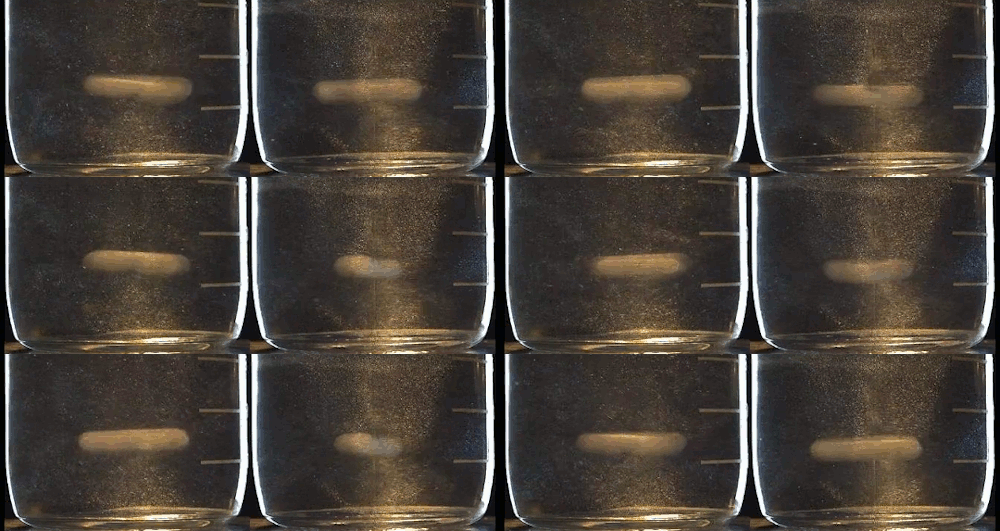
    Nearly every lab has a magnetic stirrer for mixing fluids, but this ubiquitous tool still holds some surprises, like its ability to unexpectedly levitate. Magnetic stirrers consist of two main parts, a driving magnet that creates a rotating magnetic field, and a bar magnet – commonly referred to as the flea – that is submerged in the fluid to be stirred. When the driver’s rotating field is active, the flea will spin at the bottom of its container, keeping its magnetic field in sync with the driver.

    But if you place the flea in a viscous enough fluid, the drag forces on the flea can pull it out of sync with the driver’s field. Above a certain speed, the flea will jump so that its field repulses the driver’s. That makes the flea levitate as it spins. Depending on the interplay of viscous and magnetic forces, that spin can be unstable (left) or stable (right). The researchers suggest that this peculiar behavior could help artificial swimmers propel themselves or lead to new methods for measuring fluid viscosity. (Image and research credit: K. Baldwin et al.; via APS; submitted by Kam-Yung Soh)