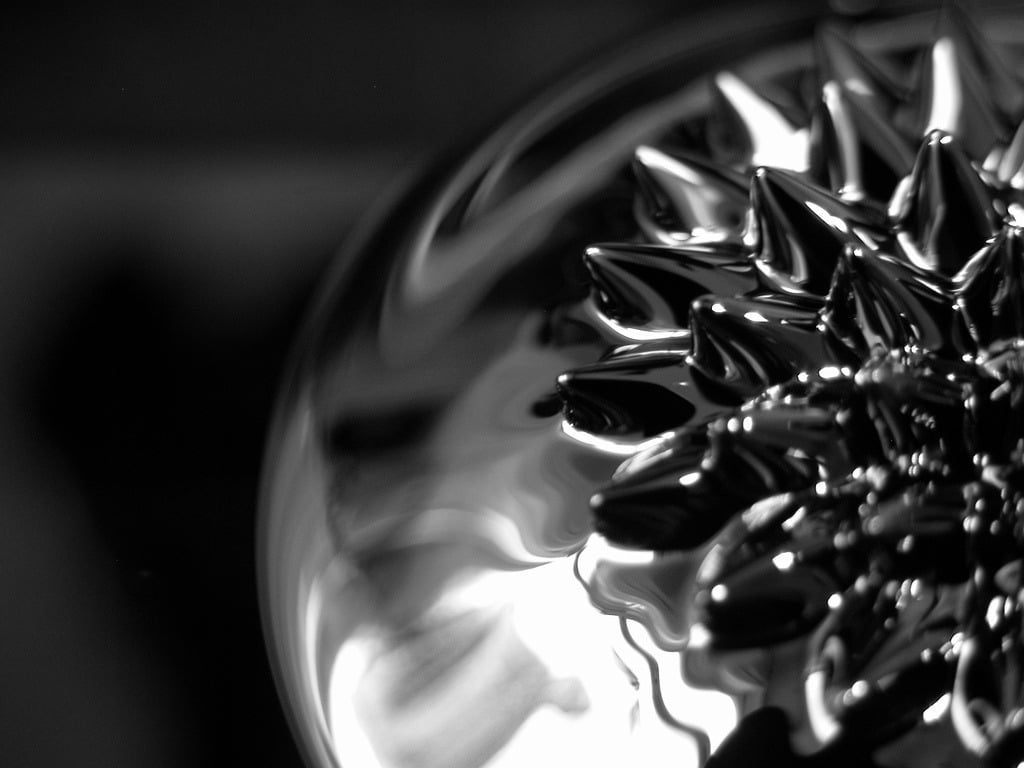
In this video, artist Afiq Omar mixes ferrofluid with soap, alcohol, milk, and other liquids to create a surrealistic fluidic dance. In addition to using different fluid mixtures, I suspect he accomplishes many effects using several different permanent magnets and electromagnets to vary the magnetic fields around the ferrofluid mixtures. (Video credit: Afiq Omar; via Wired)
Tag: magnetic field

Dancing Plasma
Two dark areas of plasma, cooler than the surrounding fluid, dance and intertwine above the sun’s surface. Plasma, a rarefied gas made up of ions, is an electrically conductive fluid, shaped here by the magnetic field of the sun. Note how the strands pass material back and forth along the magnetic field lines. This timelapse video, captured by NASA’s Solar Dynamics Observatory, takes place over the course of a day and is captured in the extreme ultraviolet range.
Ferrofluid
[original media no longer available]
The motion of ferrofluids in magnetic fields is always mesmerizing. Here a ferrofluid has been submerged in a clear alcohol-based solution in a shallow dish while a permanent magnet is used to perturb the liquid. Instead of forming its distinctive spikes due to the normal-field instability, the fluid forms ribbons and mazes due to the shifting magnetic field and the surrounding fluid.
Solar Tornadoes
NASA’s Solar Dynamics Observatory captured this video of swirls of darker, cooler plasma caught between competing magnetic forces over the course of 30 hours. The plasma strands rotate like tornadoes caught on magnetic field lines. It sometimes feels incredible to observe such familiar-looking fluid behavior in such unfamiliar places, but it’s just a reminder that physics works no matter where you are.
Solar Flare
An M-class solar flare with a towering prominence erupted from the Sun over the course of three hours in late September. Notice how the plasma does not fall straight back to the surface but flows back down following the Sun’s magnetic field lines. As an rarefied ionized gas, plasma follows coupled laws of electromagnetism and fluid dynamics. #
Aurora from the ISS
The solar wind, a rarefied stream of hot plasma ejected from the sun, constantly bombards Earth’s magnetic field. This results in the formation of the magnetosphere, which deflects most of these charged particles away from the earth. Some of them, however, are drawn toward the magnetic poles; when these charged particles strike the upper atmosphere, they cause the gases there to release photons, resulting in the lights we know as auroras. This animation shows the International Space Station flying through the aurora australis–the southern lights. The fluid-like motion of the aurora is no accident; though diffuse, the solar wind is still a fluid governed by magnetohydrodynamics.

Spiky Ferrofluid
Ferrofluids consist of ferromagnetic nanoparticles suspended in a fluid. When subjected to strong magnetic fields, they develop a distinctive peak-and-valley formation due to the normal-field instability. The shape is a result of minimizing the magnetic energy of the fluid. Both gravity and surface tension resist the formation of these peaks. Ferrofluids, in addition to appearing in art exhibits, can be used as liquid seals, MRI contrast agents, and loudspeaker cooling fluids. (Photo credit: Maurizio Mucciola)
Aurora Physics
The auroras at Earth’s poles are much more than pretty lights. This video explains their formation; fluid mechanics (specifically magnetohydrodynamics) play a major role in the convective transport of heat inside the sun as well as the movement of the plasma that makes up a solar storm that interacts with Earth’s magnetic field and produces the auroras.
Ferrofluid Self-Organization
The behavior of a ferrofluid subject to magnetic fields can be fascinating. Here a ferrofluid is subjected to a permanent magnet and thinner is added to the ferrofluid. As it spreads outward, the thinner carries ferrofluid with it. The thinner evaporates, increasing the concentration of ferrofluid in the outer ring and eventually forming peaks of ferrofluid that move inward toward the main body due to the attraction of the magnet. Near the main body, the peaks are repelled by the ferrofluid because they have the same magnetic orientation.

Solar Fluid Dynamics
The sun is a wild place fluid dynamically. The surface is riddled with convection cells the size of the Earth, and prominences of plasma (ionized gas) erupt from the surface following the sun’s magnetic field lines. Violent, but beautiful. #