Tag: magnetic field

  • Forming Zigzags

    Forming Zigzags

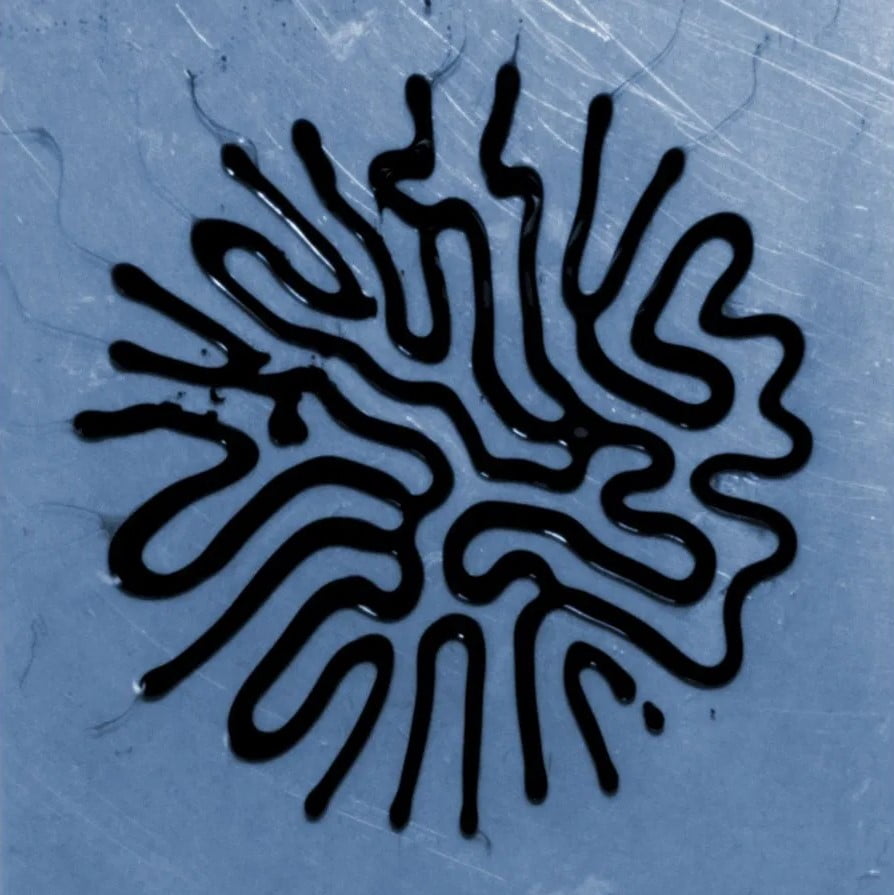
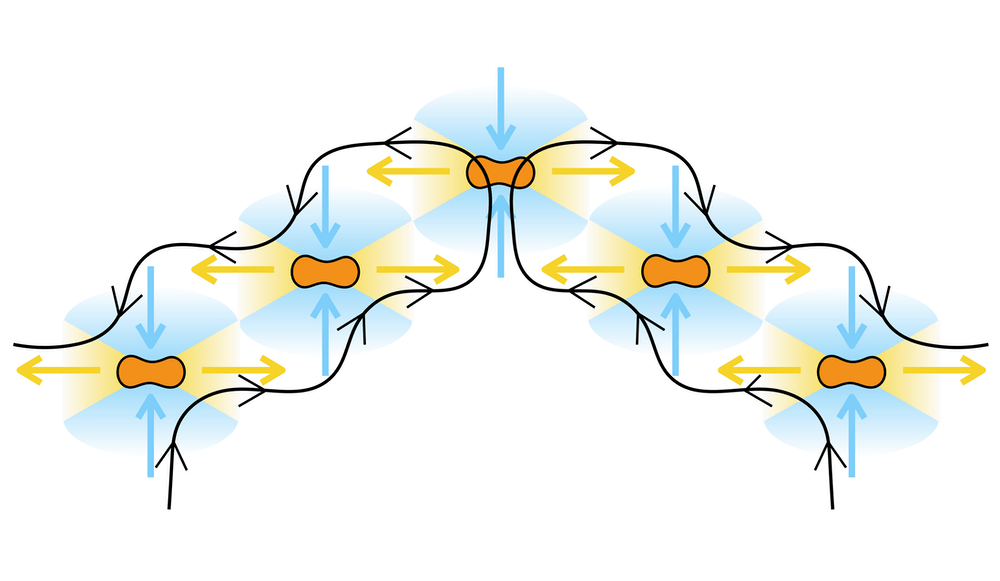
    Scientists are fascinated by the organized patterns that can emerge from non-living systems. Here, researchers study micron-sized magnetic particles, immersed in a viscoelastic fluid and subjected to an oscillating magnetic field. The peanut-shaped particles roll around their long axis and assemble to form millimeter-sized bands of zigzags. These patterns, the researchers found, do not depend on the particles’ specific shape or on the details of the applied magnetic field. Instead, the zigzags depend only on the symmetry of the flow generated around each particle. In their system, illustrated above, each particle pushed fluid away along their long axis and drew in fluid toward their waist; as a result, particle pairs would attract or repel, depending on their relative orientation. That interparticle force ultimately caused the particles to self-organize into zigzags. (Image, video, and research credit: G. Junot et al.; via APS Physics)

    This sped-up animation shows the zig-zag pattern that the particles self-organization into.
    This sped-up animation shows the zigzag pattern that the particles self-organization into.
  • Featured Video Play Icon

    Mermaid Cereal

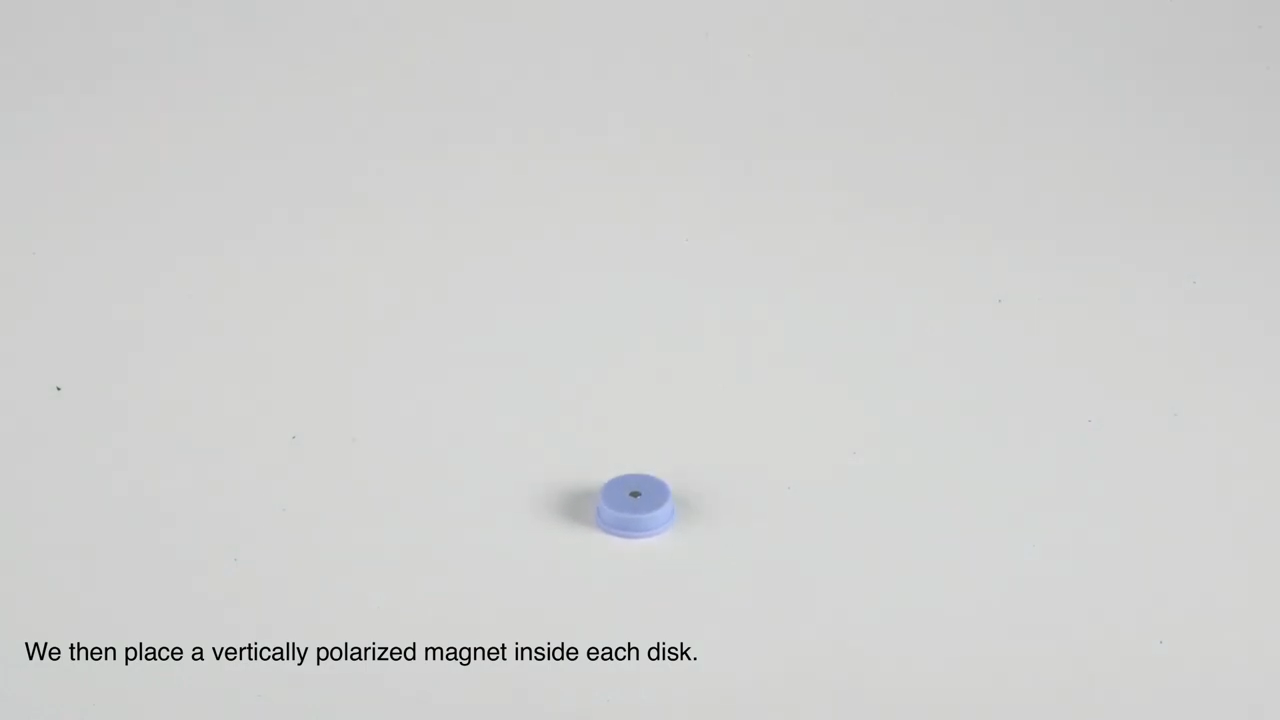
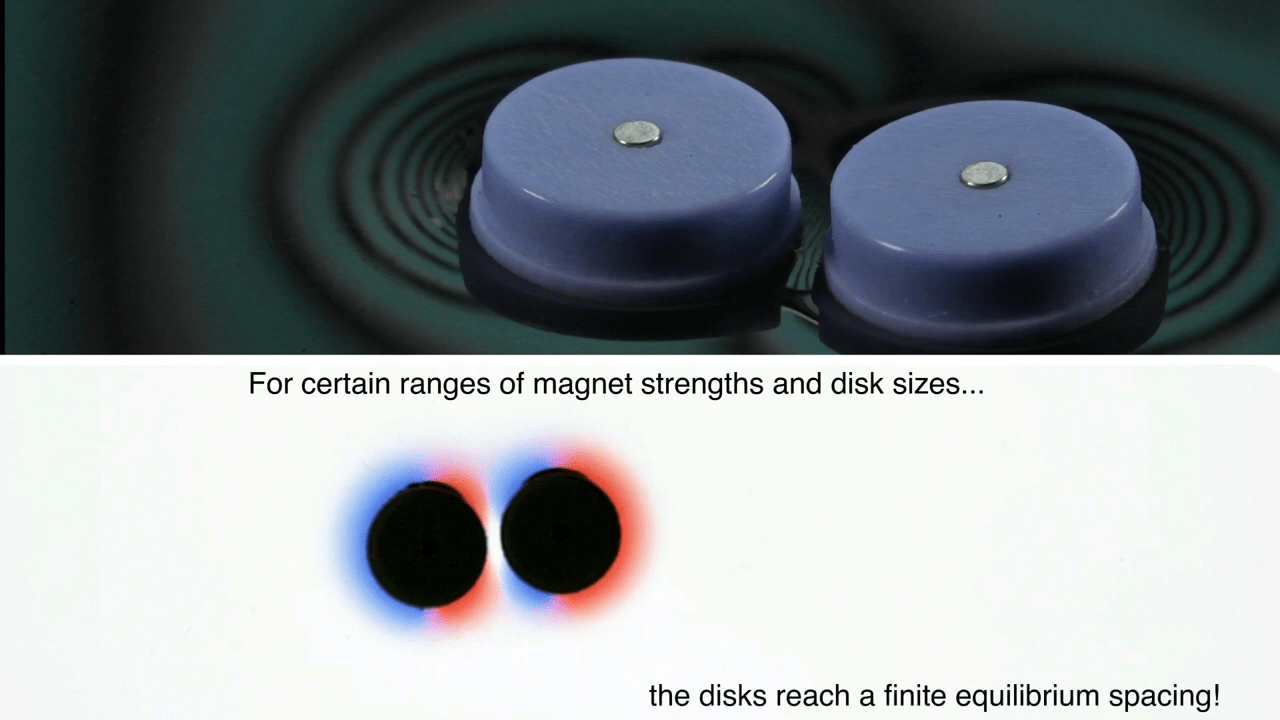
    In the Cheerios effect, floating objects can fall into one another due to capillary attraction — just like Cheerios link up in a cereal bowl. Here researchers play with that effect by adding repulsive magnets to their “cereal” pieces. They find that their so-called mermaid cereal falls into preferential spacing, with pieces pairing up but never touching. Adding lots of these pieces in a confined space creates interesting crystalline and striped patterns, as seen later in the video. (Video credit: A. Hooshanginejad et al.)

  • Featured Video Play Icon

    Magnetic Soap Films

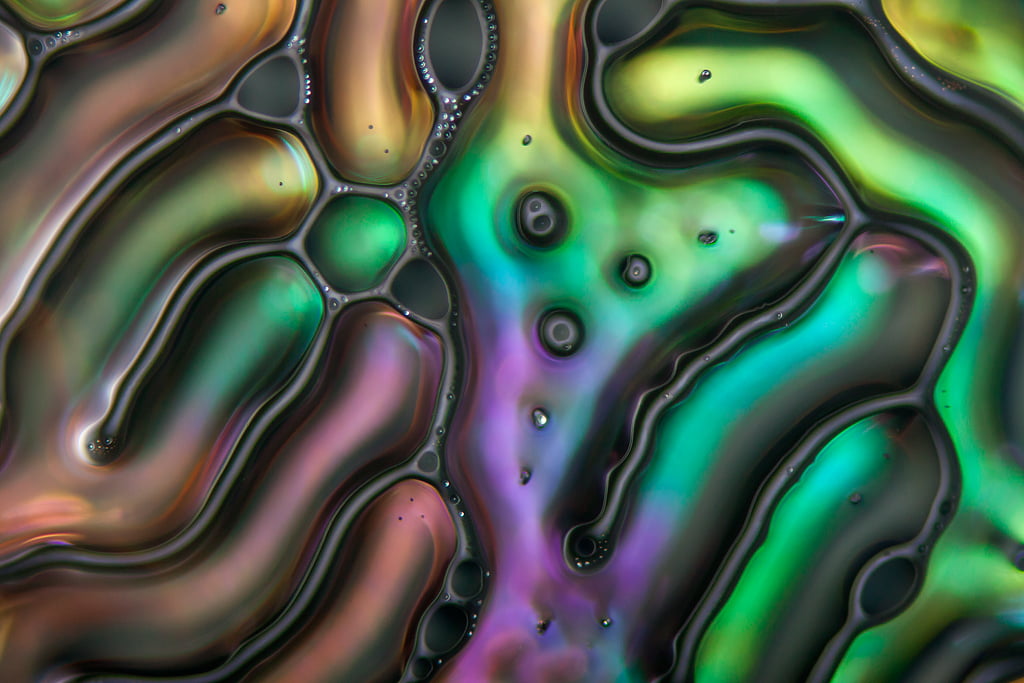
    Soap films naturally thin over time as fluid evaporates and differences in film thickness cause surface-tension-driven flows. In this video, researchers experiment with adding magnetic nanoparticles to the soap film. In the second image, the white structures near the center of the film contain nanoparticles, and they’re drawn toward the magnet that sits (out-of-frame) to the left of the film. With more nanoparticles and a stronger magnetic field (Image 3), the entire soap film takes on a distinctive profile that thins from left to right. The effect is so strong that the film quickly thins to the point of rupture. (Image and video credit: N. Lalli et al.)

  • A Forest of Ferrofluids

    A Forest of Ferrofluids

    Ferrofluids are made up of ferrous nanoparticles suspended in a carrier fluid like an oil. Under magnetic fields, they take on an array of shapes — from pointed spikes to elaborate labyrinths — depending on the field strength and what fluids they’re surrounded by. This photographic series by Linden Gledhill captures some of that fantastic variety, with ferrofluids that look like cells and nebulas in addition to mazes and tridents. See more of Gledhill’s work at his website and in previous posts. (Image credit: L. Gledhill)

  • Featured Video Play Icon

    Contactless Bending

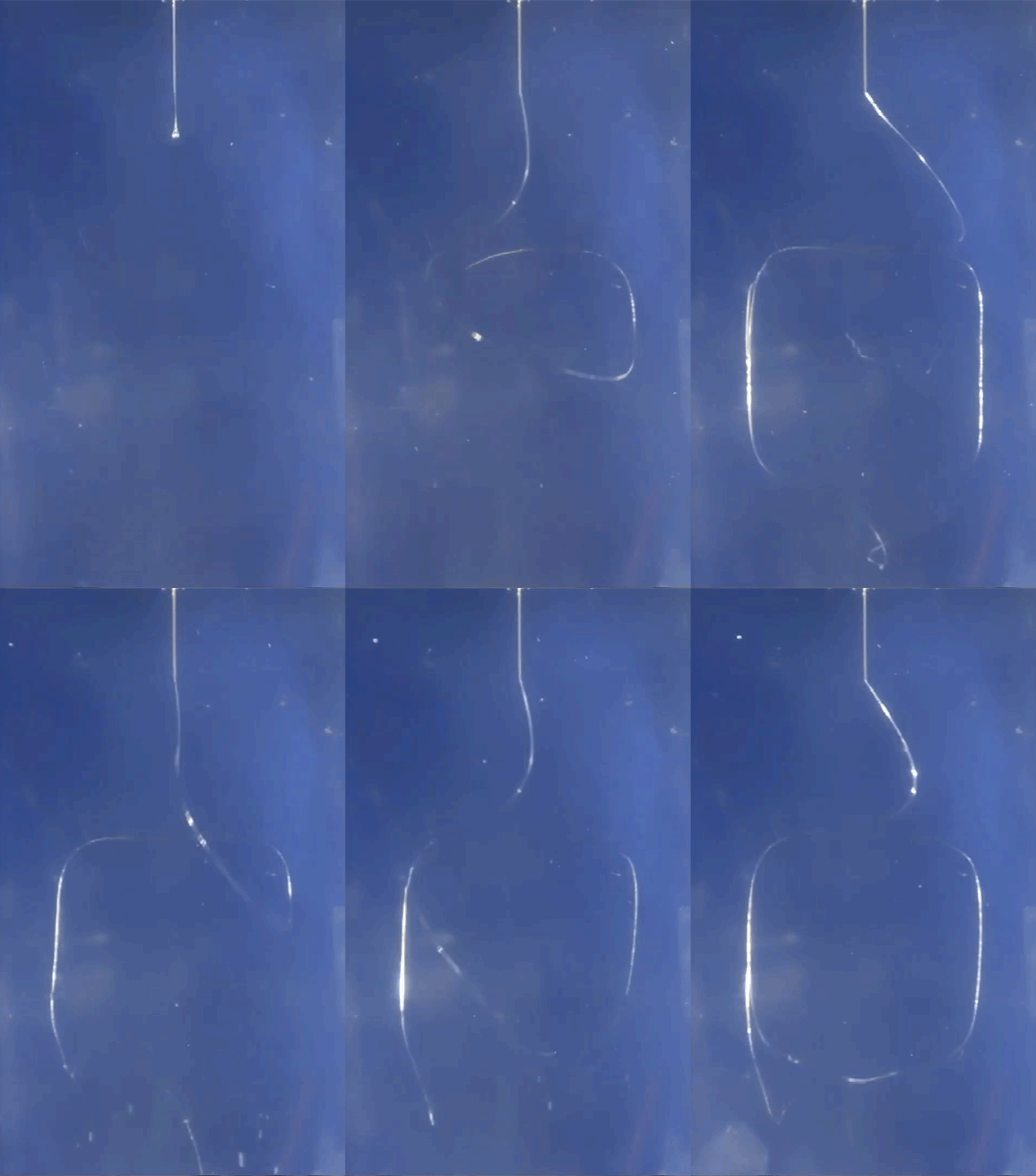
    Using electromagnetism, researchers are bending and shaping soft liquid wires even against gravity. The team used galinstan — an alloy of gallium, indium, and tin that remains liquid at room temperature. On its own, galinstan has a high surface tension and forms droplets. But with a voltage applied, that surface tension is suppressed, making the liquid form a long, thin, still-liquid wire. Adding a magnetic field allowed the researchers to manipulate the falling stream of liquid, even levitating loops of the metal against the force of gravity! (Image, video, and research credit: Y. He et al.; via Cosmos; submitted by Kam-Yung Soh)

  • Brilliant Auroras

    Brilliant Auroras

    Glowing auroras billow across Canada in this satellite image from a recent geomagnetic storm. As our sun enters a more active part of its solar cycle, we can expect more space weather as the high-energy particles of the solar wind interact with our planet’s magnetic field. The auroras themselves are light released by energetically excited atoms of oxygen and nitrogen high in the upper atmosphere.

    Earth is not the only place in the solar system to experience these light shows. With their strong magnetic fields, Jupiter and Saturn have auroras that make Earth’s look paltry in comparison. (Image credit: J. Stevens; via NASA Earth Observatory)

  • Coronal Heating

    Coronal Heating

    Compared to its interior, the surface of our sun is a cool 6,000 degrees Celsius. But beyond the surface, the sun’s corona heats up dramatically through interactions between plasma and strong magnetic fields. The exact mechanisms of this interaction have been mostly theoretical thus far, but a recent laboratory experiment has validated a part of that theory.

    One explanation for coronal heating posits that the strong magnetic fields can accelerate magnetohydrodynamic waves called Alfvén waves to speeds faster than sound, and that at this crossover point, changes occur in the waves’ behavior. Using liquid rubidium, researchers were able to observe this crossover under laboratory conditions, confirming that the Alfvén waves change at the speed of sound in exactly the manner predicted by theory. (Image credit: NASA SDO; research credit: F. Stefani et al.; via Physics World)

  • Featured Video Play Icon

    “One Month of Sun”

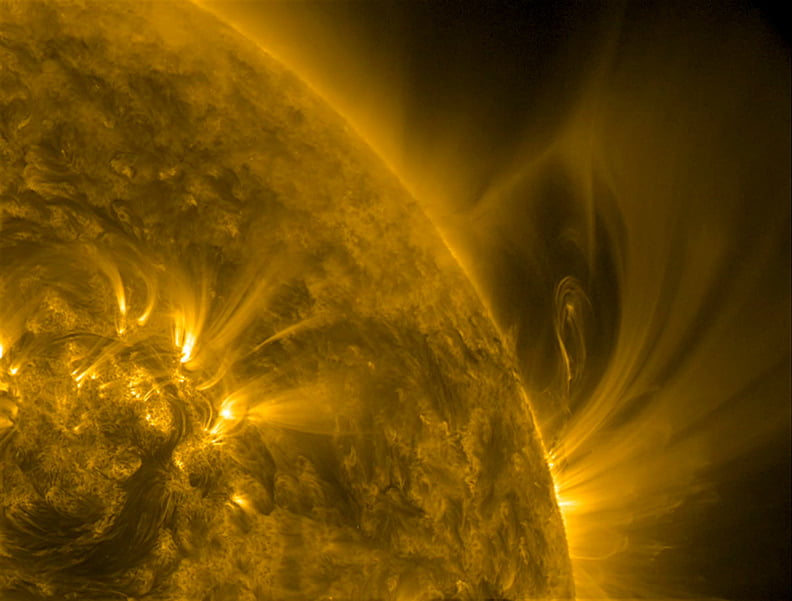
    Get lost in the beauty of our star with Seán Doran‘s film “One Month of Sun”. Constructed from more than 78,000 NASA Solar Dynamics Observatory images, the video shows solar activity from August 2014, particularly the golden coronal loops that burst forth from the sun’s visible surface. These bursts of hot plasma follow the sun’s magnetic field lines, often emerging from sunspots. (Image and video credit: S. Doran, using NASA SDO data; via Colossal)

    Golden coronal loops spring from the sun's photosphere.
    Plasma follows the magnetic field lines of the sun in this coronal loop.
  • Testing Granular Gas Theory

    Testing Granular Gas Theory

    When excited, a group of particles can behave much like a gas. These granular gases exhibit many similarities to molecular gases but contain one vital difference: without a constant input of energy, granular gases lose kinetic energy to collisions.

    Over the years, scientists have developed a special theory to describe the behaviors of granular gases, but most of its predictions could only be tested numerically. A new study used a microgravity experiment aboard a sounding rocket to physically test the theory.

    The experiment, shown above, consists of nearly 2800 magnetic particles, which the researchers could stir up using pairs of magnets. Once they shut off the magnets (which occurs at t=0 in the image above), the granular gas begins to “cool” as collisions sap away its energy. With this set-up, the researchers were able to confirm several key predictions of the granular gas theory. (Image and research credit: P. Yu et al.; via APS Physics)

  • Ferrofluid Snakes

    Ferrofluid Snakes

    We’re used to seeing ferrofluids — with their suspended iron nanoparticles — as spiky fluids when exposed to a magnetic field. But this is not always the case. Here, the ferrofluid is immersed in a thin liquid layer — window cleaner, in this case — and when a magnet is brought near, it forms snake-like, labyrinthine lines. (Image credit: M. Carter et al.)