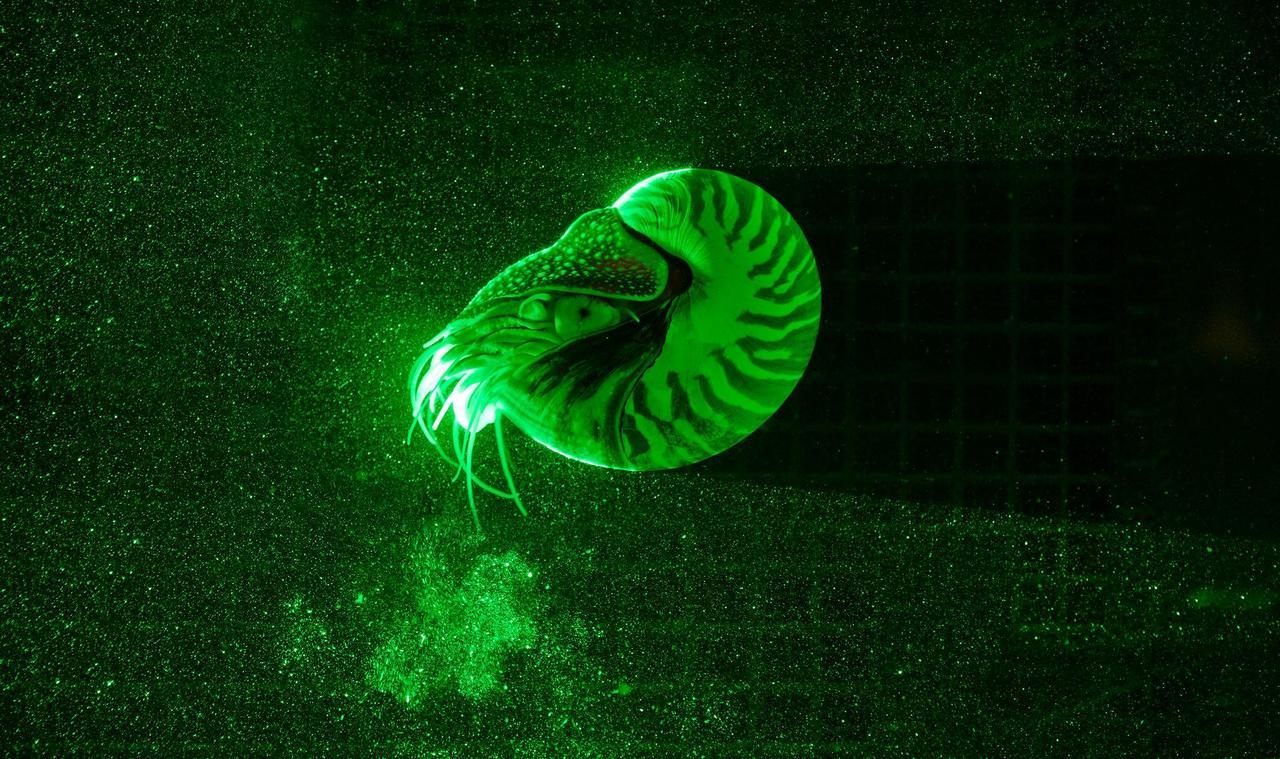
The shellbound chambered nautilus is a champion of underwater jet propulsion. It can eke out efficiencies as high as 75%, far outclassing other jet-based swimmers like squid, salps, and jellyfish. That high efficiency is especially important for the nautilus, which spends a great deal of time at depths where the oxygen needed to fuel movement is in short supply. To get around, the nautilus draws water in through an enlarged orifice, then squirts it out little by little. Its this asymmetry between drawing in and expending that keeps efficiency high. By releasing a jet slower and at lower speeds, the nautilus is able to reduce wasteful losses to friction and thereby keep the efficiency high. The drawback is that the nautilus swims relatively slowly at an average of around 8 centimeters–less than one body length–per second. (Image credit: Simon and Simon Photography/University of Leeds; research credit: T. Neil and G. Askew; via NYTimes; submitted by Kam-Yung Soh)
Tag: jets

The Fishbone
The simple collision of two liquid jets can form striking and beautiful patterns. Here the two jets strike one another diagonally near the top of the animation. One is slanted into the screen; the other slants outward. At their point of contact, the liquid spreads into a sheet and forms what’s known as a fishbone pattern. The water forms a thicker rim at the edge of the sheet, and this rim destabilizes when surface tension can no longer balance the momentum of the fluid. Fingers of liquid form along the edge, stretching outward until they break apart into droplets. Ultimately, this instability tears the liquid sheet apart. Under the right conditions, all kinds of beautiful shapes form in a system like this. (Image credit: V. Sanjay et al., source)

Oil Splatters
Most cooks have experienced the unpleasantness of getting splattered with hot oil while cooking. Here’s a closer look at what’s actually going on. The pan is covered by a thin layer of hot olive oil. Whenever a water drop gets added – from, say, those freshly washed greens you’re trying to saute – it sinks through the oil due to its greater density. Surrounded by hot oil and/or pan, the water heats up and vaporizes with a sudden expansion. This throws the overlying oil upward, creating long jets of hot oil that break into flying droplets. These are what actually hit you. This is a small-scale demonstration, but it gets at the heart of why you don’t throw water on an oil fire. (Image credit: C. Kalelkar and S. Paul, source)

Rocket Launch Systems


If you’ve ever watched a rocket launch, you’ve probably noticed the billowing clouds around the launch pad during lift-off. What you’re seeing is not actually the rocket’s exhaust but the result of a launch pad and vehicle protection system known in NASA parlance as the Sound Suppression Water System. Exhaust gases from a rocket typically exit at a pressure higher than the ambient atmosphere, which generates shock waves and lots of turbulent mixing between the exhaust and the air. Put differently, launch ignition is incredibly loud, loud enough to cause structural damage to the launchpad and, via reflection, the vehicle and its contents.
To mitigate this problem, launch operators use a massive water injection system that pours about 3.5 times as much water as rocket propellant per second. This significantly reduces the noise levels on the launchpad and vehicle and also helps protect the infrastructure from heat damage. The exact physical processes involved – details of the interaction of acoustic noise and turbulence with water droplets – are still murky because this problem is incredibly difficult to study experimentally or in simulation. But, at these high water flow rates, there’s enough water to significantly affect the temperature and size of the rocket’s jet exhaust. Effectively, energy that would have gone into gas motion and acoustic vibration is instead expended on moving and heating water droplets. In the case of the Space Shuttle, this reduced noise levels in the payload bay to 142 dB – about as loud as standing on the deck of an aircraft carrier. (Image credits: NASA, 1, 2; research credit: M. Kandula; original question from Megan H.)

Chains of Salps


Salps are small, jellyfish-like marine invertebrates that swim by ejecting a pulsatile jet. They are unusual creatures whose lives have two major stages: one in which salps swim individually and one in which they link together and swim in large chains. In the chain, salps don’t synchronize their jetting; each salp jets with its own phase and frequency. A new study suggests that, in spite of this lack of synchronicity, the salp chain’s swimming reduces the animals’ drag. There are several factors that contribute to this result. One is that drag is generally lower on a body moving at constant speed compared to one moving in bursts. When linked together and firing randomly, all the individual jets tend to average out into one continuous swimming speed. There’s even a benefit to being out of sync: previous work showed that synchronized jets lose some of their thrust when they are too close together. Salps avoid that loss by keeping to their own beat. (Image and research credit: K. Sutherland and D. Weihs, source; via Gizmodo)

Inside Ink Jet Printing
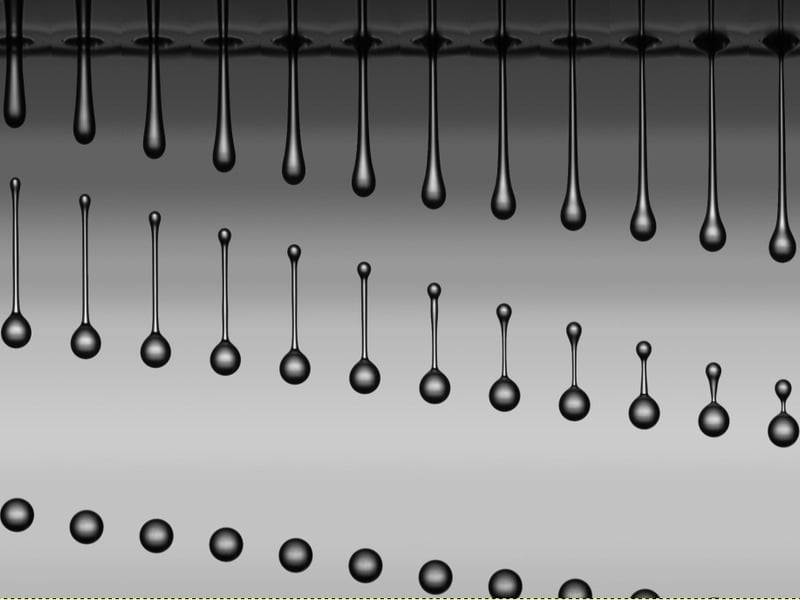
Inkjet printers produce droplets at an incredible rate. A typical printhead generates droplets that are about 10 picoliters in volume – that is, ten trillionths of a liter – moving at about 4 meters per second. Resolving the formation of those droplets would require ultra-high speed imaging at millions of frames per second. Instead researchers devised an alternative method to capture droplet formation, based on stroboscopic techniques. In this case the strobe is a 7 nanosecond laser pulse (7 billionths of a second) that illuminates a given droplet twice. By doing this for many droplets, the researchers can create a highly detailed time series like the one above, which shows the inkjet breakup and droplet formation. Here each droplet is 23 micrometers wide – about one-third the width of a human hair. (Image credit: A. van der Bos et al., source)

Superhydrophobic Splashes
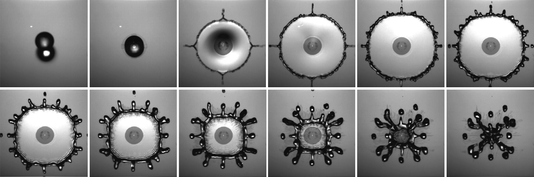
Superhydrophobic surfaces have a complicated microscale structure that changes how water interacts with them, like the hairs on a lotus leaf or the scales of a butterfly’s wing. The photo above shows snapshots at each millisecond as a water drop hits a superhydrophobic surface covered in rows of 18 micron-tall posts. The drop hits with enough speed to drive some water into the space between posts, as shown by the dark area near the center of the splash. As the rest of the droplet spreads, four microjets form along the directions of the micropost array. Those jets remain apparent until the drop reaches its maximum radius and starts to recoil. The rectangular shape of the post array affects how the water pulls away from the surface, or depins, causing the round droplet to instead take on a square-like shape as it pulls back. (Image credit: M. Reyssat et al.)

Putting Out Fires
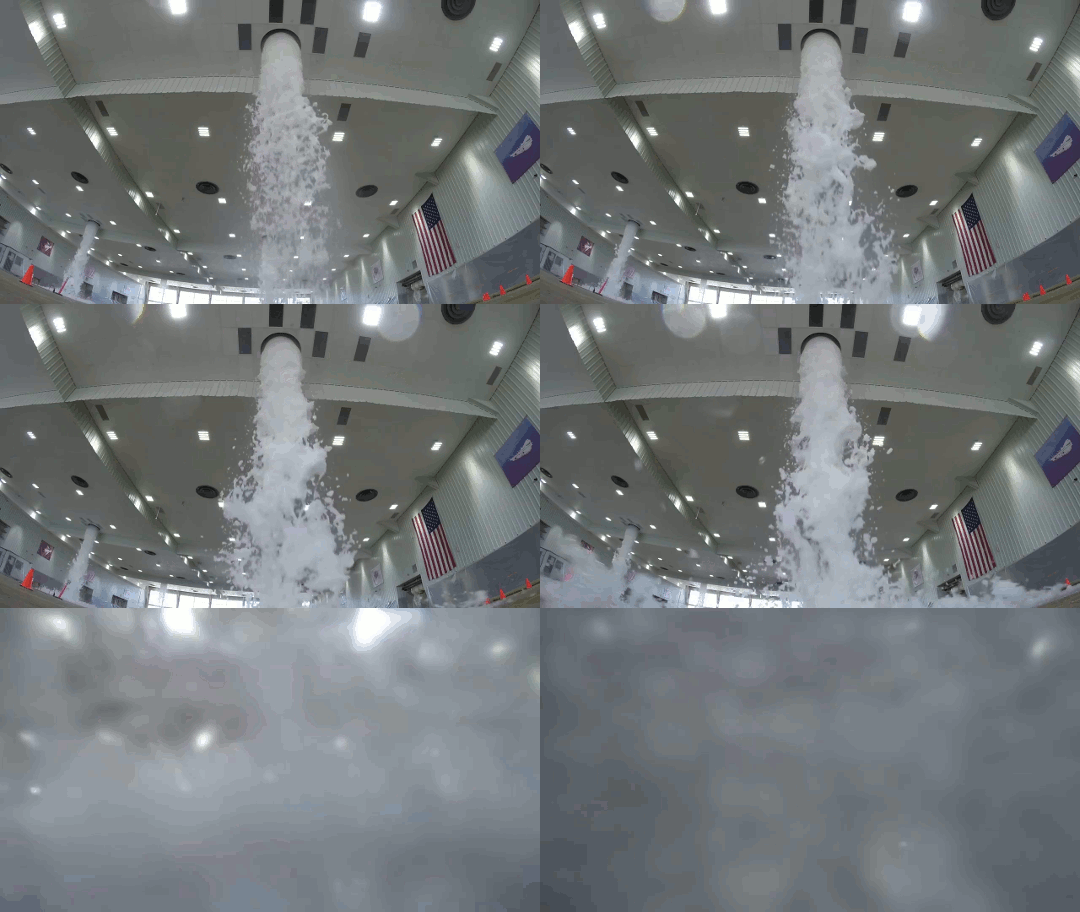
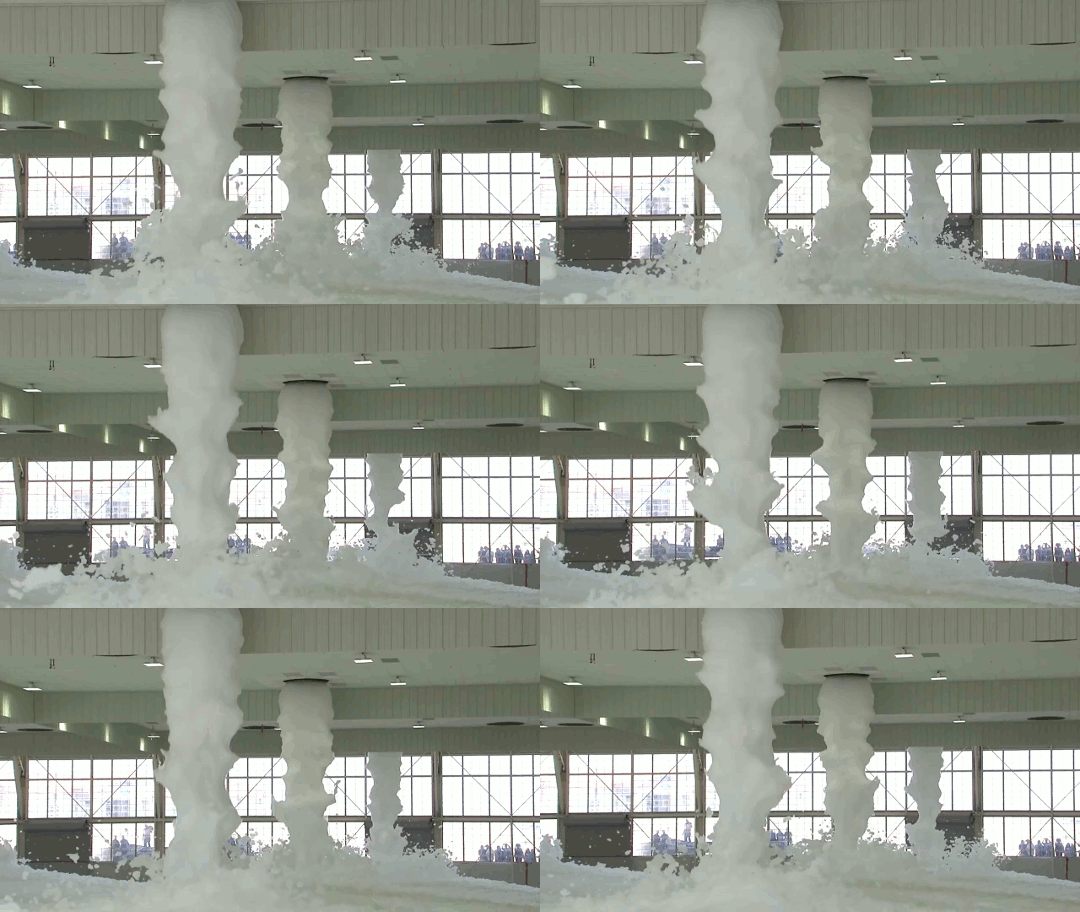
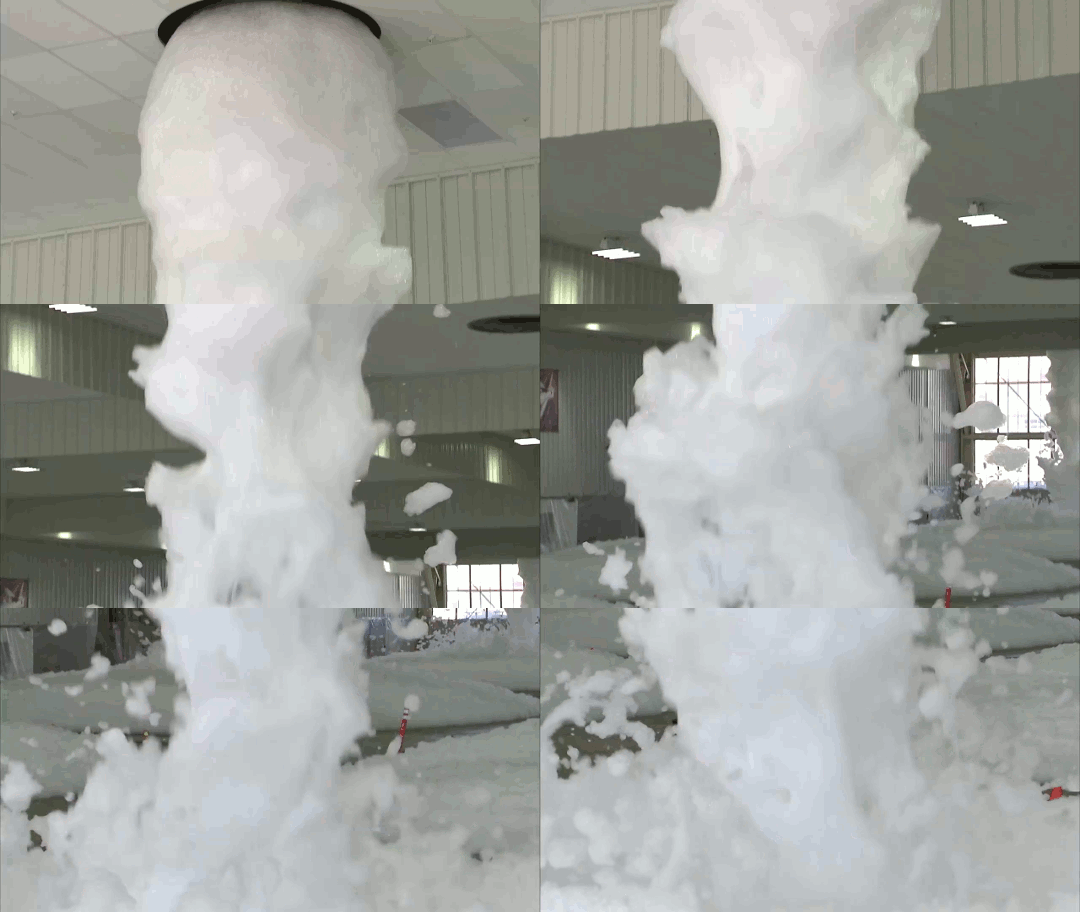
Fires in large, open spaces like aircraft hangers can be difficult to fight with conventional methods, so many industrial spaces use foam-based fire suppression systems. These animations show such a system being tested at NASA Armstrong Research Center. When jet fuel ignites, foam and water are pumped in from above, quickly generating a spreading foam that floats on the liquid fuel and separates it from the flames. Since the foam-covered liquid fuel cannot evaporate to generate flammable vapors, this puts out the fire.
The shape of the falling foam is pretty fascinating, too. Notice the increasing waviness along the foam jet as it falls. Like water from your faucet, the foam jet is starting to break up as disturbances in its shape grow larger and larger. For the most part, though, the flow rate is high enough that the jet reaches the floor before it completely breaks up. (Image credit: NASA Armstrong, source)

Using Jets to Find Food
Archer fish are well-known for their ability to hit aerial targets with perfectly aimed jets of water, as we’ve discussed previously. But a new study shows they use a similar technique to form underwater jets that help them uncover food. The researchers found that the fish altered the timing of their jet formation based on the type of substrate – fine sand, course sand, or mud – that the food pellet was hidden in. A great next step in this research would be using a technique like particle image velociometry (PIV) to measure the flow field directly and see to what extent the fish’s actions are altering the jet they produce. (Image and research credit: J. Dewenter et al.; GIF source: freshphotons)

The Archer Fish’s Arrow
Archer fish have a remarkable superpower. When hunting, they target insects above the water and knock them down with a precision strike from a jet of water they spit out. As previous research has shown, the archer fish packs an impressive punch by carefully modulating the water jet so that its tail travels faster and catches up to the front of the jet just as it strikes its target. Even more impressively, the archer fish can make this perfect strike on targets at different distances, which requires the fish to make significant adjustments to each jet. As this video from Deep Look discusses, the archer fish’s impressive hunting hints that it may have greater intelligence than we thought possible, given a comparison of its brain to ours. (Video credit: Deep Look)