This numerical simulation shows two pairs of vortices interacting in a leap-frogging motion. Another version shows the same situation but with a small perturbation in the rotational alignment that causes even more interesting interactions. Both simulations are of potential flow–an idealized flow without viscosity where velocity can be described as the gradient of a scalar function. The mathematics governing potential flow are notably easier than the full Navier-Stokes equations that govern fluid mechanics. (submitted by jessecaps)
Tag: instability

Jets from Waves
When vibrated, fluid surfaces can exhibit standing waves known as Faraday waves. In this experiment, increased forcing of these standing waves causes the formation of a jet. Under the right conditions, as the standing wave collapses, a singularity forms on the fluid surface when velocity and surface curvature diverge. The narrow jet column forms as a result of the fluid’s kinetic energy getting focused by the collapse. For more, see this letter to Nature. #

Laminar Flow Control
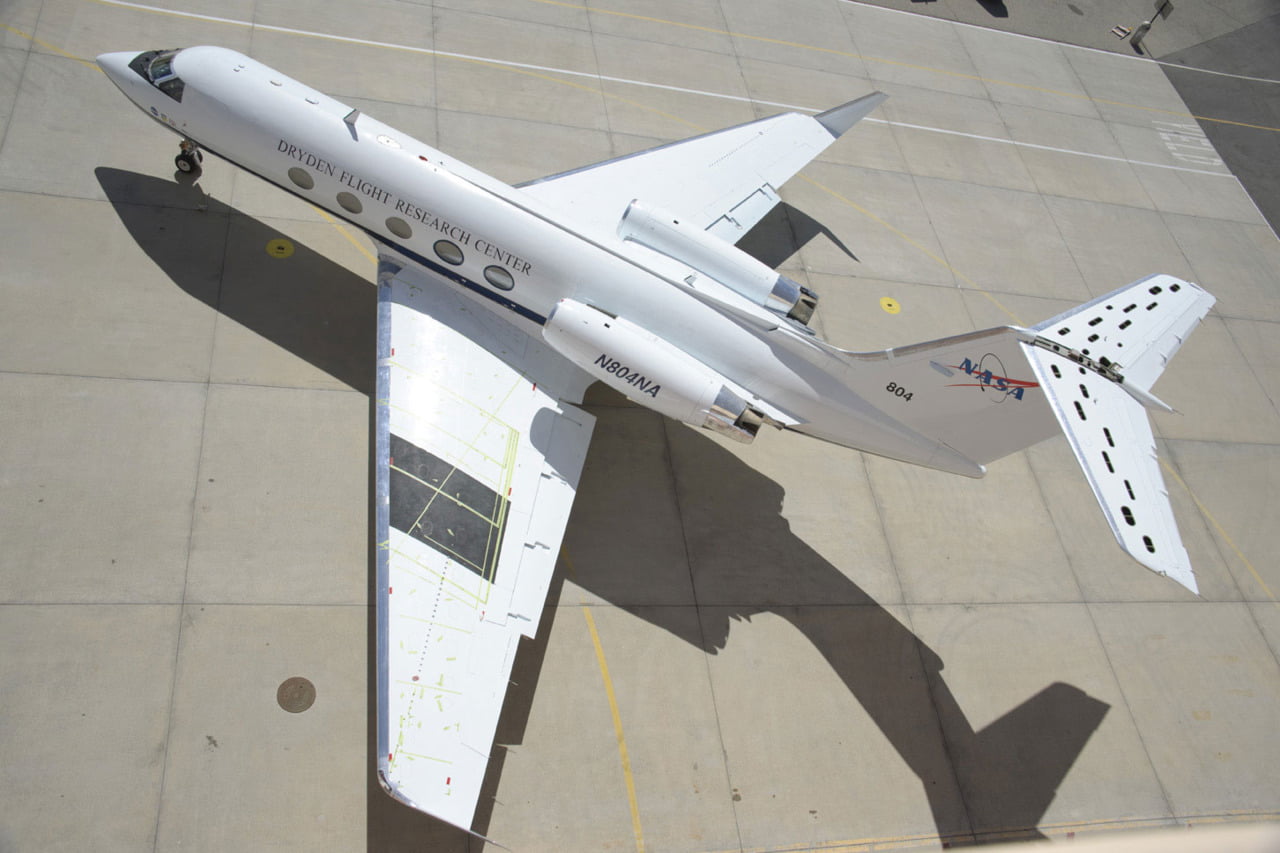
On Wednesday, March 30, 2011 at 3:00 EDT NASA engineers are holding an online chat about a current project to achieve laminar flow control on business jet-class airplanes. Keeping flow over an airplane’s wings laminar could decrease the total drag on an airplane by as much as 15%. In particular, this project involves placing tiny hockey-puck-shaped discrete roughness elements (DREs) along the front of the wing. These DREs are positioned such that they perturb the mean-flow over the wing at a higher frequency than the naturally most unstable frequency; as a result, flow actually remains laminar over a greater extent of the wing than would normally be the case. For more on the technical ideas, see this NASA blog post or feel free to ask questions in the comments. #
Full disclosure: This project is being conducted in joint with professors with whom I work, and the subject matter is related to my own research.
Shock Waves
Flow visualization really can be considered a form of art. Though we fluid mechanicians are looking for physics, we’re quite aware of the beauty of what we study. The clips in this video mostly show transient shockwave behavior, including lots of shock reflection and even a few instabilities. It’s unclear what the speeds are, aside from faster than sound; the medium is air.

Instability in a Jet
This photo shows the development of a flow instability in an axisymmetric jet. On the left, the jet is smooth and fully laminar, but, by the center of the photo, disturbances in the jet have grown large enough to distort the laminar profile. The jet is then in transition; by the right side of the frame, it has reached a turbulent state, as evidenced by the increased mixing (which causes the smoke to disperse more quickly) and intermittency of the flow. #

Plugging an Oil Leak
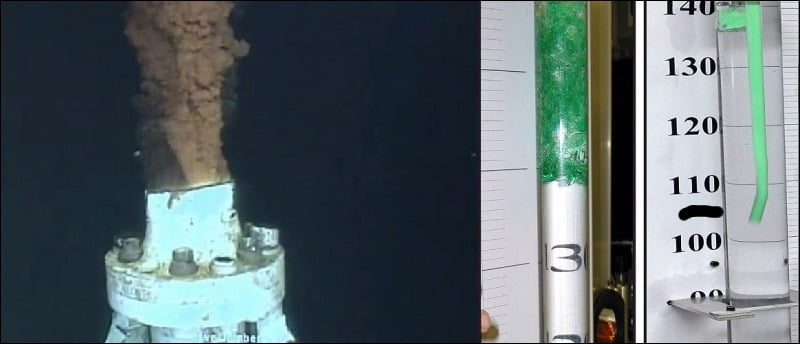
Recent research indicates that adding cornstarch to drilling mud increases the likelihood that a “top-kill” procedure will plug a leaking oil well. Adding cornstarch to water (or mud) turns it into a non-Newtonian fluid with viscoelastic properties that prevent the instabilities that lead to turbulent breakup. On the left, an underwater photo of the Deepwater Horizons leak; in the center, colored water breaks into turbulence when descending into oil; on the right, water with cornstarch maintains its coherence when pumped downward into the oil. # (PDF of research paper)
Vibrating Fluid Interfaces
The Faraday instability forms when a fluid interface is vibrated. This high-speed video shows the differences in the shapes formed by a vibrated fluid interface when the two fluids are miscible–capable of mixing–and when they are immiscible–like oil and water. Note how the miscible interface breaks down quickly into turbulence, but the immiscible interface maintains a complex shape.
DIY Solutal Convection
In this video, the HouseholdHacker heads to the kitchen and uses milk, food coloring, and dish soap to create some solutal convection much like this one with cream and liqueur. The food coloring serves as a tracer for the fluid motion; it’s really the interaction of the milk and the dish soap that drives the motion. The dish soap lowers the surface tension of the milk, causing motion via the Marangoni effect. That motion redistributes some of the dish soap as well, causing further motion in the form of a surface tension instability. As with the cream and liqueur experiment, the fat in the milk is important; you won’t see much (if any) effect with fat free milk because its surface tension properties aren’t as dissimilar to dish soap. (via misterhonk.de)
Waves on Cornstarch
A thin layer of the non-Newtonian fluid oobleck on a vibrating surface (in this case, a speaker) is a great way to show off nonlinear standing waves known as Faraday waves. The waves form because, under these circumstances, the flat surface of the air/oobleck interface has actually become unstable.

Viscous Fingers
This photo shows the Saffman-Taylor instability in a Hele-Shaw cell. Here a viscous fluid has been placed between two glass plates and a second less viscous fluid inserted, resulting in a finger-like instability as the less viscous fluid displaces the more viscous one. This is an effect that can be easily explored at home using common liquids like glycerin, water, dish soap, or laundry detergent. #